Agence France-Presse
February 24, 2025
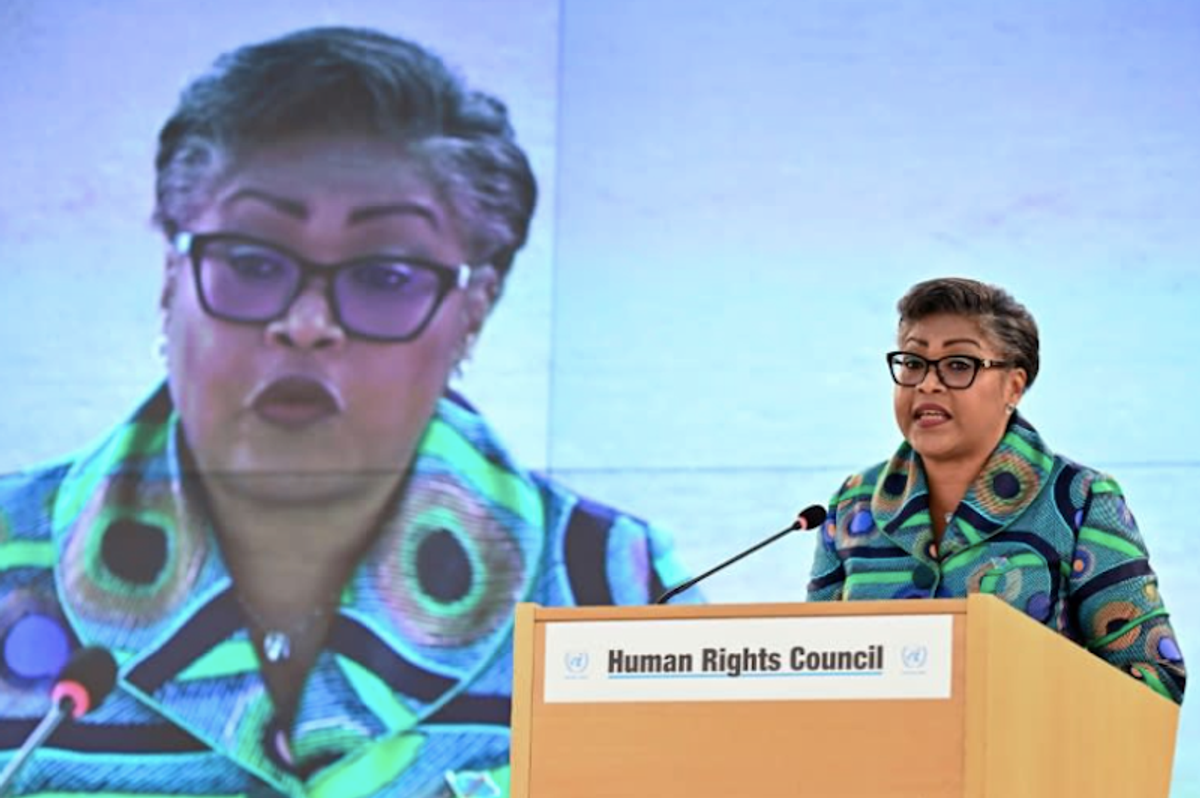
The DR Congo's Prime Minister Judith Suminwa Tuluka spoke at the UN Human Rights Council in Geneva (Fabrice COFFRINI/AFP)
by Robin MILLARD
Violence raging in eastern Democratic Republic of Congo has killed "more than 7,000 compatriots", many of them civilians, since last month, the Congolese premier said Monday.
The Rwanda-backed M23 armed group has seized large swathes of the mineral-rich eastern DRC -- including the main cities of Goma and Bukavu -- in the face of limited resistance from Congolese forces.
"The security situation in eastern DRC has reached alarming levels," Prime Minister Judith Suminwa Tuluka told the United Nations Human Rights Council in Geneva, stressing that since January, "the deaths of more than 7,000 compatriots" had been registered.
They include "more than 2,500 bodies buried without being identified", she said, adding that another 1,500 bodies were still in the morgue.
Asked at a press briefing on the sidelines of the council whether the dead were civilians or soldiers, she said that "for the moment... we have not yet been able to identify all of these people".
But, she stressed, "there is a significant mass of civilians who are part of these dead".
The M23 movement, supported by some 4,000 Rwandan soldiers, according to UN experts, now controls large tracts of troubled eastern DRC. Its rapid advance has sent tens of thousands fleeing.
Fighters took control of the South Kivu provincial capital Bukavu just over a week ago, after first capturing Goma, the capital of North Kivu and the main city in the country's east, last month.
Tuluka said that more than 3,000 people had been killed in Goma alone.
- Regional conflict fears -
UN chief Antonio Guterres told the Human Rights Council that the situation in the DRC was "a deadly whirlwind of violence and horrifying human rights abuses".
"The sovereignty and territorial integrity of the DRC must be respected," he said.
"As more cities fall, the risk of a regional war rises. It's time to silence the guns."
Tuluka agreed, warning the situation could degenerate and affect all the DRC's nine neighbours -- and not only because of the influx of refugees.
She said the proliferation of armed groups around the M23 was "becoming dangerous", and if armed groups in surrounding countries linked up, the entire region could be engulfed.
Due to meet Guterres on Monday, the prime minister said she wanted to hear how the UN sees the conflict being resolved -- and how the UN resolutions can actually be implemented on the ground.
Asked by reporters if she would like the United States to intervene, she replied: "That would not be a bad thing."
- Minerals and mobiles -
The prime minister said Rwanda wanted to occupy Congolese territory where there were critically important mines.
"The question we need to ask now is exactly who Rwanda is reselling these minerals to, that come from this illegal exploitation of resources," she told journalists.
In December, the DRC filed a criminal case against European subsidiaries of tech giant Apple, accusing them of illegally using "blood minerals" in its supply chain.
It alleges that Apple has bought contraband supplies from the country's conflict-racked east.
"They are using minerals which come from the DRC," said Tuluka, "and we want to know how this company is getting its supplies of minerals which are allowing all of us to use our telephones and computers".
© Agence France-Presse
Democratic Republic of Congo:
DRC: The need for a ceasefire
Sunday 23 February 2025, by Paul Martial
The United Nations has drawn up a new death toll following the capture of Goma, the regional capital of North Kivu in the Democratic Republic of Congo (DRC), by the M23 armed group supported by Rwandan troops. Nearly 3,000 deaths have already been recorded. The Tanzania summit bringing together the countries of the region was held on Saturday 8 February. It called for a ceasefire, which appears highly hypothetical.
Despite the announcement of a unilateral truce by the M23, the group continues to advance towards South Kivu. An intense battle took place in Nyiabibwe, 70 kilometres from the regional capital Bukavu. The DRC’s armed forces are being reinforced by those of Burundi, which has deployed more than 10,000 troops.
Formal condemnation
The violence has been documented in a major city like Goma, but these reports overlook the many war crimes committed by the M23 against the inhabitants of the villages along their path of conquest. The disapproval of the Rwandan intervention in the DRC is almost unanimous. On the other hand, divisions are emerging over the sanctions to be adopted.
China, traditionally reserved when it comes to taking a stance on conflicts in Africa, has taken a stand in favour of demanding that Rwanda and the M23 withdraw from the conquered territories. China exploits 70% of the country’s mines and is concerned about its economic interests. At the same time, Rwanda remains an excellent client in the infrastructure sector.
For Europe, the unease is tangible. The EU has signed a trade agreement on rare minerals with Rwanda in the full knowledge that three quarters of this production comes from the looting of mines in the DRC. As for France, it depends on Rwandan troops to secure its oil installations, particularly those of TotalEnergies in the Cabo Delgado region of Mozambique.
Disappointing result for the DRC
Tanzania hosted a summit bringing together the two regional entities representing Central Africa (EAC) and Southern Africa (SADC). The two bodies called for an immediate ceasefire for humanitarian operations. They have also merged their peace mediation. Another decision was to organise a ceasefire security plan in the next few days. In the absence of more precise information, interpretations differ. For Kinshasa, the plan implies the departure of M23 troops from Goma.
Finally, the summit calls for the opening of direct negotiations between the DRC and the M23, which Congolese President Tshisekedi has always refused. Given the balance of power, it would appear that he no longer has a choice, especially as religious leaders within the DRC have come out in favour of dialogue with the armed group. While the EAC and SADC have pledged their support for the sovereignty and territorial integrity of the DRC, they have not called for the Rwandan troops to leave.
Regional reconstruction
Even if the proposed cease-fire goes ahead, it is unlikely that the DRC will return to its previous situation. The Rwandan intervention has enabled the DRC to get its hands on major mining resources which, in addition to financial gains, strengthen its position as a supplier of raw materials for the energy transition in rich countries. This intervention has also opened up new opportunities for a number of countries in the DRC, which Uganda and Tanzania intend to take full advantage of. But it has also raised concerns. Burundi, which has long been opposed to Rwanda, takes a dim view of the fact that troops allied to Kigali are stationed in South Kivu close to its border. Unfortunately, the risk of the conflict spreading, as it did in the DRC at the end of the 1990s, cannot be ruled out.
While Rwanda’s violation of the DRC’s sovereignty must be condemned, the fact remains that the big capitalist countries continue to profit from the Congo’s wealth, leaving the countries of Central Africa to fight for the crumbs.
L’Anticapitaliste 13 February 2025
Attached documentsdrc-the-need-for-a-ceasefire_a8865.pdf (PDF - 905.7 KiB)
Extraction PDF [->article8865]
Paul Martial
Paul Martial is a correspondent for International Viewpoint. He is editor of Afriques en Lutte and a member of the Fourth International in France.
International Viewpoint is published under the responsibility of the Bureau of the Fourth International. Signed articles do not necessarily reflect editorial policy. Articles can be reprinted with acknowledgement, and a live link if possible.
DRC: The need for a ceasefire
Sunday 23 February 2025, by Paul Martial
The United Nations has drawn up a new death toll following the capture of Goma, the regional capital of North Kivu in the Democratic Republic of Congo (DRC), by the M23 armed group supported by Rwandan troops. Nearly 3,000 deaths have already been recorded. The Tanzania summit bringing together the countries of the region was held on Saturday 8 February. It called for a ceasefire, which appears highly hypothetical.
Despite the announcement of a unilateral truce by the M23, the group continues to advance towards South Kivu. An intense battle took place in Nyiabibwe, 70 kilometres from the regional capital Bukavu. The DRC’s armed forces are being reinforced by those of Burundi, which has deployed more than 10,000 troops.
Formal condemnation
The violence has been documented in a major city like Goma, but these reports overlook the many war crimes committed by the M23 against the inhabitants of the villages along their path of conquest. The disapproval of the Rwandan intervention in the DRC is almost unanimous. On the other hand, divisions are emerging over the sanctions to be adopted.
China, traditionally reserved when it comes to taking a stance on conflicts in Africa, has taken a stand in favour of demanding that Rwanda and the M23 withdraw from the conquered territories. China exploits 70% of the country’s mines and is concerned about its economic interests. At the same time, Rwanda remains an excellent client in the infrastructure sector.
For Europe, the unease is tangible. The EU has signed a trade agreement on rare minerals with Rwanda in the full knowledge that three quarters of this production comes from the looting of mines in the DRC. As for France, it depends on Rwandan troops to secure its oil installations, particularly those of TotalEnergies in the Cabo Delgado region of Mozambique.
Disappointing result for the DRC
Tanzania hosted a summit bringing together the two regional entities representing Central Africa (EAC) and Southern Africa (SADC). The two bodies called for an immediate ceasefire for humanitarian operations. They have also merged their peace mediation. Another decision was to organise a ceasefire security plan in the next few days. In the absence of more precise information, interpretations differ. For Kinshasa, the plan implies the departure of M23 troops from Goma.
Finally, the summit calls for the opening of direct negotiations between the DRC and the M23, which Congolese President Tshisekedi has always refused. Given the balance of power, it would appear that he no longer has a choice, especially as religious leaders within the DRC have come out in favour of dialogue with the armed group. While the EAC and SADC have pledged their support for the sovereignty and territorial integrity of the DRC, they have not called for the Rwandan troops to leave.
Regional reconstruction
Even if the proposed cease-fire goes ahead, it is unlikely that the DRC will return to its previous situation. The Rwandan intervention has enabled the DRC to get its hands on major mining resources which, in addition to financial gains, strengthen its position as a supplier of raw materials for the energy transition in rich countries. This intervention has also opened up new opportunities for a number of countries in the DRC, which Uganda and Tanzania intend to take full advantage of. But it has also raised concerns. Burundi, which has long been opposed to Rwanda, takes a dim view of the fact that troops allied to Kigali are stationed in South Kivu close to its border. Unfortunately, the risk of the conflict spreading, as it did in the DRC at the end of the 1990s, cannot be ruled out.
While Rwanda’s violation of the DRC’s sovereignty must be condemned, the fact remains that the big capitalist countries continue to profit from the Congo’s wealth, leaving the countries of Central Africa to fight for the crumbs.
L’Anticapitaliste 13 February 2025
Attached documentsdrc-the-need-for-a-ceasefire_a8865.pdf (PDF - 905.7 KiB)
Extraction PDF [->article8865]
Paul Martial
Paul Martial is a correspondent for International Viewpoint. He is editor of Afriques en Lutte and a member of the Fourth International in France.
International Viewpoint is published under the responsibility of the Bureau of the Fourth International. Signed articles do not necessarily reflect editorial policy. Articles can be reprinted with acknowledgement, and a live link if possible.
No comments:
Post a Comment