Trump and Musk Are Returning Us to the Age of the Robber Barons
For generations, the ultra-rich have been pushing to overthrow the Progressive Era’s and the New Deal’s utilitarian reforms. They have now found their moment.
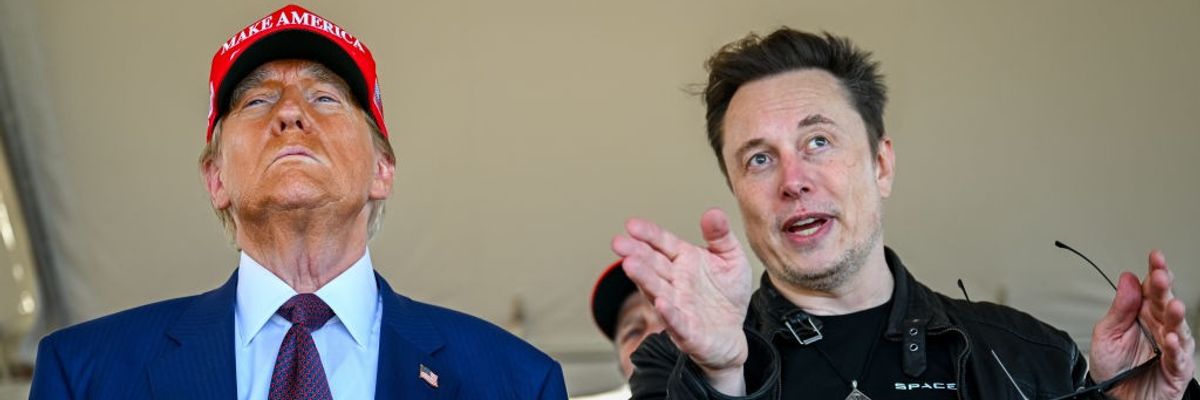
Elon Musk speaks with then-U.S. President-elect Donald Trump as they watch the launch of the sixth test flight of the SpaceX Starship rocket on November 19, 2024 in Brownsville, Texas.
(Photo: Brandon Bell/Getty Images)
Peter F. Crowley
Feb 20, 2025
Peter F. Crowley
As a prolific author from the Boston area, Peter F. Crowley writes in various forms, including short fiction, op-eds, poetry, and academic essays. His writing can be found in Pif Magazine, New Verse News, Counterpunch, Middle East Monitor, Galway Review, Digging the Fat, Adelaide’s Short Story and Poetry Award anthologies (finalist in both), and The Opiate. He is the author of the poetry books Those Who Hold Up the Earth and Empire’s End, and the short fiction collection That Night and Other Stories.
Full Bio >
For generations, the ultra-rich have been pushing to overthrow the Progressive Era’s and the New Deal’s utilitarian reforms. They have now found their moment.
Elon Musk speaks with then-U.S. President-elect Donald Trump as they watch the launch of the sixth test flight of the SpaceX Starship rocket on November 19, 2024 in Brownsville, Texas.
(Photo: Brandon Bell/Getty Images)
Peter F. Crowley
Feb 20, 2025
Common Dreams
U.S. President Donald Trump, Elon Musk, and their ilk are returning the U.S. to the Gilded Age of robber barons, replete with railroad monopolies and no union protections. They are bringing us back to a time before the Progressive movement had instituted the first real wave of social reforms, which were later widely expanded by New Deal programs. These initial reforms offered workers’ compensation, free school meals for poor children, regulated working hours, and put antitrust laws on the books. They protected the everyday person, white- and blue-collar alike, and were a setback for the ultra-rich. For generations afterward, the ultra-rich have been pushing to overthrow the Progressive Era’s and the New Deal’s utilitarian reforms.
It started with deregulation in the 1970s and was then magnified during Ronald Reagan’s neoliberal presidency. The talking points behind deregulation duped people through bastardizing the concept of “freedom.” The U.S. is a free country, the argument goes, so there shouldn’t be regulation. Yet deregulation, in this sense, is focused on giving businesses and corporations free rein, screwing the rest.
Inevitably, the neoliberals’ free trade policies, the gutting of unions, the reducing of social programs, and the lowering of taxes for the very wealthy led to wide-scale disillusionment. It birthed the Occupy Wall Street and Tea Party movements.
That brings us to today, where there is one option: resistance everywhere.
The Tea Partiers, mostly unwittingly, pushed for the policies of the late 19th-century robber barons, free of any regulation on business and extremely low (if any) taxes, as if these policies would help the average person. The Occupy movement failed in that, while offering an accurate critique of vast wealth inequality, it did not propose any concrete goals. There was the fear that its message would be branded, hijacked, or warped by the mainstream media. Fair point, I suppose. But a protest movement without policy objectives is like a tree falling in an empty forest. Luckily, the forest was not empty.
Sen. Bernie Sanders (I-Vt.) had been voicing the same message for decades. He rose to national prominence shortly after the movement’s demise, and his popularity was, in part, due to the Occupy movement raising the issue of wealth inequality to public consciousness. Unlike Occupy, Bernie had specific utilitarian policy goals.
On the other side, Trump voiced the radical Tea Partiers’ message of the robber barons, with more overt xenophobia and racism.
In 2016, both establishment parties tried to crush their mass movement candidates. The Democratic Party succeeded and had Hillary Clinton run as its presidential candidate. On the other hand, the GOP failed to stop Trump and held their nose, presuming Hillary Clinton would trounce him in the general.
When Trump won, most were surprised. Trump himself was unprepared, and the majority of institutions were unprepared to back him. His policy efforts, such as the Muslim ban and immigrant parent-child separation, were short-lived due to popular and legal pushback and sloppy execution.
During his first term, Trump’s core supporters remained steadfast behind him, but most mainstream institutions did not overtly support or cave to him.
For an unprepared presidency, dawdling along much like a toddler with a flippant mouth, the Covid-19 pandemic was icing on the cake for executive leadership failure. Because of Trump’s anti-vax rhetoric, inept health policies, and spewing of misinformation, the deaths of nearly half-a-million Americans can be attributed to him.
Unsurprisingly, Trump was booted out of office in 2020 and Joe Biden stepped in. Once again, the Democrat establishment coalesced against Bernie’s candidacy.
During Biden’s first three years in office, he was a good president, passing the most important climate change legislation in U.S. history, the Inflation Reduction Act, and the bipartisan infrastructure bill. He supported unionization efforts and tried to eliminate student loan debts. He restored a sense of decency and aid for UNWRA.
As the 2024 election came closer, the Gaza genocide commenced, which Biden wholeheartedly backed. In Biden’s last year in office, when Trump became the clear GOP presidential candidate, he tried to outflank the GOP on the right on immigration, restricting asylum seeker border crossings and attempting to push an anti-immigrant bill that Sen. Mitch McConnell (R-Ky.) crafted. (Of course, Trump killed it to prevent Biden from getting “credit.”)
Throughout the Biden years, inflation increased dramatically, similarly to most of the world. Yet Biden could never adequately explain this phenomenon to the American people and was horrible at communicating his domestic accomplishments.
He and his staff ignored his mental decline, leaving former Vice President Kamala Harris little time to campaign. Simultaneous to Biden’s growing unpopularity, far-right institutions began crafting Project 2025 (now being instituted) for a new Trump administration. When the Dems lost this time, the far-right was prepared with institutional backing. For the most part, the establishment (media, corporations, etc.) caved to Trump and his anti-constitutional, authoritarian executive actions.
That brings us to today, where there is one option: resistance everywhere.
Resist on the streets, in Congress (wake up Jeffries and Schumer!), and the courts, to save a very flawed republic before it’s too late. Before fascistic robber barons steal it away, leaving the American people whistling in the desert wind watching a whiny rich snowflake asshole pretend that the United States is a reality TV gameshow.
U.S. President Donald Trump, Elon Musk, and their ilk are returning the U.S. to the Gilded Age of robber barons, replete with railroad monopolies and no union protections. They are bringing us back to a time before the Progressive movement had instituted the first real wave of social reforms, which were later widely expanded by New Deal programs. These initial reforms offered workers’ compensation, free school meals for poor children, regulated working hours, and put antitrust laws on the books. They protected the everyday person, white- and blue-collar alike, and were a setback for the ultra-rich. For generations afterward, the ultra-rich have been pushing to overthrow the Progressive Era’s and the New Deal’s utilitarian reforms.
It started with deregulation in the 1970s and was then magnified during Ronald Reagan’s neoliberal presidency. The talking points behind deregulation duped people through bastardizing the concept of “freedom.” The U.S. is a free country, the argument goes, so there shouldn’t be regulation. Yet deregulation, in this sense, is focused on giving businesses and corporations free rein, screwing the rest.
Inevitably, the neoliberals’ free trade policies, the gutting of unions, the reducing of social programs, and the lowering of taxes for the very wealthy led to wide-scale disillusionment. It birthed the Occupy Wall Street and Tea Party movements.
That brings us to today, where there is one option: resistance everywhere.
The Tea Partiers, mostly unwittingly, pushed for the policies of the late 19th-century robber barons, free of any regulation on business and extremely low (if any) taxes, as if these policies would help the average person. The Occupy movement failed in that, while offering an accurate critique of vast wealth inequality, it did not propose any concrete goals. There was the fear that its message would be branded, hijacked, or warped by the mainstream media. Fair point, I suppose. But a protest movement without policy objectives is like a tree falling in an empty forest. Luckily, the forest was not empty.
Sen. Bernie Sanders (I-Vt.) had been voicing the same message for decades. He rose to national prominence shortly after the movement’s demise, and his popularity was, in part, due to the Occupy movement raising the issue of wealth inequality to public consciousness. Unlike Occupy, Bernie had specific utilitarian policy goals.
On the other side, Trump voiced the radical Tea Partiers’ message of the robber barons, with more overt xenophobia and racism.
In 2016, both establishment parties tried to crush their mass movement candidates. The Democratic Party succeeded and had Hillary Clinton run as its presidential candidate. On the other hand, the GOP failed to stop Trump and held their nose, presuming Hillary Clinton would trounce him in the general.
When Trump won, most were surprised. Trump himself was unprepared, and the majority of institutions were unprepared to back him. His policy efforts, such as the Muslim ban and immigrant parent-child separation, were short-lived due to popular and legal pushback and sloppy execution.
During his first term, Trump’s core supporters remained steadfast behind him, but most mainstream institutions did not overtly support or cave to him.
For an unprepared presidency, dawdling along much like a toddler with a flippant mouth, the Covid-19 pandemic was icing on the cake for executive leadership failure. Because of Trump’s anti-vax rhetoric, inept health policies, and spewing of misinformation, the deaths of nearly half-a-million Americans can be attributed to him.
Unsurprisingly, Trump was booted out of office in 2020 and Joe Biden stepped in. Once again, the Democrat establishment coalesced against Bernie’s candidacy.
During Biden’s first three years in office, he was a good president, passing the most important climate change legislation in U.S. history, the Inflation Reduction Act, and the bipartisan infrastructure bill. He supported unionization efforts and tried to eliminate student loan debts. He restored a sense of decency and aid for UNWRA.
As the 2024 election came closer, the Gaza genocide commenced, which Biden wholeheartedly backed. In Biden’s last year in office, when Trump became the clear GOP presidential candidate, he tried to outflank the GOP on the right on immigration, restricting asylum seeker border crossings and attempting to push an anti-immigrant bill that Sen. Mitch McConnell (R-Ky.) crafted. (Of course, Trump killed it to prevent Biden from getting “credit.”)
Throughout the Biden years, inflation increased dramatically, similarly to most of the world. Yet Biden could never adequately explain this phenomenon to the American people and was horrible at communicating his domestic accomplishments.
He and his staff ignored his mental decline, leaving former Vice President Kamala Harris little time to campaign. Simultaneous to Biden’s growing unpopularity, far-right institutions began crafting Project 2025 (now being instituted) for a new Trump administration. When the Dems lost this time, the far-right was prepared with institutional backing. For the most part, the establishment (media, corporations, etc.) caved to Trump and his anti-constitutional, authoritarian executive actions.
That brings us to today, where there is one option: resistance everywhere.
Resist on the streets, in Congress (wake up Jeffries and Schumer!), and the courts, to save a very flawed republic before it’s too late. Before fascistic robber barons steal it away, leaving the American people whistling in the desert wind watching a whiny rich snowflake asshole pretend that the United States is a reality TV gameshow.
Peter F. Crowley
As a prolific author from the Boston area, Peter F. Crowley writes in various forms, including short fiction, op-eds, poetry, and academic essays. His writing can be found in Pif Magazine, New Verse News, Counterpunch, Middle East Monitor, Galway Review, Digging the Fat, Adelaide’s Short Story and Poetry Award anthologies (finalist in both), and The Opiate. He is the author of the poetry books Those Who Hold Up the Earth and Empire’s End, and the short fiction collection That Night and Other Stories.
Full Bio >
We are a nation of laws, and we cannot be ruled by executive fiat.
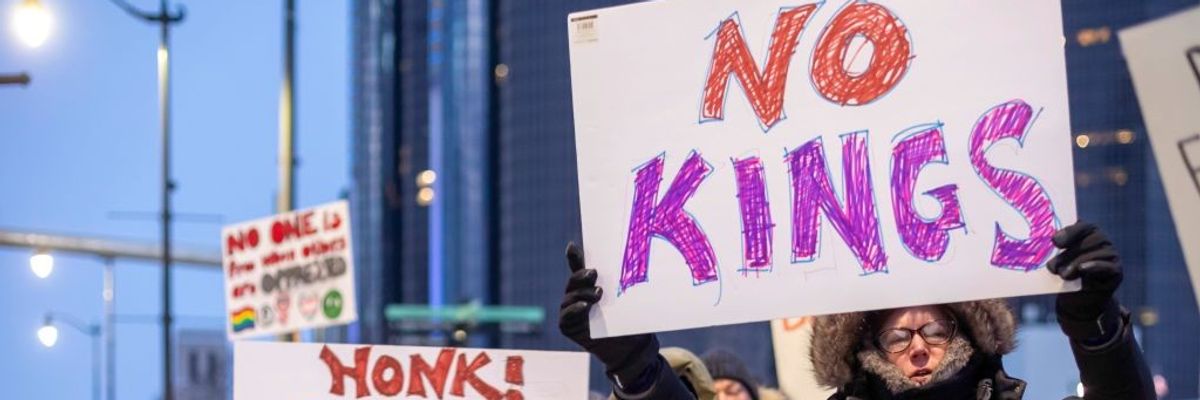
People say 'No Kings on Presidents Day' in response to what they say are President Trump's and Elon Musk's undemocratic actions on February 17, 2025 in Michigan.
(Photo by: Jim West/UCG/Universal Images Group via Getty Images)
John Bergmayer
Feb 20, 2025
Common Dreams
President Donald Trump on Tuesday signed an executive order that purports to place independent regulatory agencies, such as the Federal Communications Commission and the Federal Trade Commission, under his direct control. Based on the so-called “unitary executive” theory, which claims that any congressional limits on presidential control of every lever of government power are unconstitutional, this action poses a grave threat to the rule of law and the separation of powers—cornerstones of our constitutional system.
This executive order states that the president is charged with ‘faithfully executing the laws.’ This is true. However, the laws of our nation include the existence of independent regulatory agencies, the power of Congress to appropriate funds and direct how they are spent, and protection for certain government employees and officers from arbitrary dismissal.
Executive orders are not the law—they are statements of policy, and memos from the president about how the Executive Branch conducts its internal affairs. By attempting to use executive orders to override actual laws—the kinds that are passed by Congress, not issued on a whim from the Resolute Desk—the Trump administration is effectively asserting that it stands above the law. Indeed, that it is the law. But the role of the executive branch is not to decide what the law is, or to pick and choose which ones it likes, but to carry out and enforce the law, as written. Donald Trump is a high-ranking government employee—not a king. If there are laws he does not like, he can work with Congress to change them.
Donald Trump is a high-ranking government employee—not a king.
A nebulous and broad understanding of the phrase ‘executive power’ cannot prevail over duly enacted statutes passed by Congress and signed into law by presidents of both parties, over the course of decades. The U.S. Constitution did not change its meaning when President Trump took office. That this ‘unitary executive’ theory has made its way from the fringes of academia to the halls of power, and that it has even been accepted by some credulous judges, does not mean that it is right. Many legal observers have pointed out the shoddy scholarship and selective history that underpins it. We are a nation of laws, and we cannot be ruled by executive fiat.
In the order, the Trump administration purports to seize for itself the power Congress delegated to independent regulatory agencies, and as written, declares the White House’s interpretation of the law as ‘authoritative,’ with no mention of the courts. Of course, the president is not, and never has been, the final arbiter of what is lawful. Lawyers working for the government owe their allegiance to the American people, not to President Donald J. Trump. The many government lawyers who have already resigned rather than follow illegal or unethical directives from Trump's appointed political operatives are an inspiration, despite how frightening a hollowed-out Department of Justice might seem.
As for independent regulatory agencies, in addition to being the law of the land, they are often good policy. While I have sometimes disagreed with decisions taken by the FCC or FTC, under both Republican and Democratic control, I understand the importance of expert agencies that are free from day-to-day political interference. The FCC’s control over broadcast licenses, and its unenviable role of coordinating spectrum use between different industries and other government agencies, among other things, means it should be free to try to come to the best answer – not the one with the loudest political support. This applies to enforcement activities as well. Under the Biden administration, for instance, the FTC frequently investigated politically powerful companies, to the ire of many prominent Democrats and Democratic donors.
While I have sometimes disagreed with decisions taken by the FCC or FTC, under both Republican and Democratic control, I understand the importance of expert agencies that are free from day-to-day political interference.
President Trump, like other presidents have done, is free to express his views as to what the agencies should prioritize, and to nominate like-minded commissioners as vacancies arise. But, as directed by Congress, and reflected in commissioners' protection from being fired due to policy or political differences with the president, such agencies must make the final call on policy decisions.
The notion that independent agencies are ‘unaccountable’ is, on its face, absurd. The president nominates all agency commissioners, including ones of the opposite party, and names the Chair from among them. Agencies regularly answer to Congress, which controls their budget, and enacts the statutes that spell out the limited scope of their authority. Independent agencies cannot issue regulations without following the strict guidelines of the Administrative Procedure Act, and their rules and enforcement actions are regularly challenged in the courts, and occasionally reversed by Congress.
The wisdom of having independent agencies and tenure protections for certain government officials has been confirmed in recent weeks by the disastrous and irresponsible actions of the lawless Trump administration. One president should not be able to nullify statutes passed into law by past presidents and past Congresses with the stroke of a sharpie. Congress must re-assert its central constitutional role. Further, one hopes that federal judges and Supreme Court justices who, in the past, have lent their support to an imperial vision of the presidency, can see where this is going and act to limit the ability of the president to subvert our democracy and constitutional order.
President Donald Trump on Tuesday signed an executive order that purports to place independent regulatory agencies, such as the Federal Communications Commission and the Federal Trade Commission, under his direct control. Based on the so-called “unitary executive” theory, which claims that any congressional limits on presidential control of every lever of government power are unconstitutional, this action poses a grave threat to the rule of law and the separation of powers—cornerstones of our constitutional system.
This executive order states that the president is charged with ‘faithfully executing the laws.’ This is true. However, the laws of our nation include the existence of independent regulatory agencies, the power of Congress to appropriate funds and direct how they are spent, and protection for certain government employees and officers from arbitrary dismissal.
Executive orders are not the law—they are statements of policy, and memos from the president about how the Executive Branch conducts its internal affairs. By attempting to use executive orders to override actual laws—the kinds that are passed by Congress, not issued on a whim from the Resolute Desk—the Trump administration is effectively asserting that it stands above the law. Indeed, that it is the law. But the role of the executive branch is not to decide what the law is, or to pick and choose which ones it likes, but to carry out and enforce the law, as written. Donald Trump is a high-ranking government employee—not a king. If there are laws he does not like, he can work with Congress to change them.
Donald Trump is a high-ranking government employee—not a king.
A nebulous and broad understanding of the phrase ‘executive power’ cannot prevail over duly enacted statutes passed by Congress and signed into law by presidents of both parties, over the course of decades. The U.S. Constitution did not change its meaning when President Trump took office. That this ‘unitary executive’ theory has made its way from the fringes of academia to the halls of power, and that it has even been accepted by some credulous judges, does not mean that it is right. Many legal observers have pointed out the shoddy scholarship and selective history that underpins it. We are a nation of laws, and we cannot be ruled by executive fiat.
In the order, the Trump administration purports to seize for itself the power Congress delegated to independent regulatory agencies, and as written, declares the White House’s interpretation of the law as ‘authoritative,’ with no mention of the courts. Of course, the president is not, and never has been, the final arbiter of what is lawful. Lawyers working for the government owe their allegiance to the American people, not to President Donald J. Trump. The many government lawyers who have already resigned rather than follow illegal or unethical directives from Trump's appointed political operatives are an inspiration, despite how frightening a hollowed-out Department of Justice might seem.
As for independent regulatory agencies, in addition to being the law of the land, they are often good policy. While I have sometimes disagreed with decisions taken by the FCC or FTC, under both Republican and Democratic control, I understand the importance of expert agencies that are free from day-to-day political interference. The FCC’s control over broadcast licenses, and its unenviable role of coordinating spectrum use between different industries and other government agencies, among other things, means it should be free to try to come to the best answer – not the one with the loudest political support. This applies to enforcement activities as well. Under the Biden administration, for instance, the FTC frequently investigated politically powerful companies, to the ire of many prominent Democrats and Democratic donors.
While I have sometimes disagreed with decisions taken by the FCC or FTC, under both Republican and Democratic control, I understand the importance of expert agencies that are free from day-to-day political interference.
President Trump, like other presidents have done, is free to express his views as to what the agencies should prioritize, and to nominate like-minded commissioners as vacancies arise. But, as directed by Congress, and reflected in commissioners' protection from being fired due to policy or political differences with the president, such agencies must make the final call on policy decisions.
The notion that independent agencies are ‘unaccountable’ is, on its face, absurd. The president nominates all agency commissioners, including ones of the opposite party, and names the Chair from among them. Agencies regularly answer to Congress, which controls their budget, and enacts the statutes that spell out the limited scope of their authority. Independent agencies cannot issue regulations without following the strict guidelines of the Administrative Procedure Act, and their rules and enforcement actions are regularly challenged in the courts, and occasionally reversed by Congress.
The wisdom of having independent agencies and tenure protections for certain government officials has been confirmed in recent weeks by the disastrous and irresponsible actions of the lawless Trump administration. One president should not be able to nullify statutes passed into law by past presidents and past Congresses with the stroke of a sharpie. Congress must re-assert its central constitutional role. Further, one hopes that federal judges and Supreme Court justices who, in the past, have lent their support to an imperial vision of the presidency, can see where this is going and act to limit the ability of the president to subvert our democracy and constitutional order.
John Bergmayer is the Legal Director of Public Knowledge, which promotes freedom of expression, an open internet, and access to affordable communications tools and creative works as it aims to shape policy on behalf of the public interest.
In 'Profoundly Dangerous' Power Grab, Trump Moves to Seize Control of Independent Agencies
"Americans should understand exactly what this is: A giant gift to the corporate class and a Trumpian power grab."
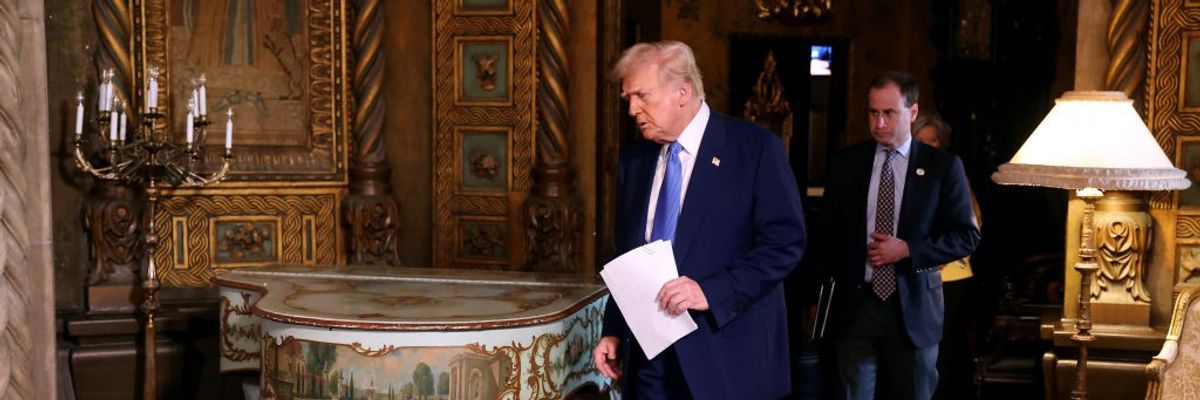
U.S. President Donald Trump, accompanied by White House staff secretary Will Scharf, delivers remarks before signing an executive order on February 18, 2025 in Palm Beach, Florida.
(Photo: Joe Raedle/Getty Images)
Jake Johnson
Feb 19, 2025
COMMON DREAMS
U.S. President Donald Trump on Tuesday signed an executive order aimed at bringing the nation's independent agencies—including the Federal Trade Commission and Securities and Exchange Commission—under his control, a sweeping power grab that's expected to spark a legal fight with enormous stakes for the country.
The new executive order, titled "Ensuring Accountability for All Agencies," laments that previous administrations "have allowed so-called 'independent regulatory agencies' to operate with minimal presidential supervision" and states that, going forward, "the president and the attorney general, subject to the president's supervision and control, shall provide authoritative interpretations of law for the executive branch."
The order goes on to require that "all executive departments and agencies"—including those granted some independence from the presidency by Congress—"shall submit for review all proposed and final significant regulatory actions to the Office of Information and Regulatory Affairs (OIRA) within the Executive Office of the President before publication in the Federal Register."
OIRA is part of the Office of Management and Budget, which is run by Project 2025 architect and far-right extremist Russell Vought.
In a fact sheet released alongside the order, the White House specifically names the FTC, the SEC, and the Federal Communications Commission (FCC) as agencies it claims have "exercised enormous power over the American people without presidential oversight."
The new order exempts from its far-reaching mandates the "monetary policy functions of the Federal Reserve."
"Not incidentally, both the FTC and SEC have ongoing investigations or enforcement actions against companies owned by Elon Musk."
Robert Weissman, co-president of Public Citizen, said in a statement that the executive order marks an "illegal" attempt to "shield corporations from accountability and centralize more power with Trump and his minions."
"This is a profoundly dangerous idea for the nation's health, safety, environment, and economy—and for our democracy," he added. "Congress made independent agencies independent of the White House for good reason."
Weissman noted that the independence of agencies such as the FTC and SEC is "designed to enable them to perform these duties without undue political pressure from giant corporations, the super-rich and the super-connected."
"Trump's EO would dissolve that independence and put the agencies under Trump's thumb, ensuring they turn a blind eye to wrongdoing by favored corporations and leave consumers and investors out to dry," Weissman continued. "Not incidentally, both the FTC and SEC have ongoing investigations or enforcement actions against companies owned by Elon Musk. Americans should understand exactly what this is: A giant gift to the corporate class and a Trumpian power grab."
The Washington Postreported that Trump's order sets the stage for "a potential Supreme Court fight that could give him significantly more power over those agencies' decisions, budgets, and leadership." Trump has already trampled decades of legal precedent by firing protected officials without cause, including the former chair of the National Labor Relations Board (NLRB).
"Courts have blocked or limited the reach of some of Trump's executive actions, but legal observers expect that the conservative-dominated Supreme Court may be open to broadening presidential power in at least some of the cases," the Post observed. "The justices are already considering a case regarding the scope of Trump's power over independent agencies, and Tuesday's executive order seems sure to prompt additional legal challenges."
Deborah Pearlstein, a constitutional scholar at Princeton University, told the newspaper that the White House is "deliberately teeing up a major question of constitutional law that will go to the Supreme Court for review."
The Supreme Court is currently controlled by a right-wing supermajority that includes three Trump-appointed justices.
Prior to Trump's order, the U.S. Justice Department—headed by Attorney General Pam Bondi—indicated that it would no longer defend the independence of the NLRB, FTC, and other agencies and would ask the Supreme Court to reverse precedent that has shielded independent agency leaders from termination without cause.
Reutersreported that "about two dozen companies, including Amazon and Elon Musk's SpaceX, have filed lawsuits since last year claiming the president should have the power to fire NLRB members at will."
"Several companies sued by the FTC have filed similar challenges against that agency," the outlet added. "They include Meta Platforms, Walmart, and Cigna's Express Scripts."

No comments:
Post a Comment