"If you think back at the last economic crashes... the rich were able to buy up assets on the cheap and emerged even wealthier and more powerful than before," noted one progressive commentator.
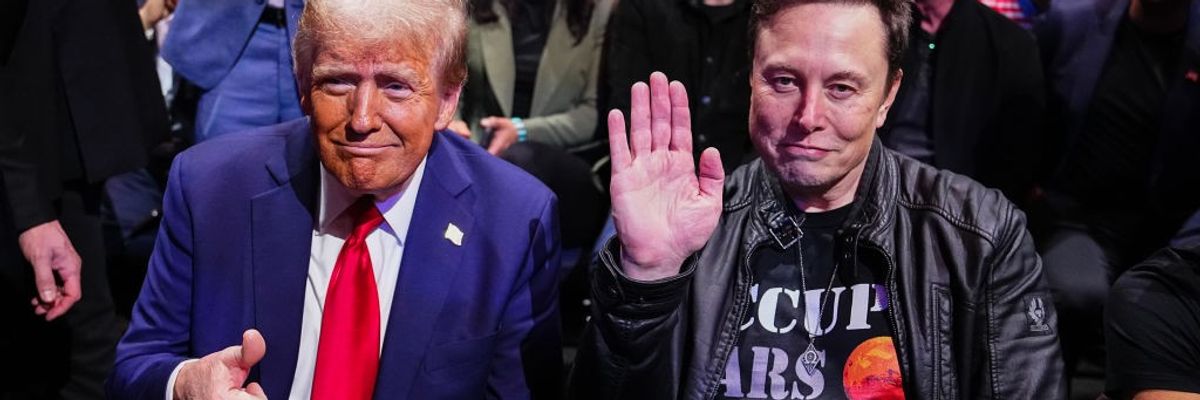
Then President-elect Donald Trump and Elon Musk pose for a photo during the UFC 309 event at Madison Square Garden on November 16, 2024 in New York City.
(Photo: Jeff Bottari/Zuffa LLC via Getty Images)
Brett Wilkins
Mar 05, 2025
OMMON DREAMS
Are U.S. President Donald Trump, top adviser Elon Musk, and allied oligarchs deliberately trying to tank the economy in order to line their own gilded pockets?
More and more observers from both sides of the political aisle are asking the question this week as the U.S. president implemented steep tariffs on some of the country's biggest trade partners, threatened a global trade war, and is taking chainsaw to government spending and programs—policies that, while inflicting economic pain upon nearly everyone else, could dramatically boost their already stratospheric wealth.
Numerous observers have likened it to the " disaster capitalism" examined in Naomi Klein's seminal 2007 book, The Shock Doctrine: The Rise of Disaster Capitalism—politicians and plutocrats exploit the chaos of natural or human-caused crises to push through unpopular policies like privatization and deregulation that harm the masses while boosting the wealth and power of the ruling class.
Economic alarm bells were already ringing before Trump's 25% tariffs on most products from Canada and Mexico and an additional 10% on China—for a total of 20%—took effect on Tuesday, prompting retaliatory measures and threats of more to come.
Then, during his rambling joint address to Congress on Tuesday night, Trump threatened to impose reciprocal tariffs on every nation on Earth starting April 2 (because he "didn't want to be accused of April Fools' Day") if those countries did not lower barriers to trade with the United States.
But what if that's the whole point?
"I've been entertaining this theory a little bit more lately, because [Trump's] economic moves seem so stupid and terrible and counterproductive without thinking that he is intentionally trying to cause harm," progressive political commentator Krystal Ball—who also has a degree in economics and is a certified public accountant— said Tuesday on the social media site X.
Ball cited an X post by Saikat Chakrabarti, a progressive Democrat running for Congresswoman Nancy Pelosi's (D-Calif.) House seat who worked on Wall Street for six years and helped found the online payment processing company Stripe, in which he accused Trump of "manufacturing a recession."
"But it makes sense when you realize his goal is to create something like Russia where the economy is run by a few oligarchs loyal to him," Chakrabarti added. "Creating that state is hard in a large, dynamic, powerful economy with too many actors who can oppose him. So he's accelerating concentrating money and power into the hands of his loyalists while he crashes the rest out."
Responding to this, Ball asserted that "at this point, until proven otherwise, the primary actor in the government and the economy is actually Elon, so I think it makes sense to think of Elon's incentives here and what he may actually want to accomplish."
"If you think back at the last economic crashes—both in Covid and in the 2008 financial crash—while initially everyone suffered, including the rich, out of both, the rich were able to buy up assets on the cheap and emerged even wealthier and more powerful than before," she noted.
"So in 2008, not only did they get their own custom bailout, but they were able to buy housing stock at absurdly low prices," Ball recalled. "The rich got richer than ever, inequality skyrocketed, and the big banks got bigger than ever."
"Same deal with the Covid-era recession," she continued. "So, while again, everyone suffered initially, there was a huge bailout package which, yes, did benefit ordinary people, but if you look at who came out really on top... you could see people like Elon Musk, people like Jeff Bezos, people like Mark Zuckerberg getting far wealthier. Their net worths, which were already very high, skyrocketed beyond anyone's wildest dreams."
Indeed, as Common Dreamsreported, 700 billionaires got $1.7 trillion richer during two years of pandemic. Between March 2020 and April 2022, Musk got 10 times richer, while Zuckerberg's net worth more than tripled and Bezos' grew by nearly $80 billion, according to Forbes.
"Here's the other piece that's worth thinking about as well," Ball added. "Crash and crisis leads to governments and authoritarian leaders claiming more power for themselves. They can use the crisis and the emergency as a justification for taking on extraordinary powers and for taking extraordinary measures... measures that can be custom fit to primarily benefit oligarchs like Elon Musk."
"So I don't know guys, while we're running around here going... 'can't they understand how this is going to be devastating for the economy,' maybe they do understand," she concluded, "and maybe that's kind of the point."
Deluge of Trump tariffs seen hitting household budgets
By AFP
March 5, 2025

Strawberries from Mexico displayed for sale in Hawthorne, California are among the items affected by new US tariffs - Copyright AFP Stefani Reynolds
Elodie MAZEIN
Consumer items ranging from avocados and strawberries to electronics and gasoline look poised for price hikes in the wake of President Donald Trump’s tariffs on Mexico, Canada and China.
“The consumer will likely see some price increases over the next couple of days,” Target Chief Executive Brian Cornell said this week.
Fresh fruit and produce imported from Mexico during the winter months have a very short supply chain, Cornell told CNBC.
Of the agricultural products imported to the United States from Mexico in 2023, 72.5 percent were fresh fruit and vegetables and beer and other alcohol, according to the US Department of Agriculture.
Yale University’s Budget Lab has estimated the net impact of Trump’s tariffs will be between a 1.0 percent and 1.2 percent hike to consumer prices, a yearly toll of $1,600 to $2,000 per household.
The Yale analysis takes into account 25 percent tariffs on Canada and Mexico and 20 percent tariffs on China. Canadian crude has a 10 percent US tariff.
The tariffs should also raise up to $1.5 trillion for the US government in 2025, but the Budget Lab characterizes the measures as regressive taxes because they hit low-income consumers disproportionately.
Recent surveys of shoppers point to a dip in consumer confidence, suggesting a possible pullback in spending.
“It is a highly dynamic situation,” said Corrie Sue Barry, CEO of electronics retailer Best Buy, who called price increases “highly likely.”
Speaking on an earnings conference call, Barry pointed to “uncertainty about the duration, timing, amount and countries involved in addition to the potential action of others in the industry as well as the potential reaction of American consumers.”
– Auto reprieve –
Automobiles have been seen as among the most hard-hit industries from tariffs on Mexico and Canada because of the deep integration of supply chains across the region.
Trump’s tariffs have ignited anxiety throughout the industry.
Ford CEO Jim Farley said last month that Trump has promised a revival in US manufacturing but has so far produced “lot of cost and a lot of chaos.”
The tariffs could add between $4,000 and $10,000 per auto assembled in North America, according to an Anderson Economic Group analysis that excludes Trump’s tariffs on steel and aluminum.
The industry has warned of slowed investment.
“Automakers, battery makers and suppliers are investing billions in American manufacturing and to modernize the industrial base,” said John Bozzella, president of the Alliance for Automotive Innovation.
“This isn’t hypothetical. All automakers will be impacted by these tariffs on Canada and Mexico.”
Jessica Caldwell, head of insights at Edmunds, said the tariffs as proposed would profoundly affect the North American auto universe.
“If the tariffs do hold, the automotive industry won’t be able to adjust overnight,” she said. “There’s no escaping the fact that higher costs will ultimately be passed on to consumers.”
On Wednesday, the Whites House announced that it would allow a one-month exemption from tariffs on auto imports from Canada and Mexico.
– Lumber, gasoline –
Gasoline prices are also set to rise as a result of 10 percent tariffs on Canadian crude. Prices at the pump could increase as much as 40 cents per gallon by mid-March, according to GasBuddy, a website for comparing prices.
The US aerospace and defense industries, which are major exporters, is “investigating mitigation strategies that would minimize the impacts of new tariffs on our industry,” said Dan Hardwick vice president of international affairs for the Aerospace Industries Association.
The construction industry will also be affected by new 25 percent tariffs on Canadian wood, on top of existing 14.5 percent levies on some items.
More than 70 percent of softwood lumber and gypsum, which is used for drywall, come from Canada and Mexico, said Carl Harris, immediately past chairman of the National Association of Homebuilders.
Home-improvement retailer Home Depot said a majority of its products are sourced from the United States, Canada and Mexico where the chain has stores.
“In general, any tariff would have a broad impact on our industry,” Home Depot said.
By AFP
March 5, 2025
Strawberries from Mexico displayed for sale in Hawthorne, California are among the items affected by new US tariffs - Copyright AFP Stefani Reynolds
Elodie MAZEIN
Consumer items ranging from avocados and strawberries to electronics and gasoline look poised for price hikes in the wake of President Donald Trump’s tariffs on Mexico, Canada and China.
“The consumer will likely see some price increases over the next couple of days,” Target Chief Executive Brian Cornell said this week.
Fresh fruit and produce imported from Mexico during the winter months have a very short supply chain, Cornell told CNBC.
Of the agricultural products imported to the United States from Mexico in 2023, 72.5 percent were fresh fruit and vegetables and beer and other alcohol, according to the US Department of Agriculture.
Yale University’s Budget Lab has estimated the net impact of Trump’s tariffs will be between a 1.0 percent and 1.2 percent hike to consumer prices, a yearly toll of $1,600 to $2,000 per household.
The Yale analysis takes into account 25 percent tariffs on Canada and Mexico and 20 percent tariffs on China. Canadian crude has a 10 percent US tariff.
The tariffs should also raise up to $1.5 trillion for the US government in 2025, but the Budget Lab characterizes the measures as regressive taxes because they hit low-income consumers disproportionately.
Recent surveys of shoppers point to a dip in consumer confidence, suggesting a possible pullback in spending.
“It is a highly dynamic situation,” said Corrie Sue Barry, CEO of electronics retailer Best Buy, who called price increases “highly likely.”
Speaking on an earnings conference call, Barry pointed to “uncertainty about the duration, timing, amount and countries involved in addition to the potential action of others in the industry as well as the potential reaction of American consumers.”
– Auto reprieve –
Automobiles have been seen as among the most hard-hit industries from tariffs on Mexico and Canada because of the deep integration of supply chains across the region.
Trump’s tariffs have ignited anxiety throughout the industry.
Ford CEO Jim Farley said last month that Trump has promised a revival in US manufacturing but has so far produced “lot of cost and a lot of chaos.”
The tariffs could add between $4,000 and $10,000 per auto assembled in North America, according to an Anderson Economic Group analysis that excludes Trump’s tariffs on steel and aluminum.
The industry has warned of slowed investment.
“Automakers, battery makers and suppliers are investing billions in American manufacturing and to modernize the industrial base,” said John Bozzella, president of the Alliance for Automotive Innovation.
“This isn’t hypothetical. All automakers will be impacted by these tariffs on Canada and Mexico.”
Jessica Caldwell, head of insights at Edmunds, said the tariffs as proposed would profoundly affect the North American auto universe.
“If the tariffs do hold, the automotive industry won’t be able to adjust overnight,” she said. “There’s no escaping the fact that higher costs will ultimately be passed on to consumers.”
On Wednesday, the Whites House announced that it would allow a one-month exemption from tariffs on auto imports from Canada and Mexico.
– Lumber, gasoline –
Gasoline prices are also set to rise as a result of 10 percent tariffs on Canadian crude. Prices at the pump could increase as much as 40 cents per gallon by mid-March, according to GasBuddy, a website for comparing prices.
The US aerospace and defense industries, which are major exporters, is “investigating mitigation strategies that would minimize the impacts of new tariffs on our industry,” said Dan Hardwick vice president of international affairs for the Aerospace Industries Association.
The construction industry will also be affected by new 25 percent tariffs on Canadian wood, on top of existing 14.5 percent levies on some items.
More than 70 percent of softwood lumber and gypsum, which is used for drywall, come from Canada and Mexico, said Carl Harris, immediately past chairman of the National Association of Homebuilders.
Home-improvement retailer Home Depot said a majority of its products are sourced from the United States, Canada and Mexico where the chain has stores.
“In general, any tariff would have a broad impact on our industry,” Home Depot said.
No comments:
Post a Comment