Developing Waterway Cruises in Northern Canada
Trump’s tariffs have elicited a backlash from Canadian tourists, who now choose to visit domestic attractions. The shift has opened the door to evaluate prospects to develop cruises that sail mainly in Canadian waters, including along shallow waterways and bodies of water where tourist cruise operations are presently absent. At present, cruise ships that carry guests on Arctic cruises, sail from the Port of Churchill on Hudson Bay. While most of the guests travel by air from Montreal to the airport at Churchill to board the ship, there is passenger railway service between Winnipeg and Churchill.
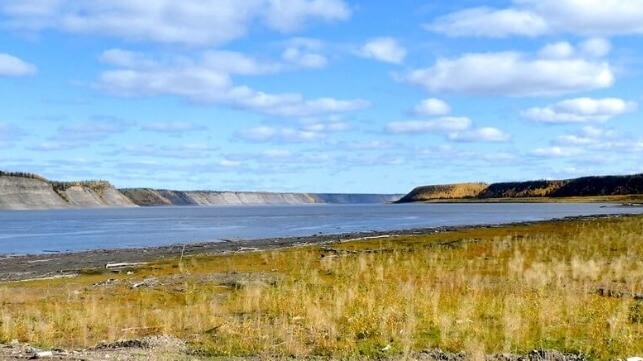
The precedent of Port of Churchill serving as a cruise ship terminal allows development of cruise tourism from other northern Canadian ports. Shallow draft river cruise ships that sail along European waterways would be an option to sail along Canada’s shallow Mackenzie River. However, extreme shoaling along some sections some northern Canadian waterways would require operation of a vessel capable of sailing in shallower water than the European river cruise design.
Precedents
Tug-propelled freight barges have sailed along the shallow Mackenzie River in northwestern Canada for decades, including into the Beaufort Sea and east toward Amundsen Gulf and Coronation Gulf. Such barges have also sailed on Hudson Bay, including along the navigable Chesterfield Inlet to the Hamlet of Baker Lake (pop. 2,000). The barges measured 450-feet length by 50-feet width, or very slightly larger than a European river cruise ship, and provide the basis to develop cruise vessels capable of sailing along shallow waterways such as the Mackenzie River, Slave River and Peace River in northwestern Canada.
Waterways
The Mackenzie River is navigable from the Beaufort Sea to Great Slave Lake, where the City of Yellowknife (pop. 20,000) has an airport and dock facilities. Duplicating the precedent at Churchill, guests interested in sailing aboard a river cruise from Yellowknife would arrive at the local airport from numerous other Canadian airports. Shallow water depth occurs along some sections of the Mackenzie River, requiring the cruise vessel to elevate in the water to transit shallow sections. There might be scope for the vessel to navigate the Slave River between Lake Athabasca and Great Slave Lake.
Arctic ice conditions during summer would determine as to whether a cruise vessel would be able to sail the extended voyage between the Beaufort Sea and Hudson Bay, sailing from Yellowknife to Port of Churchill. The sailing distance between Yellowknife and the Hamlet of Tuktoyaktuk (pop. 1,000) on the Beaufort Sea is equivalent to the Alaska cruise from Vancouver to Juneau. A cruise between Yellowknife and Churchill would likely involve a month of sailing, with stops at northern hamlets to allow guests to make extended visits to communities located north of the Arctic Circle.
Hudson Bay
A passenger train service connects Toronto to the Village of Moosonee, located on Moose River in the southwestern corner of James Bay. The shallow waters of the Moose River would allow for a river cruise ship or modified Mackenzie River barge to approach the village. A water taxi might need to shuttle guests from a dock at the village to a floating dock, to allow guests to board the cruise vessel. Once underway, the vessel could sail across Hudson Bay and to stop at Port of Churchill and other coastal villages including Baker Lake (pop. 2,000).
A large shallow draft vessel sailing from Moosonee might connect with a large cruise ship at the Port of Churchill, to allow for a transfer of passengers. Both a modified river cruise ship or a modified Mackenzie River barge rebuilt into a cruise vessel would be able to sail through the gentle summer wave conditions on James Bay and Hudson Bay. Such a cruise vessel would be able to sail to both Yellowknife and Moosonee. There would be scope to sail freight barges capable of elevating in shallow water, between Churchill and Moosonee.
Conclusions
As a result of the tariffs, Canadian are choosing to remain in Canada during their vacations, including booking passage aboard cruise vessels that sail in Canadian waters and visit Canadian destinations. There is now likely a market for cruise service along the Mackenzie River and on Hudson Bay.
The opinions expressed herein are the author's and not necessarily those of The Maritime Executive.
Norway Adopts Zero-Emissions Requirements for World Heritage Fjords
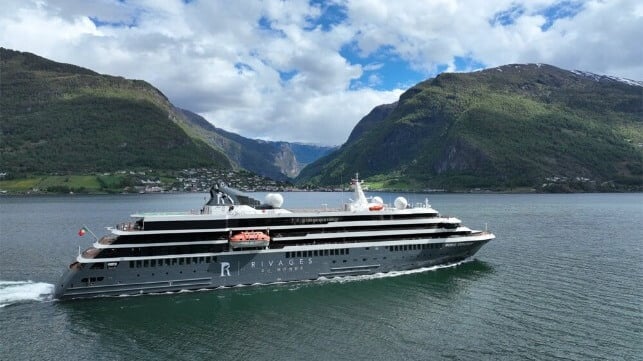
The Norwegian Storting (Parliament) has confirmed the requirements and schedule for the regulations to move passenger and ferry shipping to zero emissions while sailing within the country’s World Heritage fjords. The first phase is set to start in 2026 and progress as technology becomes available for larger ships to sail with zero emissions.
The process of developing the regulations began in 2018 with the Norwegian Maritime Authority. Implementation however has been delayed as they worked to define the scope of the regulations and waited for technology to advance to the level required to maintain shipping while achieving the goals.
“The process of developing zero-emission requirements for the World Heritage fjords has been long and demanding, both for the industry and for the Norwegian Maritime Authority,” said Alf Tore Sørheim, Director General of Shipping and Navigation. “Now that new provisions have been adopted, it is important to highlight that they provide the clarity the industry has long awaited. This ensures predictability and offers the opportunity to comply with the requirements.”
The first phase is just eight months away. As of January 1, 2026, passenger ships of less than 10,000 gross tons will have to meet the zero-emission requirement for the World Heritage fjords, which include Geirangerfjorden, a primary destination for the cruise industry, as well as Nærøyfjorden, Aurlandsfjorden, Sunnylvsfjorden and Tafjorden. All passenger ships, including ferries, must meet the requirement, but for larger ships of 10,000 gross tons and above it will be phased in with the requirement to sail with zero emissions as of January 1, 2032.
The Minister of Climate and Environment, Andreas Bjelland Eriksen, describes the legislation as a significant breakthrough for the World Heritage fjords. It is a key step in Norway’s overall sustainability programs and a commitment to the tourism industry.
The authorities note that the zero-emission requirement is technology-neutral and does not prescribe specific solutions. It is up to the operators in the World Heritage fjords to use energy sources that do not emit carbon dioxide (CO?) and methane (CH?). However, when such energy sources are used, there are requirements for greenhouse gas emission reductions, in accordance with the EU regulatory framework.
As part of the final test of the regulation, the government determined that passenger ships may use biogas as an alternative fuel, but that when biogas is used as an alternative fuel, it must be kept separate from fossil fuels until it is bunkered. In addition, the biogas must be bunkered within the final month before the ship enters the World Heritage fjords, and the amount bunkered must correspond to the amount expected to be used during the voyage through the fjords. Biogas sourced from the gas grid, accompanied by a certificate based on a mass balance system, does not meet the requirements for operating in the World Heritage fjords.
It also includes a requirement that ships must use shore power where available. The Storting also agreed to create shore-side electricity in the city of Flåm. It is allocating NOK 100 million ($9.5 million) in support of a shore power project.
Norway is at the forefront of developing technologies including batteries for its ferries as well as alternative fuels. In 2022, coastal ship operator Havila ran the first demonstration of a passenger ship operating solely on batteries in Geirangerfjord. Competitor Hurtigruten has also released its concept designs for a zero-emission passenger ship.
No comments:
Post a Comment