TVA to submit SMR construction permit application
The Tennessee Valley Authority intends to submit the Construction Permit Application for the Clinch River small modular reactor to the US regulator by June.
_79340.jpg)
"The Tennessee Valley Authority (TVA) intends to submit a CPA to license construction of a GE-Hitachi BWRX-300 small modular reactor (SMR) at TVA's Clinch River Nuclear Site (CRN Site)," the authority said in a Notification of Intent to the US Nuclear Regulatory Commission (NRC). According to the notification, it plans to submit the first part of the application, including the Clinch River Nuclear Site Environmental Report, this month and the remainder "by June 2025".
The Construction Permit Application - or CPA - is essentially the blueprint for the plant's design and safety systems. NRC approval must be granted before construction can begin.
"As communicated previously, the TVA Board has not yet authorised the deployment of a SMR at the CRN Site. TVA's submittal of the CPA is an important step to de-risk the licensing aspect of a potential, future SMR deployment. Any decisions about deployment will be subject to support, risk-sharing, required internal and external approvals, and completion of necessary environmental and permitting reviews," TVA said in the letter, which is dated 17 April.
The NRC awarded TVA an early site permit for the construction of SMRs at Clinch River in 2019, certifying that the site was suitable for the construction of a nuclear power plant from the point of view of site safety, environmental impact and emergency planning, but without specifying the choice of technology. A separate licence would be required to construct and operate a plant. TVA entered an agreement with GE Hitachi in 2022 to support its planning and preliminary licensing for the potential deployment of a BWRX-300 at the site, near Oak Ridge.
US Energy Secretary Chris Wright visited the Clinch River Nuclear Site in March (Video: TVA)
This will be the first CPA for a BWRX-300. TerraPower submitted a CPA for its first-of-a-kind Natrium plant, at Kemmerer, Wyoming, to the NRC in March 2024, which the regulator docketed for review the following May. More recently, Long Mott Energy submitted a CPA for an Xe-100 power reactor to be located in Calhoun County, Texas, on 31 March, for which the regulator is targeting a docketing decision by the end of May.
A TVA-led coalition including BWRX-300 developer GE Hitachi Nuclear Energy earlier this year applied for USD800 million in funding from the US Department of Energy's Generation III+ SMR programme to support the deployment of SMRs at Clinch River. At the time, CEO Jeff Lyash said the funding would accelerate construction of an SMR at Clinch River by two years, with commercial operation planned for 2033.
Earlier this year, Tennessee Governor Bill Lee pledged support for nuclear, with a proposal for some USD50 million for the SMR project in his 2025 State of the State address.
TerraPower begins UK design assessment process
TerraPower has formally notified UK regulators that it plans to begin the generic design approval process for its Natrium sodium-cooled fast reactor, a first step towards deploying the technology in an international market.
_36990.jpg)
The nuclear innovation company said it has submitted a letter to the UK's Department for Energy Security and Net Zero (DESNZ) that formally establishes its intention to enter the UK Generic Design Assessment (GDA) process.
The process is used by the UK's nuclear and environmental regulators - the Office for Nuclear Regulation (ONR) and the Environment Agency - to scrutinise designs for new nuclear power stations at an early stage, allowing potential design or technical concerns to be recognised early on and resolved before a developer formulates detailed plans for building at a specific site or applies for licences or permits. The Environment Agency estimates that it takes around 4 years to complete the three-step process.
TerraPower, co-founded by Microsoft co-founder Bill Gates, broke ground for its first Natrium plant, in Wyoming, USA, last year and said the regulatory milestones from that project will be used as the basis of its GDA application.
TerraPower President and CEO Chris Levesque said the company has been in active discussions in the UK "for years", adding that there is "immense interest and opportunity for the United States and United Kingdom to cooperate on deploying advanced nuclear plants over the coming decade".
The Natrium technology features a 345 MWe sodium-cooled fast reactor with a molten salt-based energy storage system. The storage technology can boost the system’s output to 500 MWe for more than five and a half hours when needed and allows a Natrium plant to integrate seamlessly with renewable resources, TerraPower says. The Natrium reactor is a TerraPower and GE Hitachi technology.
GDAs have previously been completed for the EDF/Areva UK EPR, the Westinghouse AP1000, the Hitachi-GE UK ABWR and the CGN/EDF/GNI UK HPR1000 designs. GDAs are currently ongoing for Rolls-Royce SMR Limited's small modular reactor design, GE Hitachi Nuclear Energy's BWRX-300 and Holtec International's SMR-300. Westinghouse's AP300 was accepted for a GDA review in August 2024, and in December, France-based reactor developer Newcleo submitted an application for its LFR-AS-200 small modular lead-cooled fast reactor to begin the process.
First main pump installed in Chinese SMR
The first of four main pumps has been installed at the ACP100 small modular reactor demonstration project, under construction at the Changjiang site on China's island province of Hainan, China National Nuclear Corporation has announced.
_34409.jpg)
The shielded main pump of the ACP100 - also referred to as the Linglong One - is a single-speed vertical fully-sealed pump, which must meet stringent requirements such as high safety, full sealing, and long life. The first of the four pumps for the demonstration project was produced by Hainan Nuclear Power and Harbin Electric Equipment and was shipped to the construction site in March.
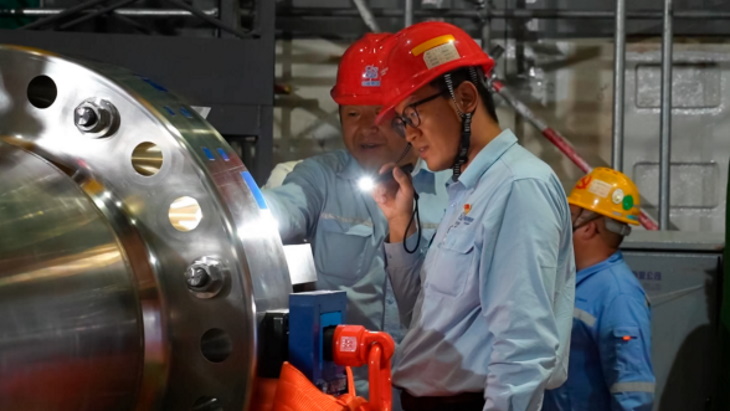
(Image: CNNC)
China National Nuclear Corporation (CNNC) said the installation of the first pump - which it refers to as the "heart" of the reactor coolant system - "further demonstrates China's comprehensive strength in the design of new nuclear energy systems, high-end equipment manufacturing and coordinated management of complex projects".
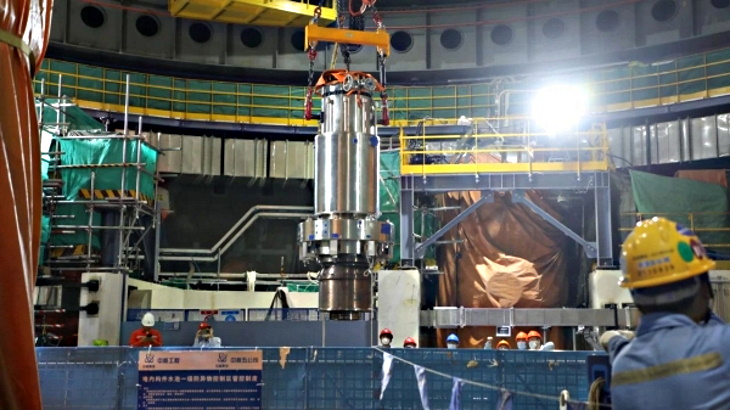
(Image: CNNC)
CNNC announced in July 2019 the launch of a project to construct an ACP100 SMR at Changjiang. The site is already home to two operating CNP600 pressurised water reactors (PWRs), while the construction of two Hualong One units began in March and December 2021. Both those units are due to enter commercial operation by the end of 2026.
First concrete for the ACP100 was poured on 13 July 2021, with a planned total construction period of 58 months. Equipment installation work commenced in December 2022 and the main internal structure of the reactor building was completed in March 2023. The outer containment dome was hoisted into place in February this year.
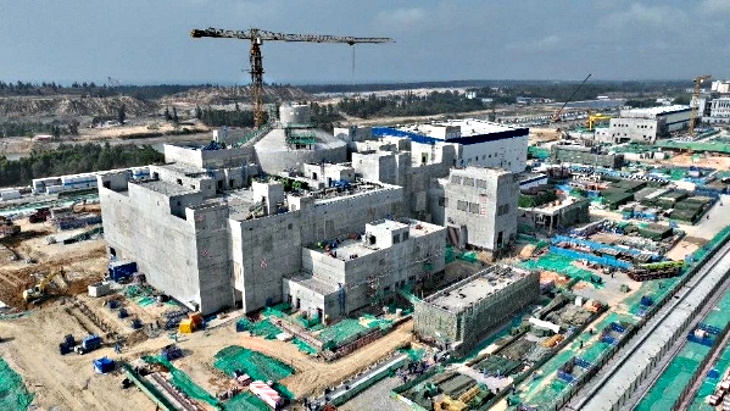
The ACP100 SMR construction site (Image: CNNC)
Under development since 2010, the 125 MWe ACP100 integrated PWR's preliminary design was completed in 2014. In 2016, the design became the first SMR to pass a safety review by the International Atomic Energy Agency.
Once completed, the Changjiang ACP100 reactor will be capable of producing 1 billion kilowatt-hours of electricity annually, enough to meet the needs of 526,000 households. The reactor is designed for electricity production, heating, steam production or seawater desalination.
Korean-led consortium awarded US research reactor contract
A consortium led by the Korea Atomic Energy Research Institute has been awarded a USD10 million contract by the University of Missouri for the design and licensing of its planned new research reactor.
_56336.jpg)
The University of Missouri (Mizzou) launched an initiative in March 2023 to build a new, larger research reactor, NextGen MURR. The university's existing MU Research Reactor - in operation for more than half a century - is the highest-powered university research reactor in the USA and is currently the country's only producer of certain medical radioisotopes.
The Korea-US University of Missouri Research Reactor Consortium - comprising the Korea Atomic Energy Research Institute (KAERI), Hyundai Engineering Company, Hyundai Engineering America and US-based engineering firm MPR Associates - has now been contracted for the design studies phase to develop the 'roadmap' for the new reactor.
It will include detailed programming studies and a preliminary site evaluation and will establish an initial project cost and schedule estimate for the entire site. This agreement is expected to take approximately six months to complete, and the results will be integrated into the preliminary design and licensing phase under a separate contract. The conceptual design of the reactor is expected to be completed by the end of 2026. The total initiative is expected to take 8-10 years.
The university's existing research reactor - MURR - was originally constructed as a 5 MWt reactor, and began operations in 1966. Its power was increased to 10 MWt in 1974, and it now operates six-and-a-half days per week, all year round. The reactor is currently the only producer in the USA of the medical isotopes yttrium-90, used for the treatment of liver cancer; molybdenum-99, for analysis of heart functions; iodine-131, used for treatment of thyroid cancer; and lutetium-177, used for treatment of pancreatic and prostate cancers.
The new 20+ MW NextGen MURR research reactor will expand the current capabilities of MURR and address new innovative demands such as cancer treatment. The university said the new reactor and supporting infrastructure will be the largest capital investment in its history and will "position Missouri as a national hub for innovation, investment and manufacturing in nuclear health technologies".
"This is a historic moment for our university, our state and the future of nuclear science and medicine," University of Missouri President Mun Choi said. "NextGen MURR represents our commitment to research that changes lives. It will allow Mizzou to lead the nation in producing critical medical isotopes while opening new frontiers in science, engineering and patient care."
"The Board of Curators is proud to support this bold step forward," said Todd Graves, chair of the university's Board of Curators. "NextGen MURR is more than a reactor - it's an engine of progress. It will enhance Missouri's role as a leader in nuclear science medical research, economic development and education for generations to come."
KAERI President Han Gyu Joo added: "Securing the design study contract for the project is a new success story for KAERI. Riding on this momentum, we will strive to lead in nuclear science and applications through the development and use of research reactor and other nuclear technologies."
KAERI noted: "This marks Korea's first involvement in a US nuclear reactor project, which greatly enhances Korea-US nuclear cooperation."
No comments:
Post a Comment