Canada Marks 80th Anniversary of Battle of the Atlantic
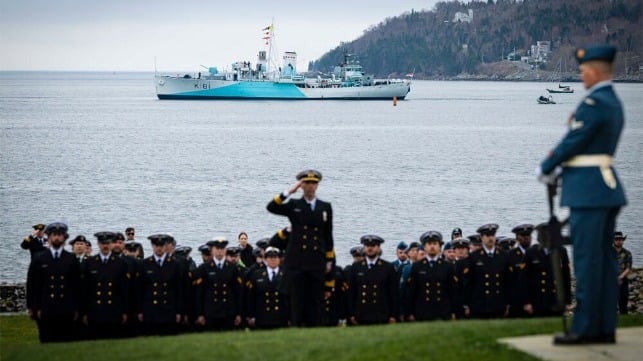
Canada is maintaining its tradition of honoring the heroism of sailors who took part in the Battle of the Atlantic and ended up paying the ultimate price. On May 4, the country commemorated the 80th anniversary of the battle that was the longest continuous military campaign during World War II and which claimed the lives of 4,600 Canadians.
Canada has designated the first Sunday in May as the day navy families gather to commemorate the battle, not only to honor the struggle, sacrifice, and loss but also to celebrate the courage of its sailors in the face of daunting obstacles. This year, events were held across the country in order to keep the memories alive.
The Battle of the Atlantic, which lasted from the outbreak of hostilities in September 1939 until victory in May 1945, is credited with transforming the Royal Canadian Navy (RCN) from a tiny, ill-equipped, and under-trained force into one of the largest navies. At the outbreak of the war, the RCN comprised only six destroyers, a handful of smaller vessels, and 3,500 sailors. By the time the conflict was ending, RCN had grown to over 373 fighting ships and almost 100,000 sailors.
The battle remains an important aspect of WWII. With continental Europe under Nazi Germany’s control, the United Kingdom stood alone against the Nazi threat. To sustain Britain’s war effort, supplies of food and war materials from the rest of the world had to be shipped there. The Nazi used all-out submarine warfare to try to cut Britain off and starve the island nation into submission, making no distinction between military warships and civilian merchant vessels.
In response, convoys were formed, with warships (escorts) protecting the merchant ships carrying the supplies. Canada was at the forefront in providing its warships to offer escort services. Over the course of the war, Canada alongside other allied naval and air forces fought more than 100 convoy battles and performed as many as 1,000 single ship actions against submarines and warships of the German and Italian navies. The RCN destroyed or shared in the destruction of 33 U-boats and 42 enemy surface craft.
RCN suffered significant casualties. The country lost over 60 ships while over 2,100 sailors, 1,700 merchant mariners, and more than 900 aviators lost their lives. The battle also reached Canadian waters with 23 ships sunk in the Gulf of St. Lawrence and the St. Lawrence River.
“As we commemorate the 80th anniversary of the Battle of the Atlantic, we honor the bravery of the Canadians who served with unwavering resolve and remember those who made the ultimate sacrifice. The Battle of the Atlantic left a lasting imprint on Canada’s national story and the identity of the RCN,” said Vice-Admiral Angus Topshee, RCN Commander.
On the 80th anniversary, Topshee recalled the bravery and inspiring action of the sailors of HMCS Esquimalt, the last Canadian ship sunk in the war on April 16, 1945. The sinking, coming just three weeks before the end of the war, remains a painful memory as 44 sailors, more than half of the crew, died within sight of their home port of Halifax.
This year’s ceremonies were more poignant as the number of living World War II veterans continues to decline.
Canada's Veterans organization compiled a detailed history of the Battle of the Atlantic presented online.
'I was there when the German U-boats surrendered'
David Wilson
BBC News NI
Bert Whoriskey was 14-years-old when a fleet of U-boats berthed outside his home
On 14 May 1945, almost a week after Britain and its allies celebrated victory in Europe, Hitler's defeated Atlantic U-boats berthed for the final time.
The German submarines – the "U-boat peril" as Churchill had called them - had been the Allies' principal threat at sea during the Battle of the Atlantic, a campaign that raged throughout the war.
On that day, the first of the U-boats made their way up the River Foyle to Lisahally in County Londonderry to formally surrender.
Eighty years on, Bert Whoriskey, then just 14, and who watched the surrender, told BBC News NI it is a day he can "never ever forget".
'The war had ended, excitement was second to none'
"The war had ended, excitement was second to none, " he said.
"There were ships of of all kinds, and at their head a big Navy destroyer, and there they were coming up the Foyle.
"The U-boats were following, around eight, or 10 of them, and they berthed about 200 yards from our house."
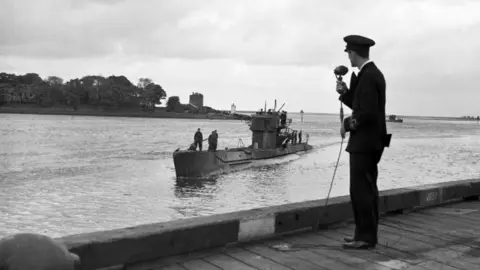
BBC commentator Lt. Commander Harry McMullan, reported on the surrender of German U-boats at Lisahally
Pre-war, Lisahally had been a quiet hamlet on the shores of the River Foyle.
It was home to about 20 families, mainly workers at a manure factory, whose homes had been built by the factory owners.
"All we had was a nice cricket pitch, and a pavilion – that was Lisahally until 1939 when Hitler decided it was time to have a war," Bert said.
Within months, Lisahally, as well as the city of Derry, and the wider north west of Northern Ireland, would be transformed. Lisahally would become one of the Allies' most strategically important ports.
Vast amounts of timber arrived, stretched out across Bert's childhood cricket pitch, along with US Naval Construction Battalions (Seabees).
Work began, and continued day and night for months.
A huge jetty was built at the "back of our house," he said.
Then the Royal Air Force arrived.
Huge oil storage facilities were built nearby, an airfield too.
Barrage balloons arrived, surrounding the area to protect it from air strike.
'Lisahally was ready'
Never had then nine-year-old Bert "seen anything as big".
"When that was all built you just looked at it, Lisahally was ready," said Bert.
Soon, he said, the ships started to arrive.
"Destroyers, battleships submarines, they all came to refuel and rearm. There was British, Canadian, American, Australian, Dutch. This went on every day for the rest of the war," Bert said.
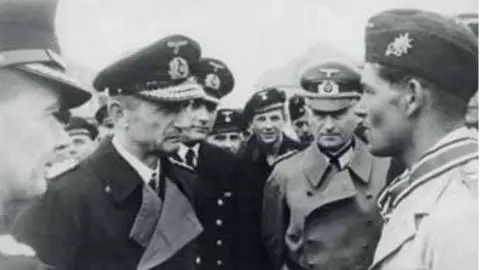
U-boat commanders were formally ordered to surrender by Admiral Sir Max Horton, commander-in-chief, Western Approaches
The naval base - shared by the Royal Navy, the Royal Canadian Navy and the United States Navy - was vital to the protection of convoys in the Atlantic.
At one time, 140 Allied escort ships were based on the River Foyle, and Londonderry was home to Base One Europe, the US Navy's operating base in Northern Ireland.
The Battle of Atlantic was the longest continuous military campaign of World War Two.
More than 66,000 Allied merchant seamen, sailors and airmen died, with 175 Allied warships and 5,000 merchant ships destroyed by German U-boats.
'They paid the ultimate price'
As months gave way to years, Bert said, "you could see the the price that was being paid for where we are today".
"The ships were coming in damaged. They would have let us on every once in a while. The young men who were crewing the ship, you could see in their faces they were terrified," he said.
"Nearly every day there would be bodies on the jetty, waiting to be taken away. That always comes back into my dreams, the bodies on the jetty getting put into the back of a lorry - people who paid the ultimate price."
When victory in Europe finally came, Bert remembers sailors jumping into the Foyle "because they were so excited".
A "big announcement" came in the days that followed, he said.
"They announced the U-boats fighting at our end of the Atlantic were surrendering at Lisahally," he said.
On 14 May the first of the U-boats berthed at Lisahally and formally ordered to surrender by Admiral Sir Max Horton, commander-in-chief, Western Approaches.
"Of all the things that happened, all the things we had seen, this was the biggest of them all," Bert said.
"We were only young. All we thought was we had spent six years fighting the Germans, and now we were going to see actual real Germans," Bert said.
Advertisement
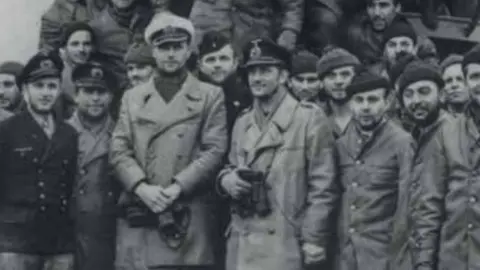
Bert remembers the German crews singing marching tunes, and playing football after their surrender
Bert and his pals had to wait until "all the pomp died down".
"The first thing we heard was the singing of marching tunes.
"When we looked at them and I will never forget, they were all very young. Not many of them were even as old as 30.
"You could tell they were glad the war was over, they knew they had survived."
The German submariners were held at the naval base for about a year and Bert and his friends used to go down and look through the fence.
"One day they were all on their knees in a big line, we thought they were going to be shot," Bert said.
"What they were doing was pulling the grass out of the ground to make a football pitch – the next day a goalpost was put up.
"We spent time marching up and down with them. They made us toys at Christmas, they made a toy double decker bus – I had never seen a double decker bus."

Admiral Lord West of Spithead said the port in Northern Ireland was hugely important
Derry's strategic importance can not be underestimated, Admiral Lord West of Spithead, the First Sea Lord and Chief of the Naval Staff from 2002 to 2006, said.
"It was absolutely crucial and we needed to get our ships and facilities as far to the west as we could," he told BBC Radio Ulster's Good Morning Ulster programme.
"It was wonderful that we could use the base up in Londonderry which put our ships a bit closer."
The U-boats were deliberately sunk - or scuttled - off the coast of Derry and Donegal after the war.
A special event to commemorate the city's wartime role is set to take place in Derry's Ebrington Square on 17 May.
No comments:
Post a Comment