It’s possible that I shall make an ass of myself. But in that case one can always get out of it with a little dialectic. I have, of course, so worded my proposition as to be right either way (K.Marx, Letter to F.Engels on the Indian Mutiny)
Saturday, May 24, 2025
Polish supply chain gears up for country's first nuclear project
By Warwick Pipe
World Nuclear News, in Warsaw
Thursday, 22 May 2025
The Polish government expects a significant share of work on the country's first nuclear power plant to be awarded to local companies, but there are steps needing to be taken by the Polish supply chain, the World Nuclear Supply Chain conference in Warsaw heard.
(Image: World Nuclear Association)
In November 2022, the then Polish government selected Westinghouse AP1000 reactor technology for construction at the Lubiatowo-Kopalino site in the Choczewo municipality in Pomerania in northern Poland. An agreement setting a plan for the delivery of the plant was signed in May last year by Westinghouse, Bechtel and Polskie Elektrownie Jądrowe (PEJ) - a special-purpose vehicle 100% owned by Poland's State Treasury. The Ministry of Climate and Environment in July issued a decision-in-principle for PEJ to construct the three-unit plant. The aim is for Poland's first AP1000 reactor to enter commercial operation in 2033. The total investment costs of the project are estimated to be about PLN192 billion (USD49 billion).
The government expects Polish companies to supply at least 40% of the components and services for the country's first nuclear power plant.
"We are starting our adventure [in nuclear power]," Andrzej Sidlo, counsellor at the Polish Ministry of Industry told the event, organised by World Nuclear Association. "However, we are not starting from scratch ... we don't yet have nuclear in our energy mix, however we have a lot of experienced nuclear companies because of export projects and because of international cooperation."
Monika Silva, Deputy General Director of IGEOS Nuclear - part of the Chamber of Commerce for Energy and Environmental Protection - told those attending that, overall, Polish companies have already supplied components and services to 44 nuclear power plant projects, two nuclear laboratories and two nuclear facilities in 26 countries around the world.
In March, international law firm Baker McKenzie - which acted as a legal counsel to Korea Electric Power Cooperation in relation to all aspects of the development, financing and refinancing of the UAE's Barakah project - published a report assessing the current state of readiness of the Polish nuclear sector in respect of the construction of the country's first nuclear power plant. The report also describes the further actions needed to bring Poland closer to completing the project.
The report, using the Nuclear Energy Readiness Index, found that Poland was about 58% ready to start construction of the Choczewo plant, scoring the highest scores for the political (9/10), regulatory and social (8/10) aspects of the undertaking. The lowest score was in the technology field (3/10). Investment and systemic issues, which consist of finance, human resources, accompanying investments and preparation of public administration, received 4 points each.
"It's very surprising that we have a very high score on the Polish political readiness because we are a pretty divided country when it comes to politics," said Agnieszka Skorupinska, Partner, Head of Sustainability and Energy Transition at Baker McKenzie. "But here we all agree we need to have nuclear, so this is a very important development and very important conclusion."
However, the Baker McKenzie report found that the preparedness of the country's supply chain was low, with local companies particularly needing guidance on norms and standards.
"We did rate it rather low, but not in the sense of companies being not fit or not prepared, but simply where the first nuclear project is ... the problem they have is that they really don't know 100% what is expected from them," Silva said. "I think when the information is clear - we need you to do this and that and this will be our requirements for that product - then it will be much easier for the Polish companies to show their real potential."
She said that the Polish industry was quite divided into two distinct groups - one that is "already involved, very developed, very skilled, having all of the levels of the requirement fulfilled". The second group are those that for many years did not believe that the Polish nuclear power plant project would materialise, so now need to take steps to prepare for it.
According to a survey released earlier this year by the Polish Economic Institute, more than 70% of Polish companies said they have experience in the energy sector that can be used in a nuclear project. One-third of companies declare experience from other projects in the nuclear sector abroad. The survey questioned more than 100 Polish companies, including more than 30% of the sample from the Pomeranian Voivodeship, where the project of the first Polish nuclear power plant is being implemented. The study included companies from the construction sector (30%), engineering and construction (28%) and machinery (22%).
Most of the surveyed companies have experience in large infrastructure projects, of which almost half (45%) have worked on the construction of gas or coal-fired power plants, and almost one-third (29%) have experience in nuclear energy. The study also showed that as many as three-quarters of Polish companies have experience in implementing at least one project in the energy sector.
The factors most frequently mentioned among those attracting domestic entrepreneurs to the Polish nuclear project included the opportunity to enter the nuclear energy sector, the possibility of developing and increasing the scale of operations, increasing employee competences and obtaining valuable references, as well as the ambitious and demanding nature of the project.
The companies surveyed were also aware of possible difficulties in joining the project. They mainly indicate a lack of financial support, a competence gap, too high investment requirements and difficulty in recruiting suitably qualified employees.
Westinghouse fuel arrives at Temelin nuclear power plant
Friday, 23 May 2025
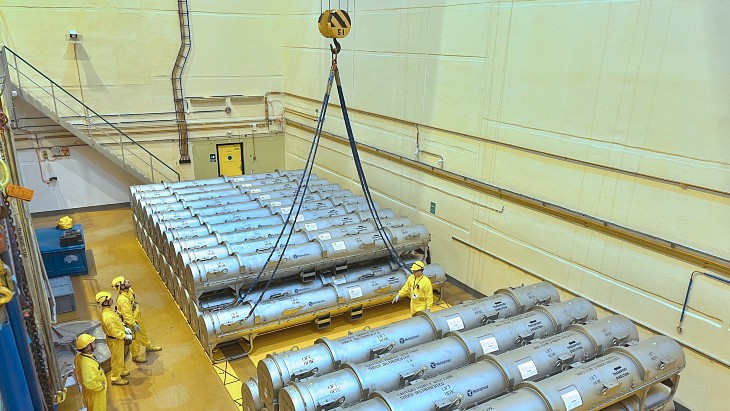
The Czech Republic has taken delivery of the first 30 fuel assemblies for the Temelin nuclear power plant from Westinghouse as it replaces its previous supplier from Russia.
(Image: CEZ)
The country's nuclear power plant operator ČEZ began work to diversify its nuclear fuel suppliers in 2018, signing a contract for the supply of fuel assemblies for the Temelin plant with Westinghouse, and France's Framatome, in 2022. The company said it is expecting new fuel from Framatome next year.
The Czech Republic currently gets about one-third of its electricity from two VVER-1000 units in operation at Temelín, which came into operation in 2000 and 2002 and four VVER-440 units at Dukovany, which began operating between 1985 and 1987.
The diversification of nuclear fuel suppliers - and increases in fuel reserves - is seen as increasing energy security among European Union countries using Russia's TVEL for fuel for their VVER reactors which were designed in the Soviet Union era. ČEZ has also contracted Westinghouse to supply the Dukovany nuclear power plant, and is in negotiations with Framatome to follow suit.
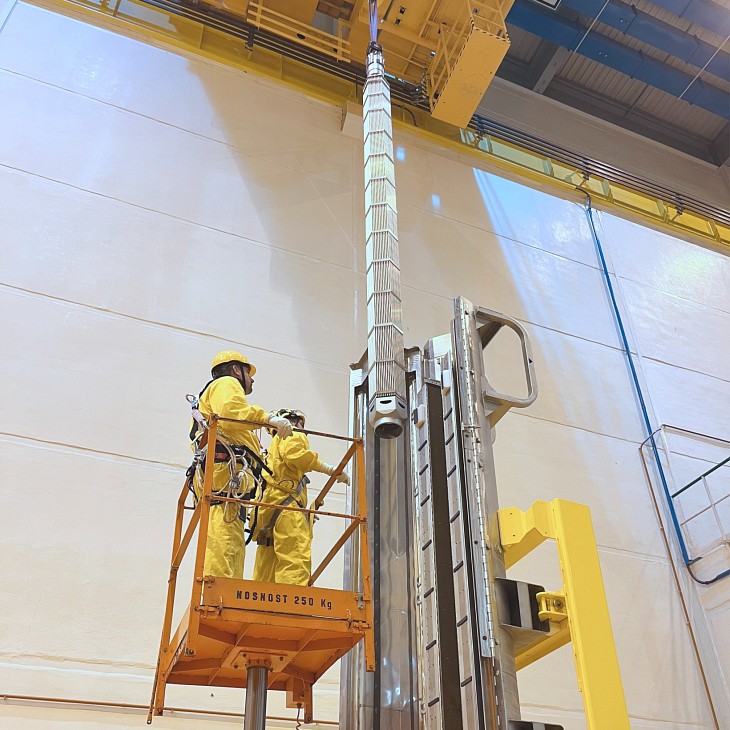
Acceptance checks are currently taking place with specialists verifying the weight of the fuel and performing visual inspections. Bohdan Zronek, director of ČEZ's nuclear energy division, said: "One of the first steps is to check the accelerometers. This is a special device that indicates inappropriate handling during transport."
(Image: ČEZ)
The company says that there had been a five-year series of analyses and tests as part of ensuring the new fuel meets the strictest safety requirements. The new fuel requires a permit from the State Office for Nuclear Safety, with ČEZ currently preparing to submit its application.
The new fuel will also enable longer fuel campaigns of 18 months at Temelin and 16 months at Dukovany, and Daniel Beneš, ČEZ chairman and CEO, said: "This is a step that significantly increases the energy security of the Czech Republic. In addition, to diversifying nuclear fuel suppliers, we also hold strategic reserves in both of our nuclear power plants."
Date set for Taiwan referendum on nuclear restart
Friday, 23 May 2025
A motion to hold a referendum on restarting the recently shut-down Maanshan nuclear power plant was passed in Taiwan's Legislative Yuan, and the Central Election Commission has now approved the proposal.
Maanshan (Image: Taipower)
The commission, which is an independent agency established to handle referendum issues, considered two referendum proposals, rejecting one relating to the the judicial death penalty process, judging that it did not fit the requirements of the Referendum Act.
However, the commission said that the referendum question on nuclear energy - 'Do you agree that the third nuclear power plant (Maanshan) will continue to operate after the competent authority agrees to confirm that there are no safety concerns?' - complied with the provisions of the Referendum Act.
"This referendum proposal is about energy policy, and it is about whether the third nuclear power plant, which stopped operating on 17 May 2025, should be put to a referendum to decide whether to continue operating. It should fall into the category of 'initiative or referendum on major policies'," it said.
It announced that the date for the referendum would be 23 August with voting from 08:00 to 16:00.
The background
Taiwan's Democratic Progressive Party (DPP) was elected to government in January 2016 with a policy of creating a "nuclear-free" Taiwan by 2025. Under this policy, Taiwan's six operable power reactors would be decommissioned as their 40-year operating licences expire. Shortly after taking office, the DPP government passed an amendment to the Electricity Act, passing its phase-out policy into law. The government aims for an energy mix of 20% from renewable sources, 50% from liquefied natural gas and 30% from coal.
As Taiwan's last operating reactor, Maanshan 2 had been providing about 3% of its electricity. On Saturday, it was disconnected from the grid and is set to be decommissioned following the expiry of its 40-year operating licence, in accordance with Taiwan's nuclear phase-out policy.
Last week, Taiwan's Legislative Yuan passed an amendment to the Nuclear Reactor Facilities Regulation Act that allows nuclear power plant operators to apply for a 20-year licence renewal beyond the existing 40-year limit, potentially extending a plant's operating lifespan to 60 years, the Central News Agency reported. The final vote saw the main opposition Kuomintang and the Taiwan People's Party push the amendment through with 60 votes in favour, defeating the ruling DPP's 51 votes.
Separately, Taipei Times reported last week that Taiwan's National Atomic Research Institute (NARI) has launched a large-scale, four-year small modular reactor research project with a budget exceeding TWD100 million (USD3.3 million). President William Lai has said he remains open to the use of advanced nuclear technologies as long as three conditions are met: nuclear safety, proper management of nuclear waste and societal consensus. Anticipating the potential commercial debut of SMRs by 2030, NARI said its goal was to provide a reference for industrial or national policies.
The vote for the referendum to be held on restarting Maanshan 2 was held just three days after it was disconnected from the grid. The proposal was passed by 58 votes to 49, and was supported by the main opposition Kuomintang and the Taiwan's People's Party.
Sweden passes bill on state aid for new reactors
Friday, 23 May 2025
Sweden's parliament - the Riksdag - has approved the government's proposals for providing state aid to companies that want to invest in new nuclear reactors in the country. The new law will enter into force later this year.
The Riksdag's East Wing (Image: Swedish Parliament)
In October 2022, Sweden's incoming centre-right coalition government adopted a positive stance towards nuclear energy. In November 2023, it unveiled a roadmap which envisages the construction of new nuclear generating capacity equivalent to at least two large-scale reactors by 2035, with up to 10 new large-scale reactors coming online by 2045.
In a bill submitted to parliament on 27 March this year, the Swedish government proposed a new law regarding state support for nuclear power investments. In the bill it proposed providing state loans to finance new reactors as well as a contract-for-difference power price mechanism.
The loans - aimed at lowering the cost of financing new nuclear - will be limited to the equivalent of four large-scale reactors (about 5000 MWe of capacity). The government noted that support may only be granted if the new reactors are located at the same location and have a total installed output of at least 300 MWe. The two-way Contracts for Difference may be entered into once a new reactor has become operational and has been licensed to produce electricity at full capacity.
The Riksdag has now approved the government's proposal. The new act on state aid enters into force on 1 August. Interested companies may apply for the aid from that date.
"This is a historic announcement that takes responsibility for public financing and tax payers' money when we enable actors to build new nuclear energy," said Minister for Financial Markets Niklas Wykman. "An expansion of nuclear power is expected to result in greater price stability and lower system costs, which helps households as well as businesses. With new nuclear reactors, we are paving the way for higher growth, more jobs and better conditions to achieve the climate transition."
The government appointed Mats Dillén in December 2023 to produce and submit proposals for models for financing and risk sharing for the construction of new nuclear power reactors. According to the mandate, the proposed models must be designed so that nuclear power with a total output of at least 2500 MWe - equivalent to the output of two large-scale reactors - must be in place by 2035 at the latest.
Dillén presented the findings of the study in August last year. His report said the investigation "identified conditions which give rise to a discrepancy between a private investor's business case for new nuclear power and the socioeconomic equivalent. It is concluded that efficiency reasons give a rationale for the state to support investments in nuclear power".
His proposed financing and risk sharing model consists of three main components that lead to a lower cost of capital that facilitates new investments in nuclear power at a low cost. The components are: state loans to finance investments in new nuclear power, which lowers the cost of capital; a two-way contract-for-difference signed between the state and the nuclear power producer; and a risk and gain-share mechanism that gives investors a minimum return on equity.
Article researched and written by WNN's Warwick Pipe
Finnish regulator on track for repository decision by year-end
Friday, 23 May 2025
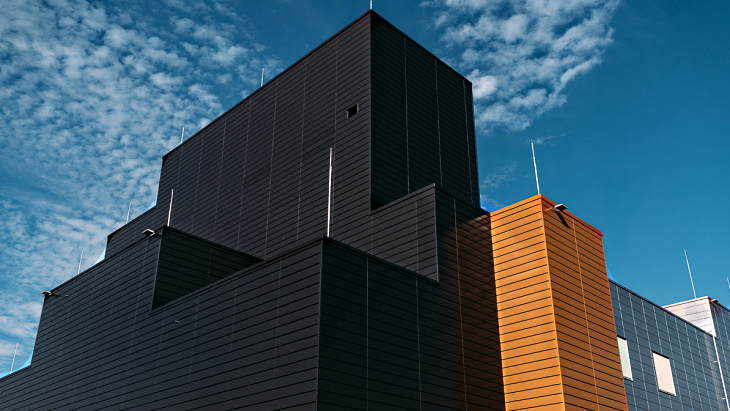
Finland's Radiation and Nuclear Safety Authority has said it remains on track to complete its assessment of Posiva Oy's operating licence application for the world's first used nuclear fuel repository despite deficiencies in the materials submitted for review.
(Image: Posiva)
Radioactive waste management company Posiva submitted its application, together with related information, to the Ministry of Economic Affairs and Employment on 30 December 2021 for an operating licence for the used fuel encapsulation plant and final disposal facility currently under construction at Olkiluoto. The repository is expected to begin operations in the mid-2020s. Posiva is applying for an operating licence for a period from March 2024 to the end of 2070.
The government will make the final decision on Posiva's application, but a positive opinion by the Radiation and Nuclear Safety Authority (STUK) is required beforehand. The regulator began its review in May 2022 after concluding Posiva had provided sufficient material. The ministry had requested STUK's opinion on the application by the end of 2023. However, in January last year, STUK requested the deadline for its opinion be extended until the end of 2024. In December, the ministry extended the deadline for the regulator's opinion to 31 December 2025.
STUK has now said that there are still deficiencies in the materials submitted for review by Posiva, "which the company must correct". The regulator also noted that Posiva has made changes to its original plans, which has required updating the materials. "The updates have delayed STUK's work more than expected in the early part of the year," it said.
Although STUK's assessment of the application is in the final stages, the statement and safety assessment cannot be completed until it has assessed and approved all of Posiva's operating licence application materials.
"As soon as we receive the remaining materials we need and the supplements we requested, the assessment can be made and the statement can be completed," said STUK Project Manager Antti Tynkkynen.
"If future Posiva data updates do not cause further clarification, it is possible that the review of the licence application data will be completed well before the end of this year," STUK said.
At the repository, used fuel will be placed in the bedrock, at a depth of about 430 metres. The disposal system consists of a tightly sealed iron-copper canister, a bentonite buffer enclosing the canister, a tunnel backfilling material made of swellable clay, the seal structures of the tunnels and premises, and the enclosing rock.
Posiva announced in late August the start of a trial run - expected to take several months - of the operation of the final disposal facility, albeit still without the used fuel.
"One of the time-consuming issues has been the supervision of the test runs of the disposal facility," STUK said. "During the first quarter of 2025, STUK required Posiva to investigate the status of the systems used in the encapsulation and disposal facility and the test runs for the entire facility. STUK has not yet received most of the test run reports for the safety-classified systems and has not been able to assess the test runs as a whole."
STUK is also assessing the readiness of Posiva's organisation to start operating the final disposal facility. In the autumn of 2024, STUK began enhanced supervision of Posiva's organisation. In parallel, STUK introduced incident investigation methods at the beginning of the year in order to deepen its understanding regarding the observations it has made concerning Posiva's organisation as well as the factors underlying them. At the same time, STUK is looking for ways to plan, target and develop its own supervision.
"I find it positive that, in addition to our own estimates, the authority is taking steps to independently ensure that our operations meet all the set safety requirements," said Ilkka Poikolainen, President and CEO for Posiva.
The government granted Posiva a construction licence for the project in November 2015 and construction work on the repository started in December 2016. Once it receives the operating licence, Posiva can start the final disposal of the used fuel generated from the operation of TVO's Olkiluoto and Fortum's Loviisa nuclear power plants. The operation will last for about 100 years before the repository is closed.
Article researched and written by WNN's Warwick Pipe
_52327.jpg)
_48620(1)_58208_19595.jpg)
_34368.jpg)
No comments:
Post a Comment