The second Trump administration "has thrown agencies into chaos, disrupting critical services provided across our nation," the coalition behind the lawsuit said, welcoming the temporary restraining order.
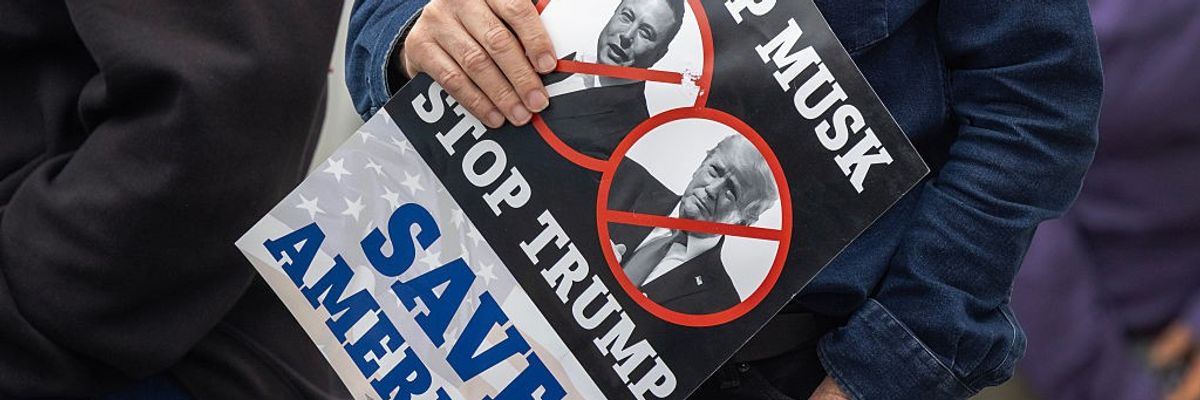
Demonstrators continue weekly protest rallies against U.S. President Donald Trump and his adviser, Tesla CEO Elon Musk, outside of a Tesla dealership on May 3, 2025 in Pasadena, California.
(Photo: David McNew/Getty Images)
Jessica Corbett
May 10, 2025
COMMON DREAMS
A federal judge in California on Friday temporarily blocked what at coalition of labor unions, local governments, and nonprofits argued was "the unconstitutional dismantling of the federal government by the president of the United States on a scale unprecedented in this country’s history and in clear excess of his authority."
Since returning to office in January, U.S. President Donald Trump—aided by his so-callled Department of Government Efficiency and its de facto leader, billionaire Elon Musk—has worked to quickly overhaul the bureaucracy, even though "the president does not possess authority to reorganize, downsize, or otherwise transform the agencies of the federal government, unless and until Congress authorizes such action," as the coalition's complaint notes.
District Judge Susan Illston agreed with the groups and governments, which include the American Federation of Government Employees (AFGE), American Federation of State County and Municipal Employees (AFSCME), Service Employees International Union (SEIU), Alliance for Retired Americans, Main Street Alliance, Natural Resources Defense Council, the city and county of San Francisco, Chicago, Baltimore, and more.
"The president has the authority to seek changes to executive branch agencies, but he must do so in lawful ways and, in the case of large-scale reorganizations, with the cooperation of the legislative branch," wrote Illston in a 42-page decision. "Many presidents have sought this cooperation before; many iterations of Congress have provided it. Nothing prevents the president from requesting this cooperation—as he did in his prior term of office."
"Indeed, the court holds the president likely must request congressional cooperation to order the changes he seeks, and thus issues a temporary restraining order to pause large-scale reductions in force in the meantime," said the judge, appointed to the U.S. District Court for the Northern District of California by former President Bill Clinton.
Illston added that "a temporary restraining order is, by definition, temporary. The court will not consider defendants' request for a stay of execution of the temporary restraining order, as doing so would render the exercise pointless. The court must promptly proceed to consideration of a preliminary injunction."
Welcoming the development in a late Friday statement, the plaintiff coalition said that "the Trump administration's unlawful attempt to reorganize the federal government has thrown agencies into chaos, disrupting critical services provided across our nation."
"Each of us represents communities deeply invested in the efficiency of the federal government—laying off federal employees and reorganizing government functions haphazardly does not achieve that," the coalition added. "We are gratified by the court's decision today to pause these harmful actions while our case proceeds."
The "largest and most significant challenge to Trump's authority to remake the government without congressional approval," as the coalition called it, was filed April 28 by the organizations' legal team: Democracy Forward, Altshuler Berzon LLP, Protect Democracy, Public Rights Project, and State Democracy Defenders Fund.
Illston's decision came just hours after an emergency hearing, during which coalition attorney Danielle Leonard "said the Trump administration's vision was to fundamentally degrade the services that Congress funds agencies to carry out, raising a profound separation of powers conflict," according toThe New York Times.
As the newspaper detailed:
"There's a presumption of regularity that used to exist with respect to the government's actions that I think they need to re-earn," she said.
Ms. Leonard said the Trump administration has never been able to point to any specific authority through which the president could seize that power from Congress. And she said that the government has consistently offered competing and contradictory explanations of why Mr. Trump can authorize the massive restructuring without Congress.

"It's an ouroboros: the snake eating its tail," she said.
Signaling a desire to keep moving through the process swiftly, Illston gave the plaintiff coalition until next Wednesday to file a motion for a preliminary injunction, and the federal defendants—Trump along with various federal agencies and their leaders—until the following Monday to respond, with a limit of 25 pages for both.
Even if the coalition's lawsuit ultimately succeeds, Republicans have a narrow majority in both chambers of Congress, meaning Trump could potentially work with lawmakers to pursue a similar gutting of the federal government before the midterm elections.
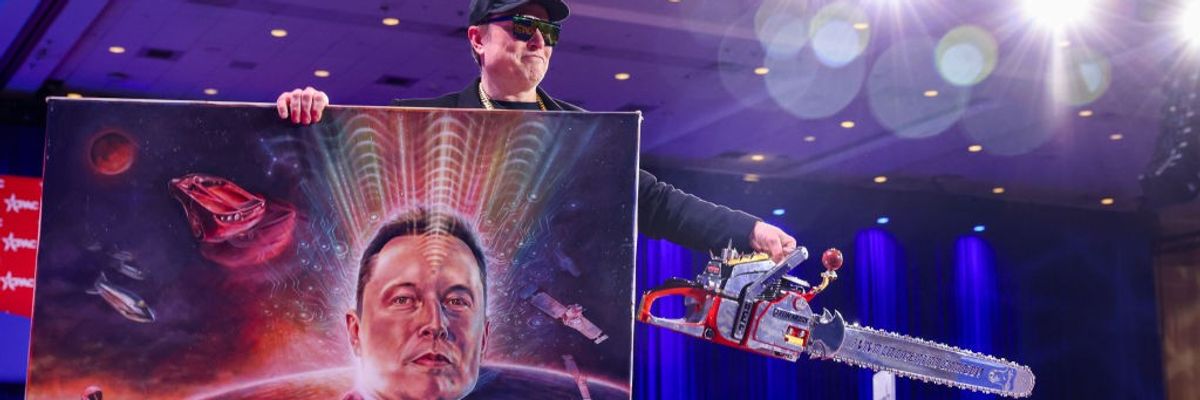
Elon Musk holds a personalized chainsaw gifted by Argentine President Javier Milei and a painting given by an attendee at the Conservative Political Action Conference (CPAC) at the National Harbor in Oxon Hill, Maryland on February 20, 2025.
(Photo: Valerie Plesch for The Washington Post via Getty Images)
Scale of Musk's DOGE Conflicts of Interest 'Should Alarm Every American'
"The wealthiest man in the world is working to dismantle the very same federal departments and agencies tasked with overseeing and placing checks on his businesses," says Public Citizen in a new analysis.
Brett Wilkins
May 08, 2025
COMMON DREAMS
Elon Musk, the world's richest person and de facto head of the Trump administration's so-called Department of Government Efficiency, "has had a direct business interest in over 70% of the agencies and departments targeted by DOGE since its inception," according to an analysis published Thursday by a leading U.S. consumer advocacy group.
The Public Citizen report, titled Duplicitous Oligarchy Grifting Endlessly, "maps out the entities DOGE has targeted and identifies which ones carry a known conflict of interest for Elon Musk's business entanglements" as the executive office leads the Trump administration's purge of federal agencies.
"The wealthiest man in the world is working to dismantle the very same federal departments and agencies tasked with overseeing and placing checks on his businesses," the report states. "He also now is adjacent to and could potentially access sensitive and potentially proprietary information from his biggest competitors in the various industries that have made him wealthy. He also has personal business interests that could shape what his DOGE project considers ripe for cuts."
Elizabeth Beavers, director of Public Citizen's Congress Watch, said in a statement that "it should alarm every American that the wealthiest man in the world has spent the last several months dismantling the same departments and agencies tasked with regulating his businesses."
"Musk's role as the most powerful person in government makes it highly unlikely that any regulator will crack down on his corporations and surely will make agency leaders look more favorably at Musk companies as potential government contractors," Beavers added.
The report considers Musk—who has signaled he will leave DOGE—to have a conflict of interest with a federal agency when one of his companies has received contracts or grants from the department, has an interest in its proprietary data, and is subject to its regulation or enforcement regime.
Public Citizen's analysis highlights interests with federal agencies including:Consumer Financial Protection Bureau, which Musk wants to abolish, would be in charge of regulating a proposed payments processing partnership between Visa and Musk's social media platform X;
Department of Justice, which is investigating electric automaker Tesla and possibly Musk as its CEO;
Federal Aviation Administration, which regulates Musk's SpaceX;
Food and Drug Administration, where some of the more than 1,000 fired staffers were reviewing Musk's Nueralink brain implants;
National Aeronautics and Space Administration, which has awarded SpaceX approximately $15 billion in contracts;
National Highway Traffic Safety Administration, which regulates Teslas, was hit with a 10% workforce reduction since President Donald Trump took office;
Securities and Exchange Commission, which has ongoing enforcement actions against Musk, including fines as high as $150 million for failing to file disclosure forms regarding shares of Twitter, which he bought in 2022; and
United States Agency for International Development, which was investigating whether Russia had improperly gained access to Musk's Starlink satellite internet system.
Musk—whose companies have tens of billions of dollars worth of government contracts—also has conflicts of interest with the departments of Defense, Agriculture, and Energy. SpaceX, for example, holds Pentagon contracts worth around $8 billion, including nearly $6 billion for the National Security Space Launch Phase 3 Lane 2 program.
Critics have laughed off the White House's assertion that Muskld self-police his conflicts of interest by recusing himself when DOGE and his business interests overlap.
"The report's findings make clear that this approach is deeply and incurably flawed—and that urgent action by Congress is required to safeguard the government from Musk's self-dealing and grift," Public Citizen said.
'The Corruption Is Staggering': Trump Officials Push Tariffed Nations to Approve Musk's Starlink
"The glaring conflict of interest inherent in this pressure to preference a Musk-owned company is disgusting," said Public Citizen co-president Lisa Gilbert.
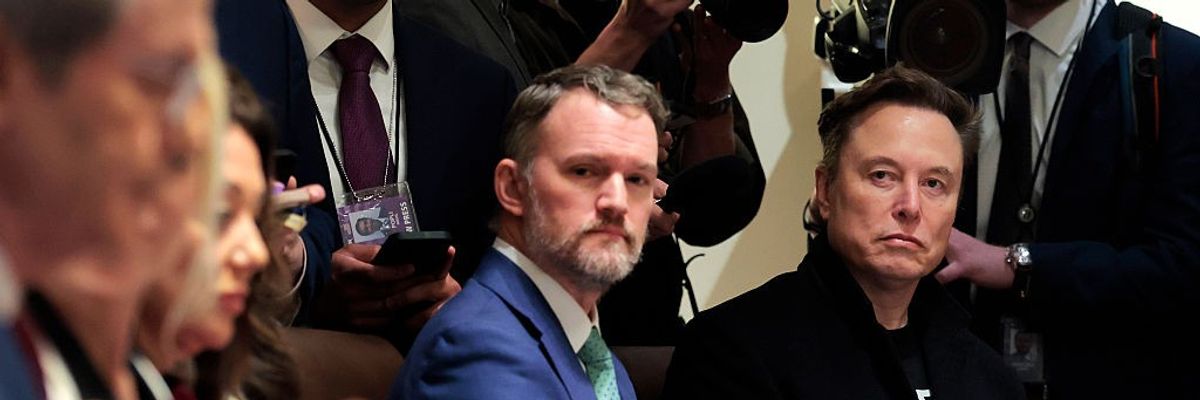
Elon Musk sits next to U.S. Trade Representative Jamieson Greer during a Cabinet meeting at the White House on April 10, 2025.
(Photo: Anna Moneymaker/Getty Images)
Jake Johnson
May 08, 2025
COMMON DREAMS
Trump administration officials have reportedly been pressuring countries facing U.S. tariffs to approve satellite internet services offered by Elon Musk's Starlink to help grease trade negotiations, further underscoring the conflicts of interest stemming from the mega-billionaire's proximity to the White House.
The Washington Postreported Wednesday that it obtained "a series of internal government messages" that "reveal how U.S. embassies and the State Department have pushed nations to clear hurdles for U.S. satellite companies, often mentioning Starlink by name."
"The documents do not show that the Trump team has explicitly demanded favors for Starlink in exchange for lower tariffs," the newspaper added. "But they do indicate that Secretary of State Marco Rubio has increasingly instructed officials to push for regulatory approvals for Musk's satellite firm at a moment when the White House is calling for wide-ranging talks on trade."
The Post points specifically to ongoing bilateral trade negotiations between the U.S. and India, where "government officials have sped through approvals of Starlink with the understanding that doing so could help them cement trade deals with the administration."
The Times of Indiareported Wednesday that Starlink, a subsidiary of Musk's SpaceX, "has been issued a Letter of Intent by the Indian government for satcom services."
Lisa Gilbert, co-president of the U.S.-based consumer advocacy group Public Citizen, said in response to the Post's reporting that "the glaring conflict of interest inherent in this pressure to preference a Musk-owned company is disgusting."
"The bottom line here is that tools of trade and government should be utilized for the benefit of the American public, not abused for personal tech bro profiteering," Gilbert added.
Rep. Greg Casar (D-Texas.), chair of the Congressional Progressive Caucus, called the revelations "a huge new scandal."
"Trump and Musk are using tariffs as leverage to get other countries to buy from Musk's companies. Working families pay $4,000+ more a year so Musk gets new deals," Casar wrote on social media. "They get richer. Everyone else gets screwed."
Last month, U.S. President Donald Trumppartially paused the more aggressive tariffs he sought to impose on countries around the world while leaving in place 10% across-the-board import duties, which are already raising costs for American families.
The Post reported Wednesday that "at least two countries have explicitly discussed or moved toward adopting Musk's Starlink as a means of avoiding Trump’s tariffs and negotiating a better trade deal with the United States."
Cambodia, which is facing a potential 49% tariff rate, appears to be one of those countries. The Post obtained a U.S. embassy cable indicating that Cambodian officials have signaled a "desire to help balance our trade relationship by promoting the market entry of leading U.S. companies such as Boeing and Starlink."
"Another cable from April 17 reported that Starlink was pushing for a license to operate in Djibouti," the newspaper reported. "Embassy staffers wrote they would help Starlink as much as they could: 'Post will continue to follow up with Starlink in identifying government officials and facilitating discussions.'"
U.S. Sen. Chris Van Hollen (D-Md.) said the internal cables show "gross corruption." Congressional Democrats are already probing the White House's use of Starlink services.
"Surprise, surprise: another Trump move that directly benefits Elon Musk—the guy who spent $260 million to elect Donald Trump and has been given the keys to the federal government," said Van Hollen. "They are rigging the government for themselves."

"The glaring conflict of interest inherent in this pressure to preference a Musk-owned company is disgusting," said Public Citizen co-president Lisa Gilbert.
Elon Musk sits next to U.S. Trade Representative Jamieson Greer during a Cabinet meeting at the White House on April 10, 2025.
(Photo: Anna Moneymaker/Getty Images)
Jake Johnson
May 08, 2025
COMMON DREAMS
Trump administration officials have reportedly been pressuring countries facing U.S. tariffs to approve satellite internet services offered by Elon Musk's Starlink to help grease trade negotiations, further underscoring the conflicts of interest stemming from the mega-billionaire's proximity to the White House.
The Washington Postreported Wednesday that it obtained "a series of internal government messages" that "reveal how U.S. embassies and the State Department have pushed nations to clear hurdles for U.S. satellite companies, often mentioning Starlink by name."
"The documents do not show that the Trump team has explicitly demanded favors for Starlink in exchange for lower tariffs," the newspaper added. "But they do indicate that Secretary of State Marco Rubio has increasingly instructed officials to push for regulatory approvals for Musk's satellite firm at a moment when the White House is calling for wide-ranging talks on trade."
The Post points specifically to ongoing bilateral trade negotiations between the U.S. and India, where "government officials have sped through approvals of Starlink with the understanding that doing so could help them cement trade deals with the administration."
The Times of Indiareported Wednesday that Starlink, a subsidiary of Musk's SpaceX, "has been issued a Letter of Intent by the Indian government for satcom services."
Lisa Gilbert, co-president of the U.S.-based consumer advocacy group Public Citizen, said in response to the Post's reporting that "the glaring conflict of interest inherent in this pressure to preference a Musk-owned company is disgusting."
"The bottom line here is that tools of trade and government should be utilized for the benefit of the American public, not abused for personal tech bro profiteering," Gilbert added.
Rep. Greg Casar (D-Texas.), chair of the Congressional Progressive Caucus, called the revelations "a huge new scandal."
"Trump and Musk are using tariffs as leverage to get other countries to buy from Musk's companies. Working families pay $4,000+ more a year so Musk gets new deals," Casar wrote on social media. "They get richer. Everyone else gets screwed."
Last month, U.S. President Donald Trumppartially paused the more aggressive tariffs he sought to impose on countries around the world while leaving in place 10% across-the-board import duties, which are already raising costs for American families.
The Post reported Wednesday that "at least two countries have explicitly discussed or moved toward adopting Musk's Starlink as a means of avoiding Trump’s tariffs and negotiating a better trade deal with the United States."
Cambodia, which is facing a potential 49% tariff rate, appears to be one of those countries. The Post obtained a U.S. embassy cable indicating that Cambodian officials have signaled a "desire to help balance our trade relationship by promoting the market entry of leading U.S. companies such as Boeing and Starlink."
"Another cable from April 17 reported that Starlink was pushing for a license to operate in Djibouti," the newspaper reported. "Embassy staffers wrote they would help Starlink as much as they could: 'Post will continue to follow up with Starlink in identifying government officials and facilitating discussions.'"
U.S. Sen. Chris Van Hollen (D-Md.) said the internal cables show "gross corruption." Congressional Democrats are already probing the White House's use of Starlink services.
"Surprise, surprise: another Trump move that directly benefits Elon Musk—the guy who spent $260 million to elect Donald Trump and has been given the keys to the federal government," said Van Hollen. "They are rigging the government for themselves."

No comments:
Post a Comment