GENERAL STRIKE AGAINST SEPARATION!
Onion Lake Cree Nation files lawsuit against Alberta Sovereignty Act
By Jeremy Appel
(ANNews) – Onion Lake Cree Nation is proceeding with its constitutional challenge against Alberta Premier Danielle Smith’s signature Alberta Sovereignty within a United Canada Act.
On May 14, the First Nation requested that the Alberta government file its statement of defence for the lawsuit that was first launched in December 2022.
Okimaw (Chief) Henry Lewis emphasized in a news release that Onion Lake is advancing its litigation in direct response to Smith’s escalating legitimization of separatist forces.
“Onion Lake Cree Nation will not stand by and allow the Premier to fuel ongoing rhetoric of Alberta separation,” Okimaw Lewis said.
After the April 28 federal election returned a minority Liberal government to power, Premier Smith’s government introduced legislation lowering the number of signatures required to launch a constitutional referendum to 10 per cent of the number of people who voted in the last provincial election from 20 per cent of all eligible voters.
If a separatist group is able to pass this threshold, Smith promised that there will be a referendum on Alberta independence in 2026.
Smith’s introduction of this legislation on top of the Sovereignty Act “sends a clear signal that her government is willing to manipulate laws, intimidate First Nations and control public opinion to push the separatist agenda,” Lewis said at a May 15 news conference in Edmonton.
Before the legislation, known as Bill 54, was passed on Wednesday, Justice Minister Mickey Amery amended it to say that no referendum can undermine Indigenous Treaty rights,
Onion Lake First Nation, which straddles the border between Alberta and Saskatchewan, is a signatory to Treaty 6, which was signed with the Crown in 1876—almost 30 years before Alberta became a province.
“Onion Lake is prepared to defend our Treaty, our People and Lands to ensure that our constitutionally recognized and protected rights are not trampled on by a separatist agenda,” said Lewis.
“Our Treaty and the Constitution take precedence over any idea of Alberta Sovereignty or separation. This divisive separatist talk further fuels and undermines the Treaty relationship we have with the Crown and the constitutional order in Canada.”
Alberta government efforts “to assert exclusive control over these Lands is a violation of international law, Canadian Constitutional law, and of Treaty,” he added.
The Sovereignty Act, which was the first piece of legislation Smith introduced as premier, empowers the provincial government to challenge federal legislation it doesn’t deem to be in Alberta’s interests.
The UCP government was widely criticized by Treaty 6, 7 and 8 First Nations leaders for failing to consult with them on legislation that impacts their covenants with the federal government.
Onion Lake’s lawsuit alleges that the Sovereignty Act interferes with its members’ traditional activities, including ceremonies, hunting, fishing and trapping, because it circumvents the Treaty that enshrines its rights.
In 2023, the Saskatchewan government passed similar legislation, the Saskatchewan First Act, which affirms the provincial government’s jurisdiction over natural resources.
The Federation of Sovereign Indigenous Nations, which represents 74 First Nations in Saskatchewan, launched a constitutional challenge against the Saskatchewan First Act, as well as the federal Natural Resources Transfer Agreement, which gave Manitoba, Saskatchewan and Alberta jurisdiction over Crown lands and natural resources.
On May 12, Assembly of First Nations National Chief Cindy Woodhouse Nepinak asked the federal government to review the transfer agreement, which was passed in 1930, arguing that it contradicts Treaty rights.
“The numbered Treaties, including 6, 7 and 8, did not surrender First Nations title to natural resources,” the Woodhouse Nepinak said.
“On the contrary, these agreements recognize the inherent rights of First Nations to manage and benefit from lands and waters within their territories. Unilateral imposition of the NRTA undermines the solemn promises of these treaties and stands in direct conflict with the Honour of the Crown.”
First Nations unity displayed at rally against separatism at Legislature
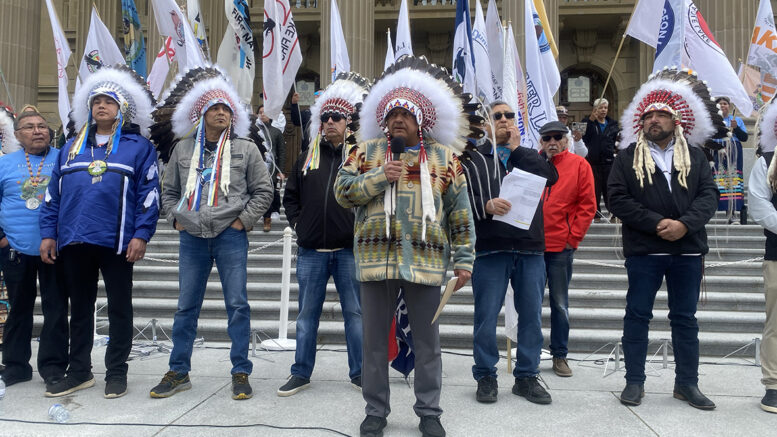 Chief Greg Desjarlais speaking at the First Nations Unity Rally held in Edmonton.
By Jeremy Appel, Local Journalism Initiative Reporter
(ANNews) – Hundreds of people attended a rally that First Nations leaders from across Alberta organized at the Legislature in Edmonton to protest the premier’s ongoing separatist threats, which every speaker agreed would run roughshod over Treaty rights.
The May 15 event opened with drumming and a grand entry while Elders burned sacred herbs for smudging, followed by remarks from leaders representing Treaty 6, 7 and 8.
The protest was a way for Treaty First Nations in Alberta to present a united front in the face of Bill 54, which lowers the threshold for bringing forward a referendum.
Premier Danielle Smith has said that she will hold a referendum on independence in 2026 if a petition in support of one gets enough signatures.
 “Let us stand loud and clear and concise that no provincial government can hold a referendum to overturn our treaty,” Confederacy of Treaty 6 First Nations Grand Chief Greg Desjarlais told attendees. “We do not answer to the provincial government.”
Desjarlais, who is also the elected chief of Frog Lake First Nation, said he “took many arrows and many bullets, many from my own people” for meeting with Premier Smith about Bill 54, which he said was part of the confederacy’s “diplomatic” and “patient” approach to the separatist threat.
The meeting resulted in Justice Minister Mickey Amery amending the bill to say that no separation referendum question can threaten First Nations Treaty rights, which First Nations leaders dismissed as meaningless.
“Let me be clear, this push for Alberta separation is not just dangerous, it’s a violation of Treaty, natural law and the land itself,” said Desjarlais.
Treaties 6, 7 and 8 were signed in 1876, 1877 and 1899, respectively, all before Alberta was established as a province in 1905.
Treaty 8 Grand Chief Trevor Mercredi commented that the day’s display of unity “is what we’ve needed for a long time.”
“When our nations and our Treaty are threatened, we need to come together,” he added.
“There’s no separation between the chiefs and the councils and our people. We are all Treaty people when it comes to our Treaty. Each and every meeting that we are attending is to protect our children.”
Grand Chief Mercredi emphasized that this includes non-Indigenous people as well. “If you’re in Alberta, in Canada, you are recognized as [part of the] Treaty,” he said.
Representing Treaty 7 was Tsuut’ina Minor Chief Regena Crowchild, who spoke on behalf of Chief Roy Whitney.
“Any attempt to undermine or infringe on our Treaty rights will be met with unwavering resistance,” said Crowchild, who emphasized that she hasn’t had any discussion “whatsoever” with the premier on Bill 54.
“Defending our Treaty rights has always been a priority for me, and there are numerous examples of Tsuut’ina taking a strong stand against both federal and provincial actions that threaten those rights.”
Saddle Lake Cree Nation Chief Jason Whiskeyjack said it’s important to take the message “that we are stronger together” to the Legislature.
“We have to celebrate who we are as a people, and when we do that the people are going to hear, not only here in this building but every Albertan in this Treaty 6, 7 and 8 territory. They need to be reminded that this is Treaty land. Everywhere they go is Treaty land,” he said.
“There’s a lot of people wanting to separate. That’s fine. They could just leave.”
Chief Wilfred Hooka-Nooza of Dene Tha’ First Nation in Treaty 8 said that attendees were gathered “not as protesters, but as guardians of a promise older than the province of Alberta itself.”
“Our Treaties are not relics. They are not documents to be shelved and forgotten,” Chief Hooka-Nooza added. “They are living, breathing commitments. They are a promise of coexistence, mutual respect and shared responsibility to this land we call home.”
In addition to band leaders, Indigenous NDP MLAs Brooks Arcand-Paul of Alexander First Nation and Jodi Calahoo Stonehouse of Michel First Nation were at the event, as was independent MLA Scott Sinclair, who is non-status First Nation.
Also in attendance were Alberta NDP Leader Naheed Nenshi and several other NDP MLAs, Edmonton Mayor Amarjeet Sohi, and former deputy premier Thomas Lukaszuk, as well as Alberta Federation of Labour president Gil McGowan and secretary treasurer Cori Longo.
First Nations criticism of Danielle Smith goes national
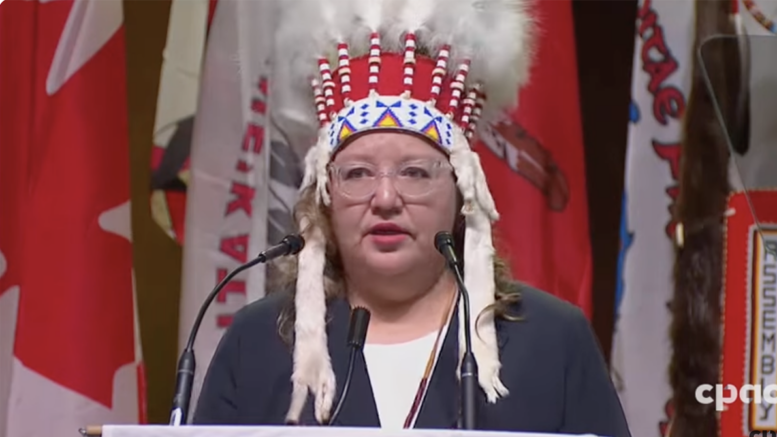 AFN National Chief Cindy Woodhouse Nepinak.
By Jeremy Appel, Local Journalism Initiative Reporter
(ANNews) – The national advocacy organization for Treaty First Nations has joined the chorus of First Nations telling Alberta premier Danielle Smith that a referendum on Alberta independence would be illegitimate without consulting the land’s original inhabitants.
“Any proposed separation of Alberta from Canada would be fundamentally illegitimate and unconstitutional without the explicit, prior, informed and collective consent of the First Nations whose lands and rights predate the formation of the province and of Canada,” Assembly of First Nations (AFN) National Chief Woodhouse Nepinak said in a May 12 news release.
“The time has come for Alberta and Canada to move beyond colonial frameworks and honour the truth of their history by restoring justice and self-determination to First Nations.”
On May 5, Smith announced that she will chair a panel that will develop proposed policies to increase Alberta’s economic independence from Ottawa, which she promised will be put to a referendum next year.
She added that she has no intention of initiating an independence referendum, but that if a group of citizens get the required number of signatures, it will also be on the ballot in 2026.
A week earlier, Justice Minister Mickey Amery introduced legislation that will lower the number of signatures required for a citizen-initiated referendum, in addition to extending the amount of time organizers have to collect the signatures.
In response to these gestures, the AFN is asking the federal government to review the Natural Resources Transfer Agreement (NRTA)—a nearly century-old arrangement that transferred possession of Crown lands and natural resources to Alberta, Saskatchewan and Manitoba without First Nations’ consent.
Woodhouse Nepinak emphasized that the NRTA violates the Treaties the federal government signed with First Nations in the three Prairie provinces, as well as sec. 35 of the Canadian Charter of Rights and Freedoms, which upholds “existing aboriginal and treaty rights of the aboriginal peoples of Canada,” including First Nations, Métis and Inuit Peoples.
“The numbered Treaties, including 6, 7 and 8, did not surrender First Nations title to natural resources,” the national chief added.
“On the contrary, these agreements recognize the inherent rights of First Nations to manage and benefit from lands and waters within their territories. Unilateral imposition of the NRTA undermines the solemn promises of these treaties and stands in direct conflict with the Honour of the Crown.”
The chiefs of Treaty 8 First Nations of Alberta left the AFN in 2022, opting to advocate for their Treaty rights directly with the federal government.
On April 30, Chief Sheldon Sunshine of Sturgeon Lake Cree Nation in Treaty 6 and Chief Billy-Joe Tuccaro of Mikisew Cree Nation in Treaty 8 co-wrote a cease-and-desist letter to Smith calling on her to stop making “separatist threats.”
“The province has no right to supersede or interfere with our Treaties, even indirectly by passing the buck to a ‘citizen’ referendum,” wrote chiefs Sunshine and Tuccaro.
The chiefs wrote an additional letter to Prime Minister Mark Carney asking him to “get the province of Alberta in line.”
Chiefs from Treaty 6, 7 and 8 First Nations in Alberta held a joint May 6 emergency meeting in Edmonton to discuss a unified response to Smith stoking the fires of separatism.
At the meeting, Chief Ouray Crowfoot of Siksika First Nation in Treaty 7 said that the premier’s “rhetoric is not just an attack on First Nations, it is an attack on the people who call Alberta home.”
“You only have to look south of the border, at the chaos and uncertainty that is going on in the world. This time, more than any time, we should be bonding together and talking about how we are going to unite as a nation versus separation as a province,” said Chief Crowfoot.
Speaking at a May 1 meeting with the Assembly of Manitoba Chiefs, AFN National Chief Woodhouse Nepinak noted that this isn’t the first time First Nations leaders have had to assert their rights in the face of separatist threats, referring to Quebec’s 1995 succession referendum, which narrowly failed.
“You can’t do it. All of Canada is Treaty territory,” she said. “First Nations were here first. We welcomed people to our shores. We welcomed people with open arms.”
“But at the same time, if people aren’t happy in this beautiful country that we’re building together, then you’re free to go and live wherever you want,” Woodhouse Nepinak added to applause from the Manitoba chiefs.
“You can take the dirt that maybe your ancestors brought with them when they came over here from other places. That’s the only piece of land that you’re going to take. You’re not going to take any Treaty land.”

No comments:
Post a Comment