US senators meet with Iraqi, Kurdistan leaders
RudawMAY24, 2025

Kurdistan Region President Nechirvan Barzani (Right) and Angus King United States Senator (Left) during a meeting on May 24, 2025. Photo: Presidency
ERBIL, Kurdistan Region - Two United States senators met separately with Kurdistan Region President Nechirvan Barzani and Iraqi Prime Minister Mohammed Shia al-Sudani on Saturday.
“President Nechirvan Barzani welcomed Mr. Angus King, an Independent Senator from Maine, along with Mr. James Lankford, a Republican Senator from Oklahoma, and their accompanying delegation,” a statement from the Kurdistan Region Presidency said.
Counterterrorism cooperation and Erbil-Baghdad relations were discussed, as well as the situation in Syria and broader regional developments.
“The potential for US job creation and investment opportunities in both Iraq and the Kurdistan Region” was also discussed, the statement added.
The visit came on the heels of two major energy contracts signed this week between the Kurdistan Regional Government (KRG) and US-based HKN Energy and WesternZagros, valued at a combined $110 billion in their lifetimes. They were signed in the presence of Kurdistan Region Prime Minister Masrour Barzani who was on a trip to Washington where he met with several American officials, including Secretary of State Marco Rubio.
Baghdad has rejected the energy contracts as illegal and the Iraqi oil ministry said that all partnerships must go through the federal government. PM Barzani called on the Iraqi government to reconsider its opposition, arguing the agreements will benefit all of Iraq.
In his meeting with the American senators in Baghdad, Iraqi PM Sudani “emphasized the importance of bilateral relations with the United States and Iraq’s aspiration to further develop and strengthen them across various fields - particularly in the sectors of economy, energy, investment, and culture - within the Iraq-US Strategic Framework Agreement,” said a statement from his office, referring to the broad agreement that guides US-Iraq relations.
Sudani said that the government has made major strides in the oil and gas sector, paving the way for increased cooperation and investment from US companies.
Rudaw
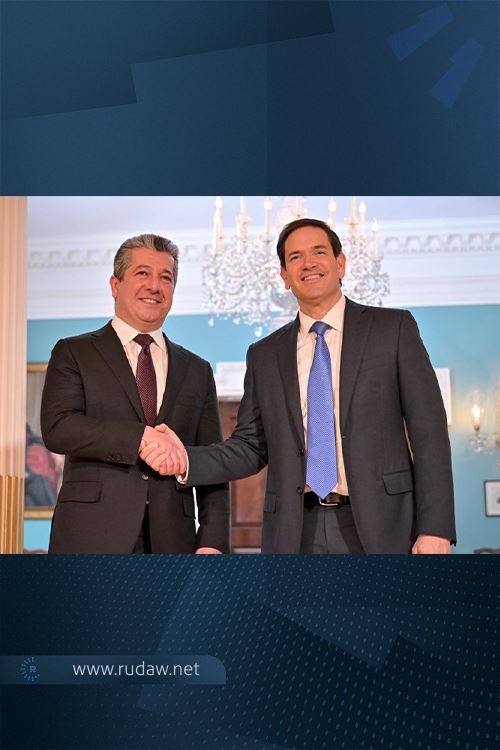
Kurdistan Region Prime Minister Masrour Barzani (left) and US Secretary of State Marco Rubio (right) meet in Washington on May 23, 2025. Photo: KRG
ERBIL, Kurdistan Region - The United States is committed to a “strong and resilient” Kurdistan Region that is key for regional stability, Secretary of State Marco Rubio said on Saturday, after meeting Prime Minister Masrour Barzani.
“Met with Iraqi Kurdistan Regional Government Prime Minister Masrour Barzani and reaffirmed U.S. support for a strong and resilient Iraqi Kurdistan Region that is critical to the stability of Iraq and the broader region,” Rubio said on X.
During the meeting, Rubio and Barzani discussed avenues to broaden trade and investment between Washington and Erbil, according to State Department spokesperson Tammy Bruce.
“The Secretary commended the Prime Minister for finalizing deals with US companies to expand natural gas production in the IKR [Iraqi Kurdistan Region], which will help Iraq move toward energy independence,” Bruce said in a statement on Friday.
Barzani arrived in Washington last week for meetings with President Donald Trump’s cabinet and American congressmen. He described his trip as boosting the Kurdistan Region’s “deep partnership” with the US.
While in the US, Barzani oversaw the signing of two major energy agreements with US-based companies HKN Energy and WesternZagros valued at a combined $110 billion over their lifespan.
Baghdad has rejected these deals as illegal. The Iraqi oil ministry said that all partnerships must go through the federal government.
Barzani has called on the Iraqi government to reconsider this stance. “I hope that they think about the interest of the Iraqi people. The more they show softness, the more they will see that the efforts we make are to the benefit of all Iraq,” Barzani told Rudaw.
The Kurdish prime minister also defended the new energy deals in an interview with Fox News on Saturday.
“We have the constitution that clearly states what rights the Kurdistan Region has. Kurdistan does have the right to sign deals, especially on the development of the gas and energy sector. We have signed deals in the past, and these two companies have been operating in Kurdistan for the past 15 years,” Barzani said.
He also praised the US as being “instrumental” to the Kurdistan Region, especially in the fight against the Islamic State (ISIS). “We are very grateful for what the US has done, and we hope that the US will continue to see us as partners,” Barzani said.
Washington and Erbil enjoy strong ties. The US has been one of the primary backers of the Kurdistan Region since it secured autonomy in the 1990s and has played an instrumental role in the development of the Kurdish Peshmerga forces, especially as the head of a global coalition against ISIS. It is also the primary backer of Peshmerga reforms.
The US is also set to soon open a new consulate general in Erbil that will be the world’s largest.
Iraq Says Direct U.S.-Kurdistan Oil Deals Violate Constitution

While the federal government of Iraq welcomes cooperation with U.S. energy firms, Baghdad noted on Friday that direct deals with the semi-autonomous Kurdistan region violate the Iraqi constitution and need to go through the federal authorities with federal approval.
Earlier this week, the Kurdistan Regional Government (KRG) in northern Iraq formalized two major energy agreements with U.S. firms HKN Energy and WesternZagros in Washington, D.C.
“These agreements lay a robust foundation for the strategic development of the Topkhana energy block in Garmian—an asset with significant commercial potential. This initiative is designed to strengthen energy security while generating attractive returns for stakeholders and driving economic growth throughout the region,” KRG said.
The combined Topkhana-Kurdamir block holds an estimated 5 trillion standard cubic feet of natural gas and 900 million barrels of recoverable crude oil, Kurdistan says.
The U.S. State Department welcomed the deals, saying that “These types of partnerships will strengthen gas production in Iraq and benefit both of our peoples.”
The agreements are valued at a combined $110 billion, despite a legal showdown with the federal government of Iraq over control of the country’s oil exports.
The recent signing of these substantial energy agreements between the KRG and American companies raises questions about the legal and political implications, given the ongoing disputes between Baghdad and Erbil over oil control.
However, Iraq’s Oil Ministry on Friday said that the deals should go through the federal government.
“The Ministry has no objection or reservation regarding engagement with these companies, provided that such engagement is not conducted directly with the Kurdistan Regional Government in isolation from the Federal Government and its official channels, as this would constitute a violation of the Iraqi Constitution and the applicable law,” the Iraqi oil ministry’s statement said on Friday.
“The oil ministry’s statement is a clear message directed at US companies, alerting them to respect Iraq’s valid laws,” an official at the oil ministry told Middle East Online on Friday.
By Charles Kennedy for Oilprice.com
KRG announces major agreements with US companies to boost gas production
19-05-2025
Rudaw
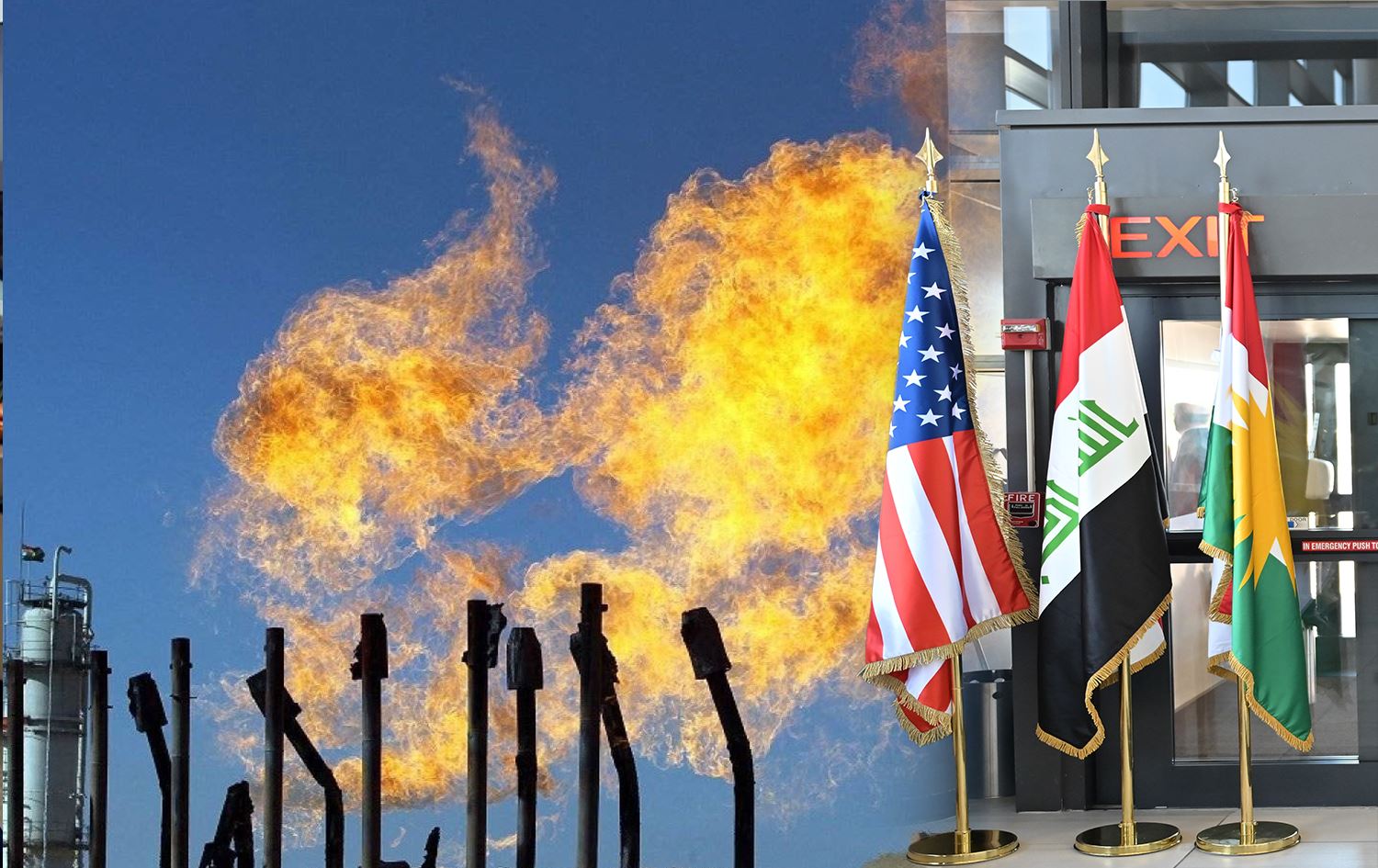
An oil field in Kurdistan Region (left) and flags of Iraq, Kurdistan and US.
ERBIL, Kurdistan Region - The Kurdistan Regional Government (KRG) is set to sign two major contracts with American companies in a bid to increase natural gas production, announced the Kurdish natural resources minister on Monday.
A KRG delegation, led by Prime Minister Masrour Barzani, arrived in Washington on Saturday to "bolster political, economic and military ties with the American government and companies," Kamal Mohammed, acting natural resources minister, told reporters on Monday.
"During this trip, two contracts about oil and gas industries will be signed. The first agreement is about gas with the Miran Energy company, which consists of two companies, the US HKN [Energy] company and ONEX [Group], which work in the oil sector," the minister added.
The HKN Energy and ONEX Group announced in a joint statement on Sunday "the signing of a binding term sheet with the Kurdistan Regional Government (KRG) for the development of the Miran Gas Field through their newly formed joint venture, Miran Energy."
Russell Freeman, CEO of HKN Energy, was cited in the statement as saying that the agreement marks "a significant milestone not only for our companies, but for the energy future of the Region." He described the project as "one of the region’s most
strategic gas resources.”
The project will be carried out in stages, with gas production initially focused on meeting domestic needs, while also supporting regional energy demands and fostering long-term economic growth. The substantial reserves at Miran will play a crucial role in enhancing the region's energy security over time, said both companies.
“The aim of the contracts is to use the gas field and add it to the Region’s gas infrastructure in order to provide electricity for the Region. Part of the electricity grid used to be provided to Iraq. Therefore, we can say both the Region and Iraq will benefit from the gas," Mohammed noted.
Research estimates that the Miran Gas Field may contain up to 8 trillion standard cubic feet (scf) of recoverable natural gas. In the initial phase, which will span 18 to 20 months, production is expected to reach between 50 to 70 million scf. Following this, production will be scaled up, according to the minister.
Another contract is with WesternZagros. The combined Topkhana-Kurdamir block will be given to the American company to produce oil and gas.
Both contracts are production sharing contracts and the KRG has not consulted the Federal Government before reaching an agreement, but it is in the interest of all Iraq, Mohammed explained.
The development coincides with the Kurdistan Region's efforts to establish a 24-hour electricity project, utilizing locally produced gas. Meanwhile, Iraq faces challenges in securing reliable power sources, with its grid largely dependent on imports from neighboring countries and the Kurdish region.
No comments:
Post a Comment