Kashmir
The Guardian view on India and Pakistan: a newly dangerous moment in an old dispute
Editorial
Both sides believe they are treading carefully, but without intercession the military clash following the murder of Hindu tourists in Kashmir could escalate
Wed 7 May 2025
The familiarity of military confrontation between India and Pakistan is no cause for reassurance: this is the worst violence in years. Though neither wants full-blown conflict, the dispute over Kashmir has produced three wars and multiple crises over eight decades. When two nuclear-armed neighbours clash, we should worry.
One reason is that errors and misjudgments are always possible. Following its overnight strikes on Pakistan, which it accuses of involvement in the massacre of Hindu tourists in Indian-administered Kashmir last month, India said that it hit only terrorist infrastructure and that its actions were “not escalatory”. This is not a judgment that can be made unilaterally. Pakistan said India was “igniting an inferno” and that its military is authorised to take corresponding actions.
The second cause for concern is the shifting context of the hostility. In India, Narendra Modi’s success is built on his identity as a Hindu nationalist strongman. He is also under intense pressure because he had declared unequivocally that Kashmir had returned to normalcy and would be not only “terror-free but [also] a heaven for tourists”.
In Pakistan, where the military pulls the strings, the parlous state of the economy is only one cause of the generals’ unpopularity. Last month, the army chief, Asim Munir, stirred controversy by calling Kashmir Pakistan’s “jugular vein” – a loaded phrase echoing the description of its founder, Muhammad Ali Jinnah. That rhetoric angered India even before the Kashmir attack that came five days later.
The massacre was claimed by the Resistance Front, regarded by India as a proxy of the Pakistan-based Lashkar-e-Taiba. Islamabad denies any link, but the military’s connections with militant groups are opaque. India is becoming increasingly blunt about attributing blame.
In the past, the US has pushed the two sides to de-escalate. But the Trump administration has little attention to spare and less diplomatic capacity. It does not have an ambassador in New Delhi. Its relations with Pakistan are at a low. Europe is preoccupied by Ukraine, security and US tariffs. Beijing should press Pakistan to keep a cool head.
Pakistan’s response to the strikes may soon be clearer. In the last crisis, in 2019, the two sides quietly stepped back from the brink. India can say it has struck; Pakistan says that it downed Indian jets (Indian officials have reportedly confirmed losing aircraft). Such an outcome would be a relief for civilians along the line of control – the de facto border – who are once more paying for decisions made far away as heavy artillery fire continues. But it might be only a temporary reprieve, and not for all. India’s announcement that it was suspending the Indus waters treaty – which might ultimately allow it to turn off the tap – is less dramatic than firing missiles, but could prove devastating for farmers in Pakistan.
Last year, Mr Modi promised to restore the special status of Jammu and Kashmir, which his government wrongly demoted to centrally administered territories six years ago. He should do so. That decision, and the lockdown that followed, have fuelled anger and militancy. Pressure should be maintained on the Pakistani military over its dangerous accommodation of militants.
The scholar Sumit Ganguly notes in his book Deadly Impasse that the two nations have often shown striking strategic restraint, but also that the dispute remains “remarkably durable”. It would be complacent to count on calibration.
Modi’s deadly bombing strike on Pakistan goes to the heart of India’s great dilemma
Chietigj Bajpaee

A military attack on the same day as a trade deal with the UK reveals a nation keen to strut the world stage, but hampered by regional enmity and history
Wed 7 May 2025
Concluding a “landmark” trade agreement with the UK and launching military operations against Pakistan on the same day: it is fair to say that, for India, the future and the past have collided this week. The agreement with Britain, which has been three years in the making, is one of several India is negotiating, including with the US and EU. It illustrates its appeal as a rising global power – the world’s most populous country and its fastest-growing major economy, which is also the fifth (and on course to be third) largest overall. In contrast, the military operations targeting Pakistan and Pakistan-administered Kashmir demonstrate how India continues to be bogged down by instabilities in its neighbourhood and held hostage to its history.
India’s military actions are in response to a terrorist attack last month in which 26 tourists were killed in Indian-administered Kashmir. The name of the military operation – Sindoor – refers to a symbol of marriage, alluding to the women who lost their husbands in the attack that selectively targeted Hindu men. New Delhi says it is trying to ensure the conflict remains limited between the nuclear-armed neighbours. It says its operations have targeted terrorist infrastructure rather than military facilities, although civilian casualties have been reported, and referred to its military action as a “precision strike” that has been “focused, measured and non-escalatory in nature”.
Whether it remains “non-escalatory” will depend on Pakistan’s response. The situation remains precarious amid the risk of accidental escalation, limited external pressure and both sides adopting an assertive military posture to appease their domestic political constituencies and hyper-nationalist foreign policies. In the past, the US played a prominent role in de-escalating tensions. But President Donald Trump nonchalantly referred to the current hostilities as a “a shame”, while stating earlier that both countries would sort it out in “one way or another”. In a world where the US sees international relations through the prism of “spheres of influence” – as reflected in Trump’s claims to Canada, Greenland and the Panama canal, while seeing the Russian invasion of Ukraine as Europe’s problem – there is clearly a limited appetite for Washington to get involved in South Asian geopolitics.
India and Pakistan have fought three wars since they were established in 1947, two of them over Kashmir. The territory is vital to Pakistan’s security, with about 80% of the country’s cultivated land dependent on water from the Indus water system that traverses Kashmir – that’s why the recent decision by India to hold a longstanding water agreement in abeyance is seen as an existential threat to Pakistan. A week before the terrorist attack, Pakistan’s army chief, Asim Munir, referred to Kashmir as Pakistan’s “jugular vein”. Reports of critical mineral deposits in Kashmir have also elevated the strategic importance of the territory to India.
However, at the heart of the tensions is the question of identity rooted in the scars of partition in 1947 that created the countries of India and Pakistan. The Pakistani state – and in particular the military and intelligence establishment – has derived legitimacy from maintaining a well-entrenched anti-India identity. The real source of authority in Pakistan is not the prime minister (Shehbaz Sharif) or the president (Asif Ali Zardari), but rather Munir and the head of the country’s intelligence service, the ISI (Muhammad Asim Malik). No civilian prime minister has completed a full term in the country’s 77-year history. If India-Pakistan relations were on good terms, there would be little justification for the military to have such a dominant role in Pakistani politics and the economy.
On India’s part, the decision by the government of Narendra Modi to rescind the special autonomous status of Kashmir in 2019 , and divide the state into two territories that were directly ruled by New Delhi, fuelled tensions with Islamabad. New Delhi claims that doing this normalised Kashmir’s status, pointing to an increase in tourism and investment inflows and largely peaceful elections in the territory last year. However, last month’s terrorist attack and India and Pakistan’s tit-for-tat military responses show that Kashmir is far from normal. Moreover, local grievances remain as Kashmiri autonomy and identity have gradually been eroded in both Indian and Pakistan-administered Kashmir.
These tensions are unlikely to subside anytime soon. Much like the Israel-Palestine conflict or tensions across the Taiwan Strait and the Russian invasion of Ukraine, they are rooted in longstanding historical faultlines and questions of national identity. Ultimately, India’s global aspirations remain held hostage to regional instabilities.
Dr Chietigj Bajpaee is senior fellow for south Asia at the thinktank Chatham House
Pakistan and India trade accusations of drone attacks as conflict escalates
Pakistani military official accuses Delhi of ‘another blatant act of aggression’ a day after Indian strikes killed dozens
Shah Meer Baloch in Islamabad
Thu 8 May 2025
Pakistan and India accused each other of overnight drone and missile attacks, with Delhi claiming to have thwarted strikes on more than a dozen cities and Islamabad claiming to have shot down 25 Indian drones.
The allegations levelled on both sides marked a stark escalation of the conflict between the two nuclear-armed nations, after Indian missile strikes on Pakistan in the early hours of Wednesday killed 31 people.
India said the strikes were a direct retaliation for an attack in Indian-administered Kashmir late last month, in which militants killed 25 Hindu tourists and their guide. India had accused Pakistan of direct involvement in the attacks, through Islamist militant organisations it has long been accused of backing.
Pakistan’s military spokesperson Gen Ahmed Sharif Chaudhry said at a press conference that India had “apparently lost the plot” as he accused it of “yet another blatant military act of aggression” in sending more than a dozen drones overnight over major cities including Rawalpindi, where Pakistan’s military has its headquarters.
He said Pakistan’s air defence systems had brought down more than a dozen drones, and a confrontation with another airborne Indian device had left four Pakistani soldiers injured. He said a civilian in the Miano area of Sindh, which borders India, died in an incident involving a drone, but he did not give further details.
Chaudhry said Pakistan considered the drones to be a “serious provocation” by India and said drone debris was being collected by the armed forces and police.
“This naked aggression continues and the armed forces are on high degree of alert and neutralising them as we speak,” he said.
India alleged that Pakistan had attempted to launch drones and missiles at a number of military targets in its north and west, including in the cities of Amritsar, Srinagar and Chandigarh. It said its air defence systems stopped all the attacks.
Pakistan and India accused each other of overnight drone and missile attacks, with Delhi claiming to have thwarted strikes on more than a dozen cities and Islamabad claiming to have shot down 25 Indian drones.
The allegations levelled on both sides marked a stark escalation of the conflict between the two nuclear-armed nations, after Indian missile strikes on Pakistan in the early hours of Wednesday killed 31 people.
India said the strikes were a direct retaliation for an attack in Indian-administered Kashmir late last month, in which militants killed 25 Hindu tourists and their guide. India had accused Pakistan of direct involvement in the attacks, through Islamist militant organisations it has long been accused of backing.
Pakistan’s military spokesperson Gen Ahmed Sharif Chaudhry said at a press conference that India had “apparently lost the plot” as he accused it of “yet another blatant military act of aggression” in sending more than a dozen drones overnight over major cities including Rawalpindi, where Pakistan’s military has its headquarters.
He said Pakistan’s air defence systems had brought down more than a dozen drones, and a confrontation with another airborne Indian device had left four Pakistani soldiers injured. He said a civilian in the Miano area of Sindh, which borders India, died in an incident involving a drone, but he did not give further details.
Chaudhry said Pakistan considered the drones to be a “serious provocation” by India and said drone debris was being collected by the armed forces and police.
“This naked aggression continues and the armed forces are on high degree of alert and neutralising them as we speak,” he said.
India alleged that Pakistan had attempted to launch drones and missiles at a number of military targets in its north and west, including in the cities of Amritsar, Srinagar and Chandigarh. It said its air defence systems stopped all the attacks.
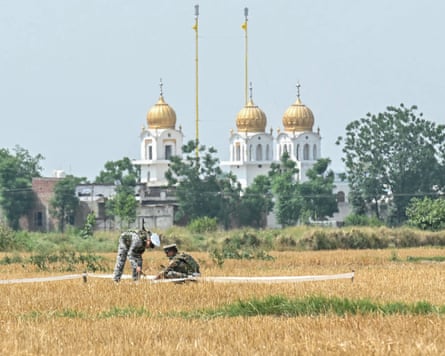
Indian soldiers inspect the debris of a missile in a field on the outskirts of Amritsar on Thursday. Photograph: Narinder Nanu/AFP/Getty Images
India’s defence ministry said it had “neutralised” the air defence system over the Pakistani city of Lahore and said: “Any attack on military targets in India will invite a suitable response.”
India’s foreign minister, Subrahmanyam Jaishankar, warned on Thursday that India would respond to any military aggression by Pakistan. “If there are military attacks on us, there should be no doubt that it will be met with a very, very firm response,” he told a visiting Iranian delegation.
Speaking to the Guardian, a senior Pakistani security official denied India’s claims of any Pakistani attack on military installations in India.
“The damage to Lahore’s system is minor, more like a scratch, it is still functioning,” he said. “We have shot down at least 25 Indian drones across bordering regions in Punjab and Sindh provinces.”
The security official said Pakistan had not yet begun its offensive retaliation against India for the missile and drone attacks, but was clear that action would now be taken.
“We have not fired any missiles or drone attacks inside India or any military installations,” he said. “This is fake news from Indian authorities. The offensive response will come now.”
Amid reports of drone attacks in Lahore, the US embassy in Pakistan issued a warning to its consulate staff: “Due to reports of drone explosions, downed drones, and possible airspace incursions in and near Lahore, the US consulate general in Lahore has directed all consulate personnel to shelter in place.”
India’s strikes on Wednesday were the most extensive military attack on Pakistan in decades, with nine locations targeted, including four in Pakistan’s Punjab region.
In a speech late on Wednesday night, Pakistan’s prime minister, Shehbaz Sharif, said he would “avenge each and every drop of blood of our martyrs”.
India’s defence ministry said it had “neutralised” the air defence system over the Pakistani city of Lahore and said: “Any attack on military targets in India will invite a suitable response.”
India’s foreign minister, Subrahmanyam Jaishankar, warned on Thursday that India would respond to any military aggression by Pakistan. “If there are military attacks on us, there should be no doubt that it will be met with a very, very firm response,” he told a visiting Iranian delegation.
Speaking to the Guardian, a senior Pakistani security official denied India’s claims of any Pakistani attack on military installations in India.
“The damage to Lahore’s system is minor, more like a scratch, it is still functioning,” he said. “We have shot down at least 25 Indian drones across bordering regions in Punjab and Sindh provinces.”
The security official said Pakistan had not yet begun its offensive retaliation against India for the missile and drone attacks, but was clear that action would now be taken.
“We have not fired any missiles or drone attacks inside India or any military installations,” he said. “This is fake news from Indian authorities. The offensive response will come now.”
Amid reports of drone attacks in Lahore, the US embassy in Pakistan issued a warning to its consulate staff: “Due to reports of drone explosions, downed drones, and possible airspace incursions in and near Lahore, the US consulate general in Lahore has directed all consulate personnel to shelter in place.”
India’s strikes on Wednesday were the most extensive military attack on Pakistan in decades, with nine locations targeted, including four in Pakistan’s Punjab region.
In a speech late on Wednesday night, Pakistan’s prime minister, Shehbaz Sharif, said he would “avenge each and every drop of blood of our martyrs”.
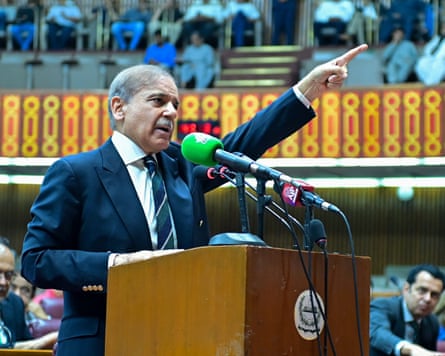
Pakistan’s prime minister, Shehbaz Sharif, addressing a special session at the National Assembly in Islamabad on Wednesday. Photograph: Pakistan’s prime minister office/AFP/Getty Images
Across both countries, flights were suspended and airports shut down. In Pakistan, all flights from Karachi, Lahore and Sialkot airports were suspended until Thursday night. More than 20 local airports across the north of India were closed until Saturday.
In Pakistan’s Sindh region, which shares a border with India, a state of emergency was declared in all hospitals and health facilities, and all medical personnel and support staff leave was cancelled, according to a notice issued by the provincial health department.
In Amritsar, 20 miles from the Pakistan border, a second security drill and brief blackout were carried out on Wednesday evening, and residents were urged to stay alert.
India’s border states of Rajasthan and Punjab were also put on high alert, with all police leave cancelled and border security forces given shoot-on-sight orders for any suspicious activities. India has activated anti-drone systems near the border.
Sharif called India’s attacks an “act of war”, and senior army officials and government ministers vowed Pakistan would respond. However, by Thursday morning the nature of that response remained unclear.
Some government ministers suggested Pakistan’s claim to have shot down five Indian military aircraft, including three elite French-made Rafale jets, during the confrontation on Wednesday was retribution, while others said Pakistan’s full response was yet to come.
India’s Pakistan strikes show how warfare has been normalised again
Read more
It is widely acknowledged that any decision over Pakistan’s military response to India will be made by the country’s army chief, Gen Asim Munir, who is under mounting public pressure to show strength against India.
Ministers in the Indian government said their attacks were retribution for Pakistan’s alleged involvement in a militant attack in the Indian region of Kashmir in April that killed 26 people. Pakistan has denied any role in that attack.
India claimed Wednesday’s strikes targeted “terrorist infrastructure” including training camps and homes belonging to well-known militant organisations that have been behind some of the worst terror attacks in India over the past two decades. They emphasised they had not hit any Pakistani military bases or equipment, and described the strikes as “measured, not escalatory, proportionate and responsible”.
However, Pakistan denied that any terror groups had been operating in the areas hit by Indian missiles, and said the strikes had targeted only civilians.
Along the contested border between India and Pakistan, which divides the disputed region of Kashmir, intensive cross-border shelling between the two sides continued into a second night. It was reported that at least one Indian soldier had been killed along with 11 civilians, and local people continued to be evacuated from the area.
International diplomatic efforts continued in an attempt to get the two sides to de-escalate. The Iranian foreign minister, Abbas Araghchi, landed in Delhi on Thursday morning, after earlier offering to play a mediating role between the two countries. The Saudi foreign minister also made a surprise trip to India on Thursday morning, where he met Jaishankar.
Across both countries, flights were suspended and airports shut down. In Pakistan, all flights from Karachi, Lahore and Sialkot airports were suspended until Thursday night. More than 20 local airports across the north of India were closed until Saturday.
In Pakistan’s Sindh region, which shares a border with India, a state of emergency was declared in all hospitals and health facilities, and all medical personnel and support staff leave was cancelled, according to a notice issued by the provincial health department.
In Amritsar, 20 miles from the Pakistan border, a second security drill and brief blackout were carried out on Wednesday evening, and residents were urged to stay alert.
India’s border states of Rajasthan and Punjab were also put on high alert, with all police leave cancelled and border security forces given shoot-on-sight orders for any suspicious activities. India has activated anti-drone systems near the border.
Sharif called India’s attacks an “act of war”, and senior army officials and government ministers vowed Pakistan would respond. However, by Thursday morning the nature of that response remained unclear.
Some government ministers suggested Pakistan’s claim to have shot down five Indian military aircraft, including three elite French-made Rafale jets, during the confrontation on Wednesday was retribution, while others said Pakistan’s full response was yet to come.
India’s Pakistan strikes show how warfare has been normalised again
Read more
It is widely acknowledged that any decision over Pakistan’s military response to India will be made by the country’s army chief, Gen Asim Munir, who is under mounting public pressure to show strength against India.
Ministers in the Indian government said their attacks were retribution for Pakistan’s alleged involvement in a militant attack in the Indian region of Kashmir in April that killed 26 people. Pakistan has denied any role in that attack.
India claimed Wednesday’s strikes targeted “terrorist infrastructure” including training camps and homes belonging to well-known militant organisations that have been behind some of the worst terror attacks in India over the past two decades. They emphasised they had not hit any Pakistani military bases or equipment, and described the strikes as “measured, not escalatory, proportionate and responsible”.
However, Pakistan denied that any terror groups had been operating in the areas hit by Indian missiles, and said the strikes had targeted only civilians.
Along the contested border between India and Pakistan, which divides the disputed region of Kashmir, intensive cross-border shelling between the two sides continued into a second night. It was reported that at least one Indian soldier had been killed along with 11 civilians, and local people continued to be evacuated from the area.
International diplomatic efforts continued in an attempt to get the two sides to de-escalate. The Iranian foreign minister, Abbas Araghchi, landed in Delhi on Thursday morning, after earlier offering to play a mediating role between the two countries. The Saudi foreign minister also made a surprise trip to India on Thursday morning, where he met Jaishankar.
No comments:
Post a Comment