Geneva (AFP) – A cascade of events in the Swiss Alps led to the dramatic collapse of the Birch glacier, wiping out Blatten village in the valley below, glaciologists and geoscientists told AFP on Friday.
Issued on: 30/05/2025 -

Experts knew days ahead of Wednesday's landslide that the glacier was likely to suffer a catastrophic failure. But the reasons why date back much further.
There are strong theories on the causes, and to what degree the disaster is linked to climate change -- but these are yet to be confirmed by scientific analysis.
"This can be considered as a cascading event, because we have different processes involved," explained Christophe Lambiel, senior lecturer at the University of Lausanne's Institute of Earth Surface Dynamics.
Mountain above the glacier
The 3,342-metre (10,965-foot) high Kleines Nesthorn mountain above the glacier was already somewhat unstable, and rockfalls accelerated dramatically around 10 days beforehand.
Experts feared a total collapse within hours, but instead there were successive rockfalls over several days, which was actually the best-case scenario.
Rockfall onto glacier
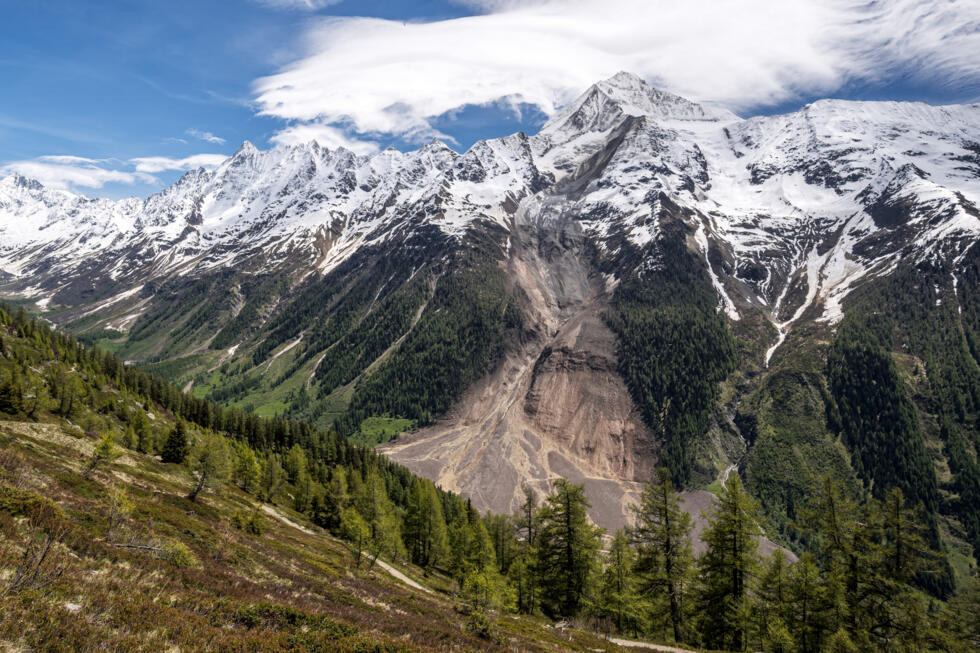
Three million cubic metres of rock were deposited on the glacier.
"If you put a lot of weight on an unstable foundation, it can just slip away. And this is what actually happened," Matthias Huss, the director of Glacier Monitoring Switzerland (GLAMOS), told AFP.
"The glacier accelerated strongly in response to this additional loading, and then the disaster struck."
The Birch glacier
The Birch glacier was a special case: the only Swiss glacier that was advancing rather than shrinking. However, this was not because of extra snowfall.
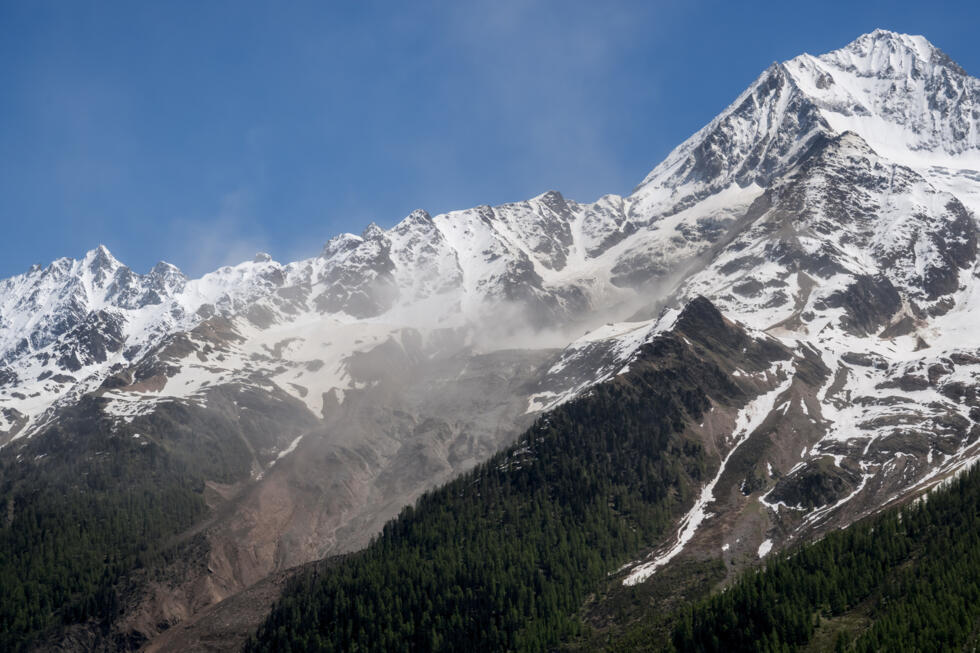
Its advance "was quite likely due to the pre-loading with rockfalls from this mountain, which has finally collapsed. So the landslide didn't start from nothing," said Huss.
The glacier was on a steep slope, and even steeper at the front, worsening the dynamics.
Smaller-scale falls from the front of the glacier Tuesday were expected to continue, with Wednesday's sudden total collapse considered a less-probable scenario.
How the glacier collapsed
The rockfalls altered the stress equation between the weight of the glacier and the slope, which governs its forward speed, Lambiel told AFP.
Like pushing a car, it takes a lot of force to initiate movement, but less once it is on the move, he explained.
Huss said the 1,000 metres of elevation between the glacier and the Lotschental valley floor added a "huge amount of potential energy", which through friction melts part of the ice, making the fall "much more dynamic than if it was just rock".
Role of melting permafrost
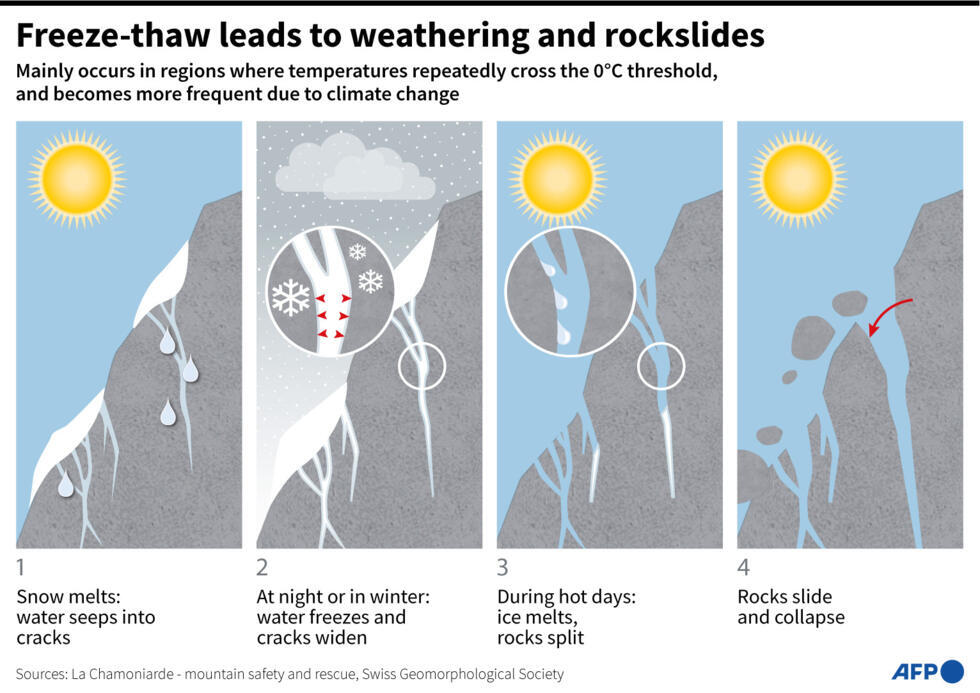
Permafrost conditions are degrading throughout the Alps. Ice inside the cracks in the rocks has been thawing to ever-deeper levels over the last decade, especially after the summer 2022 heatwave.
"Ice is considered as the cement of the mountains. Decreasing the quality of the cement decreases the stability of the mountain," said Lambiel.
Huss added: "At the moment, we can't say it's because of permafrost thaw that this mountain collapsed -- but it is at least a very probable explanation, or one factor, that has triggered or accelerated this process of the mountain falling apart."
Role of climate change
Jakob Steiner, a geoscientist at the University of Graz in Austria, told AFP: "There is no clear evidence as of yet, for this specific case, that this was caused by climate change."
Huss said making such a direct link was "complicated".
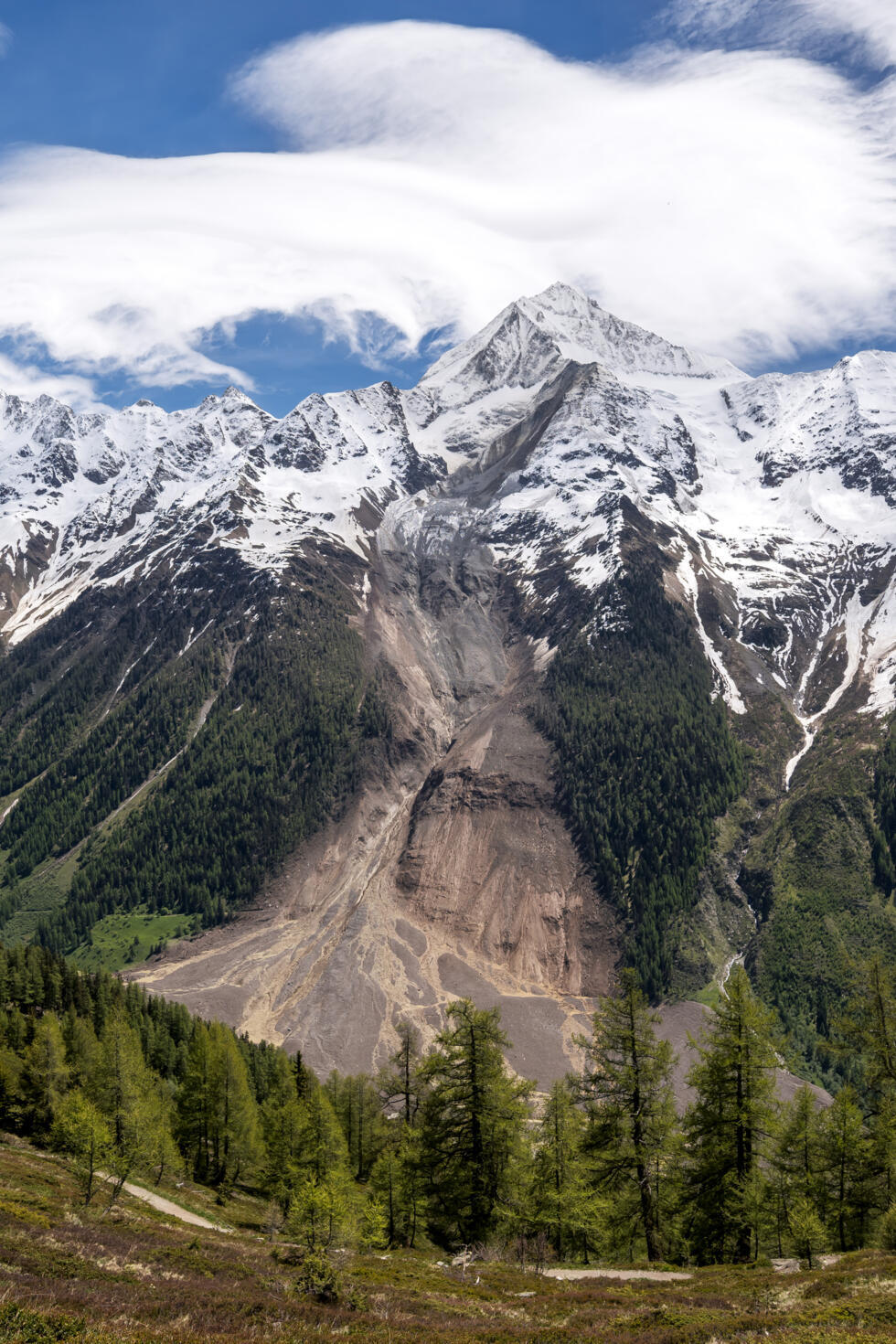
"If it was just because of climate change that this mountain collapsed, all mountains in the Alps could collapse -- and they don't," he said.
"It's a combination of the long-term changes in the geology of the mountain.
"The failing of the glacier as such -- this is not related to climate change. It's more the permafrost processes, which are very complex, long-term changes."
Lambiel said of a link between climate change and the glacier moving forward over time: "Honestly, we don't know.
"But the increasing rockfalls on the glacier during the last 10 years -- this can be linked with climate change."
Other glaciers
Modern monitoring techniques detect acceleration in the ice with high precision -- and therefore allow for early warning.
Lambiel said around 80 glaciers in the same region of Switzerland were considered dangerous, and under monitoring.
"The big challenge is to recognise where to direct the detailed monitoring," said Huss.
Lambiel said sites with glacier-permafrost interactions above 3,000 metres would now need more research. But they are difficult to reach and monitor.
Steiner said: "Probably the rapidly changing permafrost can play some kind of role.
"This is concerning because this means that mountains are becoming a lot more unstable."
rjm-burs/phz/jhb
© 2025 AFP
"What happened to Birch Glacier is what we would expect from rising temperatures in the Alps and elsewhere," one scientist said.
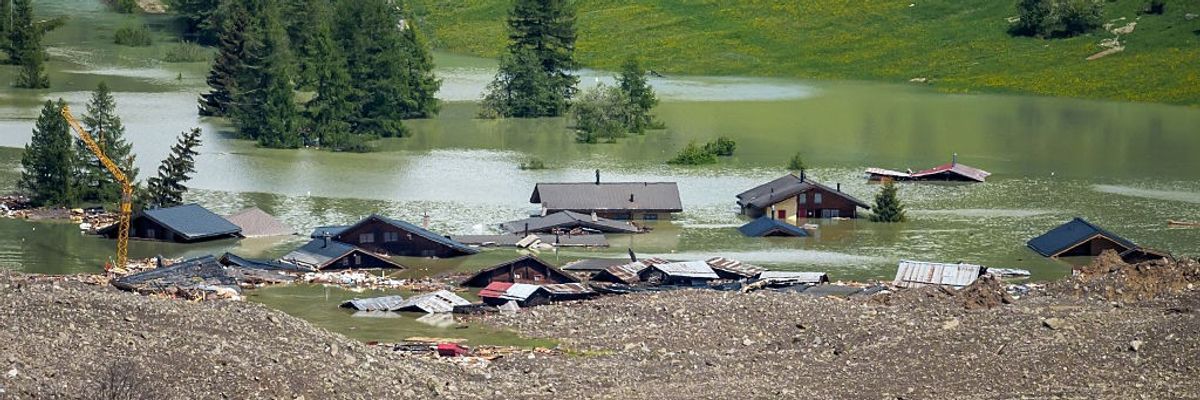
This May 29, 2025 aerial photograph shows the town of Blatten, in the Bietschhorn mountain of the Swiss Alps, destroyed by a landslide after part of the huge Birch Glacier collapsed and was swallowed up by the river Lonza the day before.
(Photo: Fabrice Coffrini/AFP via Getty Images)
Brett Wilkins
May 29, 2025
Thawing permafrost exacerbated by human-caused global heating is the likely culprit behind a massive glacier collapse that buried nearly the entire Swiss town of Blatten, one scientist said Thursday while warning of the likelihood of similar disasters in the future.
The alpine hamlet of 300 inhabitants—who were evacuated earlier amid warning signs of disaster—was almost completely wiped out on Wednesday after the Birch Glacier, located in the Lötschental Valley in northern Switzerland, collapsed. The glacial avalanche, laden with boulders and other debris, cascaded down the mountainside and into the village, obliterating everything in its path. Local officials said around 90% of Blatten was buried.
"We've lost our village," Blatten Mayor Matthias Bellwald told reporters. "The village is under rubble. We will rebuild."
While there are no verified casualties from the disaster, one 64-year-old man has been reported missing.
Mathieu Morlighem, a glaciologist at Dartmouth College in New Hampshire, toldABC News that permafrost thaw under and along the sidewalls surrounding the glacier likely caused the collapse.
"What happened to Birch Glacier is what we would expect from rising temperatures in the Alps and elsewhere," he explained. "I think we can expect more events like this in the future."
As ABC News reported:
Glaciers in Switzerland have lost almost 40% of their volume since 2000, and the loss is accelerating, according to the Swiss Federal Institute for Forest, Snow, and Landscape Research. Record-high summer temperatures in 2022 and 2023 caused a 10% glacial ice loss in the country.
Experts warn that Switzerland's glaciers could disappear completely by 2100 due to the climate emergency.
As Common Dreamsreported in March, the crisis is planetary and is predicted to adversely affect nearly 2 billion people who depend upon glaciers for agricultural irrigation and drinking water.
"Most of the world's glaciers, including those in mountains, are melting at an accelerated rate worldwide," a United Nations Educational, Scientific, and Cultural Organization report published earlier this year warned. "Combined with accelerating permafrost thaw, declining snow cover, and more erratic snowfall patterns... this will have significant and irreversible impacts on local, regional, and global hydrology, including water availability."
The Swiss collapse happened a day before Thursday's opening of the High-Level International Conference on Glaciers' Preservation in Tajikistan, which aims to "highlight the vital role of glaciers in maintaining global ecological balance and addressing water-related challenges."
By AFP
May 29, 2025

Swiss authorities say huge amounts of rock and ice from a glacier that collapsed in the Alps are hampering emergency services - Copyright AFP -
Fabrice Coffrini, with Christophe Vogt in Geneva
Swiss authorities said Thursday that rock and ice piles from a collapsed glacier that destroyed a village were preventing emergency services from working, but that they were cautiously optimistic no more homes were at risk.
The Birch glacier in Switzerland’s southern Valais (Wallis) region collapsed on Wednesday, sending a mass of rock, ice and scree hurtling down the mountain slope and into the valley below.
The barrage largely destroyed the most of Blatten, which had been home to 300 people and was evacuated last week due to the impending danger.
One 64-year-old man, believed to have been in the danger zone at the time, remains missing. A police spokesman said the difficult conditions had forced the search to be called off Thursday.
The unstable mountain face and thousands of tonnes of rocky debris also made it impossible for emergency workers to intervene to stabilise the zone and contain the risk of flooding in the valley below, officials told a news conference.
The huge pile of glacier debris, stretching some two kilometres (1.25 miles), has blocked the river Lonza.
After initially warning of a potentially devastating flood from water trapped above the debris, authorities said expert analysis indicated the risk had eased.
“The information we’ve received from geologists and other specialists tends to indicate such an event is unlikely,” Valais security chief Stephane Ganzer told a news conference.
An artificial dam in the village of Ferden, just below, has been emptied and should be able to contain any downward rush of water if it happens, said Ganzer.
However, he added: “It’s unlikely, but we don’t really like that word ‘unlikely’ here since yesterday, because we know that unlikely can become likely.”
– ‘Terrible catastrophe’ –
Authorities are studying evacuation plans and have warned residents who could be affected, Ganzer said.
“We have one person missing, we don’t want anyone else missing or deceased from this terrible catastrophe,” he said.
As a precaution, 16 more people were evacuated Wednesday from two villages located downstream from the disaster area in the Loetschental valley, known for scenic views and home to around 1,500 people living in villages.
Their views of the valley have definitively changed now.
Where the Birch glacier used to sit, there is now a gaping hole in the mountainside.
What is left of the village of Blatten is being submerged beneath the accumulating water of the Lonza river.
A sunny and warm weather forecast means “lots of snow” will melt in the coming days, meaning “we’re still facing colossal water levels” in the artificial lake that has formed, Ganzer said.
– Seismic event –
YouTube footage of the collapse showed a huge cloud of ice and rubble hurtling down the mountainside, into the valley and partially up the mountain slope on the other side.
The force was such that Swiss monitoring stations registered the phenomenon as a seismic event.
According to officials, three million cubic metres of rock fell suddenly onto the glacier, pushing it down into the valley.
Warming temperatures have shrunk the Alps’ glaciers and made them more unstable.
Swiss glaciers, severely impacted by climate change, melted as much in 2022 and 2023 as between 1960 and 1990, losing in total about 10 percent of their volume.
In August 2017, approximately 3.1 million cubic meters of rock fell from Pizzo Cengalo, a mountain in the Alps in Graubuenden canton, near the Italian border, killing eight hikers.
Some 500,000 cubic metres of rock and mud flowed as far as the town of Bondo, causing significant damage there but no casualties.
Falling debris forces suspension of search for missing man after landslide buries Swiss village
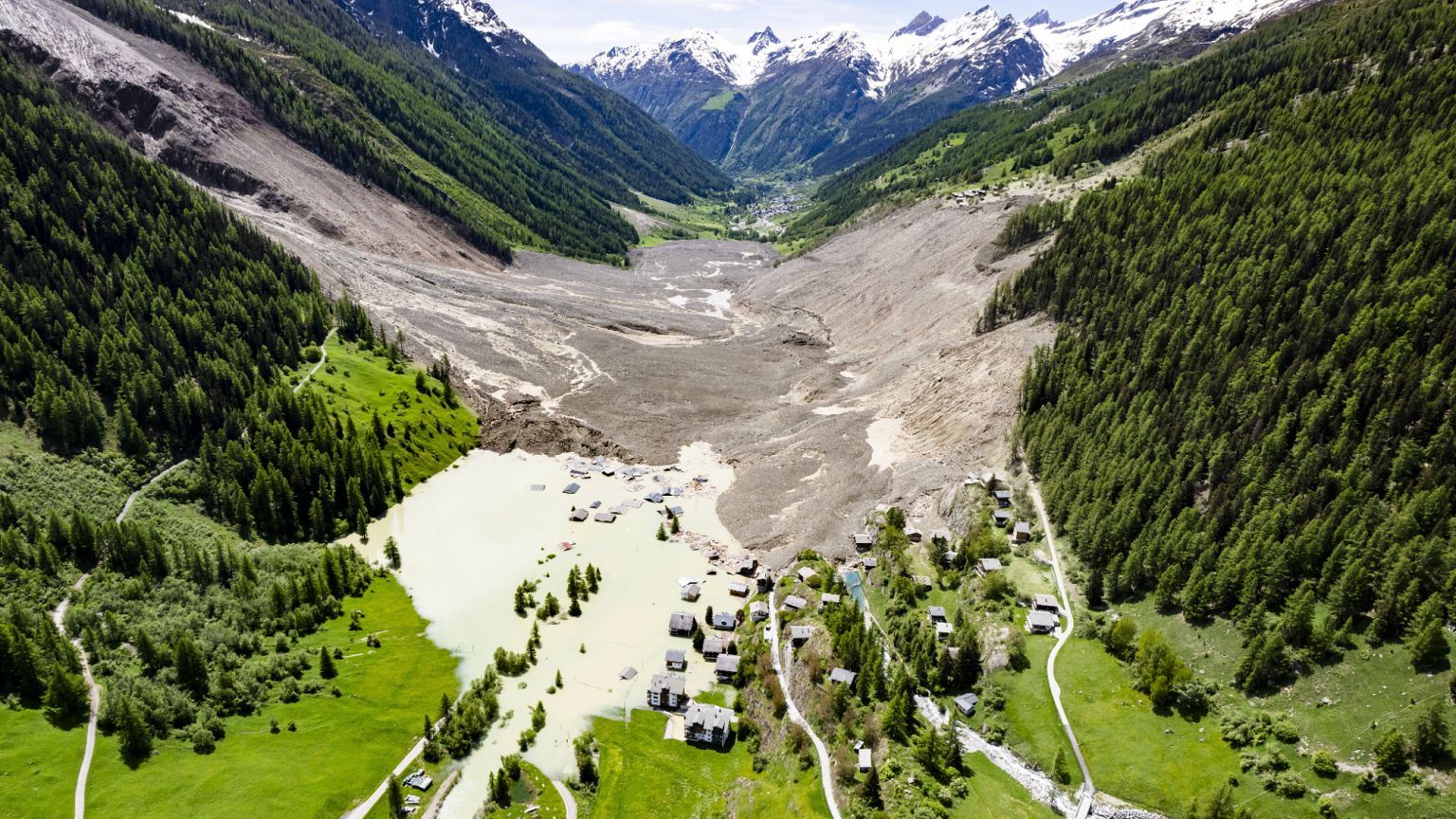
The regional government said that a large chunk of the Birch Glacier above Glatten had broken off, causing the landslide, which also buried the nearby Lonza River bed.
The search for a missing 64-year-old man has been suspended because of unsafe conditions after a huge mass of rock and ice from a glacier crashed down a mountainside in Switzerland, burying the village of Glatten.
The landslide sent plumes of dust skyward and coated with nearly all of the Alpine village with mud that authorities had evacuated earlier this month as a precaution.
State Councillor Stéphane Ganzer told Radio Télévision Suisse (RTS) that 90% of the village was destroyed.
The Cantonal Police of Valais said that a search and rescue operation was temporarily suspended later on Thursday afternoon because of falling debris.
The regional government said in a statement that a large chunk of the Birch Glacier above the village had broken off, causing the landslide, which also buried the nearby Lonza River bed, raising the possibility of dammed water flows.
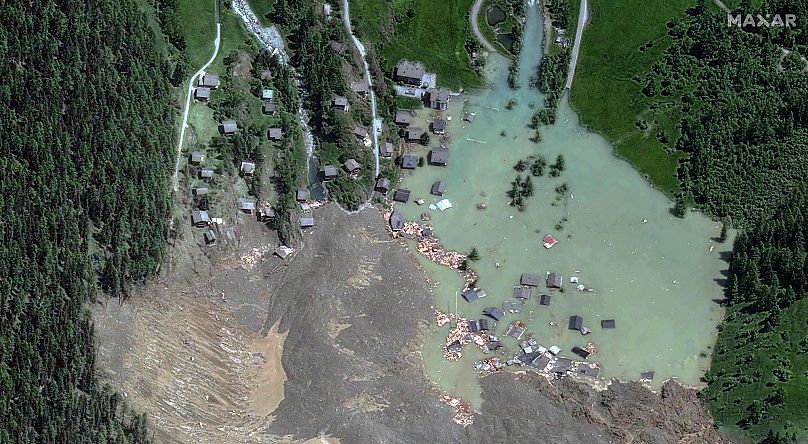
Video on social media and Swiss television showed that the mudslide near Blatten, in the southern Lötschental valley, partially submerged homes and other buildings under a mass of brownish sludge.
Swiss President Karin Keller-Sutter is expected to visit the area on Friday.
In recent days, authorities had ordered the evacuation of around 300 people, as well as all livestock, from the village amid fears that the 1.5 million-cubic metre glacier was at risk of collapse.
Swiss glaciologists have repeatedly expressed concerns about a thaw in recent years, attributed in large part to global warming, that has accelerated the retreat of glaciers in Switzerland.
The landlocked Alpine country has the most glaciers of any country in Europe and saw 4% of its total glacier volume disappear in 2023.
That was the second-biggest decline in a single year after a 6% drop in 2022.
No comments:
Post a Comment