(RNS) – ‘Our government implements affirmative action on the lines of that in the United States, designed not to discriminate against whites but to overcome the historic disadvantages Black South Africans have suffered,’ the Most Rev. Thabo Makgoba wrote.
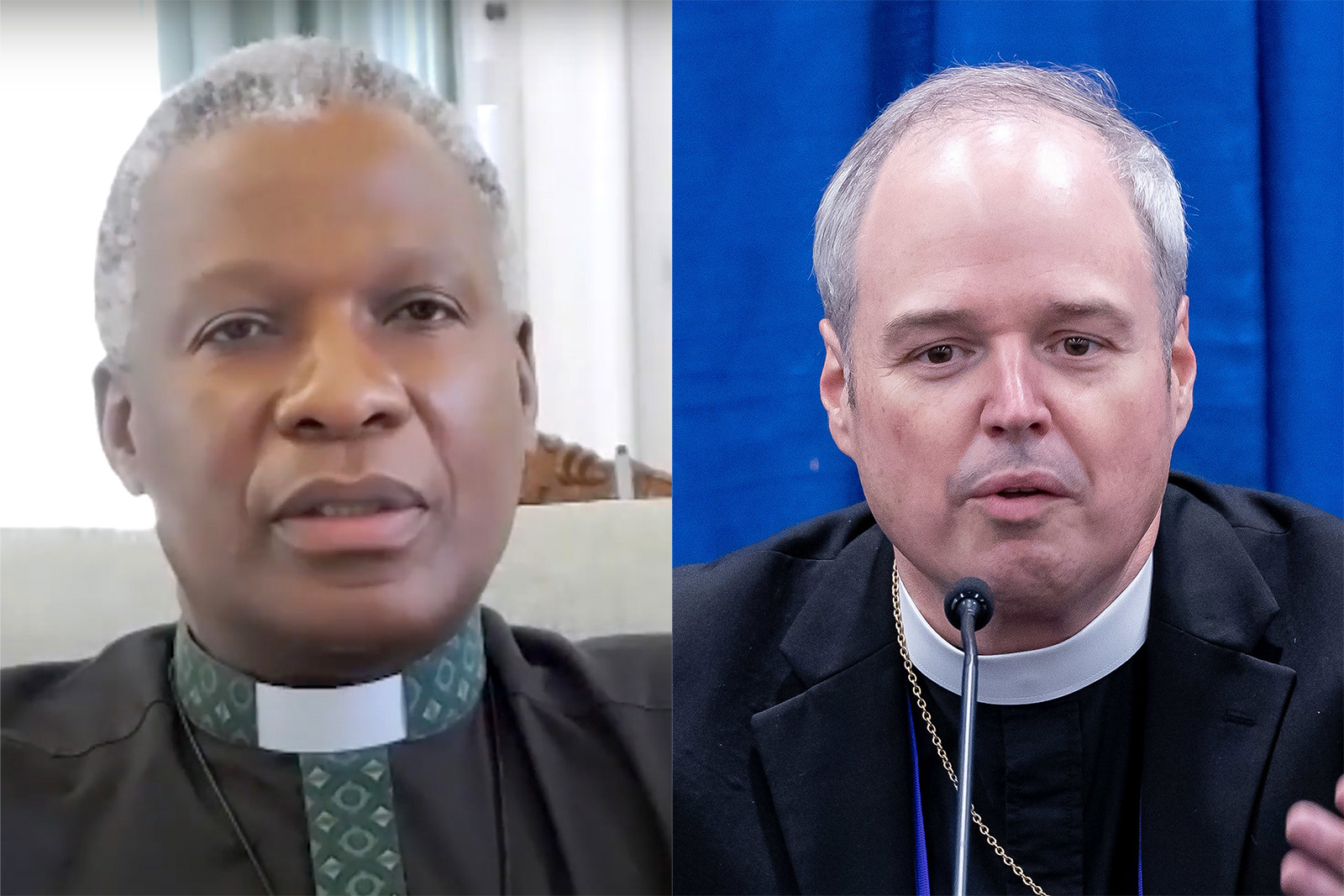
Archbishop of the Anglican Church of Southern Africa Thabo Makgoba in July 2024, left, and Episcopal Church Presiding Bishop Sean Rowe in June 2024.
(Left: screen grab. Right: photo by Randall Gornowich)
Jack Jenkins
May 15, 2025
(RNS) — The leader of Anglican churches in South Africa thanked the American head of the Episcopal Church for refusing to resettle white Afrikaners in the United States who have been deemed refugees by President Donald Trump’s administration, arguing the government’s justification for taking in members of the group is inaccurate.
In a letter sent to Episcopal Church Presiding Bishop Sean W. Rowe on Thursday (May 15), the Most Rev. Thabo Makgoba, archbishop of Cape Town and head of the Anglican Church of Southern Africa, lauded Rowe for announcing on Monday that his church would end its decades-long relationship with the U.S. government to resettle refugees. Rowe explained the decision was rooted in moral opposition to being asked to resettle white Afrikaners, especially as the U.S. refugee program has been mostly shut down since Trump took office in January.
In his message, Makgoba thanked Rowe for calling him ahead of the announcement and rejected the Trump administration’s arguments for accepting white Afrikaners, who the president has insisted are the target of genocide — a claim widely disputed by the South African government as well as faith leaders in the country.
“What the administration refers to as anti-white racial discrimination is nothing of the kind,” Makgoba’s letter read. “Our government implements affirmative action on the lines of that in the United States, designed not to discriminate against whites but to overcome the historic disadvantages Black South Africans have suffered.”
Makgoba argued white South Africans “remain the beneficiaries of apartheid” by “every measure of economic and social privilege,” noting that, despite the end of the apartheid regime, South Africa’s society remains deeply unequal.
“Measured by the Gini coefficient, which measures income disparity, we are the most unequal society in the world, with the majority of the poor Black, and the majority of the wealthy white,” Makgoba wrote. “While U.S. supporters of the South African group will no doubt highlight individual cases of suffering some members might have undergone, and criticize TEC for its action, we cannot agree that South Africans who have lost the privileges they enjoyed under apartheid should qualify for refugee status ahead of people fleeing war and persecution from countries such as the Democratic Republic of Congo, Sudan and Afghanistan.”

Deputy Secretary of State Christopher Landau greets Afrikaner refugees from South Africa, May 12, 2025, at Dulles International Airport in Dulles, Va. (AP Photo/Julia Demaree Nikhinson)
The letter comes as the Episcopal Church — which is part of the Anglican Communion, a global church body that also incudes the Anglican Church of Southern Africa — has faced both praise and backlash for its decision as 59 white Afrikaners arrived in the U.S. this week. The church arm Episcopal Migration Ministries had long been one of 10 groups — seven of which are faith-based — that partner with the federal government to resettle refugees. It will now wind down its existing contracts by the end of this fiscal year.
Conservatives condemned the Episcopal Church’s move, with Vice President JD Vance, who has feuded with faith leaders over immigration policies, offering a one-word response to the news on the social media platform X on Monday: “Crazy.”
RELATED: Episcopal Church refuses to resettle white Afrikaners, ends partnership with US government
White House spokesperson Anna Kelly also condemned the decision, saying it “raises serious questions about (the church’s) supposed commitment to humanitarian aid.”
“President Trump has made it clear: refugee resettlement should be about need, not politics,” Kelly said in a statement.
Rowe defended the decision during an appearance with CNN’s Anderson Cooper on Wednesday evening. Rowe said that Afrikaners appear to be the only refugees allowed into the country since Trump suspended the program in January, despite thousands of others seeking entry being locked in limbo. The prelate also appeared to reference that the Afrikaners were vetted over the course of months instead of the normal yearslong application process to become a refugee.
“I agree — it should be about need,” Rowe said on CNN. “As you’ve reported, look at the thousands of people fleeing war and violence. … People who have helped our military that are being left in camps on a daily basis, while white Afrikaners have been fast-tracked. … This is about people who have jumped the line.”
A State Department spokesperson did not to answer specific questions regarding the vetting process for Afrikaner refugees, saying instead, “We are unable to comment on individual cases, but eligible individuals are moving through the process of refugee resettlement.”
A spokesperson for the U.S. Department of Health and Human Services, which helps orchestrate resettlement, said the agency will “use current and available funding to resettle Afrikaner refugees” and has been coordinating their placement with “current grant recipients that receive Preferred Communities Program funding” — namely, the resettlement agencies that partner with the government.
The U.S. Conference of Catholic Bishops also announced last month it would no longer renew cooperative agreements with the federal government regarding refugee resettlement, citing the government’s suspension of the program which has resulted in widespread layoffs across the various resettlement agencies.
The remaining five faith-based resettlement groups partnering with the government have indicated they intend to continue to resettle refugees allowed into the country, with at least two — Church World Service and World Relief — confirming to RNS this week that they will resettle small numbers of Afrikaners.
However, CWS, World Relief and other faith-based resettlement groups remain vocally critical of the government’s halting of the refugee program, with four filing two separate lawsuits against the government earlier this year.
On Thursday, Tim Young, a spokesperson for Global Refuge, formerly known as Lutheran Immigration and Refugee Service, said in an X post that among the plaintiffs in its ongoing lawsuit is a Christian refugee who fled to South Africa to escape violence in her home country, Congo. She was approved to travel to the U.S., but, unlike white Afrikaners, is now unable to enter the country.
“Her family is already in the U.S. eagerly awaiting her,” Young wrote. “She was approved to travel, but the refugee program was suspended and she can’t be with her grieving mother as they mourn the loss of her brother.”
Episcopal Church refuses to resettle white Afrikaners, ends partnership with US government
(RNS) — 'In light of our church’s steadfast commitment to racial justice and reconciliation and our historic ties with the Anglican Church of Southern Africa, we are not able to take this step,' the presiding bishop of the Episcopal Church said in a letter.

FILE - White South Africans demonstrate in support of U.S. President Donald Trump in front of the U.S. embassy in Pretoria, South Africa, Feb. 15, 2025. (AP Photo/Jerome Delay, File)
Jack Jenkins
May 12, 2025
(RNS) — In a striking move that ends a nearly four-decades-old relationship between the federal government and the Episcopal Church, the denomination announced on Monday (May 12) that it is terminating its partnership with the government to resettle refugees, citing moral opposition to resettling white Afrikaners from South Africa who have been classified as refugees by President Donald Trump’s administration.
In a letter sent to members of the church, the Most Rev. Sean W. Rowe — the presiding bishop of the Episcopal Church — said that two weeks ago the government “informed Episcopal Migration Ministries that under the terms of our federal grant, we are expected to resettle white Afrikaners from South Africa whom the U.S. government has classified as refugees.”
The request, Rowe said, crossed a moral line for the Episcopal Church, which is part of the global Anglican Communion that boasts among its leaders the late Archbishop Desmond Tutu, a celebrated and vocal opponent of apartheid in South Africa.
RELATED: Register here for RNS’ free virtual event with Episcopal Presiding Bishop Sean W. Rowe on faith-based lawsuits against the Trump Administration
“In light of our church’s steadfast commitment to racial justice and reconciliation and our historic ties with the Anglican Church of Southern Africa, we are not able to take this step,” Rowe wrote. “Accordingly, we have determined that, by the end of the federal fiscal year, we will conclude our refugee resettlement grant agreements with the U.S. federal government.”
Rowe stressed that while Episcopal Migration Ministries will seek to “wind down all federally funded services by the end of the federal fiscal year in September,” the denomination will continue to support immigrants and refugees in other ways, such as offering aid to refugees who have already been resettled.
The announcement came just as flights with Afrikaners were scheduled to arrive at Dulles International Airport outside of Washington, D.C., the first batch of entries after Trump declared via a February executive order that the U.S. would take in “Afrikaners in South Africa who are victims of unjust racial discrimination.” The South African government has stridently denied allegations of systemic racial animus, as has a coalition of white religious leaders in the region that includes many Anglicans.
“The stated reasons for (Trump’s actions) are claims of victimisation, violence and hateful rhetoric against white people in South Africa along with legislation providing for the expropriation of land without compensation,” read the letter from white South African religious leaders, which included among its four authors an Anglican priest. “As white South Africans in active leadership within the Christian community, representing diverse political and theological perspectives, we unanimously reject these claims.”
In addition to ties with Tutu, the Episcopal Church has a long history of advocating against apartheid in South Africa. It first began altering its financial holdings in the region in 1966, and by the mid-1980s, the church voted to divest from companies doing business in South Africa.
In a statement, White House spokesperson Anna Kelly said the Episcopal Church’s decision “raises serious questions about its supposed commitment to humanitarian aid.” She argued “Afrikaners have faced unspeakable horrors” and are “no less deserving of refugee resettlement than the hundreds of thousands of others who were allowed into the United States during the past Administration.”
Kelly added: “President Trump has made it clear: refugee resettlement should be about need, not politics.”
The Trump administration has otherwise all but frozen the refugee program, with Afrikaners among the few — and possibly only — people granted entry as refugees since January, despite thousands from other countries hoping to enter the U.S. to avoid persecution and violence. Shortly after he was sworn in, Trump signed an executive order that essentially halted the refugee program and stopped payments to organizations that assist with refugee resettlement — including, according to one group, payments for work already performed.
RELATED: Tracking the legal battles faith groups are fighting against the Trump administration
That change has left refugees — including Christians fleeing religious persecution — without a clear path forward and forced the 10 refugee resettlement groups, seven of which are faith-based, to lay off scores of workers while still trying to support refugees who had recently arrived. Four of the faith groups have since filed two separate lawsuits, one of which recently resulted in a ruling that should have restarted the program. However, refugee groups have accused the government of “delaying compliance” with the court order.
A representative for Church World Service, which is among the groups currently suing the administration, said the organization “has agreed to support one family through remote services,” but pointed to an additional statement from last week that voiced ongoing frustration with the government’s actions.
“We are concerned that the U.S. Government has chosen to fast-track the admission of Afrikaners, while actively fighting court orders to provide life-saving resettlement to other refugee populations who are in desperate need of resettlement,” Rick Santos, head of Church World Service, one of the resettlement groups suing the government, said in a statement last week.
“By resettling this population, the Government is demonstrating that it still has the capacity to quickly screen, process, and depart refugees to the United States. It’s time for the Administration to honor our nation’s commitment to the thousands of refugee families it abandoned with its cruel and illegal executive order.”
Matthew Soerens, vice president of advocacy and policy at World Relief, an evangelical Christian group that helps resettle refugees, said in an email that his group anticipates “serving a small number” of the arrivals who qualify for Office of Refugee Resettlement-funded services. But he said the situation is “complicated by the reality that the government is not bringing them to the US through the traditional State Department initial resettlement process, where World Relief has historically been one of the ten private agencies that implement this public-private partnership, because that process remains suspended.”
RELATED: Pope Leo XIV’s previously unknown Creole roots are a most American story
He added: “Our primary response to this situation is to continue to urge the administration to resume that initial resettlement process for a broad range of individuals who have fled persecution on account of their faith, political opinion, race or other reasons outlined under US law — and to highlight the support for doing so from the evangelical Christians who are World Relief’s core base of support, including some very conservative evangelicals who see refugee resettlement as a vital tool to protect those denied religious freedom abroad.”
This article has been updated to include a response from a White House spokesperson.
(RNS) — 'In light of our church’s steadfast commitment to racial justice and reconciliation and our historic ties with the Anglican Church of Southern Africa, we are not able to take this step,' the presiding bishop of the Episcopal Church said in a letter.
FILE - White South Africans demonstrate in support of U.S. President Donald Trump in front of the U.S. embassy in Pretoria, South Africa, Feb. 15, 2025. (AP Photo/Jerome Delay, File)
Jack Jenkins
May 12, 2025
(RNS) — In a striking move that ends a nearly four-decades-old relationship between the federal government and the Episcopal Church, the denomination announced on Monday (May 12) that it is terminating its partnership with the government to resettle refugees, citing moral opposition to resettling white Afrikaners from South Africa who have been classified as refugees by President Donald Trump’s administration.
In a letter sent to members of the church, the Most Rev. Sean W. Rowe — the presiding bishop of the Episcopal Church — said that two weeks ago the government “informed Episcopal Migration Ministries that under the terms of our federal grant, we are expected to resettle white Afrikaners from South Africa whom the U.S. government has classified as refugees.”
The request, Rowe said, crossed a moral line for the Episcopal Church, which is part of the global Anglican Communion that boasts among its leaders the late Archbishop Desmond Tutu, a celebrated and vocal opponent of apartheid in South Africa.
RELATED: Register here for RNS’ free virtual event with Episcopal Presiding Bishop Sean W. Rowe on faith-based lawsuits against the Trump Administration
“In light of our church’s steadfast commitment to racial justice and reconciliation and our historic ties with the Anglican Church of Southern Africa, we are not able to take this step,” Rowe wrote. “Accordingly, we have determined that, by the end of the federal fiscal year, we will conclude our refugee resettlement grant agreements with the U.S. federal government.”
Rowe stressed that while Episcopal Migration Ministries will seek to “wind down all federally funded services by the end of the federal fiscal year in September,” the denomination will continue to support immigrants and refugees in other ways, such as offering aid to refugees who have already been resettled.
The announcement came just as flights with Afrikaners were scheduled to arrive at Dulles International Airport outside of Washington, D.C., the first batch of entries after Trump declared via a February executive order that the U.S. would take in “Afrikaners in South Africa who are victims of unjust racial discrimination.” The South African government has stridently denied allegations of systemic racial animus, as has a coalition of white religious leaders in the region that includes many Anglicans.
“The stated reasons for (Trump’s actions) are claims of victimisation, violence and hateful rhetoric against white people in South Africa along with legislation providing for the expropriation of land without compensation,” read the letter from white South African religious leaders, which included among its four authors an Anglican priest. “As white South Africans in active leadership within the Christian community, representing diverse political and theological perspectives, we unanimously reject these claims.”
In addition to ties with Tutu, the Episcopal Church has a long history of advocating against apartheid in South Africa. It first began altering its financial holdings in the region in 1966, and by the mid-1980s, the church voted to divest from companies doing business in South Africa.
In a statement, White House spokesperson Anna Kelly said the Episcopal Church’s decision “raises serious questions about its supposed commitment to humanitarian aid.” She argued “Afrikaners have faced unspeakable horrors” and are “no less deserving of refugee resettlement than the hundreds of thousands of others who were allowed into the United States during the past Administration.”
Kelly added: “President Trump has made it clear: refugee resettlement should be about need, not politics.”
The Trump administration has otherwise all but frozen the refugee program, with Afrikaners among the few — and possibly only — people granted entry as refugees since January, despite thousands from other countries hoping to enter the U.S. to avoid persecution and violence. Shortly after he was sworn in, Trump signed an executive order that essentially halted the refugee program and stopped payments to organizations that assist with refugee resettlement — including, according to one group, payments for work already performed.
RELATED: Tracking the legal battles faith groups are fighting against the Trump administration
That change has left refugees — including Christians fleeing religious persecution — without a clear path forward and forced the 10 refugee resettlement groups, seven of which are faith-based, to lay off scores of workers while still trying to support refugees who had recently arrived. Four of the faith groups have since filed two separate lawsuits, one of which recently resulted in a ruling that should have restarted the program. However, refugee groups have accused the government of “delaying compliance” with the court order.
A representative for Church World Service, which is among the groups currently suing the administration, said the organization “has agreed to support one family through remote services,” but pointed to an additional statement from last week that voiced ongoing frustration with the government’s actions.
“We are concerned that the U.S. Government has chosen to fast-track the admission of Afrikaners, while actively fighting court orders to provide life-saving resettlement to other refugee populations who are in desperate need of resettlement,” Rick Santos, head of Church World Service, one of the resettlement groups suing the government, said in a statement last week.
“By resettling this population, the Government is demonstrating that it still has the capacity to quickly screen, process, and depart refugees to the United States. It’s time for the Administration to honor our nation’s commitment to the thousands of refugee families it abandoned with its cruel and illegal executive order.”
Matthew Soerens, vice president of advocacy and policy at World Relief, an evangelical Christian group that helps resettle refugees, said in an email that his group anticipates “serving a small number” of the arrivals who qualify for Office of Refugee Resettlement-funded services. But he said the situation is “complicated by the reality that the government is not bringing them to the US through the traditional State Department initial resettlement process, where World Relief has historically been one of the ten private agencies that implement this public-private partnership, because that process remains suspended.”
RELATED: Pope Leo XIV’s previously unknown Creole roots are a most American story
He added: “Our primary response to this situation is to continue to urge the administration to resume that initial resettlement process for a broad range of individuals who have fled persecution on account of their faith, political opinion, race or other reasons outlined under US law — and to highlight the support for doing so from the evangelical Christians who are World Relief’s core base of support, including some very conservative evangelicals who see refugee resettlement as a vital tool to protect those denied religious freedom abroad.”
This article has been updated to include a response from a White House spokesperson.
‘We don’t get to discriminate’: How a Raleigh ministry decided to help resettle Afrikaners
(RNS) — Faith-based groups are weighing whether to help the US government resettle Afrikaners after it shut down refugee resettlement for all others.

Welcome House Raleigh rents a storage unit to help furnish homes for new refugees. This one in North Raleigh, N.C., is crammed full of household items.
Yonat Shimron
May 20, 2025
RALEIGH, N.C. (RNS) — The 12×30-foot storage unit in a Raleigh, North Carolina, suburb is crammed full of chairs, tables, mattresses, lamps, pots and pans.
Most of its contents will soon be hauled off to two apartments that Welcome House Raleigh is furnishing for three newly arrived refugees. It’s a job the ministry, which is a project of the Cooperative Baptist Fellowship of North Carolina, has handled countless times on behalf of newly arrived refugees from such places as Afghanistan, the Democratic Republic of the Congo, Syria and Venezuela.
But these two apartments are going to three Afrikaners — whose status as refugees is, according to many faith-based groups and others, highly controversial.
Last week, Marc Wyatt, director of Welcome House Raleigh, received a call from the North Carolina field office of the U.S. Committee for Refugees and Immigrants asking if he could help furnish the apartments for the refugees, among the 59 Afrikaners who arrived in the U.S. last week from South Africa, he told RNS. It was a common request for the ministry that partners with refugee resettlement agencies to provide temporary housing and furniture for people in need.
And at the same time, the request was extremely challenging. After thinking about it, consulting with the Welcome House network director and asking for feedback from ministry volunteers, Wyatt said yes.
“Our position is that however morally and ethically charged it is, our mandate is to help welcome and love people,” said Wyatt, a retired Cooperative Baptist Fellowship missionary who now works for CBF North Carolina. “Our holy book says God loves people. We don’t get to discriminate.”
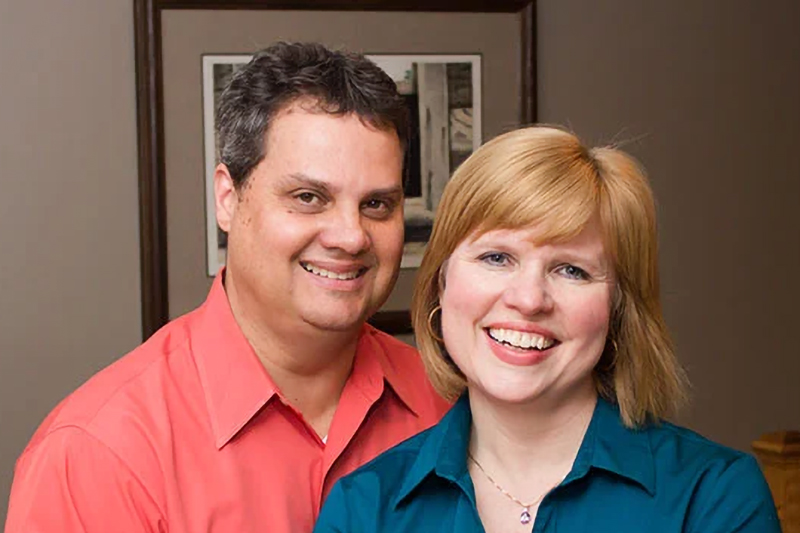
Marc and Kim Wyatt have served as missionaries for the Cooperative Baptist Fellowship for nearly 30 years. Now they run Welcome House Raleigh, a ministry of the Cooperative Baptist Fellowship of North Carolina. (Photo courtesy Marc Wyatt.)
He recognized that Afrikaners are part of a white ethnic minority that created and led South Africa’s brutal segregationist policies known as apartheid for nearly 50 years. That policy, which included denying the country’s Black majority rights to voting, housing, education and land, ended in 1994, when the country elected Nelson Mandela in its first free presidential election.
Like Wyatt and Welcome House, many faith-based groups are now considering whether to help the government resettle Afrikaners after the Trump administration shut down refugee resettlement for all others.
Last week, the Episcopal Church chose to end its refugee resettlement partnership with the U.S. government rather than resettle Afrikaners. Presiding Bishop Sean Rowe said his church’s commitment to racial justice and reconciliation, and its long relationship with the late Anglican Archbishop Desmond Tutu made it impossible for the church to work with the government on resettling Afrikaners.
In January, in one of his first executive orders, President Donald Trump shuttered the decades-old refugee program, which brings people to the U.S. who are displaced by war, natural disasters or persecution. The decision left thousands of refugees, many living in camps for years and having undergone a rigorous vetting process, stranded.
But then Trump directed the government to fast-track the group of Afrikaners for resettlement, saying these white farmers in South Africa are being killed in a genocide, a baseless claim. The order left many refugee advocates who have worked for years to resettle vulnerable people enraged.
“Refugees sit in camps for 10, 20 years, but if you’re a white South African Afrikaner, then suddenly you can make it through in three months?” asked the Rev. Randy Carter, director of the Welcome Network and a pastor of a CBF church. “There’s a lot of words I’d like to attach to that, but I don’t want any of those printed.”
Carter said he respects and honors the Episcopal Church’s decision not to work with the government on resettling the Afrikaners, even if his network has taken a different approach.
“The call to welcome is not always easy,” Carter said. “Sometimes it’s hard.”
At the same time, he said, it’s important resettlement volunteers keep in mind that the ministry opposes apartheid and racism, both in the U.S. and abroad, and is committed to repentance and repair.
The North Carolina field office for the USCRI resettlement group also recognized how fraught this particular resettlement is for its faith-based partners.
“In our communication with them, we said, ‘Look, we know this is not a normal issue. You or your constituencies may have reservations, and we understand that. That should not affect our partnership,’” said Omer Omer, the North Carolina field office director for USCRI. “If you want to participate, welcome. If not, we understand.”
Wyatt got nearly two dozen comments on his Facebook post in which he announced his decision to work with the refugee agency in resettling the Afrikaners. Nearly all wrote in support of his decision. “I’m up sleepless pondering this,” acknowledged one person. “Complicated, but the right call,” wrote another.
USCRI did not release the names of the three Afrikaners who chose to settle in Raleigh, a couple and a single individual. Other Afrikaners chose to be resettled in Idaho, Iowa, New York and Texas.
Secretary of State Marco Rubio suggested last week that more Afrikaners are on the way. The Trump administration argues white South Africans are being discriminated against by the country’s government, pointing to a law potentially allowing the government to seize privately held land under certain conditions. Since the end of apartheid, the South African government has made efforts to level the economic imbalance and redistribute land to Black South Africans that had been seized by the former colonial and apartheid governments.
The South African administration will get its chance to rebut the Trump administration’s claim when President Cyril Ramaphosa is scheduled to visit the White House on Wednesday (May 21).
However, Wyatt, who has been running the Welcome House Raleigh ministry for 10 years, providing temporary housing and a furniture bank for refugees, and now asylum seekers, said he has settled the matter in his mind.
“My wife and I have come to the position that if it’s not a full welcome, just like we would with anybody else, then it’s not a welcome,” he said. “If we don’t actually seek to include them into our lives like we would anybody else, then we’re withholding something and that’s not how we understand our holy book.”
(RNS) — Faith-based groups are weighing whether to help the US government resettle Afrikaners after it shut down refugee resettlement for all others.
Welcome House Raleigh rents a storage unit to help furnish homes for new refugees. This one in North Raleigh, N.C., is crammed full of household items.
(RNS photo/Yonat Shimron)
Yonat Shimron
May 20, 2025
RALEIGH, N.C. (RNS) — The 12×30-foot storage unit in a Raleigh, North Carolina, suburb is crammed full of chairs, tables, mattresses, lamps, pots and pans.
Most of its contents will soon be hauled off to two apartments that Welcome House Raleigh is furnishing for three newly arrived refugees. It’s a job the ministry, which is a project of the Cooperative Baptist Fellowship of North Carolina, has handled countless times on behalf of newly arrived refugees from such places as Afghanistan, the Democratic Republic of the Congo, Syria and Venezuela.
But these two apartments are going to three Afrikaners — whose status as refugees is, according to many faith-based groups and others, highly controversial.
Last week, Marc Wyatt, director of Welcome House Raleigh, received a call from the North Carolina field office of the U.S. Committee for Refugees and Immigrants asking if he could help furnish the apartments for the refugees, among the 59 Afrikaners who arrived in the U.S. last week from South Africa, he told RNS. It was a common request for the ministry that partners with refugee resettlement agencies to provide temporary housing and furniture for people in need.
And at the same time, the request was extremely challenging. After thinking about it, consulting with the Welcome House network director and asking for feedback from ministry volunteers, Wyatt said yes.
“Our position is that however morally and ethically charged it is, our mandate is to help welcome and love people,” said Wyatt, a retired Cooperative Baptist Fellowship missionary who now works for CBF North Carolina. “Our holy book says God loves people. We don’t get to discriminate.”
Marc and Kim Wyatt have served as missionaries for the Cooperative Baptist Fellowship for nearly 30 years. Now they run Welcome House Raleigh, a ministry of the Cooperative Baptist Fellowship of North Carolina. (Photo courtesy Marc Wyatt.)
He recognized that Afrikaners are part of a white ethnic minority that created and led South Africa’s brutal segregationist policies known as apartheid for nearly 50 years. That policy, which included denying the country’s Black majority rights to voting, housing, education and land, ended in 1994, when the country elected Nelson Mandela in its first free presidential election.
Like Wyatt and Welcome House, many faith-based groups are now considering whether to help the government resettle Afrikaners after the Trump administration shut down refugee resettlement for all others.
Last week, the Episcopal Church chose to end its refugee resettlement partnership with the U.S. government rather than resettle Afrikaners. Presiding Bishop Sean Rowe said his church’s commitment to racial justice and reconciliation, and its long relationship with the late Anglican Archbishop Desmond Tutu made it impossible for the church to work with the government on resettling Afrikaners.
In January, in one of his first executive orders, President Donald Trump shuttered the decades-old refugee program, which brings people to the U.S. who are displaced by war, natural disasters or persecution. The decision left thousands of refugees, many living in camps for years and having undergone a rigorous vetting process, stranded.
But then Trump directed the government to fast-track the group of Afrikaners for resettlement, saying these white farmers in South Africa are being killed in a genocide, a baseless claim. The order left many refugee advocates who have worked for years to resettle vulnerable people enraged.
“Refugees sit in camps for 10, 20 years, but if you’re a white South African Afrikaner, then suddenly you can make it through in three months?” asked the Rev. Randy Carter, director of the Welcome Network and a pastor of a CBF church. “There’s a lot of words I’d like to attach to that, but I don’t want any of those printed.”
Carter said he respects and honors the Episcopal Church’s decision not to work with the government on resettling the Afrikaners, even if his network has taken a different approach.
“The call to welcome is not always easy,” Carter said. “Sometimes it’s hard.”
At the same time, he said, it’s important resettlement volunteers keep in mind that the ministry opposes apartheid and racism, both in the U.S. and abroad, and is committed to repentance and repair.
The North Carolina field office for the USCRI resettlement group also recognized how fraught this particular resettlement is for its faith-based partners.
“In our communication with them, we said, ‘Look, we know this is not a normal issue. You or your constituencies may have reservations, and we understand that. That should not affect our partnership,’” said Omer Omer, the North Carolina field office director for USCRI. “If you want to participate, welcome. If not, we understand.”
Wyatt got nearly two dozen comments on his Facebook post in which he announced his decision to work with the refugee agency in resettling the Afrikaners. Nearly all wrote in support of his decision. “I’m up sleepless pondering this,” acknowledged one person. “Complicated, but the right call,” wrote another.
USCRI did not release the names of the three Afrikaners who chose to settle in Raleigh, a couple and a single individual. Other Afrikaners chose to be resettled in Idaho, Iowa, New York and Texas.
Secretary of State Marco Rubio suggested last week that more Afrikaners are on the way. The Trump administration argues white South Africans are being discriminated against by the country’s government, pointing to a law potentially allowing the government to seize privately held land under certain conditions. Since the end of apartheid, the South African government has made efforts to level the economic imbalance and redistribute land to Black South Africans that had been seized by the former colonial and apartheid governments.
The South African administration will get its chance to rebut the Trump administration’s claim when President Cyril Ramaphosa is scheduled to visit the White House on Wednesday (May 21).
However, Wyatt, who has been running the Welcome House Raleigh ministry for 10 years, providing temporary housing and a furniture bank for refugees, and now asylum seekers, said he has settled the matter in his mind.
“My wife and I have come to the position that if it’s not a full welcome, just like we would with anybody else, then it’s not a welcome,” he said. “If we don’t actually seek to include them into our lives like we would anybody else, then we’re withholding something and that’s not how we understand our holy book.”
No comments:
Post a Comment