The Middle East And the Persian Gulf: Trump’s Favorite Shopping Mall
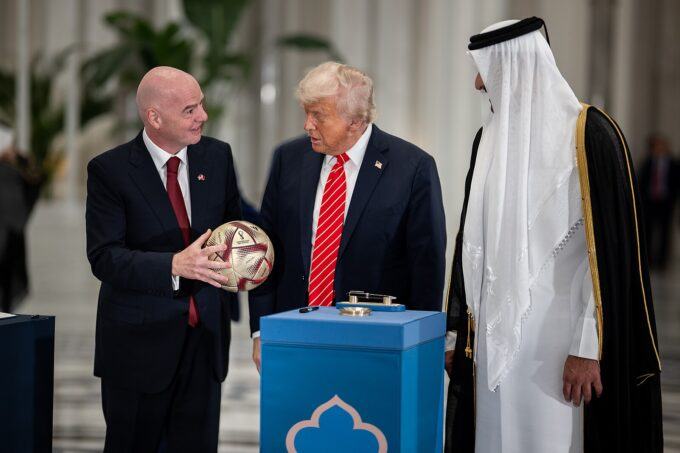
Photograph Source: The White House – Public Domain
Donald Trump’s first official travel overseas in both his first and second presidential terms centered on the Middle East and the Persian Gulf. These trips have secured great wealth and investment for the Trump family enterprises that now include a meme cryptocurrency that allows crypto investors in the Gulf to enrich Donald Trump. The latest and boldest example of the region’s largesse for Trump is the Qatari royal family’s gift of a $400 million luxury jet that could end up with Trump’s presidential foundation when (and if) he leaves the White House.
The Middle East and the Persian Gulf are the center of the Trump organization’s global business empire. Prior to Trump’s arrival in the Gulf, his sons, Donald Jr. and Eric, have signed a number of deals in the region, trading on their family name and influence, to enhance the wealth of the Trump family. Even the prodigal son-in-law, Jared Kushner, has acquired billions in investment from the Gulf states. On the eve of Trump’s arrival in the Gulf, Abu Dhabi announced an investment of $2 billion into World Liberty Financial, Trump’s cryptocurrency company, with Trump’s family earning tens of millions of dollars annually on the interest from that investment.
Final returns haven’t been posted from the visit, but the communiques and announcements have thus far indicated that Trump also is pursuing a geopolitical reshaping of the region that could lead to a smaller U.S. military presence in the Middle East and the Persian Gulf. Trump started his visit to the Gulf with a surprise announcement that the United States will lift long-standing sanctions on Syria. He followed this with an unusual meeting between Trump and Syrian leader Ahmed al-Sharaa. Saudi Arabia has made a $600 billion commitment to invest in the U.S. and, in return, the United States agreed to sell the Saudis an arms package worth nearly $142 billion, one of the largest defense cooperation agreements Washington has made. Qatar has enhanced its international standing with its high-level diplomacy and discussions with the United States.
Presumably the Saudis and the Qataris in return will press Trump to recognize the needs and rights of Palestinians, which Trump completely ignored in his first term. In view of Trump’s random acts and unpredictability, the Israelis must be concerned with how far Trump will go in solidifying U.S. relations with the Saudi and Qatari leaders. If nothing else, Israeli Prime Minister Benjamin Netanyahu must be concerned with what appear to be early signs of a possible U.S. reshaping of its role and posture in the Middle East and the Gulf.
Trump’s unpredictably is well-established but it is neverthelessIt surprising that his regional meandering is garnering great international attention despite Trump himself having no genuine understanding of the dynamics at work in the Middle East and the Persian Gulf and having appointed the worst and least experienced national security team in the history of the United States. Trump appears determined to reduce the U.S. military presence in the region, which U.S. presidents have tried and failed to do over the past fifteen years. Trump announced a ceasefire with the Houthis, which ended U.S.bombing in Yemen; called for an end to sanctions against the new Syrian government, which could lead to the withdrawal of around 1,000 U.S. forces in northeastern Syria; and endorsed a less fractious bilateral relationship with Iran, which could lead to the revival of the Joint Comprehensive Plan of Action, the Iranian nuclear accords.
Trump may not end U.S. complicity with Israeli militarization, but he has signaled to Prime Minister Netanyahu that U.S. support cannot be taken for granted. Unlike Trump’s first visit to the region in his first term, he did not include a stopover in Israel. On route to the region in the second term, Trump announced that he had negotiated the Hamas’ release of the last living American citizen being held hostage, without any discussions with Netanyahu, who was only informed of the deal after the surprise release. Netanyahu learned of the truce between the United States and the Houthis after the fact as well.
Former Israeli ambassador to the United States, Michael Oren, a hard-liner, conceded that “It certainly doesn’t look like Netanyahu has Trump’s ear right now—and if he has his ear, he doesn’t have Trump’s heart and mind.” The fact that there are even tentative indications of a possible path to a new nuclear deal with Iran as well as even a limited revival of commercial ties between Iran and the United States must be particularly worrisome to Netanyahu and the right-wing zealots.
Israelis have always expected great support from presidents from the Democratic Party, but they understand that Republican presidents (e.g., Eisenhower, Reagan, Bush Sr.) have been willing to separate themselves from Israeli excesses when necessary. Democratic presidents have been beholden for support and resources from the Jewish-American community, and for that reason have avoided getting crosswise with Israel. Netanyahu has exploited this fact for the past three decades, which has frustrated Presidents Clinton, Obama, and Biden.
The Israelis know that Trump would like to build on the 2020 Abraham Accords from his first term, which comprised a series of bilateral relations that normalized relations between Israel and several Arab countries. The Accords did nothing to address the existential problem of Palestine, however, and Trump will not be able to expand the Accords to include Saudi Arabia without paying more attention of the Palestinian problem and the need for some solution. Trump himself has referred to a solution that addresses the needs of all the parties as the “deal of the century,” which is designed to position himself for consideration of one of his major goals, a Nobel peace prize.
Nevertheless, while Trump pursues his economic and geopolitical deals in the Persian Gulf, one of the greatest tragedies in human history is unfolding as the Israelis pursue a genocidal campaign that is killing tens of thousands of innocent civilians and children, and traumatizing and ruining the lives of more than two million Palestinians who have been running for their lives for the past year and a half. The fact that the international community has demonstrated no ability to counter Israeli militarism reveals the absence of any global responsibility for this horror as it unfolds. Even Israeli military officials are acknowledging the fact that starvation is expanding across the Gaza strip, with Palestinian children paying a terrible price.
For the past two months, Israel has made sure that no food, water, medical materials and other essentials can reach the victims of its assault. Netanyahu has been given a free hand to operate. Presidents Biden and Trump are responsible for providing the Israeli Defense Forces with the weaponry—including bunker-buster bombs and missiles still being used against hospital complexes—that comprise some of the most deadly war crimes of all.
Trump, Planes and the Arabian Gulf Tour
They seemed made for each other. A former reality television star, with dubious real estate credentials, a freakish alienation from the truth, and the various leaders of the Gulf States, who never found truthful assessments that worthwhile anyway. This was certainly no time to be frugal and modest. Many a country might be dealing with soaring prices, inaccessible housing markets, and the cost of eggs, but nothing would be spared in spoiling US President Donald Trump with overpriced kitsch and exotica. Here was the MAGA brand in full flower.
With crude indulgence, Saudi Arabia’s putative leader, Crown Prince Mohammed bin Salman, pampered and spoiled the US president with hospitality and a spray of undertakings and agreements during the first part of his Arabian Gulf tour. Six US-made F-15 fighters piloted by the Saudis escorted Air Force One as it approached Riyadh on May 13. There was the coffee ceremony within the royal terminal in the airport, a limousine flanked by white Arabian horses, and a decorative honour guard equipped with golden swords.
This was a time for luxury and boundless bad taste, not bleeding hearts and bleating consciences. Memories of journalist Jamal Khashoggi, murdered in October 2018 on orders by the crown prince, could be silenced if not expunged altogether. As for climate change, what of it? On golden chairs in the royal place, the Crown Prince and US President could bask in each other’s triumphal, emetic glow. Trump exclaimed that “we like each other a lot”. In a speech, he also uttered words of music to the royal: no foreign leader should be “giving you lectures on how to live and how to govern your own affairs.”
An extravagant luncheon that followed featured a veritable Who’s Who of American corporatocracy, among them Stephen Schwarzman of the Blackstone Group, Jane Fraser of Citicorp, Ruth Porat of Google, and Alex Karp of Palantir.
The value of the agreements reached between Riyadh and Washington approximate to US$600 billion, if one is to trust the anomalous “fact sheets” released by the White House. The nature of these commitments was not exactly clear, though they promise to cover energy security, defence, technology and access to critical minerals. Terms with little clarity (“global infrastructure”, for instance) were thrown around. Naturally, Trump will not be outdone in any deal, insisting that this was all part of the America First Trade and Investment Policy that is placing “the American economy, the American worker, and our national security first.”
A few examples were mentioned, though these figure as ongoing commitments: the plans of Saudi Arabia’s DataVolt to invest US$20 billion in US data centres and energy infrastructure; the promise by Google, DataVolt, Oracle, Salesforce, AMD and Uber to invest US$80 billion in “cutting-edge transformative technologies in both countries.” The inevitable defence sales agreement was also praised, one hailed as the largest in history. Worth almost US$142 billion, it will involve over a dozen US defence firms supplying the Kingdom with equipment and technology in air force and space capabilities, air and missile defence, maritime and coastal security, border security and land forces and improved information and communication systems.
This was merely the start of the Trump Splash Show. Onward to Qatar, where another ceremonial escort of F-15 fighter planes greeted the president. Clearly, the ruling Emir, Sheikh Tamim bin Hamad al-Thani, was not going to be outdone by his Saudi counterparts. For a change, however, the president’s motorcade travelling from Doha airport to Amiri Diwan was greeted by a cavalry of mounted camels. “I haven’t seen camels like that in a long time,” fluted the impressed leader. “And really, we appreciate it very much.” But showing that imperishable tradition can exist alongside technological progress, red Tesla Cybertrucks also featured in the motorcade. This was a sweet gesture, given that Elon Musk’s company has an inventory of unsold Cybertrucks worth US$800 billion languishing in dealerships.
With the welcome indulgence concluded, the serious discussions began. These were primarily focused on aviation, defence and energy priorities. Of note was a contract with Doha for 210 Boeing-made 787 Dreamliners and 777x aircraft worth US$96 billion. The US plane maker has been struggling of late, bedevilled by mishaps and questions about the quality of its manufacture. But glossy salvations are possible in the garden of MAGA make believe. “Congratulations to Boeing,” cooed Trump. “Get those planes out there.”
The contract was part of a number of economic commitments from Qatar initially claimed by the White House to be worth a staggering US$1.2 trillion. As mathematics is not the strong suit of the Trump administration, the same announcement also qualifies the over trillion dollar boast by announcing “economic deals totalling more than $243.5 billion between the United States and Qatar, including an historic sale of Boeing aircraft and GE Aerospace engines to Qatar Airways.” Also included is an almost US$2 billion agreement allowing Qatar to acquire the MQ-9B remotely piloted aircraft system from General Atomics, and a US$1 billion agreement for Doha’s purchase of Raytheon’s small unmanned aircraft integrated defeat system.
In a shameless effort to outdo Riyadh, the Qatari royal family threw in a luxury 747 plane worth $400 million for the US Department of Defense, intended for Trump’s use as a temporary substitute Air Force One. Reported as being a “palace in the sky”, the president sees it as a gift of infinite, irrefutable generosity. “It’s a great gesture from Qatar,” he reasoned. “I appreciate it very much. I would never be one to turn down that kind of offer.”
As with his keenness to avoid anything that might ruffle feathers, or disturb restful camels, this was not a trip for presidential agitation. He was far away from irritating European allies. Here was Qatar, previously accused by Trump of being a sponsor of terrorism, rehabilitated in golden glory. Forget the security implications and brazen corruption inherent in such a move: all the parties concerned could gloat without consequential censure.
No comments:
Post a Comment