'Democracy Is on Life Support':
Trump Orders Defunding of NPR and PBS
"All of us who care about an independent press, an informed populace, a responsive government, and a thriving democracy have a stake in the outcome of this fight," said one press freedom advocate.
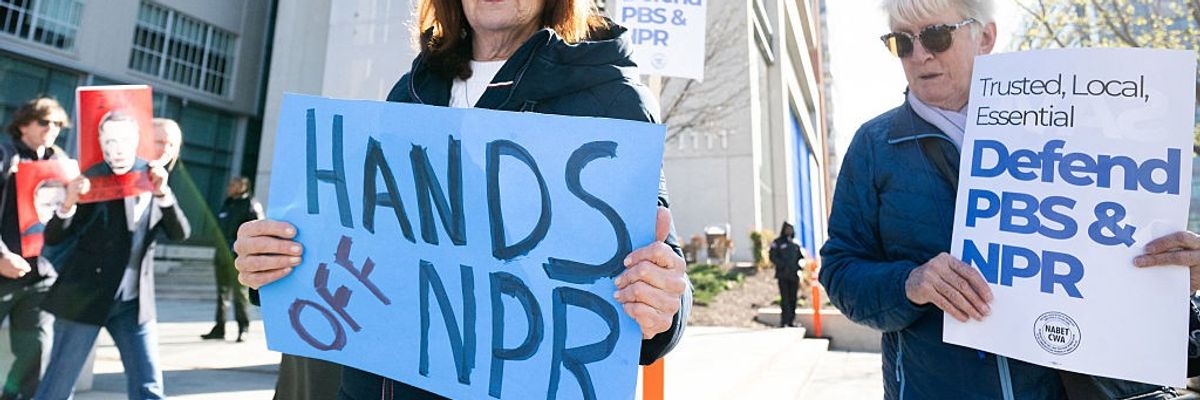
Demonstrators urge Congress to protect funding for NPR and PBS in Washington, D.C.
"All of us who care about an independent press, an informed populace, a responsive government, and a thriving democracy have a stake in the outcome of this fight," said one press freedom advocate.
Demonstrators urge Congress to protect funding for NPR and PBS in Washington, D.C.
on March 26, 2025.
(Photo: Saul Loeb/AFP via Getty Images)
Jake Johnson
May 02, 2025
COMMON DREAMS
U.S. President Donald Trump on Thursday signed an executive order calling for an end to taxpayer funding for NPR and PBS, an escalation of his dangerous assault on public media that could shutter hundreds of local stations across the country.
The president's order, which he signed behind closed doors, echoes a section of Project 2025, a far-right agenda that called for stripping public funding from NPR, PBS, and other broadcasters on the grounds that they "do not even bother to run programming that would attract conservatives."
Trump's order instructs the Corporation for Public Broadcasting (CPB)—a private nonprofit corporation created and funded by Congress—to "cease direct funding to NPR and PBS, consistent with my administration's policy to ensure that federal funding does not support biased and partisan news coverage."
The executive order, which is expected to face legal challenges, also directs all federal agencies to "identify and terminate, to the maximum extent consistent with applicable law, any direct or indirect funding of NPR and PBS."
Craig Aaron, co-CEO of the advocacy group Free Press, said in a statement Friday that "Trump's attack on public media shows why our democracy is on life support."
"After years of attacking journalists and lying about their work, it's no surprise that Trump and his minions are trying to silence and shutter any newsroom that dares to ask him questions or show the devastating impact of his policies on local communities," said Aaron. "Yet in many of those communities, the local public-media station is the only source of independent reporting. Trump, of course, prefers fawning propaganda—which too many commercial TV and radio broadcasters are willing to provide in exchange for regulatory favors, or to stay off the president's target list."
"All of us who care about an independent press, an informed populace, a responsive government, and a thriving democracy have a stake in the outcome of this fight," he added. "If we unite to defend public media—and I believe we can and will prevail—then we might just save our democracy, too."dele'
Trump's move was expected, and it came in the wake of reports that the administration intends to ask Congress to rescind previously approved funding for CPB, which is already engaged in a court fight with the president over his attempt to fire several of the organization's board members. The Associated Pressreported Thursday that the rescission request "has not yet been sent to Capitol Hill."
According to the organizations' estimates, federal funding accounts for roughly 1% of NPR's annual budget and 15% of PBS's yearly revenue.
In a letter to congressional leaders earlier this week, a coalition of civil society groups led by Reporters Without Borders (RSF) warned that, if enacted, Trump's proposed funding cuts for public broadcasting "will result in the shutdown of dozens, if not hundreds, of local, independent radio and television stations serving Americans in every corner of the country."
"As it stands, public media journalists are often the only reporters attending a school board meeting, or a local zoning hearing, or at the scene of a crime," the groups wrote. "They are the journalists most likely to hold local public officials accountable and expose
corruption. Faraway digital media outlets will not replicate this coverage, and the American public will lose out."
Trump's attack on public broadcasters is part of his administration's broader effort to undermine journalism in the United States and around the world.
RSF said in a report published Friday that Trump's "early moves in his second mandate to politicize the Federal Communications Commission (FCC), ban The Associated Press from the White House, or dismantle the U.S. Agency for Global Media, for example, have jeopardized the country's news outlets and indicate that he intends to follow through on his threats, setting up a potential crisis for American journalism."
"After a century of gradual expansion of press rights in the United States," the group said, "the country is experiencing its first significant and prolonged decline in press freedom in modern history, and Donald Trump's return to the presidency is greatly exacerbating the situation."
(Photo: Saul Loeb/AFP via Getty Images)
Jake Johnson
May 02, 2025
COMMON DREAMS
U.S. President Donald Trump on Thursday signed an executive order calling for an end to taxpayer funding for NPR and PBS, an escalation of his dangerous assault on public media that could shutter hundreds of local stations across the country.
The president's order, which he signed behind closed doors, echoes a section of Project 2025, a far-right agenda that called for stripping public funding from NPR, PBS, and other broadcasters on the grounds that they "do not even bother to run programming that would attract conservatives."
Trump's order instructs the Corporation for Public Broadcasting (CPB)—a private nonprofit corporation created and funded by Congress—to "cease direct funding to NPR and PBS, consistent with my administration's policy to ensure that federal funding does not support biased and partisan news coverage."
The executive order, which is expected to face legal challenges, also directs all federal agencies to "identify and terminate, to the maximum extent consistent with applicable law, any direct or indirect funding of NPR and PBS."
Craig Aaron, co-CEO of the advocacy group Free Press, said in a statement Friday that "Trump's attack on public media shows why our democracy is on life support."
"After years of attacking journalists and lying about their work, it's no surprise that Trump and his minions are trying to silence and shutter any newsroom that dares to ask him questions or show the devastating impact of his policies on local communities," said Aaron. "Yet in many of those communities, the local public-media station is the only source of independent reporting. Trump, of course, prefers fawning propaganda—which too many commercial TV and radio broadcasters are willing to provide in exchange for regulatory favors, or to stay off the president's target list."
"All of us who care about an independent press, an informed populace, a responsive government, and a thriving democracy have a stake in the outcome of this fight," he added. "If we unite to defend public media—and I believe we can and will prevail—then we might just save our democracy, too."dele'
Trump's move was expected, and it came in the wake of reports that the administration intends to ask Congress to rescind previously approved funding for CPB, which is already engaged in a court fight with the president over his attempt to fire several of the organization's board members. The Associated Pressreported Thursday that the rescission request "has not yet been sent to Capitol Hill."
According to the organizations' estimates, federal funding accounts for roughly 1% of NPR's annual budget and 15% of PBS's yearly revenue.
In a letter to congressional leaders earlier this week, a coalition of civil society groups led by Reporters Without Borders (RSF) warned that, if enacted, Trump's proposed funding cuts for public broadcasting "will result in the shutdown of dozens, if not hundreds, of local, independent radio and television stations serving Americans in every corner of the country."
"As it stands, public media journalists are often the only reporters attending a school board meeting, or a local zoning hearing, or at the scene of a crime," the groups wrote. "They are the journalists most likely to hold local public officials accountable and expose
corruption. Faraway digital media outlets will not replicate this coverage, and the American public will lose out."
Trump's attack on public broadcasters is part of his administration's broader effort to undermine journalism in the United States and around the world.
RSF said in a report published Friday that Trump's "early moves in his second mandate to politicize the Federal Communications Commission (FCC), ban The Associated Press from the White House, or dismantle the U.S. Agency for Global Media, for example, have jeopardized the country's news outlets and indicate that he intends to follow through on his threats, setting up a potential crisis for American journalism."
"After a century of gradual expansion of press rights in the United States," the group said, "the country is experiencing its first significant and prolonged decline in press freedom in modern history, and Donald Trump's return to the presidency is greatly exacerbating the situation."
By AFP
May 2, 2025

Trump has long had an antagonistic relationship with most mainstream news media, with the exception of the powerful conservative broadcaster Fox News. © GETTY IMAGES NORTH AMERICA/AFP Andrew Harnik
US President Donald Trump signed an executive order on Thursday to cut public funding for NPR and PBS, accusing the news outlets of being biased in his latest attack on traditional media.
Trump has long had an antagonistic relationship with most mainstream news media, previously describing them as the “enemy of the people.”
A notable exception is the powerful conservative broadcaster Fox News, some of whose hosts have taken on major roles in his administration.
National Public Radio (NPR) and the Public Broadcasting Service (CBS) are only partly funded by US taxpayers through the Corporation for Public Broadcasting (CPB) and rely heavily on private donations.
Trump in his executive order instructed the CPB Board of Directors and all executive departments and agencies “to cease Federal funding” for NPR and CBS.
He added that “neither entity presents a fair, accurate, or unbiased portrayal of current events to taxpaying citizens.”
The CPB budget has already been approved by Congress through 2027, which raises questions about the scope of Trump’s order.
Politico magazine described the order as “the White House’s biggest escalation yet in its assault on the media” and said it would likely be challenged in court.
– ‘Subsidization of Biased Media’ –
The White House published on Thursday a fact sheet titled “President Donald J. Trump Ends the Taxpayer Subsidization of Biased Media.”
It said that NPR and PBS “have fueled partisanship and left-wing propaganda with taxpayer dollars, which is highly inappropriate and an improper use of taxpayers’ money.”
To support this accusation, the document listed a number of claims about the two media outlets, which it said receive “tens of millions of dollars in taxpayer funds each year.”
For example, that “over a six-month period, PBS News Hour used versions of the term ‘far-right’ 162 times, but ‘far-left’ only 6 times,” the White House said.
It cited research — from an unnamed source — that showed that congressional Republicans have received far more negative media coverage than Democrats.
The fact sheet also listed an NPR feature about “queer animals,” and on PBS the appearance of a “drag queen” on a kid’s show and a movie “which celebrates a transgender teen’s transition.”
PBS and NPR were not immediately available for comment.
– Press freedom –
More than 40 million Americans listen to NPR public radio each week, and 36 million watch a local television station from the PBS network each month, according to their estimates.
NPR director Katherine Maher estimated in March that the radio station would receive about $120 million from the CPB in 2025, “less than five percent of its budget.”
Media rights group RSF warned Friday about “an alarming deterioration in press freedom” in the United States and “unprecedented” difficulties for independent journalists around the world.
In February, the Oval Office stripped the White House Correspondents’ Association of the nearly century-old power to decide which of them cover US presidential events, with Trump saying that he was now “calling the shots” on media access.
It also banned reporters from the Associated Press, the top US news agency, from the Oval Office and travelling on Air Force One.
This was because the AP continues to refer to the Gulf of Mexico, an international body of water, and not simply the “Gulf of America” as decreed by Trump.
The Trump administration has also begun to dismantle America’s publicly-funded “voices” abroad, including Radio Free Europe/Radio Liberty, Radio Free Asia and “Voice of America.”
Sesame Street's brutal parody of Trump may have led to his 'vendetta' against PBS: report
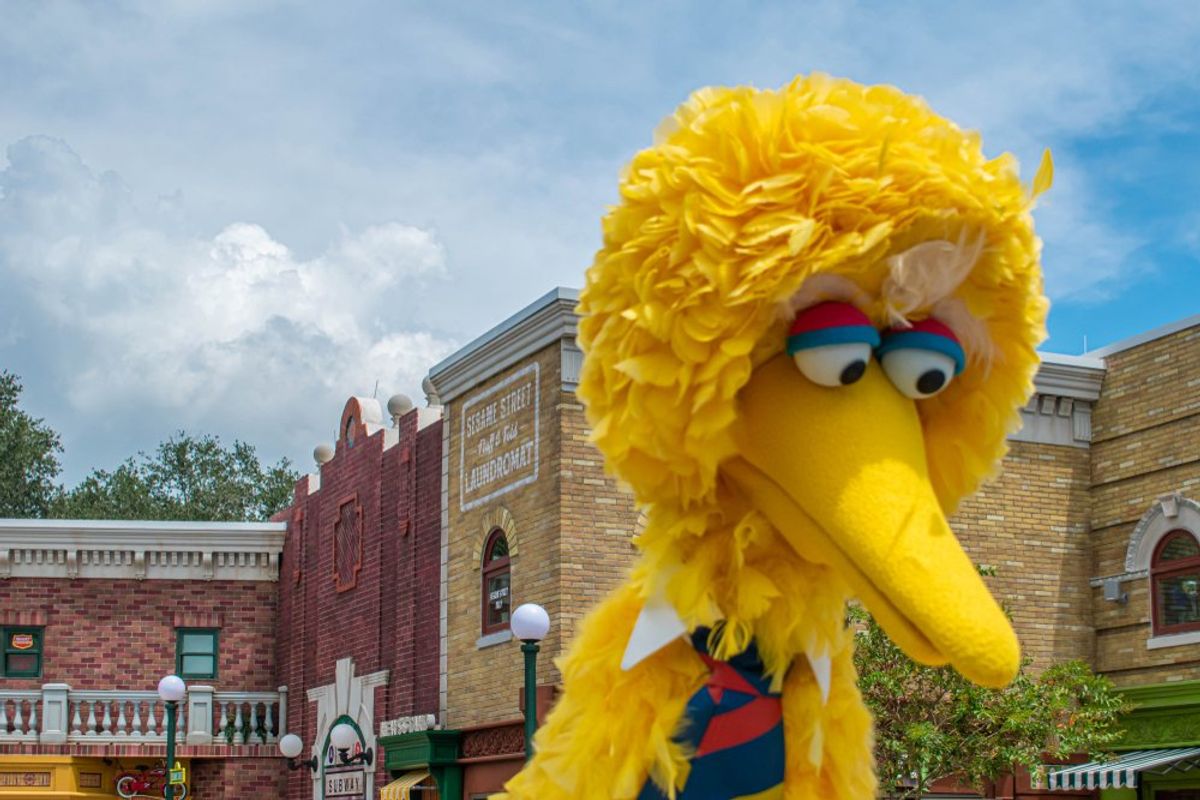
Big Bird in Sesame Street. (Photo credit: VIAVAL TOURS / Shutterstock)
A Sesame Street character with the most trash and a fragile ego was possibly one parody too far for President Donald Trump, according to the Daily Beast:
“The president signed an executive order to halt all federal funding to PBS, the free public broadcasting service. Almost immediately, people began to suspect that Trump’s vendetta against the network wasn’t because of its 'woke programming,'" wrote The Beast's Clare Donaldson. "Instead, it’s all to do with a certain puppet show that has been trolling the man since the ’80s.”
One of Trump’s longest-running haters isn’t one of his alleged scam victims, but “‘Sesame Street’—the educational children’s program that taught generations of kids to read and count.”
Cue the song lyric: “He’s got so much trash it spills out of his can!”
Ronald Grump first hit the scene in the late 1980s as a “famous Grouch builder” looking to replace Oscar’s trash can with a condominium of waste bins called “Grump Tower.” All Oscar had to do was surrender his can and relocate to a trashy condo in Grump’s new construction.
There were strings attached, of course, so Oscar ends up fighting his way back out of Grump’s twisty contract with the help of the Sesame Street community.
Later, in the 1990s, ‘Sesame Street’ convinced actor Joe Pesci to lend his voice for another round as Grump threatens to turn Sesame Street into “Grump World.”
The show later did a parody of Trump’s NBC reality show The Apprentice.
‘Alarming deterioration’ of US press freedom under Trump, says RSF
By AFP
May 2, 2025

Image: © Digital Journal
Adam PLOWRIGHT
Media rights group RSF warned Friday about “an alarming deterioration in press freedom” in the United States under President Donald Trump as well as “unprecedented” difficulties for independent journalists around the world.
Paris-based Reporters Without Borders, which has been tracking press freedom for the last 23 years, said its main index had fallen to its lowest-ever level.
“For the first time in the history of the index, the conditions for practising journalism are poor in half of the world’s countries and satisfactory in fewer than one in four,” an annual review of media freedom globally by the charity concluded.
RSF editorial director Anne Bocande highlighted the role of economic pressures in undermining fact-based reporting, with many independent outlets having to close because of funding difficulties.
Although spending on online advertising was still rising — hitting $247.3 billion in 2024, according to RSF — a growing share is captured by online giants Facebook, Google or Amazon rather than media companies.
“When journalists are impoverished, they no longer have the means to resist the enemies of the press -— those who champion disinformation and propaganda,” Bocande said in a statement.
– ‘Authoritarian shift’ –
RSF highlighted how Trump had made difficult conditions worse by axing US financial support for state-backed broadcasters such as Voice of America and Radio Free Europe/Radio Liberty (RFE/RL), as well as US foreign development aid that assisted media outlets overseas.
After a fall of 11 places in 2024, the United States declined another two to 57th place on the 2025 World Press Freedom Index, one behind formerly war-torn Sierra Leone in west Africa.
The index, calculated according to the number of violent incidents involving journalists and other data compiled by experts, was topped by oil-rich Norway for the ninth year in a row. Estonia and the Netherlands were second and third.
“In the United States, Donald Trump’s second term as president has led to an alarming deterioration in press freedom, indicative of an authoritarian shift in government,” RSF said.
“His administration has weaponised institutions, cut support for independent media, and sidelined reporters.”
Large parts of the United States were now “news deserts,” RSF said.
Trump announced Wednesday that he was considering legal action against The New York Times, in his latest attack on a media outlet.
He is also suing media group Paramount over a pre-election interview last year of his Democratic rival Kamala Harris on its CBS channel.
Trump alleges it was edited to remove an embarrassing response, although many legal analysts view the case as baseless and likely to be dismissed or fail due to constitutional protections for freedom of the press.
The Committee to Protect Journalists (CPJ), a media watchdog, also warned Wednesday that press freedom in the United States was declining and it urged newsrooms to form a united front against the “rising tide of threats” facing them.
Other countries that have suffered major declines in press freedom over the last year include Argentina (down 21 places to 87th) under right-wing Trump ally Javier Milei, and Tunisia (down 11 places to 129th).
RSF also again highlighted the plight of Palestinian journalists seeking to report on Israel’s devastating bombardment of Gaza.
“In Gaza, the Israeli army has destroyed newsrooms, killed nearly 200 journalists and imposed a total blockade on the strip for over 18 months,” it said.
Israel meanwhile had dropped a further 11 places to 112th and “continues to repress its own news media”.
Alternet
May 2, 2025
May 2, 2025
Big Bird in Sesame Street. (Photo credit: VIAVAL TOURS / Shutterstock)
A Sesame Street character with the most trash and a fragile ego was possibly one parody too far for President Donald Trump, according to the Daily Beast:
“The president signed an executive order to halt all federal funding to PBS, the free public broadcasting service. Almost immediately, people began to suspect that Trump’s vendetta against the network wasn’t because of its 'woke programming,'" wrote The Beast's Clare Donaldson. "Instead, it’s all to do with a certain puppet show that has been trolling the man since the ’80s.”
One of Trump’s longest-running haters isn’t one of his alleged scam victims, but “‘Sesame Street’—the educational children’s program that taught generations of kids to read and count.”
Cue the song lyric: “He’s got so much trash it spills out of his can!”
Ronald Grump first hit the scene in the late 1980s as a “famous Grouch builder” looking to replace Oscar’s trash can with a condominium of waste bins called “Grump Tower.” All Oscar had to do was surrender his can and relocate to a trashy condo in Grump’s new construction.
There were strings attached, of course, so Oscar ends up fighting his way back out of Grump’s twisty contract with the help of the Sesame Street community.
Later, in the 1990s, ‘Sesame Street’ convinced actor Joe Pesci to lend his voice for another round as Grump threatens to turn Sesame Street into “Grump World.”
The show later did a parody of Trump’s NBC reality show The Apprentice.
‘Alarming deterioration’ of US press freedom under Trump, says RSF
By AFP
May 2, 2025
Image: © Digital Journal
Adam PLOWRIGHT
Media rights group RSF warned Friday about “an alarming deterioration in press freedom” in the United States under President Donald Trump as well as “unprecedented” difficulties for independent journalists around the world.
Paris-based Reporters Without Borders, which has been tracking press freedom for the last 23 years, said its main index had fallen to its lowest-ever level.
“For the first time in the history of the index, the conditions for practising journalism are poor in half of the world’s countries and satisfactory in fewer than one in four,” an annual review of media freedom globally by the charity concluded.
RSF editorial director Anne Bocande highlighted the role of economic pressures in undermining fact-based reporting, with many independent outlets having to close because of funding difficulties.
Although spending on online advertising was still rising — hitting $247.3 billion in 2024, according to RSF — a growing share is captured by online giants Facebook, Google or Amazon rather than media companies.
“When journalists are impoverished, they no longer have the means to resist the enemies of the press -— those who champion disinformation and propaganda,” Bocande said in a statement.
– ‘Authoritarian shift’ –
RSF highlighted how Trump had made difficult conditions worse by axing US financial support for state-backed broadcasters such as Voice of America and Radio Free Europe/Radio Liberty (RFE/RL), as well as US foreign development aid that assisted media outlets overseas.
After a fall of 11 places in 2024, the United States declined another two to 57th place on the 2025 World Press Freedom Index, one behind formerly war-torn Sierra Leone in west Africa.
The index, calculated according to the number of violent incidents involving journalists and other data compiled by experts, was topped by oil-rich Norway for the ninth year in a row. Estonia and the Netherlands were second and third.
“In the United States, Donald Trump’s second term as president has led to an alarming deterioration in press freedom, indicative of an authoritarian shift in government,” RSF said.
“His administration has weaponised institutions, cut support for independent media, and sidelined reporters.”
Large parts of the United States were now “news deserts,” RSF said.
Trump announced Wednesday that he was considering legal action against The New York Times, in his latest attack on a media outlet.
He is also suing media group Paramount over a pre-election interview last year of his Democratic rival Kamala Harris on its CBS channel.
Trump alleges it was edited to remove an embarrassing response, although many legal analysts view the case as baseless and likely to be dismissed or fail due to constitutional protections for freedom of the press.
The Committee to Protect Journalists (CPJ), a media watchdog, also warned Wednesday that press freedom in the United States was declining and it urged newsrooms to form a united front against the “rising tide of threats” facing them.
Other countries that have suffered major declines in press freedom over the last year include Argentina (down 21 places to 87th) under right-wing Trump ally Javier Milei, and Tunisia (down 11 places to 129th).
RSF also again highlighted the plight of Palestinian journalists seeking to report on Israel’s devastating bombardment of Gaza.
“In Gaza, the Israeli army has destroyed newsrooms, killed nearly 200 journalists and imposed a total blockade on the strip for over 18 months,” it said.
Israel meanwhile had dropped a further 11 places to 112th and “continues to repress its own news media”.
US anti-disinformation guardrails fall in Trump’s first 100 days
By AFP
April 28, 2025
Anuj CHOPRA
From slashed federal funding for disinformation research to the closure of a key agency combating foreign influence operations, the United States has dismantled vital guardrails against falsehoods within President Donald Trump’s first 100 days in office.
The moves could have national security implications, experts warn, granting US adversaries such as Russia and China more freedom to sow disinformation as geopolitical rivalries intensify.
Combined with social media platforms scaling back content moderation — and Meta’s suspension of third-party fact-checking in the United States — these developments have left researchers concerned that it may become even harder for the public to separate fact from fiction.
The National Science Foundation recently cancelled hundreds of research grants that it said were “not aligned” with the agency’s priorities, including projects focused on diversity, equity, and inclusion (DEI) as well as misinformation and disinformation.

Elon Musk holds a chainsaw to symbolize his radical cuts of the US government.
By AFP
April 28, 2025
Anuj CHOPRA
From slashed federal funding for disinformation research to the closure of a key agency combating foreign influence operations, the United States has dismantled vital guardrails against falsehoods within President Donald Trump’s first 100 days in office.
The moves could have national security implications, experts warn, granting US adversaries such as Russia and China more freedom to sow disinformation as geopolitical rivalries intensify.
Combined with social media platforms scaling back content moderation — and Meta’s suspension of third-party fact-checking in the United States — these developments have left researchers concerned that it may become even harder for the public to separate fact from fiction.
The National Science Foundation recently cancelled hundreds of research grants that it said were “not aligned” with the agency’s priorities, including projects focused on diversity, equity, and inclusion (DEI) as well as misinformation and disinformation.
Elon Musk holds a chainsaw to symbolize his radical cuts of the US government.
— © AFP SAUL LOEB
Elon Musk’s Department of Government Efficiency (DOGE), charged with cutting government spending, praised the NSF’s “great work” in cancelling 402 “wasteful” DEI grants — a move the agency said saved $233 million.
“Shocking that understanding how people are misled by false information is now a forbidden topic,” said Lisa Fazio, an associate professor of psychology at Vanderbilt University, confirming that her NSF grant to examine “how false beliefs form (and) how to correct them” had been cancelled.
“Our work will continue but at a smaller scale,” she wrote on the platform Bluesky.
Several of the terminated grants were focused on health misinformation as well as artificial intelligence and deepfake detection on tech platforms, researchers said, at a time when scams fueled by cheap and widely available AI tools are rapidly proliferating.
– ‘Censorship’ –
“Research on how technology impacts society is critical to holding powerful tech platforms accountable,” said Becca Branum, a deputy director at the nonprofit Center for Democracy & Technology (CDT).
“Shielding companies from criticism by defunding research is censorship that should trouble all of us.”
The cuts came just days after Secretary of State Marco Rubio shut down the State Department’s Counter Foreign Information Manipulation and Interference (R/FIMI) hub, which tracked and countered disinformation from foreign actors.
“By shutting down the office, Rubio has opened the American information space to the likes of Russia, China, and Iran,” said Benjamin Shultz, lead researcher at the American Sunlight Project, an anti-disinformation watchdog in Washington.
In a report this month, the anti-disinformation firm Alethea said it had uncovered a Russian network seeking to sow mistrust in US defense and military programs.
The targets of the network, linked to a Russian influence operation known as “Portal Kombat,” included the US giant Lockheed Martin and the F-35 fighter jet program.
The R/FIMI was previously known as the Global Engagement Center (GEC), and once had dozens of employees operating with a budget of around $60 million.
Rubio justified its closure, saying in a statement that it was the responsibility of government officials to “preserve and protect the freedom for Americans to exercise their free speech.”
– ‘Truth and facts’ –
The GEC, established in 2016, had long faced scrutiny from Republican lawmakers, who accused it of censoring and surveilling Americans.
Its closing leaves the State Department without a dedicated office for tracking and countering disinformation from US rivals for the first time in over eight years.
The move comes as Rubio unveiled wider plans to restructure the State Department, cutting positions and shuttering specialized programs.
The Trump administration is also targeting officials who had been examining foreign interference in US elections.
The administration has reassigned several dozen officials working on the issue at the FBI and forced out others at the Department of Homeland Security’s Cybersecurity and Infrastructure Security Agency (CISA), reports said.
“As we approach 100 days of Trump 2.0, it’s harder than ever to believe that American politics — and society writ large — have reached a place where truth and facts are optional,” said Shultz.
Elon Musk’s Department of Government Efficiency (DOGE), charged with cutting government spending, praised the NSF’s “great work” in cancelling 402 “wasteful” DEI grants — a move the agency said saved $233 million.
“Shocking that understanding how people are misled by false information is now a forbidden topic,” said Lisa Fazio, an associate professor of psychology at Vanderbilt University, confirming that her NSF grant to examine “how false beliefs form (and) how to correct them” had been cancelled.
“Our work will continue but at a smaller scale,” she wrote on the platform Bluesky.
Several of the terminated grants were focused on health misinformation as well as artificial intelligence and deepfake detection on tech platforms, researchers said, at a time when scams fueled by cheap and widely available AI tools are rapidly proliferating.
– ‘Censorship’ –
“Research on how technology impacts society is critical to holding powerful tech platforms accountable,” said Becca Branum, a deputy director at the nonprofit Center for Democracy & Technology (CDT).
“Shielding companies from criticism by defunding research is censorship that should trouble all of us.”
The cuts came just days after Secretary of State Marco Rubio shut down the State Department’s Counter Foreign Information Manipulation and Interference (R/FIMI) hub, which tracked and countered disinformation from foreign actors.
“By shutting down the office, Rubio has opened the American information space to the likes of Russia, China, and Iran,” said Benjamin Shultz, lead researcher at the American Sunlight Project, an anti-disinformation watchdog in Washington.
In a report this month, the anti-disinformation firm Alethea said it had uncovered a Russian network seeking to sow mistrust in US defense and military programs.
The targets of the network, linked to a Russian influence operation known as “Portal Kombat,” included the US giant Lockheed Martin and the F-35 fighter jet program.
The R/FIMI was previously known as the Global Engagement Center (GEC), and once had dozens of employees operating with a budget of around $60 million.
Rubio justified its closure, saying in a statement that it was the responsibility of government officials to “preserve and protect the freedom for Americans to exercise their free speech.”
– ‘Truth and facts’ –
The GEC, established in 2016, had long faced scrutiny from Republican lawmakers, who accused it of censoring and surveilling Americans.
Its closing leaves the State Department without a dedicated office for tracking and countering disinformation from US rivals for the first time in over eight years.
The move comes as Rubio unveiled wider plans to restructure the State Department, cutting positions and shuttering specialized programs.
The Trump administration is also targeting officials who had been examining foreign interference in US elections.
The administration has reassigned several dozen officials working on the issue at the FBI and forced out others at the Department of Homeland Security’s Cybersecurity and Infrastructure Security Agency (CISA), reports said.
“As we approach 100 days of Trump 2.0, it’s harder than ever to believe that American politics — and society writ large — have reached a place where truth and facts are optional,” said Shultz.
No comments:
Post a Comment