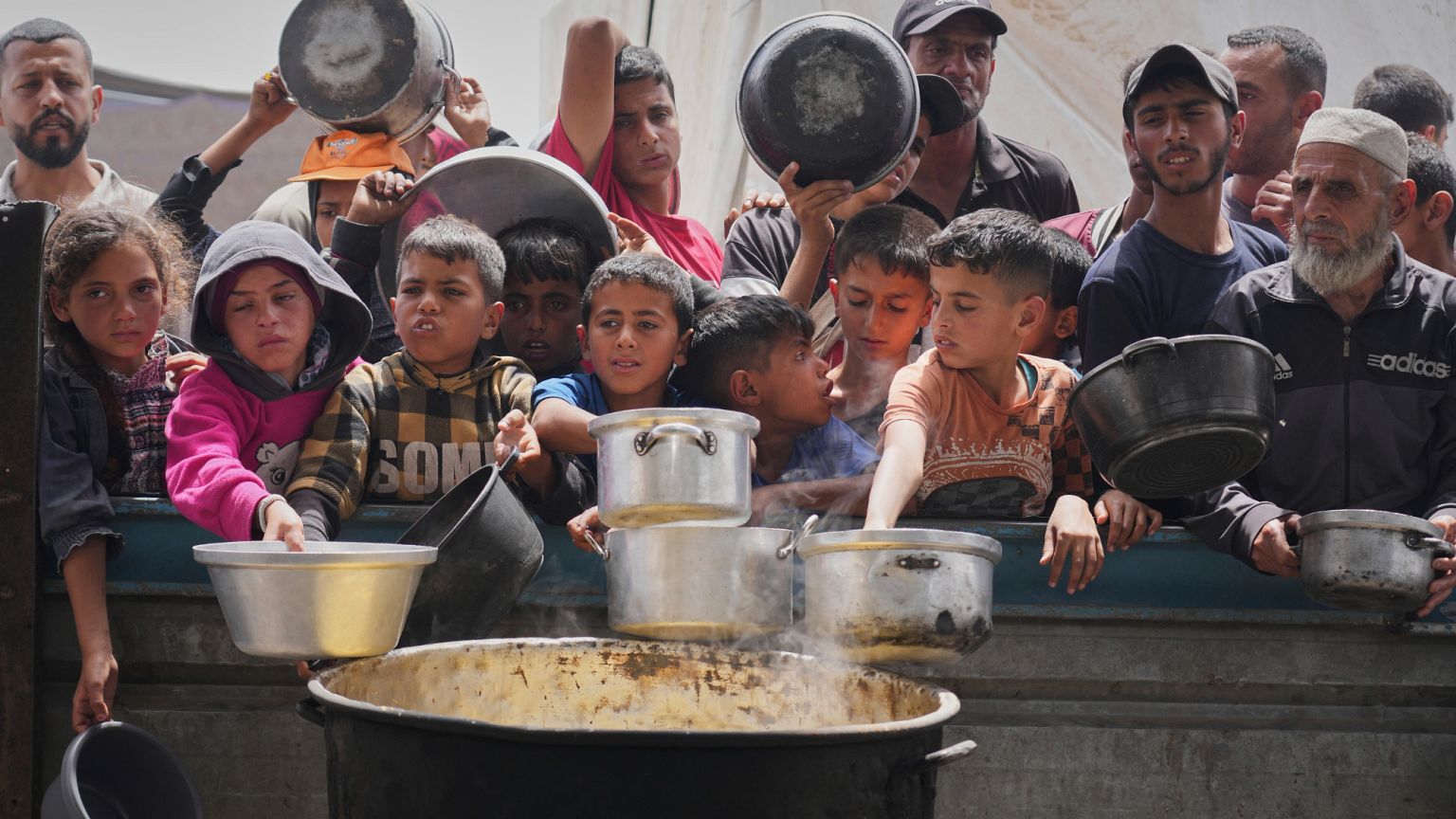
Copyright AP Photo
By Gavin Blackburn with AP
Published on 09/05/2025
A group of US security contractors, former military officers and humanitarian aid officials is proposing to take over the distribution of aid to Gaza based on plans similar to ones designed by Israel.
According to a proposal from the newly created group, the Gaza Humanitarian Foundation (GHF), obtained by AP, the idea is to implement a new aid distribution system supplanting the current one run by the UN and other international aid agencies.
The 14-page proposal circulated this week among aid groups and UN officials lays out plans similar to those Israel has been discussing privately with international aid groups for weeks.
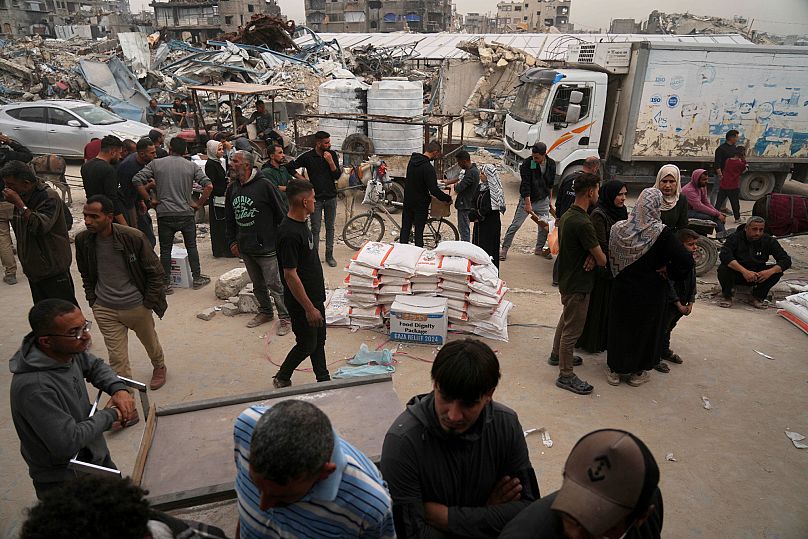
Under the new group's proposal, Palestinians would receive pre-packaged rations, potable water, hygiene kits, blankets and other supplies at four distribution hubs under the protection of private security contractors.
The group said it wants to partner with the UN and international aid groups in handing out their supplies.
A US official confirmed the authenticity of the proposal and said David Beasley, the former director of the UN World Food Program, is the lead choice to run GHF.
The official, speaking on condition of anonymity to discuss plans that have not been made public, said the proposal could still be revised, and Beasley's role is not confirmed.
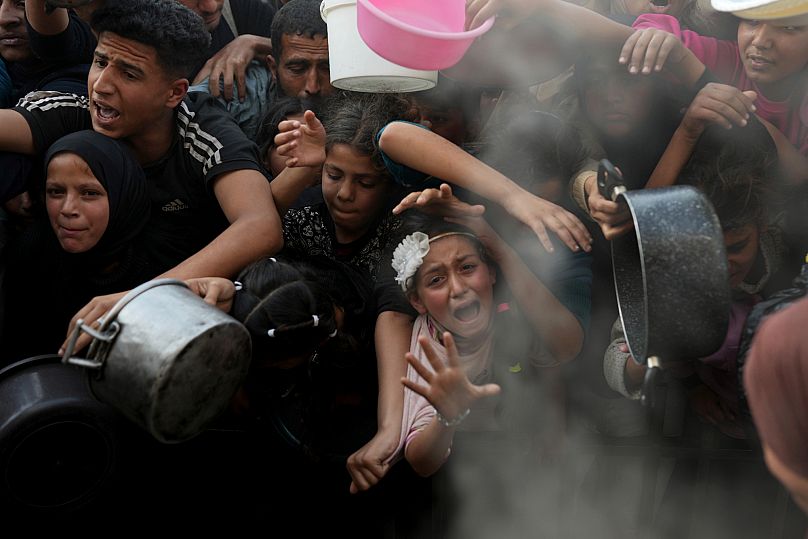
Israel has blocked food, fuel, medicine and all other supplies from entering Gaza for 10 weeks, worsening a humanitarian crisis for the 2.3 million Palestinians living in the enclave.
Officials say the aim of the blockade is to force Hamas militants to release the 59 hostages they still hold in Gaza.
Israel has also said it won't allow aid back into the Strip until a system is in place that gives it control over distribution.
A UN official said last week that Israel's plans would "weaponise aid" by placing restrictions on who is eligible to receive it.
Israel accuses Hamas and other militants of siphoning off large amounts of aid for personal gain and to strengthen their units. The UN and aid workers deny there is a significant diversion.
How would the proposal work?
According to the document, GHF would initially set up four distribution sites, each serving 300,000 people.
That would cover about half of Gaza's population. The system would be scaled up to meet the needs of 2 million people.
But the proposal does not provide a timeframe, and aid workers warn that food is rapidly running out in Gaza under Israel’s blockade.
The GHF proposal said subcontractors would use armoured vehicles to transport supplies from the Gaza border to distribution sites, where they would also provide security.
It did not specify who would provide security but said it could include personnel who previously worked in the Netzarim Corridor, an Israeli-held zone cutting off northern Gaza.
A private logistics and operations company, Safe Reach Solutions, has operated in the corridor.
GHF said people would receive assistance based on need, with no eligibility requirements. Aid workers say Israel has said it intends to vet aid recipients and screen them using facial recognition.
What have aid groups said?
Aid workers have criticised the plans, saying the proposal could not possibly meet the needs of Gaza's large population and that they would forcibly displace large numbers of Palestinians by forcing them to move nearer to the aid hubs.
Throughout the Israel-Hamas war in Gaza, the UN and other humanitarian groups have been carrying out a massive aid delivery programme.
They have trucked in supplies and distributed them across the territory, going as close as possible to where Palestinians were located.
What has chiefly hampered the system, aid workers have said, are Israeli military operations and restrictions on movement, as well as the low amount of aid allowed to enter even before the blockade.
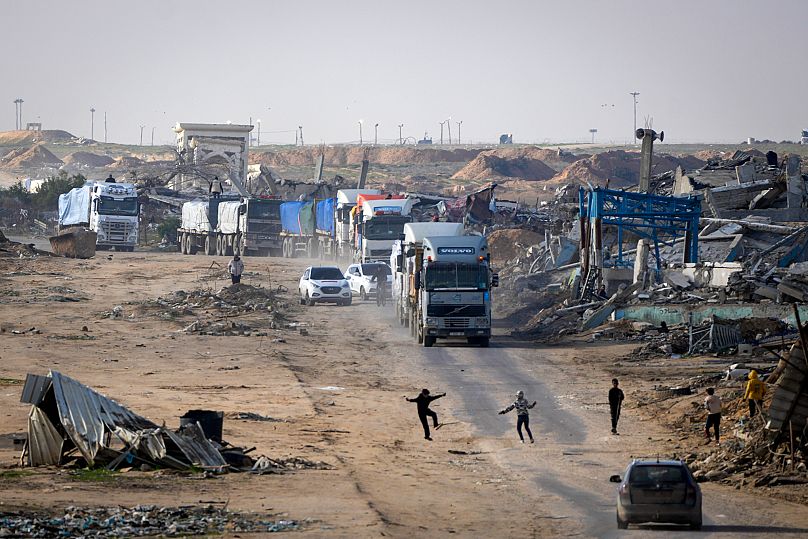
Convoys have also been attacked by criminal groups stealing aid, and Palestinians have sometimes taken supplies from trucks.
Aid workers have cast doubt on whether GHF would meet humanitarian requirements for neutrality and independence.
Shaina Low, communications adviser for Norwegian Refugee Council, one of the main organisations in Gaza, said aid groups are concerned the plan will be used "to advance military and political goals."
By forcing the population to relocate around aid hubs, the system would "depopulate entire parts of Gaza" and could be used to potentially expel the population, she said.
"They are framing (the plan) to fix the problem that doesn't really exist," she said, referring to Israel's claims that it must prevent Hamas from stealing aid.
Related
Israel says it's stopping all goods and aid from entering Gaza
The use of private security companies has also alarmed humanitarian workers. While it's common for private security firms to operate in conflict zones, they have to respect humanitarian law and, at minimum, be fully vetted and monitored, said Jamie Williamson, executive director of the International Code of Conduct Association.
Tamara Alrifai, communications director for the UN agency for Palestinian refugees, UNRWA, which has led the aid effort in Gaza, said the plan was logistically unworkable.
She said the foundation does not appear able to match the current infrastructure needed to distribute food and address other humanitarian needs.
Irish PM says Gaza is 'hell on earth'
Ireland's Taoiseach Micheál Martin called the situation in Gaza ‘hell on earth’. He told The Europe Conversation that Israel is committing war crimes, and criticised the EU’s lack of response. Food and medicine have been blocked from entering the besieged area for almost 60 days.
Martin has condemned what he described as Israel’s weaponisation of basic life necessities, referring to the country’s restriction on food and aid from entering the strip for almost two months. He told The Europe Conversation that this raises very significant issues for the European Union and the human rights laws which are central to the bloc's existence.
“In my view, this constitutes a war crime,” the Irish Prime Minister, who belongs to the Fianna Fáil party, said. “And I don't say that easily.”
He argued that he is in favour of a resolution, and wants the release of the hostages, stating it is “shocking to take people as hostages”. In November 2023, Martin visited a kibbutz where around 10% of the population was attacked during the 7 October attack by Hamas.
“I went to see, first hand, the impact of the horrific Hamas attack on Israel. I've condemned it from the outset when I went there to show empathy to people who have been attacked,” he said, adding that the hostages should have been released a long time ago.
He said however that the war waged in response has “lost any moral compass in terms of its unacceptable impact on the civilian population and on children”.
“And in Ireland, there is this sadness now and horror and a sense of helplessness at what we see on our TV screens: young children in stretchers and hospitals, very badly injured. Many families being wiped out, kids being orphaned. From a humanity point of view, it's beyond comprehension.”
The Taoiseach denounced what he called Israel’s “doubling down” in terms of intensification of the war on the ground. “I know that Israel would say, well, Hamas is in the hospitals and so forth. But children need basic access to medicine,” he said.
‘Hell on Earth’
Martin met with Ursula von der Leyen in Brussels on Thursday, discussing matters ranging from trade and support for Ukraine to the Middle East. During this meeting, the Taoiseach shared his concerns about the ongoing humanitarian crisis.
“I think the president heard clearly my perspective on it. And I think she understands where I'm coming from and where others are coming from,” Martin said.
“I anticipate that there will be a lot of thinking across Europe on this issue.” While he welcomed the European Union’s announcement of the recent €1.6 billion financial support package for Palestinians, Martin noted that, when it comes to a response, he doesn’t believe there is a consensus within the European Union.
“I acknowledge and I understand the different backgrounds of member states, and the historic background that has informed member states' approach to the Middle East,” he said.
“But there is an unacceptable level of death and destruction and displacement [in Gaza]. And it is, many people have said, going back to 2011, it's hell on earth.”
He argued that the EU has been quick to communicate its concerns to other countries around the world when they violate territorial integrity, adding that this is fundamental to the European Union and what it stands for.
Israel argued in the past that the restriction of aid is lawful and that Gaza still has enough available provisions.
Israeli foreign minister Gideon Sa'ar announced the closure of the Israeli embassy in Dublin in December last year due to what he described as the "extreme anti-Israel policy of the Irish government" which he characterised as "antisemitism".
Last month, Fine Gael - in coalition with Martin's Fianna Fáil - confirmed its delegates at the European People’s Party's Valencia congress refused to put their names to a motion condemning Hamas’ October 7, 2023 attacks in Israel and calling for the release of remaining hostages, and defended the party’s position. The Fine Gael delegation said it could not support the motion because it didn’t mention “the ongoing suffering of the people of Gaza", as reported.
Euronews has contacted the Israeli embassy in Brussels and the mission of Israel to the EU and NATO for a response.
The Netherlands pivots on Israel as it asks for EU-Israel trade deal review
Dutch Foreign Minister Caspar Veldkamp said his government is "drawing a line in the sand" over the Gaza humanitarian aid blockade, which he says goes against international humanitarian law.
The Netherlands is ramping up its pressure on Israel over its war on Hamas in Gaza in what appears to be a significant change in course for one of Israel's most loyal allies.
Dutch Foreign Minister Caspar Veldkamp said on Wednesday that Israel's ongoing blockade of humanitarian aid is in violation of international humanitarian law, and urged collective action from Brussels to review the EU-Israel trade deal.
"What we're doing here, is giving a very clear signal," Veldkamp said at the meeting of EU foreign ministers in Warsaw.
"We've drawn our line in the sand because the situation in Gaza Strip is dismal, it's a catastrophic humanitarian situation," he added.
Ahead of the meeting, Veldkamp had written a letter to EU foreign affairs chief Kaja Kallas urging a review of the EU-Israel trade deal, saying Israel is violating the association agreement.
The letter, seen by Euronews, states that Israel's "continued blockade of humanitarian aid and electricity supplies to the Gaza Strip" is "at odds with the provisional measures of the International Court of Justice."
Veldkamp also wrote that Israel's intended system to control all aid distribution in Gaza does not comply with humanitarian principles of "neutrality, impartiality and independence."
The Dutch proposal will be examined when EU foreign ministers next convene in Brussels on May 20, top diplomat Kaja Kallas confirmed on Thursday.
She added that further possible responses to Israel's plans to expand the war in Gaza would be “brainstormed.”
The EU-Israel Association Agreement governs trade ties between the two partners “shall be based on respect for human rights and democratic principles.”
The Dutch government intends to veto any agreement extension pending an EU review into Israel's compliance with the pact, which came into force in 2000.
The EU is Israel's largest trading partner, and the Netherlands has previously led initiatives to block discussions on suspending the association agreement.
It is some of the strongest language yet from the Dutch government against its ally, which has so far avoided outright accusing Israel of violating international law.
Pressure from aid organisations
The Dutch government had been on the receiving end of mounting pressure from local branches of international aid organisations to take a stronger stance against Israeli violence in Gaza.
Dutch Prime Minister Dick Schoof sat down with representatives of Oxfam Novib, Amnesty International, Pax, Save the Children and Doctors Without Borders last month, who had then expressed disappointment at the conversation's outcome.
"There is no red line for the government. They are holding onto the conviction that diplomatic pressure achieves more," Oxfam Novib director Michiel Servaes asid.
On Thursday, Schoof expressed support for Veldkamp's statements, saying they reflect government policy. He said Israel's announcement to expand its operations in Gaza and control the entire Strip was probably a factor that contributed to Veldkamp's decision to write to Kallas.
Still, the move was not without internal criticism. Geert Wilders of the hard-right PVV, the main coalition partner and the winner of the most recent national election, lashed out at Veldkamp on X, calling him a "weak minister".
Other foreign ministers present in Warsaw echoed Veldkamp's words.
Belgian Foreign Minister Maxime Prévot said, "it’s time for the European Union and the whole international community to wake up. Honestly, what we are seeing is an absolute shame. It’s not acceptable.”
Luxembourg Foreign Minister Xavier Bettel said he had spent much time in the region in recent months, but his pleas to Israel to show restraint have been in vain.
“I have the feeling they’re listening to no one. I fully understand they have pressure, and Hamas, and they still have hostages. But we have to be around to table to see how we can find solutions,” Bettel told reporters.
“We need to find a solution to that and not to give the impression to the Palestinians that at the end of the day, they won’t exist anymore,” he said.
The Israel-Hamas war began when Hamas militants attacked southern Israel on 7 October 2023, killing around 1,200 people, most of them civilians. Hamas took 251 people as hostages, and is currently holding 59, of whom 24 are believed to be alive.
A subsequent Israeli offensive has to date killed 52,400 Palestinians, mostly women and children, according to the Hamas-run Gaza health ministry whose figures do not distinguish between fighters and civilians.
The Israeli military says 850 of its soldiers have died since the start of the war.

No comments:
Post a Comment