Former French surgeon Joël Le Scouarnec sexually abused 299 children over the course of 25 years, most of whom were under the age of 15, in one of the largest cases of child sexual abuse France has ever seen. As the trial comes to a close, his victims and organisations combatting violence against children wish the case had garnered more public attention or political action.
Analysis
Issued on: 27/05/2025
FRANCE24
By: Lara BULLENS

Protestors react during a demonstration in support of the victims of former surgeon Joel Le Scouarnec outside the court in Vannes, western France on May 19, 2025.
AFP - DAMIEN MEYER
Just over a dozen victims and their families rallied outside a courthouse in western France last week, surrounded by activists.
By their feet, a crime scene had been reconstructed. Symbolic objects like children’s clothes, toys and a notebook were scattered atop a white sheet. Each object was given a number, as though it would later be taken in for forensic testing.
Joël Le Scouarnec, a French paedophile surgeon accused of raping and abusing 299 child patients between 1989 and 2014, has been on trial since February in one of the largest sex abuse cases France has ever seen.
A final verdict is expected tomorrow, on May 28.
Just over a dozen victims and their families rallied outside a courthouse in western France last week, surrounded by activists.
By their feet, a crime scene had been reconstructed. Symbolic objects like children’s clothes, toys and a notebook were scattered atop a white sheet. Each object was given a number, as though it would later be taken in for forensic testing.
Joël Le Scouarnec, a French paedophile surgeon accused of raping and abusing 299 child patients between 1989 and 2014, has been on trial since February in one of the largest sex abuse cases France has ever seen.
A final verdict is expected tomorrow, on May 28.
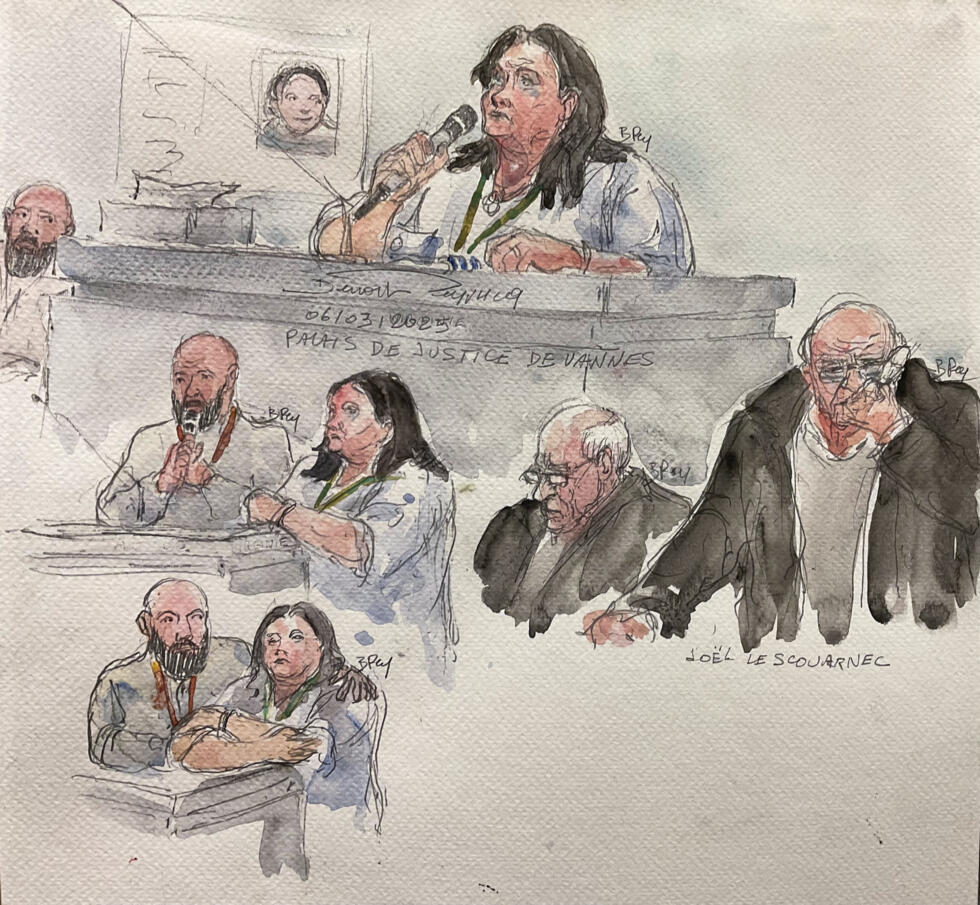
This court sketch from 6 March shows a victim being auditioned and French paedophile surgeon Joel Le Scouarnec during his trial.
© Benoit Peyrucq, AFP
As the three-month trial draws to a close, victims and organisations combatting child abuse are not only frustrated with the lack of attention the case has received, but angry at the meagre actions taken by the French government to ensure a crime of this scale never happens again.
‘Shame must change sides’
But it is not for want of trying. Those who fell victim to Le Scouarnec’s abuse as children have made significant efforts to try and draw public attention to the case, and the issue of child sexual abuse more broadly.
Many waived their right to anonymity in the hearings, agreeing to testify in the courtroom. Others demanded action, like Nicolas Gourlet, who during his testimony in late April asked that “things change so we don’t end up with another Le Scouarnec out there”.
Gourlet was sexually assaulted by Le Scouarnec in 2006 at the age of 13, after undergoing surgery for a cyst on his navel. He is now 31 years old.
Throughout the trial, an increasing number of victims also changed their minds about speaking openly to the press in the hope that “shame changes sides”, as Gourlet said, echoing the words of Gisèle Pelicot in the mass rape trial that rocked France last year.
Read moreFrance unveils new measures to protect women in wake of Pelicot affair
But despite their efforts, Le Scouarnec’s victims say very little has been done.
“Nothing is happening. We haven’t seen a single political reaction,” Manon Lemoine, who was 11 when she was raped by Le Scouarnec, told AFP. “Despite how difficult this trial is for us, we are obliged to put our energy into making ourselves heard, to try and get a bit of visibility, a bit of consideration,” she said.

As the three-month trial draws to a close, victims and organisations combatting child abuse are not only frustrated with the lack of attention the case has received, but angry at the meagre actions taken by the French government to ensure a crime of this scale never happens again.
‘Shame must change sides’
But it is not for want of trying. Those who fell victim to Le Scouarnec’s abuse as children have made significant efforts to try and draw public attention to the case, and the issue of child sexual abuse more broadly.
Many waived their right to anonymity in the hearings, agreeing to testify in the courtroom. Others demanded action, like Nicolas Gourlet, who during his testimony in late April asked that “things change so we don’t end up with another Le Scouarnec out there”.
Gourlet was sexually assaulted by Le Scouarnec in 2006 at the age of 13, after undergoing surgery for a cyst on his navel. He is now 31 years old.
Throughout the trial, an increasing number of victims also changed their minds about speaking openly to the press in the hope that “shame changes sides”, as Gourlet said, echoing the words of Gisèle Pelicot in the mass rape trial that rocked France last year.
Read moreFrance unveils new measures to protect women in wake of Pelicot affair
But despite their efforts, Le Scouarnec’s victims say very little has been done.
“Nothing is happening. We haven’t seen a single political reaction,” Manon Lemoine, who was 11 when she was raped by Le Scouarnec, told AFP. “Despite how difficult this trial is for us, we are obliged to put our energy into making ourselves heard, to try and get a bit of visibility, a bit of consideration,” she said.
Protesters recreate an evidence scene during a demonstration in support of the victims of Le Scouarnec on May 19, 2025.
© Damien Meyer, AFP
The victims' group has asked the French government to form a special committee of representatives from the health and justice ministries, as well as the children’s commissioner, to draw lessons from the Scouarnec case and improve the government response to, and prevention of, child sexual abuse.
“We haven’t heard back yet, but we’re waiting for them to act on what’s happening now, on this tragedy,” Lemoine said.
Gabriel Trouve, who was assaulted by Le Scouarnec at age 5 when he was hospitalised, believes the trial should serve as an “open-air lab” to expose “all the systemic failures” that exist, and to ensure a “solid support and prevention system” is put in place.
In the shadow of Pelicot and Betharram
Those frustrated with the lack of public attention the Scouarnec trial received have often made comparisons to the Pelicot trial and the sex abuse scandal at the Catholic boarding school Notre-Dame de Bétharram, which has garnered a lot of attention in recent months.
But Martine Brousse, president of “La Voix de l’Enfant”, a French organisation that combats violence against children, says that the case against Scouarnec has not gained as much attention as the Pelicot or Bétharram trials partly because of how isolated the former surgeon’s victims were from the start.
“Most of them didn’t know each other before the trial. And while some people knew they had been abused or raped, some only found out during the investigation,” Brousse underlines.
“In the Pelicot trial, it was one woman surrounded by feminist organisations. In the case of Bétharram, hundreds of victims banded together and created a collective [with an appointed spokesperson],” she continues. “That is not the case for the victims of Le Scouarnec.”
The spokesperson at the head of the Bétharram collective also published a book on April 24, called "The Silence of Bétharram".
But the sex abuse scandal at the Bétharram Catholic school in southwest France also had important political implications. Prime Minister François Bayrou was accused of knowing about the widespread abuse that took place at the school during his time as education minister between 1993 and 1997. One of his own daughters, Hélène Perlant, spoke out about suffering abuse while attending summer camp at the school when she was 14.
Bayrou denies the accusations, but faced one of the most delicate moments of his tenure so far when he was questioned about the abuse by a parliamentary committee – amplifying debates around the case in both the political and public spheres.
As the trial closes, Brousse thinks it is “unfortunately too late” for the victims to create the same amount of traction as the Pelicot and Bétharram cases.
Le Scouarnec was questioned for the last time on May 20 at a hearing in a courthouse in Vannes, western France.
A long road ahead
For Brousse, there are many things that have changed to better protect children in medical settings in recent decades.
Paediatric reception centres known as “Enfants en Danger” (“Children in Danger”) or UAPED have become widespread across France. The specialised service brings together paediatricians, child psychiatrists, forensic doctors, legal professionals and psychologists who accommodate victims in a safe location and offer them support. Training on violence against children is also recommended to all healthcare professionals, though not mandatory.
“But there is still a long way to go,” Brousse says. “Especially regarding prevention.”
Le Scouarnec was first convicted 20 years ago, in 2005, for possession of child pornography. He was given a four-month suspended prison sentence and a €90 fine. But the paedophile surgeon continued to work in hospitals, without any professional restrictions, and continued to abuse children until he was finally arrested in 2017.
“I’m always surprised at how few penalties there are for possessing child pornography,” says Solène Podevin-Favre, the co-director of Ciivise, an independent commission that collects testimonies on incest and sexual violence towards children.
“These are people who take pleasure in seeing a child being raped,” she continues. “We need to monitor and punish professionals accordingly.”
France increased the minimum sentence for possessing and consulting child pornography from three to five years in 2021, as part of a three-year plan to end violence against children. Offenders are also now automatically included in a registry that bans them from working with children.
What has shocked many in the Scouarnec case was the lack of disciplinary action the paedophile received, despite numerous attempts to flag him.
Read more'They knew and did nothing': French surgeon's trial for sexual abuse exposes systematic failures
A psychiatrist who worked with Le Scouarnec raised concerns in 2006 after his initial conviction and wrote to the Order of Physicians, which regulates France’s medical profession. He doubted the former surgeon’s ability to “remain completely calm when treating young children”, but no action was taken.
The hospital they worked at promoted Le Scouarnec as head of surgery instead, and its director applauded his “excellent relations both with patients and their families”.
“Anywhere children are being looked after, whether it is a school or a sports club or a hospital, employees should be systematically obliged to present certificates proving they have not previously been convicted [of child abuse],” Brousse says. “That is what prevention is all about. Making sure you don’t let a predator into your establishment.”
Podevin-Favre agrees with Brousse that people working with children should be screened regularly. “We need to systematically check their files to see if they are listed as perpetrators of sexual or violent offenses. Not only when they are hired, but every year, to ensure that children are safe to be around them.”
The French government approved a recommendation by Ciivise to make these kinds of checks mandatory. “While this means the government considers the measure a priority and is committed to implementing it, it is still unclear when that will happen and with what resources,” Podevin Favre explains.
Another recommendation made by the commission is to make it mandatory for doctors to report all cases of abuse, “not only for minors under the age of 15, which was the case until now, and ensuring those who report a case are not sanctioned by the Order of Physicians”, says Podevin-Favre. That recommendation was also greenlit by the government.
The Order of Physicians has come under fire for not responding to initial warnings concerning Le Scouarnec. And a 2019 report by the Court of Auditors revealed that the institution did not address sexual misconduct allegations “with sufficient rigour”. From 2014 to 2017, 43 percent of complaints were dismissed, and only 12 percent resulted in medical licenses being revoked.
The report even made a direct reference to Le Scouarnec on page 108 when it mentioned the "recent actions of a surgeon" in western France, saying the case was "proof" of how important it is for the Order of Physicians to share information as quickly as possible.
“There is no comprehensive child protection policy in France, and that’s what’s really lacking,” Podevin-Favre points out. “We pile up measures left and right, but we don’t provide the means for a response that is up to par with the issue of child sexual abuse.”
“We have to stay vigilant. And we have to give children the benefit of the doubt,” concludes Brousse.
'They knew and did nothing': French surgeon's trial for sexual abuse exposes systematic failures
The victims' group has asked the French government to form a special committee of representatives from the health and justice ministries, as well as the children’s commissioner, to draw lessons from the Scouarnec case and improve the government response to, and prevention of, child sexual abuse.
“We haven’t heard back yet, but we’re waiting for them to act on what’s happening now, on this tragedy,” Lemoine said.
Gabriel Trouve, who was assaulted by Le Scouarnec at age 5 when he was hospitalised, believes the trial should serve as an “open-air lab” to expose “all the systemic failures” that exist, and to ensure a “solid support and prevention system” is put in place.
In the shadow of Pelicot and Betharram
Those frustrated with the lack of public attention the Scouarnec trial received have often made comparisons to the Pelicot trial and the sex abuse scandal at the Catholic boarding school Notre-Dame de Bétharram, which has garnered a lot of attention in recent months.
But Martine Brousse, president of “La Voix de l’Enfant”, a French organisation that combats violence against children, says that the case against Scouarnec has not gained as much attention as the Pelicot or Bétharram trials partly because of how isolated the former surgeon’s victims were from the start.
“Most of them didn’t know each other before the trial. And while some people knew they had been abused or raped, some only found out during the investigation,” Brousse underlines.
“In the Pelicot trial, it was one woman surrounded by feminist organisations. In the case of Bétharram, hundreds of victims banded together and created a collective [with an appointed spokesperson],” she continues. “That is not the case for the victims of Le Scouarnec.”
The spokesperson at the head of the Bétharram collective also published a book on April 24, called "The Silence of Bétharram".
But the sex abuse scandal at the Bétharram Catholic school in southwest France also had important political implications. Prime Minister François Bayrou was accused of knowing about the widespread abuse that took place at the school during his time as education minister between 1993 and 1997. One of his own daughters, Hélène Perlant, spoke out about suffering abuse while attending summer camp at the school when she was 14.
Bayrou denies the accusations, but faced one of the most delicate moments of his tenure so far when he was questioned about the abuse by a parliamentary committee – amplifying debates around the case in both the political and public spheres.
As the trial closes, Brousse thinks it is “unfortunately too late” for the victims to create the same amount of traction as the Pelicot and Bétharram cases.
Le Scouarnec was questioned for the last time on May 20 at a hearing in a courthouse in Vannes, western France.
A long road ahead
For Brousse, there are many things that have changed to better protect children in medical settings in recent decades.
Paediatric reception centres known as “Enfants en Danger” (“Children in Danger”) or UAPED have become widespread across France. The specialised service brings together paediatricians, child psychiatrists, forensic doctors, legal professionals and psychologists who accommodate victims in a safe location and offer them support. Training on violence against children is also recommended to all healthcare professionals, though not mandatory.
“But there is still a long way to go,” Brousse says. “Especially regarding prevention.”
Le Scouarnec was first convicted 20 years ago, in 2005, for possession of child pornography. He was given a four-month suspended prison sentence and a €90 fine. But the paedophile surgeon continued to work in hospitals, without any professional restrictions, and continued to abuse children until he was finally arrested in 2017.
“I’m always surprised at how few penalties there are for possessing child pornography,” says Solène Podevin-Favre, the co-director of Ciivise, an independent commission that collects testimonies on incest and sexual violence towards children.
“These are people who take pleasure in seeing a child being raped,” she continues. “We need to monitor and punish professionals accordingly.”
France increased the minimum sentence for possessing and consulting child pornography from three to five years in 2021, as part of a three-year plan to end violence against children. Offenders are also now automatically included in a registry that bans them from working with children.
What has shocked many in the Scouarnec case was the lack of disciplinary action the paedophile received, despite numerous attempts to flag him.
Read more'They knew and did nothing': French surgeon's trial for sexual abuse exposes systematic failures
A psychiatrist who worked with Le Scouarnec raised concerns in 2006 after his initial conviction and wrote to the Order of Physicians, which regulates France’s medical profession. He doubted the former surgeon’s ability to “remain completely calm when treating young children”, but no action was taken.
The hospital they worked at promoted Le Scouarnec as head of surgery instead, and its director applauded his “excellent relations both with patients and their families”.
“Anywhere children are being looked after, whether it is a school or a sports club or a hospital, employees should be systematically obliged to present certificates proving they have not previously been convicted [of child abuse],” Brousse says. “That is what prevention is all about. Making sure you don’t let a predator into your establishment.”
Podevin-Favre agrees with Brousse that people working with children should be screened regularly. “We need to systematically check their files to see if they are listed as perpetrators of sexual or violent offenses. Not only when they are hired, but every year, to ensure that children are safe to be around them.”
The French government approved a recommendation by Ciivise to make these kinds of checks mandatory. “While this means the government considers the measure a priority and is committed to implementing it, it is still unclear when that will happen and with what resources,” Podevin Favre explains.
Another recommendation made by the commission is to make it mandatory for doctors to report all cases of abuse, “not only for minors under the age of 15, which was the case until now, and ensuring those who report a case are not sanctioned by the Order of Physicians”, says Podevin-Favre. That recommendation was also greenlit by the government.
The Order of Physicians has come under fire for not responding to initial warnings concerning Le Scouarnec. And a 2019 report by the Court of Auditors revealed that the institution did not address sexual misconduct allegations “with sufficient rigour”. From 2014 to 2017, 43 percent of complaints were dismissed, and only 12 percent resulted in medical licenses being revoked.
The report even made a direct reference to Le Scouarnec on page 108 when it mentioned the "recent actions of a surgeon" in western France, saying the case was "proof" of how important it is for the Order of Physicians to share information as quickly as possible.
“There is no comprehensive child protection policy in France, and that’s what’s really lacking,” Podevin-Favre points out. “We pile up measures left and right, but we don’t provide the means for a response that is up to par with the issue of child sexual abuse.”
“We have to stay vigilant. And we have to give children the benefit of the doubt,” concludes Brousse.
'They knew and did nothing': French surgeon's trial for sexual abuse exposes systematic failures
The trial of French surgeon Joël Le Scouarnec began on Monday with him facing accusations of assaulting nearly 300 patients, mostly children, over several decades. The case has sparked widespread outrage, with France’s Order of Physicians accused of turning a blind eye to early warnings.
Explainer
Issued on: 24/02/2025 -
By: Anaelle JONAH
FRANCE24

This court sketch created on February 24, 2025 shows retired surgeon Joel Le Scouarnec during a hearing on the opening day of his trial on charges of assaulting or raping 299 patients at the Criminal Court in Vannes.
© Benoit Peyrucq, AFP
French surgeon Joël Le Scouarnec, already serving a 15-year prison sentence for child abuse, went on trial on Monday accused of sexually assaulting nearly 300 patients, most of them children, over several decades. The 74-year-old, who continued practising medicine despite a 2005 conviction for possessing child abuse images and repeated warnings from colleagues, faces up to 20 additional years in prison if found guilty.
"I've done hideous things," Le Scouarnec told the court as his trial opened, adding that he is "perfectly aware these wounds cannot be erased or healed".
Read moreFrench former surgeon admits to ‘vast majority’ of cases in historic child sexual abuse trial
Held at the Criminal Court of Morbihan in Brittany, the new trial centres on allegations that Le Scouarnec assaulted or raped 299 patients, primarily while they were under general anaesthesia, between 1989 and 2014. Of the victims, 256 were under the age of 15, with the youngest just one year old.
Le Scouarnec was first convicted in 2020 for abusing four children, including two of his nieces. However, his ability to continue practising medicine until his retirement despite early red flags has drawn sharp criticism of France’s medical regulatory bodies, particularly the Order of Physicians, which is now a civil party in the case.
"How many people knew he was a paedophile and let him practise medicine?" one victim asked AFP. "They knew and they did nothing."
Systemic failures under scrutiny
Le Scouarnec was flagged by the FBI in 2004 for accessing child abuse images online while he was working in Lorient, a city in Britanny. A year later, a French court handed him a suspended four-month sentence. By then, he had already moved to a city 20 kilometres away in Quimperlé, where he was welcomed as a much-needed surgeon.
Psychiatrist Thierry Bonvalot, who worked with Le Scouarnec at the local hospital, raised concerns in 2006 after learning of his conviction.
"He described surgery using so many sexual metaphors that I was shocked. He admitted he had been sentenced for child pornography," Bonvalot told AFP. "I realised he was dangerous and asked him to resign. He refused."
Bonvalot wrote to the Order of Physicians, which regulates France’s medical profession, questioning Le Scouarnec’s ability "to remain completely calm when treating young children" in view of his "legal past".
However, no action was taken. Instead, the hospital promoted Le Scouarnec to head of surgery, with the director describing him as a "serious and competent" doctor with "excellent relations both with patients and their families, as well as with staff".
A report questioning his moral fitness to practise medicine reached the health ministry in 2007 after the "concerning" death of a patient on his operation table. However, due to a government reshuffle, no action was taken. Le Scouarnec continued working in Brittany before moving to Jonzac in southwestern France in 2008, where he remained until his retirement in 2017.
It was only in 2017, when a 6-year-old girl accused him of rape, that police uncovered extensive diaries detailing decades of abuse.
'Illegitimate and irresponsible'
The Order of Physicians has faced mounting criticism for its failure to act on early warnings about Le Scouarnec. Victims and medical associations have condemned the organisation’s inaction as reckless.
"We believe that the constitution of a civil party is illegitimate and irresponsible, not to say insulting in view of [the Order of Physicians’] inaction since 2006," a group of doctors’ unions and associations said in a statement ahead of the trial.
The Order, which did not accept FRANCE 24's request for comment on the case, said it will "reserve its comments for the time of the hearing".
In a separate statement, it pledged to fight against sexual violence in medicine. "In recent years, the Order of Physicians has undertaken reforms to strengthen vigilance and coordination with the judiciary. Such acts should never have happened and must never happen again," it said.
However, a 2019 report by the Court of Auditors found that the organisation failed to handle sexual misconduct cases "with sufficient rigour". Between 2014 and 2017, 43 percent of complaints were dismissed, and only 12 percent led to disbarment.
Doctors 'can't be neutral'
The case has reignited calls for reforms to France’s medical ethics codes, which critics say discourage doctors from reporting abuse. Those who speak out risk legal consequences for violating professional "fraternity" rules.
"There have been cases where professionals reported an offence and were then sued for breaching professional solidarity. This has to stop. Doctors who report sexual assault must be protected," said Dr. Gilles Lazimi, a general practitioner and member of the High Council for Equality Between Women and Men.
The Independent Commission on Incest and Sexual Violence Against Children has repeatedly called for reforms, warning in 2022 and again in 2024 that doctors who report abuse risk professional retaliation.
The commission also urged clarification “on the obligation for doctors to report child victims of sexual violence".
"A doctor can't be neutral. He can't remain silent, can't fail to act. If he stays silent, he is necessarily on the side of the aggressor," Lazimi said.
The trial is expected to last several weeks, with the verdict likely to have far-reaching implications for the regulatory framework for French medicine.
French surgeon Joël Le Scouarnec, already serving a 15-year prison sentence for child abuse, went on trial on Monday accused of sexually assaulting nearly 300 patients, most of them children, over several decades. The 74-year-old, who continued practising medicine despite a 2005 conviction for possessing child abuse images and repeated warnings from colleagues, faces up to 20 additional years in prison if found guilty.
"I've done hideous things," Le Scouarnec told the court as his trial opened, adding that he is "perfectly aware these wounds cannot be erased or healed".
Read moreFrench former surgeon admits to ‘vast majority’ of cases in historic child sexual abuse trial
Held at the Criminal Court of Morbihan in Brittany, the new trial centres on allegations that Le Scouarnec assaulted or raped 299 patients, primarily while they were under general anaesthesia, between 1989 and 2014. Of the victims, 256 were under the age of 15, with the youngest just one year old.
Le Scouarnec was first convicted in 2020 for abusing four children, including two of his nieces. However, his ability to continue practising medicine until his retirement despite early red flags has drawn sharp criticism of France’s medical regulatory bodies, particularly the Order of Physicians, which is now a civil party in the case.
"How many people knew he was a paedophile and let him practise medicine?" one victim asked AFP. "They knew and they did nothing."
Systemic failures under scrutiny
Le Scouarnec was flagged by the FBI in 2004 for accessing child abuse images online while he was working in Lorient, a city in Britanny. A year later, a French court handed him a suspended four-month sentence. By then, he had already moved to a city 20 kilometres away in Quimperlé, where he was welcomed as a much-needed surgeon.
Psychiatrist Thierry Bonvalot, who worked with Le Scouarnec at the local hospital, raised concerns in 2006 after learning of his conviction.
"He described surgery using so many sexual metaphors that I was shocked. He admitted he had been sentenced for child pornography," Bonvalot told AFP. "I realised he was dangerous and asked him to resign. He refused."
Bonvalot wrote to the Order of Physicians, which regulates France’s medical profession, questioning Le Scouarnec’s ability "to remain completely calm when treating young children" in view of his "legal past".
However, no action was taken. Instead, the hospital promoted Le Scouarnec to head of surgery, with the director describing him as a "serious and competent" doctor with "excellent relations both with patients and their families, as well as with staff".
A report questioning his moral fitness to practise medicine reached the health ministry in 2007 after the "concerning" death of a patient on his operation table. However, due to a government reshuffle, no action was taken. Le Scouarnec continued working in Brittany before moving to Jonzac in southwestern France in 2008, where he remained until his retirement in 2017.
It was only in 2017, when a 6-year-old girl accused him of rape, that police uncovered extensive diaries detailing decades of abuse.
'Illegitimate and irresponsible'
The Order of Physicians has faced mounting criticism for its failure to act on early warnings about Le Scouarnec. Victims and medical associations have condemned the organisation’s inaction as reckless.
"We believe that the constitution of a civil party is illegitimate and irresponsible, not to say insulting in view of [the Order of Physicians’] inaction since 2006," a group of doctors’ unions and associations said in a statement ahead of the trial.
The Order, which did not accept FRANCE 24's request for comment on the case, said it will "reserve its comments for the time of the hearing".
In a separate statement, it pledged to fight against sexual violence in medicine. "In recent years, the Order of Physicians has undertaken reforms to strengthen vigilance and coordination with the judiciary. Such acts should never have happened and must never happen again," it said.
However, a 2019 report by the Court of Auditors found that the organisation failed to handle sexual misconduct cases "with sufficient rigour". Between 2014 and 2017, 43 percent of complaints were dismissed, and only 12 percent led to disbarment.
Doctors 'can't be neutral'
The case has reignited calls for reforms to France’s medical ethics codes, which critics say discourage doctors from reporting abuse. Those who speak out risk legal consequences for violating professional "fraternity" rules.
"There have been cases where professionals reported an offence and were then sued for breaching professional solidarity. This has to stop. Doctors who report sexual assault must be protected," said Dr. Gilles Lazimi, a general practitioner and member of the High Council for Equality Between Women and Men.
The Independent Commission on Incest and Sexual Violence Against Children has repeatedly called for reforms, warning in 2022 and again in 2024 that doctors who report abuse risk professional retaliation.
The commission also urged clarification “on the obligation for doctors to report child victims of sexual violence".
"A doctor can't be neutral. He can't remain silent, can't fail to act. If he stays silent, he is necessarily on the side of the aggressor," Lazimi said.
The trial is expected to last several weeks, with the verdict likely to have far-reaching implications for the regulatory framework for French medicine.
No comments:
Post a Comment