
The genocide in Gaza is fast approaching 20 months since it began. My family and I have been displaced from our home in the Jabaliya refugee camp several times, but this is the first time we were forced to leave the north and flee south to Deir al-Balah, from where I am writing to you.
Living in Jabaliya had become impossible. By stripping us of our health and money, ongoing displacement has forced changes on us: from being a proud family to one that lives in humiliation. We were pushed south last month, during Israel’s fourth invasion of Jabaliya in mid-May. In preparation for yet another ground invasion, the Israeli military started pounding Jabaliya with airstrikes, leveling buildings to the ground. Israeli troops began advancing from the north and the east, getting closer every day.
I started looking for a home to rent in western Gaza City, where it was somewhat safer and where we could find some kind of shelter. On May 20, while returning from that search, my father called me in a panic to say a quadcopter was firing heavily at our home in the western Jabaliya camp. Our time was up. We had to flee. So we decided to spend the night at my brother’s burned down house in central Jabaliya.
We figured we would stay the night and leave the next morning, but that night we were plunged into the depths of hell.
Just two hours after arriving at my brother’s place, we heard someone outside shouting, “People of the neighborhood! The army is threatening to bomb the area! Evacuate immediately!” My legs began to tremble. Barely ten seconds later, the house next to our was bombed. It felt like the Day of Judgment had come, and my brother’s house would be next. I scrambled and grabbed some of my mother’s things, picked up my five-year-old niece, Deema, and ran down the stairs.
I found my mother—an elderly woman in her sixties—on the ground floor struggling to make her way through the rubble to escape. She could barely stand, and she couldn’t see in the pitch-black darkness. I held her hand, picked up the bags, and while still carrying Deema, we made our way outside. We walked, not knowing where we were going. We just walked blindly.
We couldn’t hear each other because of the shock. One person would say something and another would reply with something else. I was silent, unable to speak or think. We eventually made our way to my cousin’s house on Al-Jalaa Street in western Gaza City. I don’t know how we managed it. I don’t know how my mother was able to walk that far. I don’t know how Deema stayed asleep on my shoulder while I carried her and the bags.
The next morning, we managed to return home because the army tends to retreat slightly during the dayrun. We took advantage of that brief window to gather our things from our homes in west and central Jabaliya to leave for Deir al-Balah.
Two years before the war, my father had built the house we left in Jabaliya. He had just retired from teaching, and he poured his entire life savings into the multi-story home—with a 180-square meter apartment for each of his seven children. My older brother bought plots of land nearby for his children. We finally had some semblance of stability and a future. The genocide has crushed all of that.
Every time Israel issued a displacement order, we were forced to leave it all behind. Yet we always managed to return. Since the start of this war, we only lived in our newly-built home for a total of two months combined, repeatedly moving back and forth in repeated displacements. We never got the chance to enjoy it or take in its beauty.
Every time we received a new displacement order, my father said what would become a trademark phrase: “Where will we go? I feel like my soul is leaving my body. I feel a deep pain in my stomach.”
A More Brutal and Devastating Nakba
We are living through what happened to my grandfather during the Nakba of 1948. At that time, he had lost 75 dunums (about 18.5 acres) of vineyards in the village of Barbara—some 17 kilometers (10.5 miles) northwest of Gaza City, near what is now the Israeli city of Ashkelon.
My grandfather died in October 2024, while we were besieged in our home during the third invasion of Jabaliya. With little food or water, his health deteriorated after the start of the war, and it got markedly worse during each Israeli ground invasion of Jabaliya.
On the evening of October 7, 2024, following a terrifyingly close air strike, he took his final breath. The Israeli army was just a few meters from our home. They had surrounded the cemetery, so we were forced to bury him in the grounds of our home. A few hours later, we escaped from the tanks and bulldozers and fled to Gaza City.
The fourth Israeli invasion of Jabalia began on May 15—the 77th anniversary of the Nakba. The Nakba we are living through now is even more brutal and devastating than the one in 1948. Since then, Israel has made sure that every Palestinian generation has tasted the bitterness of the Nakba, so we can never rest or live peacefully.
I have now become a refugee twice over: once from our historic village of Barbara, and now from Jabaliya, where subsequent generations of my family have been born and raised. Everything has been destroyed for us—my grandfather’s descendants—and we have become nothing. Ever since the first Nakba, our lives have been about building from nothing, and the Israeli army has set about destroying everything. They steal, and we lose.
I try to overcome all of this, so I don’t lose my mind. I try to ignore the loss of our spacious home, where I once felt the utmost comfort, where my father had prepared for my future marriage. I try to believe that there’s a better future ahead of us. I try to look at the glass half-full—to think of life as a journey of movement and travel. But ever since I lived abroad in Spain in 2022, I’ve known that a person without a homeland is worth nothing. Leaving my home and my country felt like a lump in my throat.
I used to feel inferior around my Spanish classmates, because they had the privilege of a homeland—something to protect them and offer them refuge. They didn’t face difficulties in traveling, and they could go anywhere in the world. They lived free of an occupation that controls everything in our lives down to the number of calories we can consume in a day.
From The Depths of Hell
When the Israeli army forces us to move, they issue what they call “evacuation” orders. The Israeli army uses this to portray itself as an army that fights in accordance with international law—that distinguishes between civilians and combatants, that has no intention of harming children. This is far from the truth.
The Israeli military has invaded and besieged many areas before issuing these so-called evacuation orders, as has happened in Rafah and Shujaiya. Israeli invasions force people to flee to so-called “safe zones” under heavy bombardment, making their way through checkpoints with nothing but the clothes on their backs, unable to carry even a day’s worth of food, any documents, or a blanket to cover themselves at night. Many of the leaflets the army drops on civilians contain terrifying threats that amount to psychological warfare. And then, they bomb the safe zones anyway.
Anyone observing the conditions of the displaced people in Gaza can clearly see that the Israeli military doesn’t care about the fate of civilians at all. Israeli forces only tell them to flee—run!—and it doesn’t care where they will stay, what they will eat, or how they will live. Israel wants to force two million Palestinians in Gaza to cram into a tiny plot of land in the south—to live in tent camps with no infrastructure—where rivers of sewage run beneath their feet. Israel’s plan is to force people to leave their neighborhoods by labelling them “combat zones,” so they can destroy, bomb, and flatten everything to make them uninhabitable, even if the residents are ever able to return.
All Israel wants is destruction and ruin, more land to seize, and eventually to establish settlements and pave the way for so-called “voluntary” migration, which many will be forced to accept after being broken by repeated displacement.
Throughout this war, I never evacuated to the south, hoping to stay close to my home and return once the army retreated. I paid the price for that decision with injury and hunger. But now, for the first time, I am displaced in Deir al-Balah, staying at my aunt’s house. It’s the first time I have come south in some 15 years—since I visited my aunt when I was nine or ten years old.
I don’t know how long my aunt will be able to host us, or where we’ll go when we leave. I tell myself we’re just here to visit my aunt after a long time—that I’m on a retreat or vacation somewhere else in the world—just to avoid dying from heartbreak over what we have left behind.
The night we fled Jabaliya wasn’t the worst or most violent of the war. It was just another night from the depths of hell—like every night before it. But this time, we had no choice. We haven’t had a single peaceful night’s sleep since the beginning of the genocide. The deep, dark circles under my eyes are proof of that. Still, I refuse to accept this as normal. I haven’t gotten used to suffering. I just want to sleep one peaceful night before I die.

Hamas has submitted a new proposal for a Gaza ceasefire that the group says “aims to achieve a permanent ceasefire, a comprehensive withdrawal [of Israeli forces] from the Gaza Strip, and ensure the flow of aid to our people and our families in the Gaza Strip.” The thirteen point document, obtained by Drop Site, represents Hamas’s official response to an Israeli proposal for a 60-day temporary truce circulated Thursday by President Donald Trump’s special envoy, Steve Witkoff.
Among the terms Hamas wants included in any deal are a guarantee that as long as Palestinian resistance forces hold their fire, negotiations for a complete end to the genocide will continue beyond a 60-day initial truce and that this would be guaranteed by the U.S., Egypt and Qatar. “The United States and President Trump are committed to working diligently to ensure the continuation of negotiations until a final agreement is reached,” the document says.
Hamas also wants the immediate resumption of aid deliveries in accordance with the protocols established in the original January ceasefire deal, as well as guarantees that the flow of aid—distributed primarily by the UN and Red Crescent—will not be shut off by Israel as long as negotiations continue. The mediators “will ensure that negotiations continue until a permanent ceasefire agreement is reached, along with the ongoing cessation of hostilities and the entry of humanitarian aid,” the document says.
Hamas’s proposal would require an immediate and complete halt to all Israeli military activity in Gaza and an initial withdrawal of Israeli troops to their positions prior to March 2, when Israel abandoned the original January ceasefire agreement and imposed a full spectrum blockade on Gaza. The proposal calls for all Israeli aerial activity, military and reconnaissance, to halt for ten hours per day and 12 hours on days when exchanges of captives occur.
Under Hamas’s framework, Trump would announce the ceasefire deal and state that he is committed to preserving the ceasefire until a final resolution is reached. Witkoff, according to the proposal, would travel to the region to chair the negotiations. Hamas dropped a term, contained in an earlier agreement, that would have seen Witkoff personally shake hands with Hamas’s lead negotiator Khalil Al Hayya, as well as one that said Trump would thank all parties, including Hamas, for their work in achieving a deal.
Hamas’s draft reintroduces terms from a deal that Hamas said it made with Witkoff on May 25. Israel rejected that document and four days later, on May 29, Witkoff and Israel announced new terms, which would permit Israel to resume its genocidal war after 60 days and to keep its forces entrenched deep inside Gaza. It contained no guarantees for allowing the unrestricted flow of food, medicine, fuel and other life essentials to the Gaza Strip.
In a post on X Saturday, soon after he received Hamas’s response, Witkoff denounced Hamas’s draft. “It is totally unacceptable and only takes us backward. Hamas should accept the framework proposal we put forward as the basis for proximity talks, which we can begin immediately this coming week,” Witkoff wrote. “That is the only way we can close a 60-day ceasefire deal in the coming days… and in which we can have at the proximity talks substantive negotiations in good-faith to try to reach a permanent ceasefire.”
Senior Hamas official Basem Naim disputed Witkoff’s characterization. “We did not reject Mr. Witkoff’s proposal. We agreed with him on a proposal, which he deemed acceptable for negotiation. We then received the other party’s response (the Israelis) through Mr. Witkoff, which rejected all that we had agreed upon with him,” Naim told Drop Site. “Nevertheless, we responded positively and responsibly, responding to him in a manner that fulfilled the aspirations and demands of our people. Why is the Israeli response considered the only response for negotiation? This violates the integrity and fairness of mediation and constitutes a complete bias towards the other side.”
Netanyahu echoed Witkoff’s rejection of Hamas’s proposal, saying in a statement, “It is unacceptable and sets the process back. Israel will continue its efforts to bring our hostages home and to defeat Hamas.”
In its new ceasefire outline, Hamas reinserted language that Witkoff and Israel removed from the May 25 agreement that stated that Hamas would relinquish its governance of Gaza to an independent technical committee of Palestinians to administer all affairs in Gaza and to coordinate reconstruction. Hamas has consistently said it would give up power as part of a long term ceasefire deal. “An independent technocratic committee will immediately assume management of all affairs of the Gaza Strip upon the start of the agreement’s implementation, with full authority and responsibilities,” the proposal states.
Among the new terms Hamas proposed was that the Rafah crossing on the border with Egypt be reopened and the free flow of people and commercial goods into Gaza would be permitted “without any restrictions.” The Rafah crossing represents the only gateway Gaza’s residents have to the outside world—as the rest of the Strip is encircled by Israel. Israeli Prime Minister Benjamin Netanyahu has made clear he does not intend to allow the re-opening of the crossing and has bragged in recent days that the Witkoff “term sheet” Israel endorsed allows Israeli forces to retain control of the crossing.
Hamas also called for immediate reconstruction to begin on hospitals, clinics, schools, bakeries and other essential sites destroyed in Israel’s war, as well as the rehabilitation of electricity, water, sewage, telecommunications, and roads “in all areas of the Strip.”
Hamas proposed the commencement of immediate negotiations to achieve a long term truce, which it described as, “A cessation of mutual (hostile) military operations between the two parties for a long period of 5-7 years, guaranteed by the mediators (the United States, Egypt, and Qatar).” It also called for a massive 3-5 year reconstruction effort to rebuild Gaza that would “be implemented under the supervision of several countries and organizations, including Egypt, Qatar, and the United Nations.”
Hamas’s proposal would result in the same number of Israeli captives released in the initial 60-day period outlined in the Witkoff-Israel proposal and the deal made between Witkoff and Hamas: ten living Israelis and the bodies of 18 deceased. But in its new draft, Hamas proposes the releases be staggered over the course of two months, rather than one week. Witkoff’s framework says that five living Israeli captives would be released on day one of a deal and the remaining five on day seven.
Hamas says it wants the releases spread out over two months to prevent Netanyahu from resuming the war after the first week of a deal: four on day one, two on day 30 and four on day 60. “The release of the living prisoners and bodies will take place simultaneously and according to an agreed-upon mechanism,” the document states. Hamas would also agree to return the bodies of 18 Israelis, the same number as Witkoff’s term sheet, though these would also be staggered over a 50-day period.
The Hamas document does not specify the number of Palestinian captives that would be freed in exchange for the Israelis held in Gaza, but officials have told Drop Site they expect the formulas used in previous exchanges would apply. “On the tenth day, Hamas will provide information on the numbers of living and dead prisoners remaining in Hamas and the Palestine factions’ custody. In return, Israel will provide full information on all living and dead prisoners captured from the Gaza Strip since October 7, 2023,” the document states.
“Hamas commits to ensuring the health, care, and security of Israeli detainees immediately upon the commencement of the ceasefire,” it adds. “In return, Israel commits to ensuring the health, care, and security of Palestinian prisoners and detainees in Israeli prisons and detention centers, in accordance with international law and norms.” In the Israeli-Witkoff proposal, only Hamas would have been required to commit to the care and security of the captives it holds. Israeli guarantees about the treatment of Palestinian captives were not included.
Hamas states that negotiations for a permanent ceasefire should be completed during the 60-day truce. After an agreement is announced and the “complete withdrawal of Israeli forces from the entire Gaza Strip” is enacted, Hamas would free all remaining Israeli captives “in exchange for an agreed-upon number of Palestinian prisoners.”
Hamas’s proposal is presented in the same 13-point structure as the previous framework, which Witkoff referred to as a “term sheet.” It contains a range of amendments and terms that largely seek to return the ceasefire negotiations to the spirit of the original deal signed on January 17, which Israel unilaterally abandoned after the first phase of what was supposed to be a three-phase deal spanning 126 days.
Hamas said that its new proposal was crafted after extensive consultations with a range of Palestinian political factions and parties and that the document was crafted out of an “immense sense of responsibility towards our people and their suffering.”
Hamas officials have consistently told Drop Site they will not agree to any proposal that does not include a clearly defined framework for a total end to the genocide and the withdrawal of Israeli forces. Netanyahu has said Israel will not agree to terms that prevent it from resuming its war of annihilation against Gaza.
Below is an English translation of the complete Arabic text of Hamas’s ceasefire proposal made on May 31, 2025:
31 May 2025
Framework for Negotiating an Agreement to a Permanent Ceasefire
1. Duration: A 60-day ceasefire. President Trump guarantees Israel’s commitment to the ceasefire during the agreed-upon period.
2. Release of Israeli Prisoners and Bodies: 10 living Israeli prisoners and 18 bodies will be released. Four living prisoners will be released on the first day, two living prisoners on the 30th day, and four living prisoners on the 60th day. Six bodies will be handed over on the 10th day, six on the 30th day, and six on the 50th day.
3. Aid and the Humanitarian Situation:
a. Aid will be delivered to Gaza immediately upon approval of the ceasefire agreement, in accordance with the humanitarian protocol included in the January 19, 2025 agreement, through the United Nations, its agencies, and other organizations, including the Red Crescent.
b. Rehabilitation of infrastructure (electricity, water, sewage, telecommunications, and roads) and the entry of necessary materials, including construction materials, and the rehabilitation and operation of hospitals, health centers, schools, and bakeries in all areas of the Strip.
c. Allowing residents of the Strip to travel to and from the Gaza Strip through the Rafah crossing without any restrictions, and allowing the return of goods and trade movement.
d. During the negotiations period, arrangements and plans for the reconstruction of homes, facilities, and infrastructure destroyed during the war will be completed, as well as support for those affected by the war. A 3 to 5 year reconstruction plan for the Gaza Strip will be implemented under the supervision of several countries and organizations, including Egypt, Qatar, and the United Nations.
4. Israeli Military Activities: All Israeli military activities in Gaza shall cease once this agreement enters into force. During the ceasefire period, aerial activity (military and reconnaissance) over the Gaza Strip will be suspended for 10 hours daily, and for 12 hours on days of prisoner and detainee exchanges.
5. Withdrawal of Israeli Forces: On the first day, four living Israeli prisoners will be released, provided that Israeli forces withdraw to their positions prior to March 2, 2025, in all areas of the Gaza Strip, in accordance with the maps stipulated in the January 19 2025 agreement.
6. Negotiations: On the first day, indirect negotiations will begin under the auspices of the mediators guaranteeing the permanent ceasefire, on the following topics:
a. Keys and conditions for the exchange of all remaining Israeli prisoners in exchange for an agreed-upon number of Palestinian prisoners in Israeli prisons.
b. Declaration of a permanent ceasefire and full withdrawal of Israeli forces from the Gaza Strip. (After agreement on the exchange of the remaining prisoners and bodies and before the start of the handover procedures, the permanent ceasefire and complete withdrawal of Israeli forces from the entire Gaza Strip will be announced.)
c. Next-day arrangements in the Gaza Strip, including:
· An independent technocratic committee will immediately assume management of all affairs of the Gaza Strip upon the start of the agreement’s implementation, with full authority and responsibilities
· A cessation of mutual (hostile) military operations between the two parties for a long period of 5-7 years, guaranteed by the mediators (the United States, Egypt, and Qatar).
7. Presidential Support: The President is serious about the parties’ commitment to the ceasefire agreement and insists that negotiations during the temporary ceasefire, if successfully concluded with an agreement between the parties, will lead to a permanent resolution of the conflict.
8. Release of Palestinian Prisoners and Bodies: In exchange for the release of the ten living Israeli prisoners and the 18 bodies, a mutually agreed-upon number of Palestinian prisoners and bodies will be released.
· The release of the living prisoners and bodies will take place simultaneously and according to an agreed-upon mechanism.
9. Status of Prisoners and Detainees:
a. On the tenth day, Hamas will provide information on the numbers of living and dead prisoners remaining in Hamas and the Palestine factions’ custody. In return, Israel will provide full information on all living and dead prisoners captured from the Gaza Strip since October 7, 2023.
b. Hamas commits to ensuring the health, care, and security of Israeli detainees immediately upon the commencement of the ceasefire. In return, Israel commits to ensuring the health, care, and security of Palestinian prisoners and detainees in Israeli prisons and detention centers, in accordance with international law and norms.
10. Release of Remaining Prisoners: Negotiations regarding a permanent ceasefire should be completed within 60 days. Upon agreement and after the declaration of a permanent ceasefire and the full withdrawal of Israeli forces from the Gaza Strip, the remaining prisoners (living and dead) from the list of 58 submitted by Israel will be released in exchange for an agreed-upon number of Palestinian prisoners.
11. Guarantors: The mediators (the United States, Egypt, and Qatar) will guarantee the continuation of the ceasefire for 60 days and will ensure that negotiations continue until a permanent ceasefire agreement is reached, along with the ongoing cessation of hostilities and the entry of humanitarian aid.
12. Envoy to Chair Negotiations: The Special Envoy, Ambassador Steve Witkoff, will travel to the region to finalize the agreement. Witkoff will chair the negotiations.
13. President Trump: President Trump will personally announce the ceasefire agreement: The United States and President Trump are committed to working diligently to ensure the continuation of negotiations until a final agreement is reached.

At least 16 Palestinians have been killed in Israeli air strikes on Wednesday across the Gaza Strip, including at least 12 people killed while sheltering in a tent housing displaced Gazans in the southern city of Khan Younis, the territory's civil defence agency said.
Issued on: 04/06/2025 -
By: FRANCE 24
Video by: Oliver FARRY
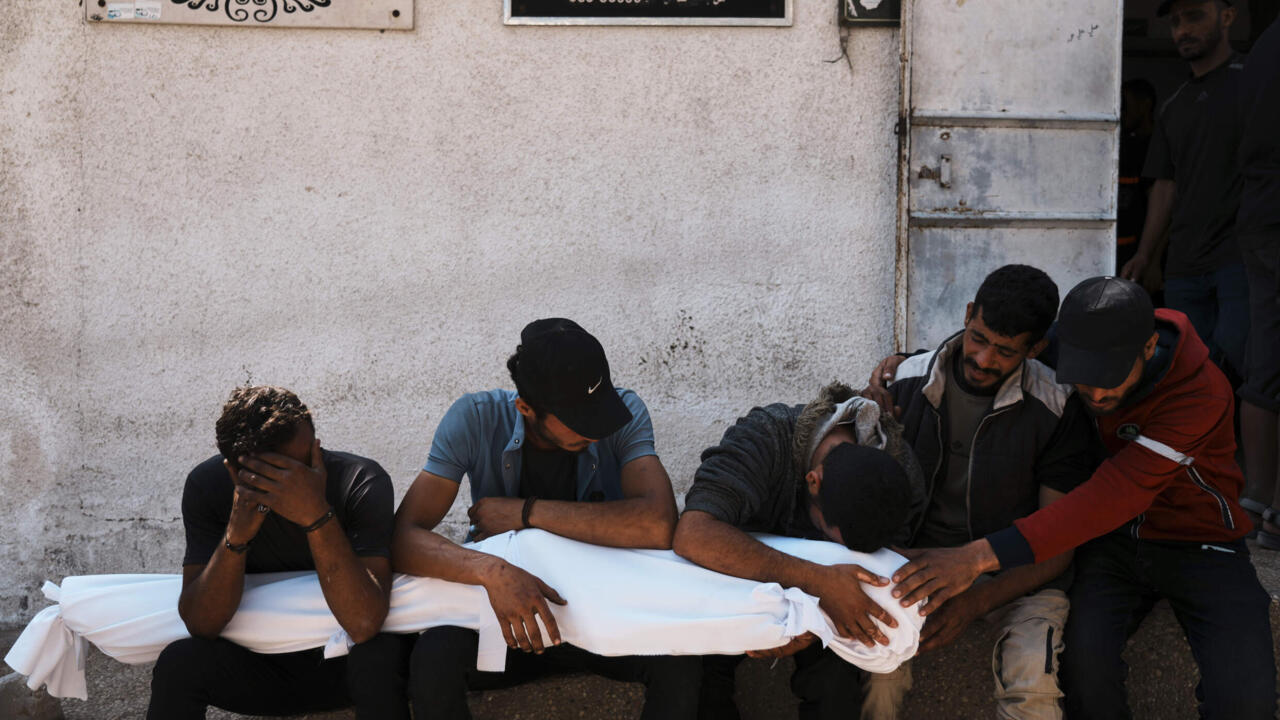
The civil defence agency in Gaza said an Israeli strike on a tent housing displaced Palestinians near the southern city of Khan Younis on Wednesday killed at least 12 people.
"At least 12 people were killed, including several children and women, in a strike by an Israeli drone this morning on a tent for displaced persons" near Khan Younis, the agency's spokesman Mahmud Bassal told AFP, adding that four more people had been killed in other strikes.
The Israeli army did not immediately respond to an AFP request for comment.
The fresh wave of strikes came as a controversial US-backed agency said that aid centres in the hunger-wracked territory will temporarily close on Wednesday after dozens of people were shot dead by Israeli troops while trying to receive humanitarian aid.

Twenty-seven people were killed in southern Gaza on Tuesday when Israeli troops opened fire near one of the centres operated by the US-backed Gaza Humanitarian Foundation (GHF). At least 31 people were killed and scores were wounded by Israeli gunfire in a previous incident on Sunday, according to the enclave's health ministry.
Israel recently eased its blockade of the Palestinian enclave, but the UN has said the entire population remains at risk of famine.
The UN Security Council will vote Wednesday on a resolution calling for a ceasefire and humanitarian access to Gaza, a measure expected to be vetoed by the United States.
The GHF said its "distribution centres will be closed for renovation, reorganisation and efficiency improvement work" on Wednesday and would resume operations on Thursday.
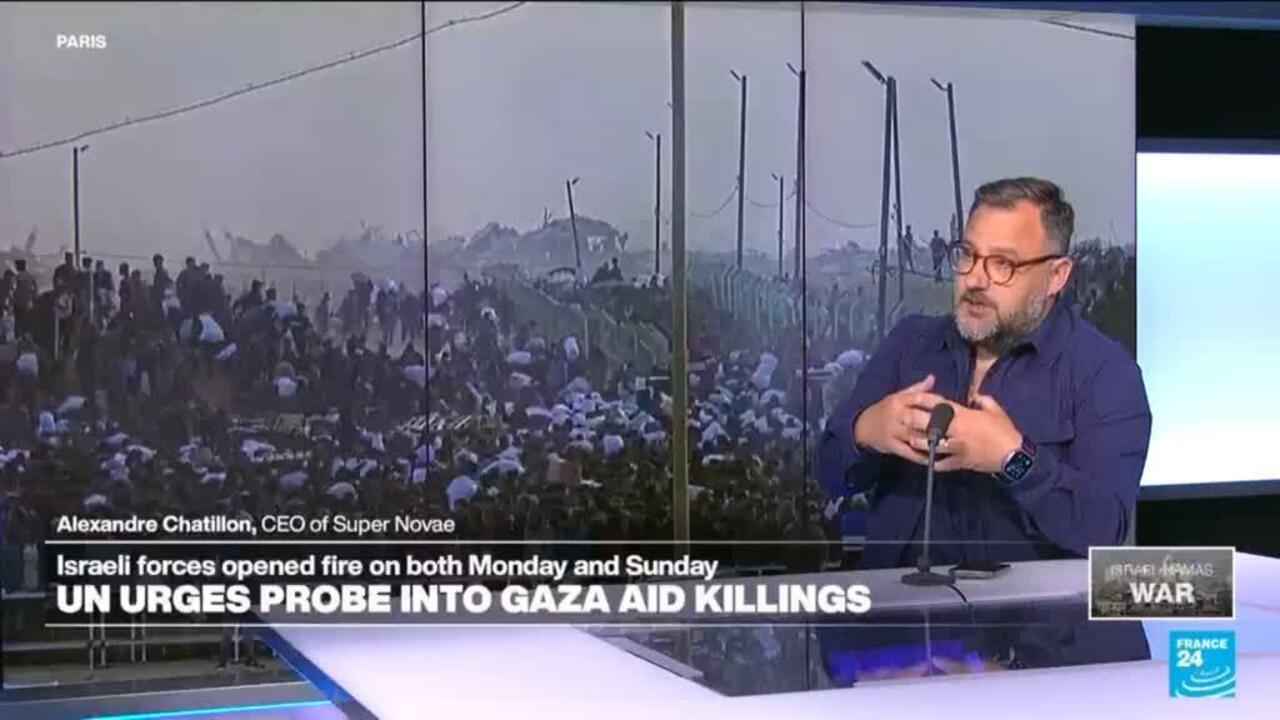
The Israeli army, which confirmed the temporary closure, warned against travelling "on roads leading to the distribution centres, which are considered combat zones".
The GHF, officially a private effort with opaque funding, began operations a week ago but the UN and major aid groups have refused to cooperate with it over concerns it was designed to cater to Israeli military objectives.
Following Tuesday's deadly incident near one of GHF's centres, UN Secretary General Antonio Guterres decried the killing of Palestinians seeking food aid as "unacceptable".
Israeli authorities and the GHF – which uses contracted US security – have denied allegations that the Israeli army shot at civilians rushing to pick up aid packages at GHF sites. The Israeli army has said the incident is under investigation.
(FRANCE 24 with AFP)
Israel is Fully Integrating its Gaza “Food Aid Hubs” into the Genocide

It is entirely unsurprising that Israel has yet again been caught out in a lie – a lie that the BBC once again spread far and wide on its news services.
Israel claimed that it had not fired at starving Palestinians queuing on Sunday morning to get food from one of its highly militarised “aid distribution hubs” – a system Israel imposed on Gaza in place of a long-established and successful aid network run by the United Nations.
More than 30 Palestinians are known to have been killed and dozens more injured in the weekend incident.
Israel blamed Hamas fighters for shooting Palestinian civilians, saying they were trying to stop the crowds from taking food boxes. The Israeli military dished up a video, taken by one of its drones, as supposed proof.
The BBC broadcast that video on its main shows, and then did one of its standard “Israel said, the Palestinians said. Who can really know the truth?” reports of the incident.

The Burning of Children Instead of Paper
The Lesser of Two Evils
 Israel Has Wiped Out Over 1,000 Entire Families
International Middle East Media Center, 27 May 2025
Our apologies, good friends, for the fracture of good order, the burning of paper instead of children, the angering of the orderlies in the front parlor of the charnel house. We could not, so help us God, do otherwise.
For we are sick at heart, our hearts give us no rest for thinking of the Land of Burning Children. And for thinking of that other Child, of whom the poet Luke speaks. The infant was taken up in the arms of an old man, whose tongue grew resonant and vatic at the touch of that beauty.
And the old man spoke; this child is set for the fall and rise of many in Israel, a sign that is spoken against. Small consolation; a child born to make trouble, and to die for it, the First Jew (not the last) to be subject of a “definitive solution.” He sets up the cross and dies on it; in the Rose Garden of the executive mansion, on the D.C. Mall, in the courtyard of the Pentagon.
That was Father Daniel Berrigan’s statement read in court in October 1968 during the trial of The Catonsville Nine. On May 17th, 1968, with Democratic President Lyndon Johnson presiding over 500,000 + American troops waging war against Vietnam, nine people, including Father Daniel Berrigan and his brother Father Phillip Berrigan, entered a draft board in Catonsville, Maryland and removed draft files of those who were about to be sent to Vietnam. They took these files outside and burned them with home-made napalm, a weapon commonly used on civilians by the U.S. forces. They were sentenced to federal prison.
Less than a month after their sentencing, the Republican Richard Nixon was elected U.S. president on a campaign promise that he had a “secret peace plan” to end the U.S. war against Vietnam. He did the opposite, intensified the war, spreading it to Laos and Cambodia, killing millions. He was reelected in 1972 while committing this carnage. He won 49 out of 50 states. The war ended in 1975 with a U.S. defeat.
My name is Aaron Bushnell, and I am an active duty member of the United States Air Force. I will no longer be complicit in genocide. I’m about to engage in an extreme act of protest but, compared to what people have been experiencing in Palestine at the hands of their colonizers, it’s not extreme at all. This is what our ruling class has decided will be normal.
That is the statement of Senior Airman (SRA) Aaron Bushnell, 25 years-old, who martyred himself when he immolated himself outside the Israeli embassy in Washington, D.C., on Feb. 25, 2024, to protest the Israel-U.S genocide of Palestinians. Aaron had previously said: “What would I do if my country was committing genocide? The answer is, you’re doing it. Right now”
Right now is still now, 16 months later and ongoing.
I am writing this on a piece of paper but you will most probably read it on a screen, the same screens that have provided ample news and views of the burning of Palestinian children in Gaza, another new Land of Burning Children. If you have not seen such pictures, it is because you have turned away in what Jean Paul Sartre called “bad faith,” knowing what they contain and demand of your conscience, but hiding that radicalizing truth from yourself.
Those pictures demand, at the very least, that you condemn and never support those who carry out these atrocities – in the U.S.A. that means Joseph Biden and Donald Trump, first and foremost, neither of whom you can you ever again support by saying he is or was “the lesser of two evils” – just as Martin Luther King, Jr. did when he was jolted by photographs of dead and napalmed Vietnamese children in early 1967 in William Pepper’s Ramparts magazine’s photographic essay, “The Children of Vietnam.” King was so sickened by the photos that he, against all advice, publicly turned vociferously against the U.S. war against Vietnam, and was therefore assassinated by the U.S. government the following year, one month before the Catonsville protest that was less than three weeks before the assassination of Senator Robert Kennedy.
If you follow King’s example and reject evil, you will not be assassinated, but you will have redeemed your soul.
Thanks to Ray Bradbury’s novel Fahrenheit 451, many know that paper burns at Fahrenheit 451.
But at what temperature do children burn? Do you need to know?
The history of American presidential politics has often been a tale of the election of “the lesser of two evils.” And that justification has been used time-and-again to support the savage killing of innocent people around the world. The presidential elections of this century tell that story very clearly, just as many decades of history confirm U.S. support for Israel’s ongoing attempts to exterminate the Palestinian people.
The lesser of two evils apologists have been very active in recent years, defending their indefensible politicians.
A good friend of mine, a small monetary contributor to the Democratic party and a consistent voter for Democratic presidential candidates, has long accused me of going easy on Donald Trump. This began during the presidential campaign in 2016, but had its roots previously in my critique of Barack Obama (following that of Bill Clinton and George W. Bush) who in the words of the late Glen Ford of Black Agenda Report “may go down in history as the most effective – and deceptive – imperialist of them all.” He wrote this in the foreword to Jeremy Kuzmarov’s searing documentation of Barack Obama’s war crimes of bombing seven Muslim countries, destroying Libya, and engineering a coup d’état in Ukraine, Obama’s Unending Wars. My friend’s opinion is shared by many other friends and extended family members who won’t read my writing. Without saying it, they imply that I am an apologist for Mr. Trump and unfairly oppose the Democratic warmongers, Obama and Biden, whom they consider peace lovers.
Other friends and associates, traditional Democrats, enthusiastically voted for Barack Obama in 2008 after eight years of lies, crackdowns on civil liberties (the Patriot Act, etc.), and the endless savage wars waged by Republican George W. Bush’s criminal administration. The eight prior years of Democrat Bill Clinton’s reversal of economic safeguards for the poor, his endless bombing and sanctions against Iraq resulting in his acceptable deaths of more than 500,000 Iraqi children, and his destruction of Yugoslavia and the bombing of Serbia, gave them pause, but Bush’s policies were so evil that Obama seemed like a breadth of fresh air in comparison. [Admission: I have voted for one U.S. president in my lifetime – McGovern in 1972.] But soon Obama showed them his true colors and they became disconsolate. And when in 2016 it became apparent that the Democrats, led by Obama and Hillary Clinton conjured up Russiagate to make certain that the reality-TV Trump not get elected but he did, they moved gradually toward Trump’s camp. Now they say that I have been too hard on Trump, who, they maintain, is a man of peace, despite his complete and longstanding support for Israel’s genocide of Palestinians, his interventions in Syria and the bombing of Yemen, his policy on Ukraine during his first term that was a continuation of the policy pursued by the Obama administration, and his lack of an executive order when taking office this year ending all support for Ukraine.
Both sides tout their peacemaker presidents as they may, shouting peace, peace, while there is no peace. That the U.S. has a permanent warfare state seems lost on them. That they are being played by a sycophant media that thrives on gamesmanship while supporting the warfare state never really penetrates their thinking.
Nevertheless, between easy and hard, I have given much thought to their judgments, only to conclude that both groups are falsely driven by desperate emotions, ahistorical naïveté, and wishful thinking. For it was clear before every presidential election since 1964 (with the possible exception of Democratic Senator George McGovern in 1972) that we were being taken for a ride by bi-partisan thugs for the American Empire, Trump surely not excluded. But pipe-dreams prevailed and the empire rolled on, driven by a propaganda machine second to none.
That propaganda machine is now so powerful because it is so obvious. It’s like those advertisements that mock the products that they are selling only to sell more. Considering themselves too smart for such stupidity, the most well-meaning and intelligent individuals are caught in its tentacles; they have had their minds occupied by its cognitive infiltration. Something so obvious just couldn’t be true for them; couldn’t convince anyone but the most stupid. This is Guy Debord’s The Society of the Spectacle.
Do they consider the sights and sounds of the U.S.-Israel genocide of Palestinians real? Do they ask, “What is Truth?” Do they, like Pontius Pilate, wash their hands and declare their innocence of the blood of Palestinians even as they stand behind their chosen presidential genociders?
Yet I have concluded that it is not primarily propaganda or intelligence that has created this bifurcated checkmate, this stasis of thinking wherein two sides aggressively assert their leaders’ good intentions as opposed to the other. What is presented as terribly complex and confusing is unheard-of-simple, to paraphrase the great Russian poet and novelist Boris Pasternak. It is heretical to say so, but it is so: Too many people have lost their minds, they are alienated from their own experience and the logic of simple facts. And by doing so have buried their consciences. The Scottish psychiatrist Ronald Laing put it this way in 1967:
There are forms of alienation that are relatively strange to statistically ‘normal’ forms of alienation. The ‘normally’ alienated person, by reason of the fact that he acts more or less like everyone else, is taken to be sane. Other forms of alienation that are out of step with the prevailing state of alienation are those that are labeled by the ‘normal’ majority as bad or mad.
The condition of alienation, of being asleep, of being unconscious, of being out of one’s mind, is the condition of the normal man.
We need only consider the one simple example of Israel’s ongoing genocide against the Palestinians. It has been going on in plain sight for sixteen months under President Biden and four months under President Trump with his full continuing U.S. support. No American can honestly say they didn’t know this genocide was being carried out by their country. According to Israel’s Defense Ministry, as reported on May 28, 2025 by antiwar.com, “The US has delivered 90,000 tons of bombs, guns, and other military equipment to Israel since October 7, 2023, to support the genocidal war against Palestinians in the Gaza Strip, according to numbers from the Israeli Defense Ministry. The Defense Ministry said Tuesday that the 800th plane carrying US weapons arrived in Israel in the morning, and 140 ships have also delivered US equipment in the nearly 600 days since October 7.”
Knowing about this genocide where well over 50,000 + Palestinians at a minimum, more than a third of them children, have been killed, burnt alive, bombed apart, and far more wounded and starved to death with Biden and Trump’s full support, should make any person who has retained one scintilla of humanity reject these bloodthirsty killers instantly and forever.
But it is not so. They retain the support of their ardent followers. They excuse them. Men who burn children alive are not rejected outright, but are found to have redeeming qualities by their political supporters. Something so inconceivably terrible is happening in full view, but what it signifies about Biden and Trump, the Democrats and the Republicans, is let slide, as if genocide were just a minor foible. These men are often elected by their followers as the lesser of two evils, as if the genocidal slaughter of innocents were a lesser evil. As if …. so many as ifs. So many excuses.
Yes, it is unheard-of-simple. While there are endless U.S. wars of aggression and massive slaughters of innocents one could cite to make a case against the support of U.S. leaders, this one example should suffice. You either unequivocally accept or reject those who support genocide. No ifs, ands, or buts.
At what temperature do children burn? Do you really not know?

[Ahmad Hasaballah/Getty Images]
Child casualties in Gaza a ‘stain on our conscience’: UNICEF
ALJAZEERA, 25 Oct 2023
No comments:
Post a Comment