BC Ferries Selects China Merchants to Build Badly Needed New Ferries
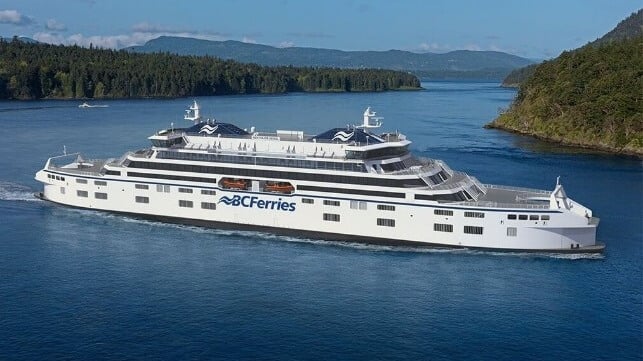
Canada’s BC Ferries announced it has selected China Merchants Industry Weihai Shipyard to build four new large ferries after a four-year procurement process. The company needs to replace an aging fleet but the selection of a Chinese yard may still raise controversy despite the fact that no Canadian shipyard participated in the bidding.
The company has been forced to go overseas for its new ferries turning to Germany, Poland, and Romania to build new ferries. It currently has four new diesel-electric ferries under construction by Damen in Romania due for delivery in 2026. Seaspan which owns the largest shipyard in British Columbia said in the past it could not compete with the low-wage countries that have lower standards for the environment and safety.
BC Ferries is seeking to blunt some of the critics by highlighting that in the first 10 years of service, the company anticipates spending over C$230 million (US$168 million) locally on refits and maintenance and more than C$1 billion (US$730 million) over the vessel’s 45-year lifespan.
“CMI Weihai is a global leader in passenger ferry construction, and shipbuilding more broadly,” said Nicolas Jimenez, CEO of BC Ferries. “It was the clear choice based on the overall strength of its bid, including its technical capabilities, high-quality and safety standards, ferry-building experience, proven ability to deliver safe, reliable vessels on dependable timelines, and the overall cost and value it delivers for our customers – all essential as we continue to experience growing demand and the urgent need to renew our aging fleet.”
BC Ferries references China Merchants' strong experience building passenger and vehicle ferries for large operations. It highlights the ongoing project with Stena RoRo for the E-Flexer class of RoPax ferries that are being deployed for companies including Corsica Linea, Brittany Ferries, and Canada’s Marine Atlantic ferry company. CMI is also working with Italy’s Grimaldi.
The new vessels are a critical component of BC Ferries’ strategic plan to replace aging vessels. They will take over from four vessels all over 50 years of age and in the case of the Queen of New Westminster 65 years. Last year, the company says its operation of the aging vessel cost it C$14 million (US$10 million) in repairs and lost revenues while the vessel was out of service after it lost a propeller.
The new ships will start construction in late 2026 with the first vessel entering service in 2029. The fourth ship will enter service by 2031. They will be built with diesel-battery hybrid propulsion systems and designed with the capability to operate on full electric power in the future. They will also reduce underwater radiated noise. Critically they will have a greater capacity able to handle 52 percent more passengers and 24 percent more vehicles. BC Ferries declined to announce the cost for competitive reasons and future vessel procurement but said the contract is within the limits approved by the BC Ferries Commissioner.
The company highlights that it is also planning for a 15 percent growth in customers over the next decade. Since 2016, BC Ferries has added 10 new vessels to its fleet, including four mid-size Salish Class vessels and six smaller Island Class ships. With four more Island Class vessels arriving in 2026, and all four of the large new ferries expected to be in service between 2029 and 2031, BC Ferries remains on track to introduce 18 new vessels in 15 years.
China Leads Newbuild Orders Despite Threats of Port Fees and Slowing Market
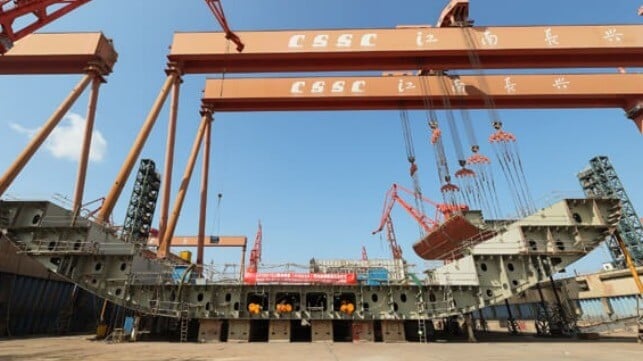
The threats of tariffs, port fees from the U.S. on Chinese-built ships, and a slowing overall market for newbuilds have yet to chip away at China’s leadership in shipbuilding. The latest data from Clarkson Research points to China’s continued dominance while South Korea and others look for new strategies to take advantage of the uncertainties in the market.
Shipbuilding orders overall are off dramatically in the first five months of 2025 compared to the record pace of 2024. Clarkson’s data shows that total orders were down by more than half (55 percent) with analysts commenting that it is the first sign of uncertainty, the issues in global trade, and falling freight rates. This is despite a record pace for containership orders which are at an all-time high with the total capacity on order up nearly 50 percent from a year ago.
Chinese shipbuilders continued to lead the orders in the first five months of the year with Clarkson calculating they booked 7.86 million compensated gross tons or nearly half the orders compared to 3.1 CGT for South Korea which represented 24 percent of the global market. Total orders worldwide were calculated at 15.92 million CGT.
While the U.S. released the details of its plan for port fees in mid-April, orders continued a similar pattern in May. China booked 39 percent of global orders (640,000 CGT) or a total of 42 ships. South Korea booked just 15 percent of the orders in May or 250,000 CGT for eight ships while in a market anomaly, France rivaled China with nearly a third of the orders, or 546,000 CGT, driven by MSC Cruises' large cruise ship order.
Korea’s shipbuilders however are working to make inroads and according to the media reports are planning to expand their aggressive bidding for containership orders. Last year, China held nearly 87 of the containership construction market share but the Koreans are highlighting their expertise in high-value shipbuilding such as methanol-fueled ships, LNG, and future technologies. The Korean media points to reports that Ocean Network Express (ONE) and Hapag-Lloyd are meeting with Korean shipbuilders, but Tradewinds reported that MSC Mediterranean Shipping Company told Nor-Shipping last week that the U.S.’s port fees would not be a barrier to orders in China.
The South Koreans also point to the fact that their CGT per vessel was nearly double China’s in May. They point to this as evidence that they are winning orders for more complex and larger ships. South Korea has traditionally dominated the high-value segment for LNG and other gas carriers and looks to use this also with containerships going forward.
Construction slots are booked three or more years ahead at some of the large shipyards, especially in South Korea, which some speculate might also be a reason the Korean yards are lagging behind their Chinese competitors. However, as global ordering has slowed, the backlog is starting to thin. South Korea currently has 22 percent of the total global orderbook, 36.3 million CGT versus China’s 96.4 million CGT backlog which equals 59 percent of the global order total.
The U.S. trade representative continues to push forward with the plan to launch port fees later this year on Chinese-built ships. Last week, it released revisions for the fees planned for all vehicle carriers arriving in the U.S., but so far, the threat of the fees seems to have done little to drive orders away from Chinese shipbuilders.
No comments:
Post a Comment