Crew of Futuristic Carrier USS Ford Will Wear Electronic Fatigue Trackers
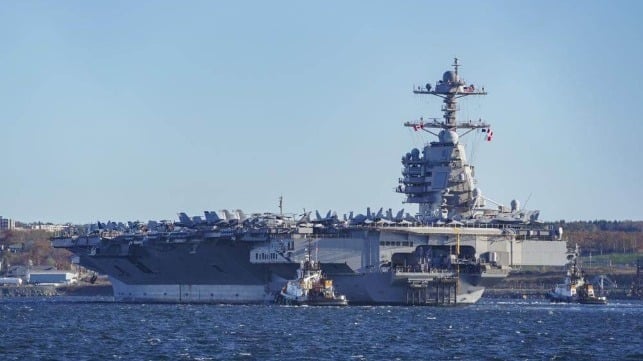
The crew of the futuristic carrier USS Gerald R. Ford are about to test out an equally futuristic personnel-monitoring device. On their next deployment, members of the crew will have an Oura Ring personal health tracker - a small titanium ring that contains sensors for heart rate, body temperature, blood oxygen level and acceleration. Among other things, this data allows Oura to assess sleep quality and fatigue, which are the main targets of a new Navy study.
Fatigue is a constant theme in maritime casualty reports, and the U.S. Navy's two biggest losses of the past decade both had lack of sleep as a contributing factor. In the early hours of June 17, 2017, the destroyer USS Fitzgerald collided with the container ship ACX Crystal, tearing a hole measuring about 12 feet by 17 feet in Fitzgerald's hull. Seven sailors were killed, and the survivors saved their ship only through heroic efforts at damage control. Barely more than two months later, destroyer USS John S. McCain struck the tanker Alnic MC near Singapore, killing 10 of McCain's sailors.
Investigators found that the crews of McCain and Fitzgerald had had too little time for rest. Aboard Fitzgerald, the watch officers had "little to no sleep" before the night of the casualty because of in-port events, an after-action report found. On McCain, records showed that the 14 crewmembers on the bridge during the collision had an average of less than 5 hours of sleep in the previous 24 hours, and one relevant individual had had no sleep at all.
Eight years later, Navy researchers are still working to develop better tools to help commands address fatigue. The health-data study aboard USS Gerald R. Ford is an attempt to gather more information on how a long deployment affects the crew, researchers told Navy Times.
Operational security informed the Navy's selection of hardware and software: after the Strava fiasco of 2018, in which a cloud-based personal fitness app disclosed the GPS locations of military personnel around the world, the Navy selected a product that would be more discreet. Oura Ring lacks a long-distance RF signature, researchers told Navy Times.
The ultimate objective is to give crewmembers a way to watch their own readiness, and at the same time, to give commanding officers detailed data on how their subordinates are affected by fatigue. “[We're] helping leadership on these ships understand how the mission is impacting the sleep and the recovery of their sailors, especially as they go on these deployments that involve a lot of stress,” Dr. Rachel Markwald of the Naval Health Research Center told Navy Times.
Participating crewmembers will get to keep their own Oura Ring if they wear it during more than three-quarters of the deployment.
LALIZAS and ATIVA NÁUTICA: United for Safety at Sea in Brazil
[By: LALIZAS]
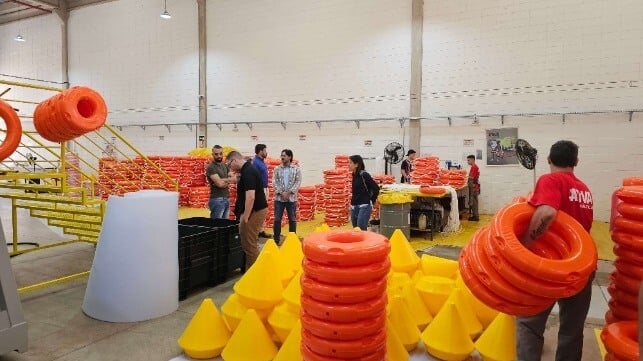
LALIZAS continues its global expansion across the Americas. After entering North America with the acquisition of LALIZAS/ALEXANDER in 2018, REVERE SURVIVAL in 2024 and the launch of LALIZAS Canada in 2025, the company now sets sail for South America, proudly announcing the acquisition of ATIVA NÁUTICA, Brazil’s leading lifejacket manufacturer.
This milestone marks a significant step in the manufacturer’s global growth, while also celebrating a remarkable company that has shaped the safety nautical sector in Brazil for over two decades.
Founded in 1998 by Marta Lara and Roberto Sampaio in Campinas, São Paulo, Ativa began as a small venture in a 250 m2 space with just three employees. Through their commitment and dedication, alongside with their niece and partner Julia Ramalho, Ativa became Brazil’s leading name in lifesaving equipment. Today, the team has grown to 200 members, and Julia will continue her journey with LALIZAS to uphold Ativa’s culture and values. LALIZAS holds even greater respect for small businesses that have grown into successful organisations, as it also began with manufacturing in a small house in Piraeus, Greece, with just three employees.
Marta and Roberto seized the opportunity to become part of something greater. Partnering with LALIZAS meant not only aligning with shared values and principles but also joining forces with a group known for elevating businesses while honouring their legacy. Ativa chose LALIZAS, confident in its reputation for transforming companies into stronger, more profitable organisations without compromising their unique identity.
“Ativa is like my third child,” said Marta Lara. “Seeing Ativa as part of a global group with such a prestigious history makes us very proud and honoured. Knowing that LALIZAS will care for it, grow it, and respect its legacy gives me peace of mind.”
The safety equipment manufacturer has a strong record of accomplishment in this area, beginning with the acquisition of Italian companies in 2012 (Lofrans’, MAX POWER, Nuova Rade, and OCEAN Fenders), as well as ARIMAR in 2019, all of which are leaders in the nautical market, each with its own distinct character.
“This acquisition is a testament to LALIZAS’ global strength—not just as a manufacturer of safety equipment, but as a trusted industry leader known for empowering companies, transforming them into even more successful and profitable businesses, while always respecting their roots and people,” Stavros Lalizas, Founder & CEO of LALIZAS commented.
LALIZAS is thrilled to welcome Ativa to #thelalizasforce and is dedicated to advancing the nautical industry in Brazil through its extensive expertise and high-quality nautical equipment. “This move strengthens our position in the Americas and unlocks new opportunities in a thriving market. Together, we are setting new standards in safety — across continents,” he concluded.
The products and services herein described in this press release are not endorsed by The Maritime Executive.
No comments:
Post a Comment