Despite Trump-Musk Feud, CO2 Milestone Is the 'Important News of the Day'
Scientists said that atmospheric carbon dioxide concentrations peaked above 430 parts per million for the first time in perhaps 30 million years.
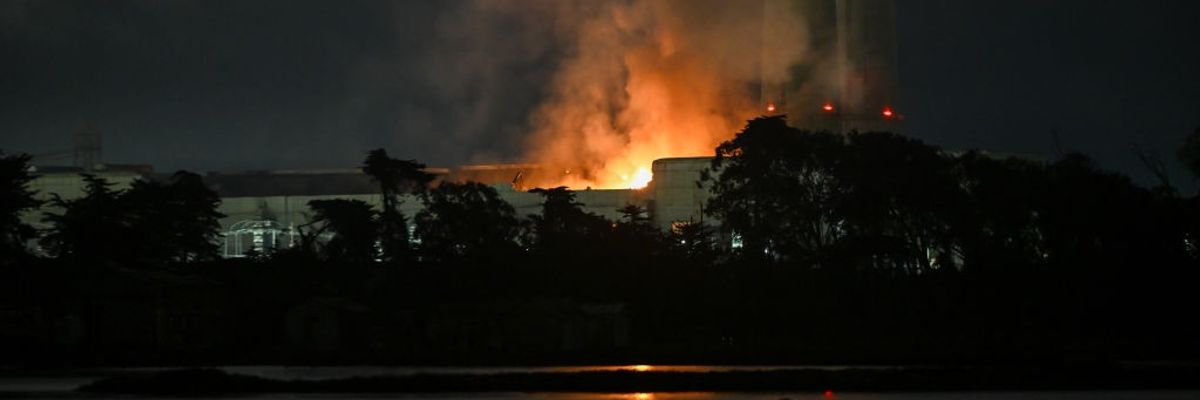
A view of flames and giant smoke is seen over the sky as a fire erupted at the natural gas Moss Landing Power Plant in Moss Landing of Monterey Bay, California, United States on January 17, 2025.
(Photo: Tayfun Coskun/Anadolu via Getty Images)
Olivia Rosane
Jun 06, 2025
COMMON DREAMS
The concentration of carbon dioxide in the atmosphere peaked above 430 parts per million in 2025—the highest it has been in millions of years—according to data released by the National Oceanic and Atmospheric Administration and Scripps Institution of Oceanography at the University of California, San Diego on Thursday.
The news was overshadowed by the explosive feud between U.S. President Donald Trump and his erstwhile backer Elon Musk, but climate activist Bill McKibben argued that it was ultimately more consequential.
"In the long run, this is actually going to be the important news of the day—CO2 in the atmosphere passes another grim milestone," McKibben wrote on social media.
Carbon dioxide has been accumulating in the atmosphere due primarily to the human burning of fossil fuels, as well as by the clearing of forests and other natural carbon sinks. There, it acts as a greenhouse gas, trapping heat from the Earth, and is the primary gas responsible for the rise of global temperatures by approximately 1.1°C from the 1850 -1900 average. This warming has already had a host of dramatic impacts, from extreme weather events to sea-level rise to polar ice melt, and scientists warn these impacts will only accelerate under current energy policies, which put the world on track for around 3°C of warming by 2100.
The last time that atmospheric CO2 concentrations topped 430 ppm was most likely more than 30 million years ago, Ralph Keeling, who directs the Scripps CO2 Program, toldNBC News.
"It's changing so fast," he said. "If humans had evolved in such a high-CO2 world, there would probably be places where we wouldn't be living now. We probably could have adapted to such a world, but we built our society and a civilization around yesterday's climate."
"While largely symbolic, passing 430 ppm should be a wake-up call."
Scripps and National Oceanic and Atmospheric Administration both measure carbon dioxide levels from NOAA's Mauna Loa Observatory in Hawaii, where Charles Keeling began taking measurements in 1958. As CO2 levels rise over time, they also follow a seasonal cycle—peaking in May before falling in the Northern Hemisphere summer and rising again in the fall.
This May, Scripps Oceanography calculated an average of 430.2 ppm for 2025, which is 3.5 ppm over the average for May 2024. NOAA's Global Monitoring Laboratory, meanwhile, calculated a monthly average of 430.5 ppm, a 3.6 ppm jump from the year before and the second-steepest yearly climb since 1958.
"Another year, another record," Keeling said in a statement. "It's sad."
The news comes two months after Mauna Loa daily measurements surpassed 430 ppm for the first time in March, which Plymouth Marine Laboratory professor Helen Findlay called "extremely disappointing and worrying."
"While largely symbolic, passing 430 ppm should be a wake-up call, especially given the accelerated response we are seeing of glaciers and ice sheets to current warming," Dr. James Kirkham, chief scientist of the Ambition on Melting Ice coalition of governments, said at the time.
"This upward trajectory is a direct result of continued fossil fuel use, likely exacerbated by emissions from extreme wildfires last year, methane leaks from fossil fuel extraction and possibly greater permafrost emissions, alongside decreased ability of very warm oceans to absorb CO2," Kirkham said.
The monthly record also comes a little more than a week after a United Nations report warned that there was a small chance global temperatures could surpass 2°C in at least 1 of the next 5 years, only a decade after world leaders pledged in the Paris agreement to keep global temperatures "well-below" that level.
"Carbon emissions are still rising, and the atmosphere is going to keep heating further until greenhouse gas concentrations stabilize," Matt Kean, who chairs Australia's Climate Change Authority, wrote in response to the Scripps and NOAA figures. "What sort of climate do we want to leave our children and those who come after them?"
Nightmare of Nightmares: New (Big) CO2 Emissions
Global warming just got a brand-new source for trapping heat as Arctic tundra turns up the dial on CO2 emissions. It’s now in the ranks of cars, trains, and planes as an official emitter of carbon dioxide, CO2. But it distinguishes itself in one critical way. There’s no “on/off” switch. Once turned on, it’ll self-reinforce continued growth, meaning ever-increasing levels of CO2 emissions year-over-year.
The National Oceanic & Atmospheric Administration, NOAA, made the official announcement only recently: “2024 Arctic Report Card: The Arctic Tundra is Now a Net Source of Carbon Dioxide.” climate.gov .
Arctic tundra covers a significant portion of the Northern Hemisphere, accounting for approximately 20% of the Earth’s surface, and nearly 25% of the land surface in the Northern Hemisphere. Obviously, this has big impact on global CO2 emissions and the many dangers attendant to rising global temperatures, e.g. BBC News May 31, 2025: “The village of Blatten has stood for centuries, then in seconds it was gone.”
It doesn’t take a brain surgeon to figure this one out, i.e., it means the planet is going to get a lot hotter a lot sooner as vital ecosystems wilt/melt/thaw and disintegrate. Already, one of Arctic tundra’s distant cousins, the Amazon rainforest, joined the CO2 Net-Emissions Club a couple of years ago. The magnificent rainforest is net-emitting CO2 in portions of the forest in harmony with cars, planes and trains. For example, The Economist recognized his unsettling event 3 years ago: “The Brazilian Amazon Has Been a Net Carbon Emitter Since 2016,” The Economist, May 21, 2022.
As for the rainforest, there are several contributing factors to CO2 emissions, for example: Conversion of rainforest to agriculture has caused a 17 percent decrease in forest extent in the Amazon, which stretches over an area almost as large as the continental U.S. Replacing dense, humid forest canopies with drier pastures and cropland has increased local temperatures and decreased evaporation of water from the rainforest, which deprives downwind locations of rainfall. (NOAA)
Now, the planet’s two largest warehouses, serving as carbon sinks for millions of years, over 10 million years for the Amazon, have opened business with the Anthropocene (era of human domination). Although, in all fairness, the Anthropocene doesn’t really need help in heating up the planet. It’s doing a spectacular job on its own. “Earth Shattered Heat Records in 2023 and 2024; Is Global Warming Speeding Up?” Nature, January 6, 2025.
In the case of Arctic tundra, NOAA says: “The land areas of the Arctic have been a carbon sink for thousands of years, meaning there has been a net removal of carbon dioxide from the atmosphere by plants, with long-term storage in the soil and permafrost. However, increasing surface air temperatures are causing permafrost to warm and thaw, allowing stored carbon dioxide and methane to be released into the atmosphere. Wildfires and other disturbances are adding pulse releases of carbon dioxide and methane. These changes together have shifted the Arctic tundra from a net carbon sink into a source.” (2024 Arctic Report Card).
A New Regime – Insurance/Homeowners Replace Dinosaurs
The Anthropocene has pushed the Arctic into a new, dangerous regime. Studies over the decades show that it has dramatically changed from even a decade or two ago. All of this is spearheaded by its new role as a net emitter of carbon dioxide CO2 and methane CH4. Arctic tundra stores 1,600 billion metric tons of organic carbon, mostly in permafrost. This is double the amount currently in the planet’s atmosphere, which is already causing the planet to heat up. The Amazon rainforest holds another 124 billion tons of carbon. This tandem, by increasing carbon emissions above and beyond cars, trains and planes, and industry, is likely zeroing out all of the saved CO2 via electric vehicles, and then some.
The new regime has the earmarks of a big troublemaker. It’s reminiscent of that last big encounter with climate change 65 million years ago when the villain was an asteroid, the victim, dinosaurs. Poof! Gone after 165 million years living on Earth.
Today’s version has fossil fuel playing the role of the asteroid and the property/casualty insurance industry with homeowners the victims. This sorrowful arrangement is likely how things stretch out over time because world leadership has never taken climate change seriously enough to head it off at the pass. As such, as global temperatures increase, over time, more people are displaced by repetitive high tide flooding, unlivable regions of recurring temperatures too high for survival, desertification, loss of glacial potable water, major rivers seasonally drying up, etc. It’s a long list.
For example: “Will Flooding Force Seattle’s South Park Residents to Leave?” Seattle Times, June 1, 2025: “Sea-level rise, which globally is linked to fossil fuel emissions, is expected to worsen all types of flooding in South Park and climate change is expected to make storms — and storm surges — worse. The average high tide in Elliott Bay has already risen about 10 inches since 1899, according to data from the National Oceanic and Atmospheric Administration,” Ibid.
The property/casualty insurance industry is already de facto declaring some regions uninsurable and/or so costly as to cause people flight. For Example: “Florida has lost more than 30 home insurance companies in recent years. Most recently, AAA, Farmers and Progressive made headlines for rolling back coverage availability in Florida. As of May 2024, there are 11 Florida home insurance companies in liquidation.” (“Home Insurance ‘Crisis’: First Florida, Now California — is my State Next?” Bankrate, Sept. 16, 2024)
“Florida and California may receive the most press for their home insurance problems, but the future of home insurance in other states also looks grim. Across the country, home insurance rates are on the rise,” Ibid.
And, even worse yet: “Map Shows 9 States Where Homeowners Are Losing Their Insurance,” Newsweek, March 1, 2024. In all cases of insurance crises, climate change is the villain.
The disinformed who believe climate change a hoax or no big deal should do a reality check with a casual search on Google using only six words: “homeownership and climate change insurance crisis.” They’ll spend hours and hours, likely days, reading articles about climate change ruining the property insurance industry while undermining homeownership. Then, maybe pass along findings to representatives in Congress and asked them what to do about it. Several articles already show Congress informed of climate change endangering homeownership insurance, for example: (“New Data Reveal Climate Change-Driven Insurance Crisis is Spreading,” Senate Committee on the Budget)
When conservatively managed property/casualty insurance companies complain about the damage caused by excessive global heat uprooting ecosystems that support life and structure for homeownership, you know for certain climate change is not regular ole climate change of the ages; it’s something much worse, and most certainly, it’s not a hoax! Ask y0ur insurance agent for confirmation of this obvious fact.
In fact, more to the point: Risk of extinction of the entire fabric of the capitalist system goes to the heart of a recent article written by Gunther Thallinger, Member of the Board of Management of Allianz Group (est. 1889, Munich) the world’s largest insurance company: “Climate, Risk, Insurance: The Future of Capitalism,” March 25, 2025.
Solution: It’s all about burning fossil fuels. Figure it out!
No comments:
Post a Comment