Red Sea and Suez Canal Traffic Increases But Carriers Still Avoid Transits
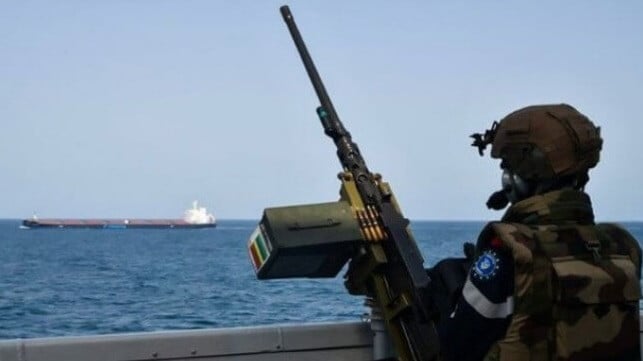
June 5 marked a historic day for the Suez Canal as it is 50 years since it reopened after the Arab-Israeli War of June 1967 closed the canal for eight years. Egypt marked the occasion as it again attempts to rebuild traffic in the canal following the attacks of the Houthis in 2023 and 2024 that chased away most vessels.
Egypt announced its latest efforts in May reporting it would offer large containerships a 15 percent discount on fees. The 90-day promotion was an attempt to lure the major east-west traffic between Asia and Europe into the canal. The Suez Canal Authority also hosted a meeting with representatives of the major carriers reporting that they were receptive to restoring the diverted routes.
The commander of the EU effort to protect ships, Rear Admiral Vasileios Gyparis of the Hellenic Navy who overseas EUNAVFOR Aspides told Reuters traffic is up 60 percent from the low point in August 2024. He reported they are seeing 36 to 37 ships a day up from a low of around 20 a day. However, he admitted to Reuters that it is still below the 72 to 75 a day before the Houthis launched their attacks in late 2023.
Similarly, the Suez Canal has not announced its current daily average. In August 2022, however, it highlighted a new record of 89 vessels making the passage in a single day. It typically averaged over 60 vessels a day.
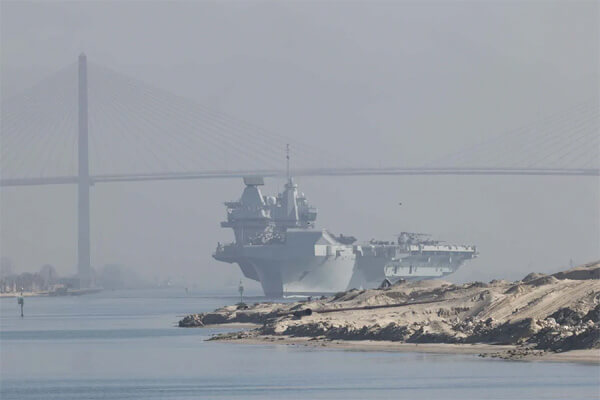
HMS Prince of Wales and its carrier strike group transited the Suez Canal on May 24 (Royal Navy)
The lack of the return is despite the Houthis not having attacked a merchant ship in 2025, although they continue to assert that they will attack any vessel associated with Israel. They suspended all attacks when the Gaza ceasefire went into effect in January but resumed targeting U.S. warships when the U.S. unleashed a barrage at the orders of Donald Trump in March. The U.S. announced a ceasefire in May and despite reports the Houthis were rearming, they have not fired on ships, including there were no reports of attacks as the UK sent the carrier HMS Prince of Wales and her carrier group through the region in recent days.
The Aspides commander told Reuters the operation has “provided close protection to 476 ships, shot down 18 drones, destroyed two remote-controlled boats, and intercepted four ballistic missiles.” Aspides began its patrols in February 2024. As of mid-May, it marked 15 months saying it had supported more than 830 merchant vessels.
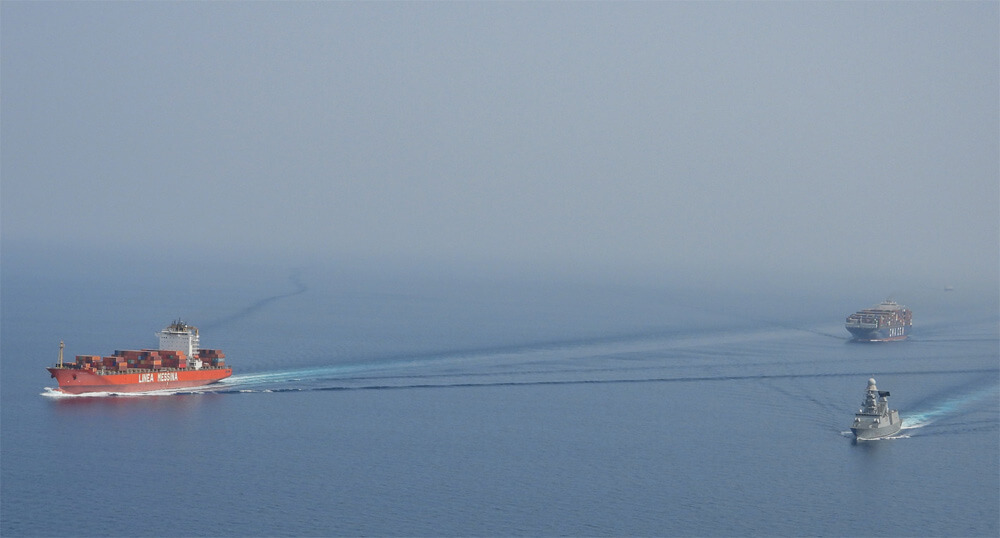
ITS Andrea Doria providing close protection to merchant ships in the Red Sea (EUNAVFOR Aspidtes)
Aspides reports that it continues its close protection operations with the EU extending its mission at least to February 28, 2026. It highlighted at the end of May, a French frigate in the operation escorted both a tanker and a CMA CGM containership. ITS Andrea Doria, an Italian Navy destroyer, took a Linea Messina containership and several CMA CGM vessels through the region also in late May.
CMA CGM, however, told The New York Times in a story appearing today that it was “sending a small number of vessels through the Red Sea.” It said it did not plan to resume transits through the Suez Canal on a large scale in the short term, “unless security conditions allow it.” The New York Times reports tracking sites showed at least five CMA CGM vessels transiting the Red Sea in recent weeks.
Other major carriers have also said they have no short-term plans to resume their normal routes. CEO of AP Moller-Maersk, Vincent Clerc said, The New York Times highlights, that he thought it is still far from the threshold to return to the Red Sea routing.
CMA CGM Pursues Port Investment in Algeria
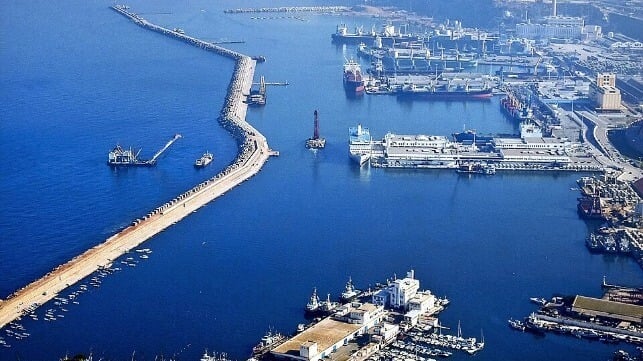
CMA CGM is moving ahead with its investment deal in Algeria. It comes as the French carrier is building its logistics and terminal operations including in the Mediterranean where it recently announcement that it would modernize Syria’s Latakia port and has a long-standing agreement to redevelop the port of Beirut.
The ocean carrier’s CEO Rodolphe Saadé met on June 2 with the Algerian President Abdelmadjid Tebboune. They discussed two discussed upcoming port projects by the shipping giant. The meeting was initially scheduled in April but a diplomatic dispute between Algeria and France led to the delay. Algeria’s ties with its former colonizer, France, have been lukewarm over the years. However, the relationship deteriorated in April leading to expulsion of diplomats from both sides.
CMA CGM appears keen to overcome these difficulties and move forward with its projects in Algeria. “We can be an ally of Algeria in developing infrastructure and making Algerian ports true regional hubs. I strongly believe in the potential of this country,” Saadé told the local media.
With CMA CGM scaling its footprint in the Mediterranean region, Algerian port sector presents a good opportunity for this ambition. Algeria is increasingly diversifying its economy to cut reliance on oil and gas exports. Central to this shift is a revamp of the port sector to cater for the rising container shipping traffic.
CMA CGM has shown interest in modernizing the ports of Oran and Djen Djen. This will help in decongesting the Port of Algiers, which is currently experiencing delay challenges with vessel waiting times exceeding seven days.
In Oran, CMA CGM reportedly wants to lease the container terminal through its subsidiary, CMA Terminals. The goal is to expend the terminal to have a capacity of handling over one million TEUs annually. According to local media reports, a technical team from CMA Terminals has almost finalizing an investment plan for Oran port, likely to be made public by end of this year.
To improve its intra-med connections, CMA CGM is also considering a feeder shipping line between Marseille and Oran, reducing the transit time to less than 48 hours. The service will be operated by its subsidiary La Méridionale, which was acquired in 2023.
Top photo by Habib Kaki -- CC BY 3.0
No comments:
Post a Comment