REST IN POWER
A Personal Tribute to Bill Moyers, Who Never Stopped Pushing
I would never claim to be an heir to Bill Moyers’ legacy, but I am among the millions of ordinary Americans for whom he was a powerful source of inspiration.

Journalist Bill Moyers moderates the "All Hands on Deck: Perspectives from Higher Education, Government, Philanthropy, and Business" panal during the TIME Summit On Higher Education on October 18, 2012 in New York City.
(Photo: Jemal Countess/Getty Images for TIME)
Steven Harper
Jun 30, 2025
A Life of Public Service
A partial summary of Bill Moyers’ impressive life fills entire pages of The New York Timesand The Washington Post—treatment reserved for royalty and rock stars. Bill was both.
In those pages you’ll read about his illustrious political career as President Lyndon Johnson’s special assistant, press secretary, and key architect of the “Great Society”—a collection of programs that are now in danger, including the War on Poverty that produced Medicare, Medicaid, the Food Stamp Act, and the Economic Opportunity Act; the Civil Rights Act of 1964; the Voting Rights Act of 1965; the National Foundation on the Arts and the Humanities Act of 1965; and more.
You’ll marvel at his unparalleled journalism that resulted in landmark documentaries, best-selling books, dozens of Emmy Awards, two Alfred I. Dupont-Columbia University Awards, nine Peabody Awards, three George Polk Awards, and the first-ever Honorary Doctor of Fine Arts from the American Film Institute.
A Source of Private Inspiration
I’m going to cover different ground that you won’t find anywhere else. During the final years of Bill’s life, I had the honor of working directly with him on one of his most important missions: preserving democracy.
The Times obituary reported that Bill “retired in 2015 at the age of 80.” That’s incorrect. His online site, “Moyers on Democracy,” continued for years after that. Other outlets, including Common Dreams and Alternet, republished its articles and interviews regularly. Much of it remains available at BillMoyers.com.
In late 2016, Bill invited me to become a regular contributor to his site. It was the beginning of a collaboration that developed into a friendship I will always cherish. Amplifying my voice to his millions of readers, he put his remarkable reputation on the line for me. In one of our conversations, he explained why.
He often asked me, “Can democracy die from too many lies?” We agreed that the answer is yes, and the problem is eternal.
While meeting in the Oval Office with President Lyndon Johnson, Bill mentioned Martin Luther King Jr.’s famous line, “The arc of the moral universe is long, but it bends toward justice.”
President Johnson became animated.
“That’s bullsh*t,” he said to Moyers. “You have to keep pushing, and pushing, and pushing… and then hope to bend it just a little.”
“Johnson was right,” Bill told me 50 years later. “And you’re pushing.”
Later he flattered me with the ultimate compliment that now moves me to write this tribute:
“I think we are kindred spirits,” he said. “A kindred spirit about what? Our country, our professions, the truth... as close to it as we could get.”
“My only regret is that our paths didn’t cross 30 years ago,” I said.
I would never presume to know Bill as well as others who enjoyed longer and deeper personal and professional relationships with him. But his private messages about my articles for BillMoyers.com encouraged me to keep pushing:
“This is a keeper. Your work is making all of us proud!”
“This is brilliant!”
To that private encouragement, he added public support. Preferring the depth of coverage that today’s cable news seldom provides, he told me that he didn’t want to be a “pundit.” But he made an exception for me. To amplify my voice and our work, we appeared together on MSNBC’s “The Last Word with Lawrence O’Donnell.”
After Bill broke that ice, I made several more solo television appearances.
“I’ll be watching,” he always said.
Bill also interviewed me several times and posted our extended conversations on his site. His probing questions had the same insight that had characterized his award-winning interviews with far more illustrious individuals—including Elie Wiesel, Jimmy Carter, Maya Angelou, Pete Seeger, Desmond Tutu, George Lucas, and Joseph Campbell. His interviews with Campbell on “The Power of Myth” attracted 30 million viewers and led to another best-selling book.
Even after Bill finally retired and archived BillMoyers.com in 2021, he continued to follow and encourage my work. Here are just a few of his messages to me:
“Your mastery of the story is so impressive, but the story is so equally frightening I can’t get it out of my mind. I am circulating it.”
“Please know I miss our collaboration.”
“Very strong, as usual. You are effectively decoding the news for people who can’t follow it, including, alas, much of the press.”
“Very powerful piece. And brave.”
“Powerful! Go for it!”
“Your piece is stirring… It is so good to see how you continue to serve the truth.”
“Terrific!”
A Troubling Possibility
In our conversations, Bill told me that America was unlikely to lose its democracy in the dramatic fashion that autocrats sometimes conquered nations. U.S. elections and the three branches of government won’t merge into dictatorship, he suggested. Instead, another scenario was more insidious—a slide into a false democracy, like Viktor Orbán’s Hungary or Recep Tayyip Erdoğan’s Turkey where voters still cast ballots, but the outcomes are predetermined and the strongman chief executive is above the law.
He often asked me, “Can democracy die from too many lies?”
We agreed that the answer is yes, and the problem is eternal: “Falsehood flies, and the Truth comes limping after it,” wrote Jonathan Swift in 1710. But that’s no excuse for abandoning the fight for the truth or, as Bill would say, as close to it as we can get.
I would never claim to be an heir to Bill Moyers’ legacy. Many people are far ahead of me in that special line. But I am among the millions of ordinary Americans for whom he was a powerful source of inspiration. Two of his private messages remind me that he still is:
“A strong piece, Steve. Keep it up.”
“I am so very grateful to you for continuing the fight. You see connections between the twinkling where others see only UFO’s.”
The fight—and the pushing—continues.
I would never claim to be an heir to Bill Moyers’ legacy, but I am among the millions of ordinary Americans for whom he was a powerful source of inspiration.
Journalist Bill Moyers moderates the "All Hands on Deck: Perspectives from Higher Education, Government, Philanthropy, and Business" panal during the TIME Summit On Higher Education on October 18, 2012 in New York City.
(Photo: Jemal Countess/Getty Images for TIME)
Steven Harper
Jun 30, 2025
Common Dreams
On June 26, America lost an iconic force for good. I lost a great friend.
On June 26, America lost an iconic force for good. I lost a great friend.
A Life of Public Service
A partial summary of Bill Moyers’ impressive life fills entire pages of The New York Timesand The Washington Post—treatment reserved for royalty and rock stars. Bill was both.
In those pages you’ll read about his illustrious political career as President Lyndon Johnson’s special assistant, press secretary, and key architect of the “Great Society”—a collection of programs that are now in danger, including the War on Poverty that produced Medicare, Medicaid, the Food Stamp Act, and the Economic Opportunity Act; the Civil Rights Act of 1964; the Voting Rights Act of 1965; the National Foundation on the Arts and the Humanities Act of 1965; and more.
You’ll marvel at his unparalleled journalism that resulted in landmark documentaries, best-selling books, dozens of Emmy Awards, two Alfred I. Dupont-Columbia University Awards, nine Peabody Awards, three George Polk Awards, and the first-ever Honorary Doctor of Fine Arts from the American Film Institute.
A Source of Private Inspiration
I’m going to cover different ground that you won’t find anywhere else. During the final years of Bill’s life, I had the honor of working directly with him on one of his most important missions: preserving democracy.
The Times obituary reported that Bill “retired in 2015 at the age of 80.” That’s incorrect. His online site, “Moyers on Democracy,” continued for years after that. Other outlets, including Common Dreams and Alternet, republished its articles and interviews regularly. Much of it remains available at BillMoyers.com.
In late 2016, Bill invited me to become a regular contributor to his site. It was the beginning of a collaboration that developed into a friendship I will always cherish. Amplifying my voice to his millions of readers, he put his remarkable reputation on the line for me. In one of our conversations, he explained why.
He often asked me, “Can democracy die from too many lies?” We agreed that the answer is yes, and the problem is eternal.
While meeting in the Oval Office with President Lyndon Johnson, Bill mentioned Martin Luther King Jr.’s famous line, “The arc of the moral universe is long, but it bends toward justice.”
President Johnson became animated.
“That’s bullsh*t,” he said to Moyers. “You have to keep pushing, and pushing, and pushing… and then hope to bend it just a little.”
“Johnson was right,” Bill told me 50 years later. “And you’re pushing.”
Later he flattered me with the ultimate compliment that now moves me to write this tribute:
“I think we are kindred spirits,” he said. “A kindred spirit about what? Our country, our professions, the truth... as close to it as we could get.”
“My only regret is that our paths didn’t cross 30 years ago,” I said.
I would never presume to know Bill as well as others who enjoyed longer and deeper personal and professional relationships with him. But his private messages about my articles for BillMoyers.com encouraged me to keep pushing:
“This is a keeper. Your work is making all of us proud!”
“This is brilliant!”
To that private encouragement, he added public support. Preferring the depth of coverage that today’s cable news seldom provides, he told me that he didn’t want to be a “pundit.” But he made an exception for me. To amplify my voice and our work, we appeared together on MSNBC’s “The Last Word with Lawrence O’Donnell.”
After Bill broke that ice, I made several more solo television appearances.
“I’ll be watching,” he always said.
Bill also interviewed me several times and posted our extended conversations on his site. His probing questions had the same insight that had characterized his award-winning interviews with far more illustrious individuals—including Elie Wiesel, Jimmy Carter, Maya Angelou, Pete Seeger, Desmond Tutu, George Lucas, and Joseph Campbell. His interviews with Campbell on “The Power of Myth” attracted 30 million viewers and led to another best-selling book.
Even after Bill finally retired and archived BillMoyers.com in 2021, he continued to follow and encourage my work. Here are just a few of his messages to me:
“Your mastery of the story is so impressive, but the story is so equally frightening I can’t get it out of my mind. I am circulating it.”
“Please know I miss our collaboration.”
“Very strong, as usual. You are effectively decoding the news for people who can’t follow it, including, alas, much of the press.”
“Very powerful piece. And brave.”
“Powerful! Go for it!”
“Your piece is stirring… It is so good to see how you continue to serve the truth.”
“Terrific!”
A Troubling Possibility
In our conversations, Bill told me that America was unlikely to lose its democracy in the dramatic fashion that autocrats sometimes conquered nations. U.S. elections and the three branches of government won’t merge into dictatorship, he suggested. Instead, another scenario was more insidious—a slide into a false democracy, like Viktor Orbán’s Hungary or Recep Tayyip Erdoğan’s Turkey where voters still cast ballots, but the outcomes are predetermined and the strongman chief executive is above the law.
He often asked me, “Can democracy die from too many lies?”
We agreed that the answer is yes, and the problem is eternal: “Falsehood flies, and the Truth comes limping after it,” wrote Jonathan Swift in 1710. But that’s no excuse for abandoning the fight for the truth or, as Bill would say, as close to it as we can get.
I would never claim to be an heir to Bill Moyers’ legacy. Many people are far ahead of me in that special line. But I am among the millions of ordinary Americans for whom he was a powerful source of inspiration. Two of his private messages remind me that he still is:
“A strong piece, Steve. Keep it up.”
“I am so very grateful to you for continuing the fight. You see connections between the twinkling where others see only UFO’s.”
The fight—and the pushing—continues.
'We Have Lost a Giant': Broadcast Legend Bill Moyers Dies at 91
"Moyers believed that journalism should serve democracy, not just the bottom line."
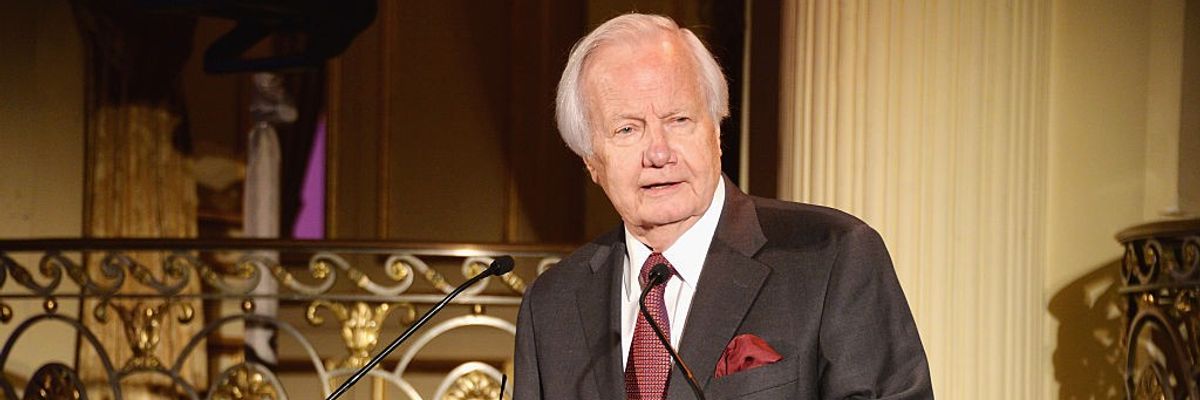
Bill Moyers speaks at an event at the Plaza Hotel on June 8, 2016 in New York City.
(Photo: Clint Spaulding/Patrick McMullan via Getty Images)
Jessica Corbett
Jun 27, 2025
COMMON DREAMS
The life and work of journalist Bill Moyers was being celebrated across the world of independent and public media on Thursday as news of his death at the age of 91 spread across the United States and beyond.
"RIP Bill Moyers, one of the greatest of the greats," Press Watch's Dan Froomkin said on social media as remembrances and celebrations of the legendary broadcaster, democracy defender, and longtime Common Dreams contributor poured in.
"RIP Bill Moyers, one of the greatest of the greats," Press Watch's Dan Froomkin said on social media as remembrances and celebrations of the legendary broadcaster, democracy defender, and longtime Common Dreams contributor poured in.
Moyers died of complications from prostate cancer at Memorial Sloan Kettering Cancer Center in New York City.
He began his long media career as a teenager, reporting for his local newspaper in Texas. He was also an ordained Baptist minister and former President Lyndon B. Johnson's press secretary.
"He believed deeply in the power and potential of public media, and he set the standard for public broadcasting by telling stories you couldn't find anywhere else."
A joint statement from the LBJ Presidential Library, his foundation, and the Johnson family noted that "Moyers played a central role in developing and promoting Johnson's Great Society agenda, an ambitious domestic policy program to eliminate poverty, expand civil rights, and improve education and healthcare nationwide."
Moyers left the White House and returned to journalism in 1967. He served as publisher of Newsday, then launched his award-winning television career, from which he retired in 2015. His website,BillMoyers.com, went into "archive mode" in 2017.
With his television programming—much of which aired on PBS—Moyers took "his cameras and microphones to cities and towns where unions, community organizations, environmental groups, tenants rights activists, and others were waging grassroots campaigns for change," Peter Dreier wrote for Common Dreams a decade ago.
In a comment to Common Dreams after Moyer's death, The Nation's John Nichols, who co-founded the group Free Press and co-authored The Death and Life of American Journalism, highlighted the late journalist's work during the era of former President George W. Bush and Vice President Dick Cheney.
"There were journalism and democracy campaigners before Bill Moyers, and there will be journalism and democracy campaigners who carry the movement forward now that he has passed," Nichols said. "But every honest history will record that the modern media reform movement—with its commitment to diversity, to equity, and to defending the sort of speak-truth-to-power reporting that exposes injustice, inequality, authoritarianism, and militarism—was made possible by Bill's courageous advocacy during the Bush-Cheney years. He raised the banner—as a former White House press secretary, a bestselling author, and a nationally recognized journalist and PBS host—and we rallied around it."
Free Press president and co-CEO Craig Aaron said in a statement that "Bill Moyers was a legend who lived up to his reputation. Moyers believed that journalism should serve democracy, not just the bottom line. He believed deeply in the power and potential of public media, and he set the standard for public broadcasting by telling stories you couldn't find anywhere else. He always stood up to bullies—including those who come forward in every generation to try to crush public media and end its independence. We can honor his memory by continuing that fight."
Many journalists weighed in on social media, sharing stories of his "very generous heart," and how he was "the rarest combination of curiosity, kindness, honesty, and conviction."
"Bill Moyers was a close friend, a mentor, and a role model. In a media world where there's almost no solidarity, he guided my career and was an unwavering supporter of our accountability journalism at The Lever," said the outlet's founder, David Sirota, on Thursday. "This is terrible news. We have lost a giant."
"There's this idea of 'never meet your heroes'—and in my experience, I think that aphorism holds up for the most part," Sirota added. "But it was the opposite with Bill—as great a journalism hero as he was in public, he was just as great a mentor in private. He truly was the best of us."
Katrina vanden Heuvel, The Nation's editorial director and publisher, said Thursday that "Moyers distinguished himself as a journalist by refusing to be a stenographer for the powerful. Instead of providing yet another venue for the predictable preening of establishment leaders, Moyers gave a platform to dissenting voices from both the left and the right. Instead of covering the news from the narrow perspective of the political and corporate elite, Moyers gave voice to the powerless and the issues that affect them."
"We journalists are of course obliged to cover the news," Moyers said at an event hosted by the magazine in Washington, D.C., according to vanden Heuvel. "But our deeper mission is to uncover the news that powerful people would prefer to keep hidden."
Beyond the media world, Moyers was also remembered fondly. Sen. Bernie Sanders (I-Vt.) said Thursday that "Bill Moyers, a friend, public servant, and outstanding journalist, has passed away. As an aide to President Johnson, Bill pushed the president in a more progressive direction. As a journalist, he had the courage to explore issues that many ignored. Bill will be sorely missed."
While Moyers has now passed, his legacy lives on in his mountain of work, more than 1,000 hours of which were collected in 2023 by the American Archive of Public Broadcasting, a collaboration between the Library of Congress and Boston's GBH. The Bill Moyers Collection is available online at AmericanArchive.org.
"We journalists are of course obliged to cover the news," Moyers said at an event hosted by the magazine in Washington, D.C., according to vanden Heuvel. "But our deeper mission is to uncover the news that powerful people would prefer to keep hidden."
Beyond the media world, Moyers was also remembered fondly. Sen. Bernie Sanders (I-Vt.) said Thursday that "Bill Moyers, a friend, public servant, and outstanding journalist, has passed away. As an aide to President Johnson, Bill pushed the president in a more progressive direction. As a journalist, he had the courage to explore issues that many ignored. Bill will be sorely missed."
While Moyers has now passed, his legacy lives on in his mountain of work, more than 1,000 hours of which were collected in 2023 by the American Archive of Public Broadcasting, a collaboration between the Library of Congress and Boston's GBH. The Bill Moyers Collection is available online at AmericanArchive.org.
No comments:
Post a Comment