No War With Iran
June 20, 2025
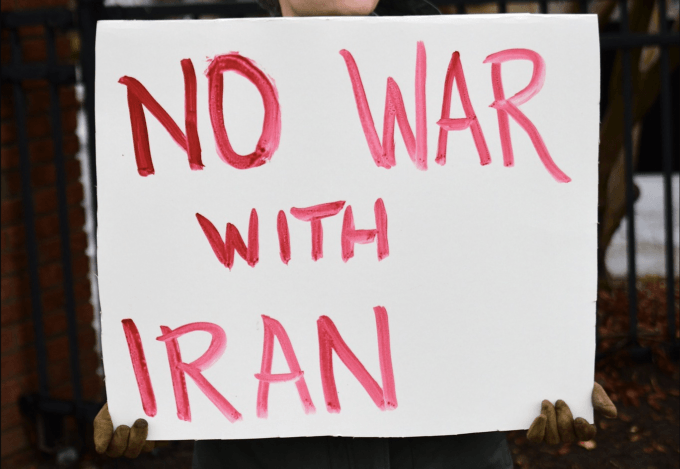
Photograph Source: Anthony Crider – CC BY 2.0
Israel’s attack on Iran opens a huge danger of escalation in the Middle East.
Israel has a long history of attacking Iran — including bombing Iranian facilities, assassinating Iranian leaders and scientists, launching cyberattacks, and more. Iran has on occasion struck back, including launching strikes on Tel Aviv in this latest back and forth.
But this latest assault is more dangerous than previous rounds of violence. It holds the prospect of full-scale war between the two strongest military forces in the region — and potentially the United States too.
For decades, Congress and multiple administrations have guaranteed billions of dollars in military aid to Israel every year — an amount that’s skyrocketed since Israel’s attack on Gaza, which the International Court of Justice and other authorities
So while it’s not yet clear how much the U.S. knew or approved of Israel’s attack on Iran, there’s no question that Washington’s longstanding military and economic support made it possible. That alone is enough to make the U.S. complicit in Israel’s illegal war — and worryingly, a target of Iranian retaliation, especially with so many U.S. military facilities nearby.
There are about 40,000 U.S. troops stationed across the Middle East, and now the U.S. is sending two additional destroyers to the coast of Israel. Iran has already retaliated against Israel. If Tehran also makes good on a threat to attack U.S. targets in the region, or if the U.S. decides to help Israel escalate its attacks, there’s a real risk the U.S. could become directly involved — perhaps including airstrikes or troops on the ground.
Because the U.S. government has long supported Israel, there’s a lot about Israel you simply don’t hear very often in the United States. For one thing, there is only one nuclear weapons state in the Middle East — and that’s Israel, not Iran.
Israel reportedly maintains at least 90 nuclear weapons, but it’s the only nuclear power in the world that refuses to confirm or deny its arsenal. While Iran has enriched uranium, it has no nuclear weapons and — despite Israeli claims — does not have a program to create one.
In the U.S., we hear a lot of negative messaging about Iran. And like any government, Iran’s has policies and practices that can be legitimately criticized.
But we should be clear that, when it comes to life and politics in the Middle East, it’s Israel that remains the main destabilizing force. Just in the last two years, Israel has attacked and occupied new swathes of territory in Lebanon, Syria, the West Bank, and is carrying out a genocide in Gaza. It has also bombed Iraq and Yemen.
Now Israel’s government is raising the level of instability to a new level, directly confronting Iran.
U.S. support for these policies has led to enormous suffering across the Middle East. And now it may be directly endangering Americans as well, something the American people seem to understand. In one recent poll, 60 percent of Americans — including over half of Trump voters — oppose the U.S. getting more involved in the fighting between Iran and Israel.
As in Gaza, Americans bear a particular responsibility to try to stop this fighting, for the simple reason that our government is supplying Israel’s weapons and preventing any accountability for how they’re used.
Our message needs to be clear: No war with Iran!
Israel’s Attack on Iran: The Violent New World is Going to Horrify You
Photograph Source: Anthony Crider – CC BY 2.0
Israel’s attack on Iran opens a huge danger of escalation in the Middle East.
Israel has a long history of attacking Iran — including bombing Iranian facilities, assassinating Iranian leaders and scientists, launching cyberattacks, and more. Iran has on occasion struck back, including launching strikes on Tel Aviv in this latest back and forth.
But this latest assault is more dangerous than previous rounds of violence. It holds the prospect of full-scale war between the two strongest military forces in the region — and potentially the United States too.
For decades, Congress and multiple administrations have guaranteed billions of dollars in military aid to Israel every year — an amount that’s skyrocketed since Israel’s attack on Gaza, which the International Court of Justice and other authorities
So while it’s not yet clear how much the U.S. knew or approved of Israel’s attack on Iran, there’s no question that Washington’s longstanding military and economic support made it possible. That alone is enough to make the U.S. complicit in Israel’s illegal war — and worryingly, a target of Iranian retaliation, especially with so many U.S. military facilities nearby.
There are about 40,000 U.S. troops stationed across the Middle East, and now the U.S. is sending two additional destroyers to the coast of Israel. Iran has already retaliated against Israel. If Tehran also makes good on a threat to attack U.S. targets in the region, or if the U.S. decides to help Israel escalate its attacks, there’s a real risk the U.S. could become directly involved — perhaps including airstrikes or troops on the ground.
Because the U.S. government has long supported Israel, there’s a lot about Israel you simply don’t hear very often in the United States. For one thing, there is only one nuclear weapons state in the Middle East — and that’s Israel, not Iran.
Israel reportedly maintains at least 90 nuclear weapons, but it’s the only nuclear power in the world that refuses to confirm or deny its arsenal. While Iran has enriched uranium, it has no nuclear weapons and — despite Israeli claims — does not have a program to create one.
In the U.S., we hear a lot of negative messaging about Iran. And like any government, Iran’s has policies and practices that can be legitimately criticized.
But we should be clear that, when it comes to life and politics in the Middle East, it’s Israel that remains the main destabilizing force. Just in the last two years, Israel has attacked and occupied new swathes of territory in Lebanon, Syria, the West Bank, and is carrying out a genocide in Gaza. It has also bombed Iraq and Yemen.
Now Israel’s government is raising the level of instability to a new level, directly confronting Iran.
U.S. support for these policies has led to enormous suffering across the Middle East. And now it may be directly endangering Americans as well, something the American people seem to understand. In one recent poll, 60 percent of Americans — including over half of Trump voters — oppose the U.S. getting more involved in the fighting between Iran and Israel.
As in Gaza, Americans bear a particular responsibility to try to stop this fighting, for the simple reason that our government is supplying Israel’s weapons and preventing any accountability for how they’re used.
Our message needs to be clear: No war with Iran!
Twenty years ago, the US warned prematurely of the ‘birth pangs’ of a new Middle East. Now they have arrived in full force – and they will not end in Iran

Western politicians and media are tying themselves up in knots trying to spin the impossible: presenting Israel’s unmistakable war of aggression against Iran as some kind of “defensive” move.
This time there was no rationalising pretext, as there was for Israel to inflict a genocide in Gaza following Hamas’ one-day attack on 7 October 2023.
There was not a serious attempt beforehand to concoct a bogus doomsday scenario – as there was in the months leading up to the US and UK’s illegal invasion of Iraq in 2003. Then we were lied to about Baghdad having “weapons of mass destruction” that could be launched at Europe in 45 minutes.
Rather, Iran was deep in negotiations with the United States on its nuclear enrichment programme when Israel launched its unprovoked attack last Friday.
The West has happily regurgitated claims by Israeli Prime Minister Benjamin Netanyahu that Israel was forced to act because Iran was on the cusp of producing a nuclear bomb – an entirely evidence-free claim he has been making since 1992.
None of his dire warnings has ever been borne out by events.
In fact, Israel struck Iran shortly after President Donald Trump had expressed hope of reaching a nuclear agreement with Tehran, and two days before the two countries’ negotiators were due to meet again.
In late March Trump’s head of national intelligence, Tulsi Gabbard, had expressly statedas part of the US intelligence community’s annual assessment: “Iran is not building a nuclear weapon and Supreme Leader [Ali] Khameini has not authorised a nuclear weapons programme he suspended in 2003.”
This week four sources said to be familiar with that assessment told CNN that Iran was not trying to build a bomb but, if it changed tack, it would be “up to three years away from being able to produce and deliver one [a nuclear warhead] to a target of its choosing”.
Nonetheless, by Tuesday this week Trump appeared to be readying to join Israel’s attack. He publicly rebuked his own intelligence chief’s verdict, sent US warplanes to the Middle East via the UK and Spain, demanded Iran’s “unconditional surrender”, and made barely veiled threats to kill Khameini.
Western politicians and media are tying themselves up in knots trying to spin the impossible: presenting Israel’s unmistakable war of aggression against Iran as some kind of “defensive” move.
This time there was no rationalising pretext, as there was for Israel to inflict a genocide in Gaza following Hamas’ one-day attack on 7 October 2023.
There was not a serious attempt beforehand to concoct a bogus doomsday scenario – as there was in the months leading up to the US and UK’s illegal invasion of Iraq in 2003. Then we were lied to about Baghdad having “weapons of mass destruction” that could be launched at Europe in 45 minutes.
Rather, Iran was deep in negotiations with the United States on its nuclear enrichment programme when Israel launched its unprovoked attack last Friday.
The West has happily regurgitated claims by Israeli Prime Minister Benjamin Netanyahu that Israel was forced to act because Iran was on the cusp of producing a nuclear bomb – an entirely evidence-free claim he has been making since 1992.
None of his dire warnings has ever been borne out by events.
In fact, Israel struck Iran shortly after President Donald Trump had expressed hope of reaching a nuclear agreement with Tehran, and two days before the two countries’ negotiators were due to meet again.
In late March Trump’s head of national intelligence, Tulsi Gabbard, had expressly statedas part of the US intelligence community’s annual assessment: “Iran is not building a nuclear weapon and Supreme Leader [Ali] Khameini has not authorised a nuclear weapons programme he suspended in 2003.”
This week four sources said to be familiar with that assessment told CNN that Iran was not trying to build a bomb but, if it changed tack, it would be “up to three years away from being able to produce and deliver one [a nuclear warhead] to a target of its choosing”.
Nonetheless, by Tuesday this week Trump appeared to be readying to join Israel’s attack. He publicly rebuked his own intelligence chief’s verdict, sent US warplanes to the Middle East via the UK and Spain, demanded Iran’s “unconditional surrender”, and made barely veiled threats to kill Khameini.
‘Samson option’
Israel’s engineering of a pretext to attack Iran – defined by the Nuremberg tribunal in 1945 as the “supreme international crime” – has been many years in the making.
The current talks between the US and Iran were only needed because, under intense Israeli pressure during his first term as president, Trump tore up an existing agreement with Tehran.
That deal, negotiated by his predecessor, Barack Obama, had been intended to quieten Israel’s relentless calls for a strike on Iran. It tightly limited Tehran’s enrichment of uranium to far below the level where it could “break out” from its civilian energy programme to build a bomb.
Israel, by contrast, has been allowed to maintain a nuclear arsenal of at least 100 warheads, while refusing – unlike Iran – to sign the Nuclear Non-Proliferation Treaty and – again unlike Iran – denying access to monitors from the International Atomic Energy Agency.
The West’s collusion in the pretence that Israel’s nuclear weapons are secret – a policy formally known in Israel as “ambiguity” – has been necessary only because the US is not allowed to provide military aid to a state with undeclared nuclear weapons.
Israel is by far the largest recipient of such aid.
No one – apart from incorrigible racists – believes Iran would take the suicidal step of firing a nuclear missile at Israel, even if it had one. That is not the real grounds for Israeli or US concern.
Rather, the double standards are enforced to keep Israel as the only nuclear-armed state in the Middle East so that it can project unrestrained military power across an oil-rich region the West is determined to control.
Israel’s bomb has left it untouchable and unaccountable, and ready to intimidate its neighbours with the “Samson option” – the threat that Israel will use its nuclear arsenal rather than risk an existential threat.
Israel’s national security minister, Itamar Ben Gvir, appeared to imply just such a scenario against Iran this week in a reported comment: “There will be other difficult days ahead, but always remember Hiroshima and Nagasaki.”
Bear in mind that Israeli governments count as “existential” any threat to Israel’s current status as a settler-colonial state, one occupying and forcibly uprooting the Palestinian people from their homeland.
Israel’s nuclear weapons ensure it can do as it pleases in the region – including commit genocide in Gaza – without significant fear of reprisals.
Israel’s engineering of a pretext to attack Iran – defined by the Nuremberg tribunal in 1945 as the “supreme international crime” – has been many years in the making.
The current talks between the US and Iran were only needed because, under intense Israeli pressure during his first term as president, Trump tore up an existing agreement with Tehran.
That deal, negotiated by his predecessor, Barack Obama, had been intended to quieten Israel’s relentless calls for a strike on Iran. It tightly limited Tehran’s enrichment of uranium to far below the level where it could “break out” from its civilian energy programme to build a bomb.
Israel, by contrast, has been allowed to maintain a nuclear arsenal of at least 100 warheads, while refusing – unlike Iran – to sign the Nuclear Non-Proliferation Treaty and – again unlike Iran – denying access to monitors from the International Atomic Energy Agency.
The West’s collusion in the pretence that Israel’s nuclear weapons are secret – a policy formally known in Israel as “ambiguity” – has been necessary only because the US is not allowed to provide military aid to a state with undeclared nuclear weapons.
Israel is by far the largest recipient of such aid.
No one – apart from incorrigible racists – believes Iran would take the suicidal step of firing a nuclear missile at Israel, even if it had one. That is not the real grounds for Israeli or US concern.
Rather, the double standards are enforced to keep Israel as the only nuclear-armed state in the Middle East so that it can project unrestrained military power across an oil-rich region the West is determined to control.
Israel’s bomb has left it untouchable and unaccountable, and ready to intimidate its neighbours with the “Samson option” – the threat that Israel will use its nuclear arsenal rather than risk an existential threat.
Israel’s national security minister, Itamar Ben Gvir, appeared to imply just such a scenario against Iran this week in a reported comment: “There will be other difficult days ahead, but always remember Hiroshima and Nagasaki.”
Bear in mind that Israeli governments count as “existential” any threat to Israel’s current status as a settler-colonial state, one occupying and forcibly uprooting the Palestinian people from their homeland.
Israel’s nuclear weapons ensure it can do as it pleases in the region – including commit genocide in Gaza – without significant fear of reprisals.
War propaganda
The claim that Israel is “defending itself” in attacking Iran – promoted by France, Germany, Britain, the European Union, the G7 and the US – should be understood as a further assault on the foundational principles of international law.
The assertion is premised on the idea that Israel’s attack was “pre-emptive” – potentially justified if Israel could show there was an imminent, credible and severe threat of an attack or invasion by Iran that could not be averted by other means.
And yet, even assuming there is evidence to support Israel’s claim it was in imminent danger – there isn’t – the very fact that Iran was in the midst of talks with the US about its nuclear programme voided that justification.
Rather, Israel’s contention that Iran posed a threat at some point in the future that needed to be neutralised counts as a “preventive” war – and is indisputably illegal under international law.
Note the striking contrast with the West’s reaction to Russia’s so-called “unprovoked” attack on Ukraine just three years ago.
Western capitals and their media were only too clear then that Moscow’s actions were unconscionable – and that severe economic sanctions on Russia, and military support for Ukraine, were the only possible responses.
So much so that early efforts to negotiate a ceasefire deal between Moscow and Kyiv, premised on a Russian withdrawal, were stymied by Prime Minister Boris Johnson, presumably on Washington’s orders. Ukraine was instructed to fight on.
Israel’s attack on Iran is even more flagrantly in violation of international law.
Netanyahu, who is already a fugitive from the International Criminal Court, which wants to try him for committing crimes against humanity in Gaza by starving the population there, is now guilty of the “supreme international crime” too.
Not that one would not know any of this from listening to western politicians or the billionaire-owned media.
There, the narrative is once again of a plucky Israel, forced to act unilaterally; of Israel facing down an existential threat; of Israel being menaced by barbaric terrorists; of the unique suffering – and humanity – of Israel’s population; of Netanyahu as a strong leader rather than an out-and-out war criminal.
It is the same, well-worn script, trotted out on every occasion, whatever the facts or circumstances. Which is clue enough that western audiences are not being informed; they are being subjected to yet more war propaganda.
The claim that Israel is “defending itself” in attacking Iran – promoted by France, Germany, Britain, the European Union, the G7 and the US – should be understood as a further assault on the foundational principles of international law.
The assertion is premised on the idea that Israel’s attack was “pre-emptive” – potentially justified if Israel could show there was an imminent, credible and severe threat of an attack or invasion by Iran that could not be averted by other means.
And yet, even assuming there is evidence to support Israel’s claim it was in imminent danger – there isn’t – the very fact that Iran was in the midst of talks with the US about its nuclear programme voided that justification.
Rather, Israel’s contention that Iran posed a threat at some point in the future that needed to be neutralised counts as a “preventive” war – and is indisputably illegal under international law.
Note the striking contrast with the West’s reaction to Russia’s so-called “unprovoked” attack on Ukraine just three years ago.
Western capitals and their media were only too clear then that Moscow’s actions were unconscionable – and that severe economic sanctions on Russia, and military support for Ukraine, were the only possible responses.
So much so that early efforts to negotiate a ceasefire deal between Moscow and Kyiv, premised on a Russian withdrawal, were stymied by Prime Minister Boris Johnson, presumably on Washington’s orders. Ukraine was instructed to fight on.
Israel’s attack on Iran is even more flagrantly in violation of international law.
Netanyahu, who is already a fugitive from the International Criminal Court, which wants to try him for committing crimes against humanity in Gaza by starving the population there, is now guilty of the “supreme international crime” too.
Not that one would not know any of this from listening to western politicians or the billionaire-owned media.
There, the narrative is once again of a plucky Israel, forced to act unilaterally; of Israel facing down an existential threat; of Israel being menaced by barbaric terrorists; of the unique suffering – and humanity – of Israel’s population; of Netanyahu as a strong leader rather than an out-and-out war criminal.
It is the same, well-worn script, trotted out on every occasion, whatever the facts or circumstances. Which is clue enough that western audiences are not being informed; they are being subjected to yet more war propaganda.
Regime change
But Israel’s pretexts for its war of aggression are a moving target – hard to grapple with because they keep changing.
If Netanyahu started by touting an implausible claim that Iran’s nuclear programme was an imminent threat, he soon shifted to arguing that Israel’s war of aggression was also justified to remove a supposed threat from Iran’s ballistic missile programme.
In the ultimate example of chutzpah, Israel cited as its evidence the fact that it was being hit by Iranian missiles – missiles fired by Tehran in direct response to Israel’s rain of missiles on Iran.
Israel’s protestations at the rising death toll among Israeli civilians overlooked two inconvenient facts that should have underscored Israel’s hypocrisy, were the western media not working so hard to obscure it.
First, Israel has turned its own civilian population into human shields by placing key military installations – such as its spy agency and its defence ministry – in the centre of densely populated Tel Aviv, as well as firing its interception rockets from inside the city.
Recall that Israel has blamed Hamas for the deaths of tens of thousands of Palestinians in Gaza over the past 20 months based on the largely unevidenced claim that its fighters have been hiding among the population. Now that same argument can, and should, be turned against Israel.
And second, Israel is all too obviously itself hitting residential areas in Iran – just as, of course, it did earlier by destroying almost all of Gaza’s buildings, including homes, hospitals, schools, universities and bakeries.
Both Netanyahu and Trump have called on Iranians to “evacuate immediately” the city of Tehran – something impossible for most of its 10 million inhabitants to do in the time allowed.
But their demand raises too the question of why, if Israel is trying to stop the development of an Iranian nuclear warhead, it is focusing so many of its attacks on residential areas of Iran’s capital.
More generally, Israel’s argument that Tehran must be stripped of its ballistic missiles assumes that only Israel – and those allied with it – are allowed any kind of military deterrence capability.
It seems not only is Iran not allowed a nuclear arsenal as a counter-weight to Israel’s nukes, but it is not even allowed to strike back when Israel decides to launch its US-supplied missiles at Tehran.
What Israel is effectively demanding is that Iran be turned into a larger equivalent of the Palestinian Authority – a compliant, lightly armed regime completely under Israel’s thumb.
Which gets to the heart of what Israel’s current attack on Iran is really designed to achieve.
It is about instituting regime change in Tehran.
But Israel’s pretexts for its war of aggression are a moving target – hard to grapple with because they keep changing.
If Netanyahu started by touting an implausible claim that Iran’s nuclear programme was an imminent threat, he soon shifted to arguing that Israel’s war of aggression was also justified to remove a supposed threat from Iran’s ballistic missile programme.
In the ultimate example of chutzpah, Israel cited as its evidence the fact that it was being hit by Iranian missiles – missiles fired by Tehran in direct response to Israel’s rain of missiles on Iran.
Israel’s protestations at the rising death toll among Israeli civilians overlooked two inconvenient facts that should have underscored Israel’s hypocrisy, were the western media not working so hard to obscure it.
First, Israel has turned its own civilian population into human shields by placing key military installations – such as its spy agency and its defence ministry – in the centre of densely populated Tel Aviv, as well as firing its interception rockets from inside the city.
Recall that Israel has blamed Hamas for the deaths of tens of thousands of Palestinians in Gaza over the past 20 months based on the largely unevidenced claim that its fighters have been hiding among the population. Now that same argument can, and should, be turned against Israel.
And second, Israel is all too obviously itself hitting residential areas in Iran – just as, of course, it did earlier by destroying almost all of Gaza’s buildings, including homes, hospitals, schools, universities and bakeries.
Both Netanyahu and Trump have called on Iranians to “evacuate immediately” the city of Tehran – something impossible for most of its 10 million inhabitants to do in the time allowed.
But their demand raises too the question of why, if Israel is trying to stop the development of an Iranian nuclear warhead, it is focusing so many of its attacks on residential areas of Iran’s capital.
More generally, Israel’s argument that Tehran must be stripped of its ballistic missiles assumes that only Israel – and those allied with it – are allowed any kind of military deterrence capability.
It seems not only is Iran not allowed a nuclear arsenal as a counter-weight to Israel’s nukes, but it is not even allowed to strike back when Israel decides to launch its US-supplied missiles at Tehran.
What Israel is effectively demanding is that Iran be turned into a larger equivalent of the Palestinian Authority – a compliant, lightly armed regime completely under Israel’s thumb.
Which gets to the heart of what Israel’s current attack on Iran is really designed to achieve.
It is about instituting regime change in Tehran.
Trained in torture
Again, the western media are assisting with this new narrative.
Extraordinarily, TV politics shows such as the BBC’s Sunday with Laura Kuenssberg invited on as a guest Reza Pahlavi, the son of the Iranian shah ousted by the ayatollahs in 1979 to create an Islamic republic. He used the slot to call on Iranians to “rise up” against their leaders.
The framing – an entirely Israeli confected one – is that Iranian society is desperate to throw off the yoke of Islamic dictatorship and return to the halcyon days of monarchical rule under the Pahlavis.
It is a beyond-absurd analysis of modern Iran.
Asking Pahlavi to discuss how Iran might be freed from clerical rule is the equivalent of inviting Josef Stalin’s grandson into the studio to discuss how he plans to lead a pro-democracy movement in Russia.
In fact, the much-feared Pahlavis were only in power in 1979 – and in a position to be overthrown – because Israel, Britain and the US meddled deeply in Iran to keep them in place for so long.
When Iranians elected the secular reformist Mohammed Mossadegh, a lawyer and intellectual, as prime minister in 1951, Britain and the US worked tirelessly to topple him. His chief crime was that he took back control of Iran’s oil industry – and its profits – from the UK.
Within two years, Mossadegh was overthrown in US-led Operation Ajax, and the Shah re-installed as dictator. Israel was drafted in to train Iran’s Savak secret police in torture techniques to use on Iranian dissidents, learnt from torturing Palestinians.
Predictably, the West’s crushing of all efforts to democratically reform Iran opened up a space for resistance to the Shah that was quickly occupied by Islamist parties instead.
In 1979, these revolutionary forces overthrew the western-backed dictator Mohammad Reza Pahlavi. Ayatollah Ruhollah Khomeini returned from exile in Paris to found the Islamic Republic of Iran.
Again, the western media are assisting with this new narrative.
Extraordinarily, TV politics shows such as the BBC’s Sunday with Laura Kuenssberg invited on as a guest Reza Pahlavi, the son of the Iranian shah ousted by the ayatollahs in 1979 to create an Islamic republic. He used the slot to call on Iranians to “rise up” against their leaders.
The framing – an entirely Israeli confected one – is that Iranian society is desperate to throw off the yoke of Islamic dictatorship and return to the halcyon days of monarchical rule under the Pahlavis.
It is a beyond-absurd analysis of modern Iran.
Asking Pahlavi to discuss how Iran might be freed from clerical rule is the equivalent of inviting Josef Stalin’s grandson into the studio to discuss how he plans to lead a pro-democracy movement in Russia.
In fact, the much-feared Pahlavis were only in power in 1979 – and in a position to be overthrown – because Israel, Britain and the US meddled deeply in Iran to keep them in place for so long.
When Iranians elected the secular reformist Mohammed Mossadegh, a lawyer and intellectual, as prime minister in 1951, Britain and the US worked tirelessly to topple him. His chief crime was that he took back control of Iran’s oil industry – and its profits – from the UK.
Within two years, Mossadegh was overthrown in US-led Operation Ajax, and the Shah re-installed as dictator. Israel was drafted in to train Iran’s Savak secret police in torture techniques to use on Iranian dissidents, learnt from torturing Palestinians.
Predictably, the West’s crushing of all efforts to democratically reform Iran opened up a space for resistance to the Shah that was quickly occupied by Islamist parties instead.
In 1979, these revolutionary forces overthrew the western-backed dictator Mohammad Reza Pahlavi. Ayatollah Ruhollah Khomeini returned from exile in Paris to found the Islamic Republic of Iran.
Crescent of resistance
Notably Khomeini’s successor as supreme leader, Ali Khameini, issued a religious edict in 2003 banning Iran from developing a nuclear weapon. He considered it a violation of Islamic law.
Which is why Iran has been so reluctant to develop a bomb, despite Israel’s endless provocations and claims to the contrary.
What Iran has done instead is two things that are the real trigger for Israel’s war of aggression.
First, it developed the best alternative military strategy it could muster to protect itself from Israeli and western belligerence – a belligerence related to Iran’s refusal to serve as a client of the West, as the Shah once had, rather than the issue of human rights under clerical rule.
Iran’s leaders understood they were a target. Iran has huge reserves of oil and gas, but unlike the neighbouring Gulf regimes it is not a puppet of the West. It can also shut down the Strait of Hormuz, the main gateway for the flow of oil and gas to the West and Asia.
And as a Shia-led state (in contrast to the Sunni Islam that dominates much of the rest of the Middle East), Iran has a series of co-religionist communities across the region – in Lebanon, Syria, Iraq, Yemen and elsewhere – with which it has developed strong ties.
For example, with Iran’s help, Hezbollah in Lebanon built up a large stockpile of rockets and missiles close to Israel’s border. That was supposed to deter Israel from trying to attack and occupy Lebanon again, as it did for two decades from the early 1980s through to 2000.
But it also meant that any longer-range attack by Israel on Iran would prove risky, exposing it to a barrage of missiles on its northern border.
Ideologues in Washington, known as the neoconservatives, who are keenly supportive of Israeli hegemony in the Middle East, deeply opposed what came to be seen as “the axis of resistance”.
The neocons, seeking a way to crush Iran, quickly exploited the 9-11 attacks on the Twin Towers in New York in 2001 as an opportunity to erode Iranian power.
General Wesley Clark was told at the Pentagon in the days after the attack that the US had come up with a plan to “take out seven countries in five years”.
Notably, even though most of the hijackers who crashed planes into the Twin Towers were from Saudi Arabia, the Pentagon’s list of targets centrally featured members of the so-called “Shia crescent”.
All have been attacked since. As Clark noted, the seventh and final state on that list – the hardest to take on – is Iran.
Notably Khomeini’s successor as supreme leader, Ali Khameini, issued a religious edict in 2003 banning Iran from developing a nuclear weapon. He considered it a violation of Islamic law.
Which is why Iran has been so reluctant to develop a bomb, despite Israel’s endless provocations and claims to the contrary.
What Iran has done instead is two things that are the real trigger for Israel’s war of aggression.
First, it developed the best alternative military strategy it could muster to protect itself from Israeli and western belligerence – a belligerence related to Iran’s refusal to serve as a client of the West, as the Shah once had, rather than the issue of human rights under clerical rule.
Iran’s leaders understood they were a target. Iran has huge reserves of oil and gas, but unlike the neighbouring Gulf regimes it is not a puppet of the West. It can also shut down the Strait of Hormuz, the main gateway for the flow of oil and gas to the West and Asia.
And as a Shia-led state (in contrast to the Sunni Islam that dominates much of the rest of the Middle East), Iran has a series of co-religionist communities across the region – in Lebanon, Syria, Iraq, Yemen and elsewhere – with which it has developed strong ties.
For example, with Iran’s help, Hezbollah in Lebanon built up a large stockpile of rockets and missiles close to Israel’s border. That was supposed to deter Israel from trying to attack and occupy Lebanon again, as it did for two decades from the early 1980s through to 2000.
But it also meant that any longer-range attack by Israel on Iran would prove risky, exposing it to a barrage of missiles on its northern border.
Ideologues in Washington, known as the neoconservatives, who are keenly supportive of Israeli hegemony in the Middle East, deeply opposed what came to be seen as “the axis of resistance”.
The neocons, seeking a way to crush Iran, quickly exploited the 9-11 attacks on the Twin Towers in New York in 2001 as an opportunity to erode Iranian power.
General Wesley Clark was told at the Pentagon in the days after the attack that the US had come up with a plan to “take out seven countries in five years”.
Notably, even though most of the hijackers who crashed planes into the Twin Towers were from Saudi Arabia, the Pentagon’s list of targets centrally featured members of the so-called “Shia crescent”.
All have been attacked since. As Clark noted, the seventh and final state on that list – the hardest to take on – is Iran.
Show of strength
Israel’s other concern was that Iran and its allies, unlike the Arab regimes, had proved steadfast in their support for the Palestinian people against decades of Israeli occupation and oppression.
Iran’s defiance on the Palestinian cause was underscored during Trump’s first presidency, when Arab states began actively normalising with Israel through the US-brokered Abraham accords, even as the plight of the Palestinians worsened under Israeli rule.
Infuriatingly for Israel, Iran and the late Hezbollah leader Hassan Nasarallah became the main flagbearers of popular support for the Palestinians – among Muslims across the board.
With the Palestinian Authority largely quiescent by the mid-2000s, Iran channelled its assistance to Hamas in besieged Gaza, the main Palestinian group still ready to struggle against Israeli apartheid rule and ethnic cleansing.
The result was a tense stability of sorts, with each side restraining itself in a Middle Eastern version of “mutually assured destruction”. Neither side had an incentive to risk an all-out attack for fear of the severe consequences.
That model came to an abrupt end on 7 October 2023, when Hamas decided its previous calculations needed reassessing.
With the Palestinians feeling increasingly isolated, choked by Israel’s siege and abandoned by the Arab regimes, Hamas staged a show of force, breaking out for one day from the concentration camp of Gaza.
Israel seized the opportunity to complete two related tasks: destroying the Palestinians as a people once and for all, and with it their ambitions for a state in their homeland; and rolling back the Shia crescent, just as the Pentagon had planned more than 20 years earlier.
Israel started by levelling Gaza – slaughtering and starving its people. Then it moved to destroy Hezbollah’s southern heartlands in Lebanon. And with the collapse of the Syrian regime of Bashar al-Assad, Israel was able to occupy parts of Syria, smash what remained of its military infastructure, and clear a flight path to Iran.
These were the preconditions for launching the current war of aggression on Iran.
Israel’s other concern was that Iran and its allies, unlike the Arab regimes, had proved steadfast in their support for the Palestinian people against decades of Israeli occupation and oppression.
Iran’s defiance on the Palestinian cause was underscored during Trump’s first presidency, when Arab states began actively normalising with Israel through the US-brokered Abraham accords, even as the plight of the Palestinians worsened under Israeli rule.
Infuriatingly for Israel, Iran and the late Hezbollah leader Hassan Nasarallah became the main flagbearers of popular support for the Palestinians – among Muslims across the board.
With the Palestinian Authority largely quiescent by the mid-2000s, Iran channelled its assistance to Hamas in besieged Gaza, the main Palestinian group still ready to struggle against Israeli apartheid rule and ethnic cleansing.
The result was a tense stability of sorts, with each side restraining itself in a Middle Eastern version of “mutually assured destruction”. Neither side had an incentive to risk an all-out attack for fear of the severe consequences.
That model came to an abrupt end on 7 October 2023, when Hamas decided its previous calculations needed reassessing.
With the Palestinians feeling increasingly isolated, choked by Israel’s siege and abandoned by the Arab regimes, Hamas staged a show of force, breaking out for one day from the concentration camp of Gaza.
Israel seized the opportunity to complete two related tasks: destroying the Palestinians as a people once and for all, and with it their ambitions for a state in their homeland; and rolling back the Shia crescent, just as the Pentagon had planned more than 20 years earlier.
Israel started by levelling Gaza – slaughtering and starving its people. Then it moved to destroy Hezbollah’s southern heartlands in Lebanon. And with the collapse of the Syrian regime of Bashar al-Assad, Israel was able to occupy parts of Syria, smash what remained of its military infastructure, and clear a flight path to Iran.
These were the preconditions for launching the current war of aggression on Iran.
‘Birth pangs’
Back in 2006, as Israel was bombing swaths of Lebanon in an earlier attempt to realise the Pentagon’s plan, Condoleezza Rice, the then US secretary of state, prematurely labelled Israel’s violence as the “birth pangs of a new Middle East”.What we have been witnessing over the past 20 months of Israel’s slow rampage towards Iran is precisely a revival of those birth pangs. Israel and the US are jointly remaking the Middle East through extreme violence and the eradication of international law.
Success for Israel can come in one of two ways.
Either it installs a new authoritarian ruler in Tehran, like the Shah’s son, who will do the bidding of Israel and the US. Or Israel leaves the country so wrecked that it devolves into violent factionalism, too taken up with civil war to expend its limited energies on developing a nuclear bomb or organising a “Shia crescent” of resistance.
But ultimately this is about more than redrawing the map of the Middle East. And it is about more than toppling the rulers in Tehran.
Just as Israel needed to take out Hamas, Hezbollah and Syria before it could consider clearing a path to Iran’s destruction, the US and its western allies needs the axis of resistance eradicated, as well as Russia bogged down in an interminable war in Ukraine, before it can consider taking on China.
Or as the German Chancellor Friedrich Merz noted this week, in one of those quiet-part-out-loud moments: “This [the attack on Iran] is the dirty work Israel is doing for all of us.”
This is a key moment in the Pentagon’s 20-year plan for “global full-spectrum dominance”: a unipolar world in which the US is unconstrained by military rivals or the imposition of international law. A world in which a tiny, unaccountable elite, enriched by wars, dictate terms to the rest of us.
If all this sounds like a sociopath’s approach to foreign relations, that is because it is. Years of impunity for Israel and the US have brought us to this point. Both feel entitled to destroy what remains of an international order that does not let them get precisely what they want.
The current birth pangs will grow. If you believe in human rights, in limits on the power of government, in the use of diplomacy before military aggression, in the freedoms you grew up with, the new world being born is going to horrify you.
- First published at Middle East Eye.
Back in 2006, as Israel was bombing swaths of Lebanon in an earlier attempt to realise the Pentagon’s plan, Condoleezza Rice, the then US secretary of state, prematurely labelled Israel’s violence as the “birth pangs of a new Middle East”.What we have been witnessing over the past 20 months of Israel’s slow rampage towards Iran is precisely a revival of those birth pangs. Israel and the US are jointly remaking the Middle East through extreme violence and the eradication of international law.
Success for Israel can come in one of two ways.
Either it installs a new authoritarian ruler in Tehran, like the Shah’s son, who will do the bidding of Israel and the US. Or Israel leaves the country so wrecked that it devolves into violent factionalism, too taken up with civil war to expend its limited energies on developing a nuclear bomb or organising a “Shia crescent” of resistance.
But ultimately this is about more than redrawing the map of the Middle East. And it is about more than toppling the rulers in Tehran.
Just as Israel needed to take out Hamas, Hezbollah and Syria before it could consider clearing a path to Iran’s destruction, the US and its western allies needs the axis of resistance eradicated, as well as Russia bogged down in an interminable war in Ukraine, before it can consider taking on China.
Or as the German Chancellor Friedrich Merz noted this week, in one of those quiet-part-out-loud moments: “This [the attack on Iran] is the dirty work Israel is doing for all of us.”
This is a key moment in the Pentagon’s 20-year plan for “global full-spectrum dominance”: a unipolar world in which the US is unconstrained by military rivals or the imposition of international law. A world in which a tiny, unaccountable elite, enriched by wars, dictate terms to the rest of us.
If all this sounds like a sociopath’s approach to foreign relations, that is because it is. Years of impunity for Israel and the US have brought us to this point. Both feel entitled to destroy what remains of an international order that does not let them get precisely what they want.
The current birth pangs will grow. If you believe in human rights, in limits on the power of government, in the use of diplomacy before military aggression, in the freedoms you grew up with, the new world being born is going to horrify you.
- First published at Middle East Eye.
FAQ: Israel’s Illegal War on Iran
It has been one week since Israel launched a dangerous war against Iran. With so much misinformation and pro-war propaganda being repeated by politicians and news media, CJPME has just issued a new factsheet that addresses critical questions, including:
- Was Israel’s attack pre-emptive or illegal?
- Is there evidence that Iran is building a nuclear weapon?
- Does Israel have nuclear weapons?
Factsheet: Israel’s Illegal War With Iran
Was Israel’s attack pre-emptive or illegal?
Israel and the U.S. have characterized the June 13 attacks on Iran as a pre-emptive act of self-defence, and Canada and the G7 echoed this framing, stating that Israel has “a right to defend itself.”
However, legal experts widely dispute this justification. Given the lack of evidence of an imminent attack by Iran, experts argue that Israel’s use of force violated Article 2(4) of the Charter of the United Nations and, therefore, was unlawful and amounts to the crime of aggression.
Israel’s targeting of Iranian nuclear facilities — which, according to the International Atomic Energy Agency (IAEA), resulted in damage or destruction of centrifuges — also violates international law. IAEA resolutions affirm that any armed attack on nuclear facilities devoted to peaceful purposes is a violation of the principles of the UN Charter, international law and the Statute of the Agency.
Is there evidence that Iran is building a nuclear weapon?
No, there is no evidence that Iran is actively building a nuclear weapon. Neither the UN nor the IAEA have accused Iran of attempting to build a nuclear weapon. Nor has Israel provided any evidence to support its claim that Iran is close to acquiring a nuclear bomb.
Will Israel’s attack address nuclear proliferation?
No, and some experts argue that Israel’s attacks on Iran could paradoxically fuel both the Iranian government and public to seek a nuclear deterrent.
Israel itself is believed to have more than 90 nuclear weapons, and the capacity to produce many more, according to the Center for Arms Control and Nonproliferation. However, Israel does not acknowledge the existence of a nuclear arsenal. Israel is also not a party to the NPT (unlike Iran), and therefore does not allow international inspections and is not subject to any safeguards (unlike Iran).
The Mirage of Monarchical Salvation: Reza Pahlavi and Media Spectacle of the Israel-Iran War

Photograph by Nathaniel St. Clair
The abuse of greatness is when it disjoins remorse from power!
—Shakespeare, Julius Caesar, Act II, Scene I.
As geopolitical tensions between Israel and Iran have escalated into open warfare, a familiar voice has re-emerged in Western and Israeli media: Reza Pahlavi, the exiled son of Mohammad Reza Shah Pahlavi (d. 1980), Iran’s last monarch deposed in the 1979 Islamic Revolution. With rehearsed gravitas, he has issued calls for regime change in Iran, offering himself as a transitional figure of unity and ‘democratic restoration’, talking points that should be taken both with extreme scrutiny as well as with modest grains of salt. These statements, particularly in the context of the Israel-Iran conflict, must be dissected rigorously. Pahlavi’s public interventions are not only politically tone-deaf but rest on a legacy of autocracy and comprador Anglo-American colonialism in the region, since they are overtly aligned with neocolonial interests whilst betraying the aspirations of Iranians inside Iran itself seeking sovereignty and dignity, and not a recycled monarchy.
In early 2023, Pahlavi and his pro-Zionist, pro-Trump supporters among the Iranian diaspora literally sabotaged the ‘Woman, Life, Freedom’ movement. Today, during this escalating Iran-Israel war, they are now riding on a wave seeking to sabotage Iran itself as a nation-state in a desperate attempt to come back to power by any means necessary, even if this were to entail an Iran completely devastated by the US-enabled genocidal Israeli war machine.
The Historical Baggage: Autocracy in Democratic Garb
To understand the implications of Pahlavi’s recent media statements, one must begin with the weight of history. The Pahlavi dynasty, from Reza Shah (d. 1944) to Mohammad Reza Shah, ruled Iran with an iron fist. Political opposition was crushed, the SAVAK (secret police) terrorized dissenters, and socioeconomic inequalities widened under the guise of modernization. Reza Pahlavi, by birth and design, inherits this legacy. Yet in his media appearances, including recent interviews with pro-Israeli outlets, he positions himself as a symbol of democracy. This contradiction is stark: one cannot claim to lead a democratic future while refusing to meaningfully confront the sins of one’s political inheritance. For example, to this day Reza Pahlavi has yet to acknowledge the deleterious implications of the CIA and MI6’s role in his father’s return to power in August 1953 with the overthrow of Muhammad Mossadegh’s (d. 1967) democratic-nationalist government.
Even among the Iranian diaspora, particularly in Europe and North America, Pahlavi is often viewed by many as an artifact of Cold War-era politics rather than a legitimate agent of change. Inside Iran, he has virtually no traction beyond small monarchist enclaves. He is not trusted by younger generations, especially among Iran’s ethnic minorities, women, and working classes, who see the monarchy as a force of Persian uber-nationalism – even fascism – and cultural repression. His recent performances in Western media reaffirm this detachment.
Weaponizing War: Israel, Interventionism, and Contradiction
Reza Pahlavi’s public support for Israeli strikes against Iran—framed as attacks against the IRGC and “Khamenei’s regime”—exposes a fundamental contradiction in his political messaging. While he condemns the Islamic Republic for aligning with foreign powers like Russia and China and endangering Iran’s sovereignty, he simultaneously champions Israeli military aggression, implicitly inviting a foreign power to determine Iran’s internal future. This is not an act of liberation; it is an overt betrayal of Iran’s national self-determination.
His position also disregards the human cost of war. The Israeli airstrikes have not exclusively targeted military sites. Civilian infrastructure, fuel depots, and non-combatant areas have also suffered damage. Two acquintances of the present author—acquintances aligned with the ‘Woman, Life, Freedom’ movement and who lost members of their family to IR security forces during 2022—were among those who died during the first salvo of Israeli missile strikes targeting apartment blocs in Tehran on 13 June 2025. Pahlavi’s silence on these consequences speaks volumes. Insofar as he claims to represent the Iranian people, he should be defending their lives, not just political outcomes favorable to external sponsors. As mentioned above, the monarchy he represents was itself once installed through a CIA-MI6 coup in 1953. His tacit approval of similar patterns today suggests a continuity of ideology—one where Iranian self-rule is conditional upon Western interests.
Hollow Blueprints: The Iran Transition Council and Exilic Fantasy
Pahlavi and his supporters often point to the so-called Iran Transition Council and other diaspora-based bodies as ready-made frameworks for post-regime governance. These organizations lack both transparency and inclusivity. They do not represent the ethnic, religious, and ideological diversity of modern Iran. Furthermore, their insistence on centering Pahlavi as the primary unifying figure signals a return to personality cults, not a break from them.
Political analysts have also observed that these councils and movements often mirror Western liberal discourse rather than resonate with grassroots Iranian struggles. Their emphasis on elite consensus, diplomatic favor, and foreign validation eclipses the lived realities of laborers, students, and women inside Iran. In this context, the idea that Reza Pahlavi could facilitate a “soft landing” for regime change is not just naïve—it is dangerous.
Sectarian Myopia: Ignoring the Regional Implications
Reza Pahlavi’s statements have failed to address the broader regional consequences of a direct Israel-Iran war. His endorsement of Israeli military actions risks feeding a sectarian inferno across the Middle East. By framing Iran’s current leadership as a uniquely evil regime that must be overthrown by any means necessary, he validates narratives used by Gulf monarchies and Western think tanks to justify endless conflict and arms sales.
What is entirely absent from Pahlavi’s discourse is any recognition of Palestine. At a time when Israel continues its occupation and genocidal bombardment of Gaza, Pahlavi’s total silence on Palestinian suffering further isolates him from Iranian public opinion, which overwhelmingly sympathizes with the Palestinian cause—even among regime critics. This suggests that his vision of democracy is a disturbingly selective: one in which Iranian voices are valued only insofar as they align with Western and Israeli geopolitical aims.
The Myth of Royal Redemption: Manufactured Legitimacy in Western Media
The amplification of Pahlavi’s voice in Anglo-American and Israeli media illustrates a broader problem: the manufacturing of exile leadership for imperial utility. Despite his lack of institutional backing or internal influence, Pahlavi is presented as a credible alternative. This manufactured legitimacy is reminiscent of U.S. policy errors in Iraq and Afghanistan, where exiled figures like Ahmad Chalabi (d. 2015) were groomed as transitional leaders, only to exacerbate chaos once installed.
The same risks are evident here. Western states and media should heed the lessons of history. Outsourcing regime change narratives to nostalgic monarchs or discredited exiles creates the illusion of consensus while ignoring the complexities on the ground. Iranians do not need a savior in a suit claiming ancient lineage. They need solidarity, international legal protection, and material support for grassroots movements that genuinely represent their pluralistic aspirations. While some amongst the Western anti-imperialist Left wrongly believe otherwise, the original and on the ground ‘Woman, Life, Freedom’ movement inside Iran itself was precisely such a thing.
Conclusion: A Call for Authenticity and Caution
Reza Pahlavi’s interventions in the Israel-Iran war reveal the enduring seduction of spectacle over substance. By cloaking monarchical ambition in democratic rhetoric, by supporting military aggression while condemning foreign influence, and by speaking for a people who neither elected him nor need him, Pahlavi illustrates the dangers of nostalgia masquerading as progress. The Iranian people deserve better than another recycled dynasty or a puppet of foreign interests. Any real democratic transformation must begin from within by the people, for the people, and free from the ghosts of empire.

Photograph by Nathaniel St. Clair
The abuse of greatness is when it disjoins remorse from power!
—Shakespeare, Julius Caesar, Act II, Scene I.
As geopolitical tensions between Israel and Iran have escalated into open warfare, a familiar voice has re-emerged in Western and Israeli media: Reza Pahlavi, the exiled son of Mohammad Reza Shah Pahlavi (d. 1980), Iran’s last monarch deposed in the 1979 Islamic Revolution. With rehearsed gravitas, he has issued calls for regime change in Iran, offering himself as a transitional figure of unity and ‘democratic restoration’, talking points that should be taken both with extreme scrutiny as well as with modest grains of salt. These statements, particularly in the context of the Israel-Iran conflict, must be dissected rigorously. Pahlavi’s public interventions are not only politically tone-deaf but rest on a legacy of autocracy and comprador Anglo-American colonialism in the region, since they are overtly aligned with neocolonial interests whilst betraying the aspirations of Iranians inside Iran itself seeking sovereignty and dignity, and not a recycled monarchy.
In early 2023, Pahlavi and his pro-Zionist, pro-Trump supporters among the Iranian diaspora literally sabotaged the ‘Woman, Life, Freedom’ movement. Today, during this escalating Iran-Israel war, they are now riding on a wave seeking to sabotage Iran itself as a nation-state in a desperate attempt to come back to power by any means necessary, even if this were to entail an Iran completely devastated by the US-enabled genocidal Israeli war machine.
The Historical Baggage: Autocracy in Democratic Garb
To understand the implications of Pahlavi’s recent media statements, one must begin with the weight of history. The Pahlavi dynasty, from Reza Shah (d. 1944) to Mohammad Reza Shah, ruled Iran with an iron fist. Political opposition was crushed, the SAVAK (secret police) terrorized dissenters, and socioeconomic inequalities widened under the guise of modernization. Reza Pahlavi, by birth and design, inherits this legacy. Yet in his media appearances, including recent interviews with pro-Israeli outlets, he positions himself as a symbol of democracy. This contradiction is stark: one cannot claim to lead a democratic future while refusing to meaningfully confront the sins of one’s political inheritance. For example, to this day Reza Pahlavi has yet to acknowledge the deleterious implications of the CIA and MI6’s role in his father’s return to power in August 1953 with the overthrow of Muhammad Mossadegh’s (d. 1967) democratic-nationalist government.
Even among the Iranian diaspora, particularly in Europe and North America, Pahlavi is often viewed by many as an artifact of Cold War-era politics rather than a legitimate agent of change. Inside Iran, he has virtually no traction beyond small monarchist enclaves. He is not trusted by younger generations, especially among Iran’s ethnic minorities, women, and working classes, who see the monarchy as a force of Persian uber-nationalism – even fascism – and cultural repression. His recent performances in Western media reaffirm this detachment.
Weaponizing War: Israel, Interventionism, and Contradiction
Reza Pahlavi’s public support for Israeli strikes against Iran—framed as attacks against the IRGC and “Khamenei’s regime”—exposes a fundamental contradiction in his political messaging. While he condemns the Islamic Republic for aligning with foreign powers like Russia and China and endangering Iran’s sovereignty, he simultaneously champions Israeli military aggression, implicitly inviting a foreign power to determine Iran’s internal future. This is not an act of liberation; it is an overt betrayal of Iran’s national self-determination.
His position also disregards the human cost of war. The Israeli airstrikes have not exclusively targeted military sites. Civilian infrastructure, fuel depots, and non-combatant areas have also suffered damage. Two acquintances of the present author—acquintances aligned with the ‘Woman, Life, Freedom’ movement and who lost members of their family to IR security forces during 2022—were among those who died during the first salvo of Israeli missile strikes targeting apartment blocs in Tehran on 13 June 2025. Pahlavi’s silence on these consequences speaks volumes. Insofar as he claims to represent the Iranian people, he should be defending their lives, not just political outcomes favorable to external sponsors. As mentioned above, the monarchy he represents was itself once installed through a CIA-MI6 coup in 1953. His tacit approval of similar patterns today suggests a continuity of ideology—one where Iranian self-rule is conditional upon Western interests.
Hollow Blueprints: The Iran Transition Council and Exilic Fantasy
Pahlavi and his supporters often point to the so-called Iran Transition Council and other diaspora-based bodies as ready-made frameworks for post-regime governance. These organizations lack both transparency and inclusivity. They do not represent the ethnic, religious, and ideological diversity of modern Iran. Furthermore, their insistence on centering Pahlavi as the primary unifying figure signals a return to personality cults, not a break from them.
Political analysts have also observed that these councils and movements often mirror Western liberal discourse rather than resonate with grassroots Iranian struggles. Their emphasis on elite consensus, diplomatic favor, and foreign validation eclipses the lived realities of laborers, students, and women inside Iran. In this context, the idea that Reza Pahlavi could facilitate a “soft landing” for regime change is not just naïve—it is dangerous.
Sectarian Myopia: Ignoring the Regional Implications
Reza Pahlavi’s statements have failed to address the broader regional consequences of a direct Israel-Iran war. His endorsement of Israeli military actions risks feeding a sectarian inferno across the Middle East. By framing Iran’s current leadership as a uniquely evil regime that must be overthrown by any means necessary, he validates narratives used by Gulf monarchies and Western think tanks to justify endless conflict and arms sales.
What is entirely absent from Pahlavi’s discourse is any recognition of Palestine. At a time when Israel continues its occupation and genocidal bombardment of Gaza, Pahlavi’s total silence on Palestinian suffering further isolates him from Iranian public opinion, which overwhelmingly sympathizes with the Palestinian cause—even among regime critics. This suggests that his vision of democracy is a disturbingly selective: one in which Iranian voices are valued only insofar as they align with Western and Israeli geopolitical aims.
The Myth of Royal Redemption: Manufactured Legitimacy in Western Media
The amplification of Pahlavi’s voice in Anglo-American and Israeli media illustrates a broader problem: the manufacturing of exile leadership for imperial utility. Despite his lack of institutional backing or internal influence, Pahlavi is presented as a credible alternative. This manufactured legitimacy is reminiscent of U.S. policy errors in Iraq and Afghanistan, where exiled figures like Ahmad Chalabi (d. 2015) were groomed as transitional leaders, only to exacerbate chaos once installed.
The same risks are evident here. Western states and media should heed the lessons of history. Outsourcing regime change narratives to nostalgic monarchs or discredited exiles creates the illusion of consensus while ignoring the complexities on the ground. Iranians do not need a savior in a suit claiming ancient lineage. They need solidarity, international legal protection, and material support for grassroots movements that genuinely represent their pluralistic aspirations. While some amongst the Western anti-imperialist Left wrongly believe otherwise, the original and on the ground ‘Woman, Life, Freedom’ movement inside Iran itself was precisely such a thing.
Conclusion: A Call for Authenticity and Caution
Reza Pahlavi’s interventions in the Israel-Iran war reveal the enduring seduction of spectacle over substance. By cloaking monarchical ambition in democratic rhetoric, by supporting military aggression while condemning foreign influence, and by speaking for a people who neither elected him nor need him, Pahlavi illustrates the dangers of nostalgia masquerading as progress. The Iranian people deserve better than another recycled dynasty or a puppet of foreign interests. Any real democratic transformation must begin from within by the people, for the people, and free from the ghosts of empire.

Stop Netanyahu Before He Gets Us All Killed
Reprinted from CommonDreams.
For nearly 30 years, Israel’s Prime Minister Benjamin Netanyahu has driven the Middle East into war and destruction. The man is a powder keg of violence. Throughout all the wars that he has championed, Netanyahu has always dreamed of the big one: to defeat and overthrow the Iranian Government. His long-sought war, just launched, might just get us all killed in a nuclear Armageddon, unless Netanyahu is stopped.
Netanyahu’s fixation on war goes back to his extremist mentors, Ze’ev Jabotinsky, Yitzhak Shamir, and Menachem Begin. The older generation believed that Zionists should use whatever violence – wars, assassinations, terror – is needed to achieve their aims of eliminating any Palestinian claim to a homeland.
The founders of Netanyahu’s political movement, the Likud, called for exclusive Zionist control over all of what had been British Mandatory Palestine. At the start of the British Mandate in the early 1920s, the Muslim and Christian Arabs constituted roughly 87% of the population and owned ten times more land than the Jewish population. As of 1948, the Arabs still outnumbered the Jews roughly two to one. Nonetheless, the founding charter of Likud (1977) declared that “between the Sea and the Jordan there will only be Israeli sovereignty.” The now infamous chant, “from the River to the Sea,” which is characterized as anti-Semitic, turns out to be the anti-Palestinian rallying call of the Likud.
The challenge for Likud was how to pursue its maximalist aims despite their blatant illegality under international law and morality, both of which call for a two-state solution.
In 1996, Netanyahu and his American advisors devised a “Clean Break” strategy. They advocated that Israel would not withdraw from the Palestinian lands captured in the 1967 war in exchange for regional peace. Instead, Israel would reshape the Middle East to its liking. Crucially, the strategy envisioned the US as the main force to achieve these aims – waging wars in the region to dismantle governments opposed to Israel’s dominance over Palestine. The US was called upon to fight wars on Israel’s behalf.
The Clean Break strategy was effectively carried out by the US and Israel after 9/11. As NATO Supreme Commander General Wesley Clark revealed, soon after 9/11, the US planned to “attack and destroy the governments in seven countries in five years – starting with Iraq, then Syria, Lebanon, Libya, Somalia, Sudan, and Iran.”
The first of the wars, in early 2003, was to topple the Iraqi government. Plans for further wars were delayed as the US became mired in Iraq. Still, the US supported Sudan’s split in 2005, Israel’s invasion of Lebanon in 2006, and Ethiopia’s incursion into Somalia that same year. In 2011, the Obama administration launched CIA operation Timber Sycamore against Syria and, with the UK and France, overthrew Libya’s government through a 2011 bombing campaign. Today, these countries lie in ruins, and many are now embroiled in civil wars.
Netanyahu was a cheerleader of these wars of choice – either in public or behind the scenes – together with his neocon allies in the U.S. Government including Paul Wolfowitz, Douglas Feith, Victoria Nuland, Hillary Clinton, Joe Biden, Richard Perle, Elliott Abrams, and others.
Testifying in the U.S. Congress in 2002, Netanyahu pitched for the disastrous war in Iraq, declaring “If you take out Saddam, Saddam’s regime, I guarantee you that it will have enormous positive reverberations on the region.” He continued, “And I think that people sitting right next door in Iran, young people, and many others, will say the time of such regimes, of such despots is gone.” He also falsely told Congress, “There is no question whatsoever that Saddam is seeking, is working, is advancing towards to the development of nuclear weapons.”
The slogan to remake a “New Middle East” provides the slogan for these wars. Initially stated in 1996 through “Clean Break,” it was popularized by Secretary Condoleezza Rice in 2006. As Israel was brutally bombarding Lebanon, Rice stated:
“What we’re seeing here, in a sense, is the growing – the birth pangs of a new Middle East and whatever we do we have to be certain that we’re pushing forward to the new Middle East not going back to the old one.”
In September 2023, Netanyahu presented at UN General Assembly a map of the “New Middle East” completely erasing a Palestinian state. In September 2024, he elaborated on this plan by showing two maps: one part of the Middle East a “blessing,” and the other–including Lebanon, Syria, Iraq, and Iran–a curse, as he advocated regime change in the latter countries.
Israel’s war on Iran is the final move in a decades-old strategy. We are witnessing the culmination of decades of extremist Zionist manipulation of US foreign policy.
The premise of Israel’s attack on Iran is the claim that Iran is on the verge of acquiring nuclear weapons. Such a claim is fatuous since Iran has repeatedly called for negotiations precisely to remove the nuclear option in return for an end to the decades of US sanctions.
Since 1992, Netanyahu and his supporters have claimed that Iran will become a nuclear power “in a few years.” In 1995, Israeli officials and their US backers declared a 5-year timeline. In 2003, Israel’s Director of Military Intelligence said that Iran will be a nuclear power “by the summer of 2004.” In 2005, the head of Mossad said that Iran could build the bomb in less than 3 years. In 2012, Netanyahu claimed at the United Nations that “it’s only a few months, possibly a few weeks before they get enough enriched uranium for the first bomb.” And on and on.
This 30-year-plus pattern of shifting deadlines has marked a deliberate strategy, not a failure in prophecy. The claims are propaganda; there is always an “existential threat.” More importantly, there is Netanyahu’s phony claim that negotiations with Iran are useless.
Iran has repeatedly said that it does not want a nuclear weapon and that it has long been prepared to negotiate. In October 2003, Supreme Leader Ayatollah Ali Khamenei issued a fatwa forbidding the production and use of nuclear arms – a ruling later officially cited by Iran at an IAEA meeting in Vienna in August 2005 and referenced since as a religious and legal barrier to pursuing nuclear weapons.
Even for those skeptical of Iran’s intentions, Iran has consistently advocated for a negotiated agreement supported by independent international verification. In contrast, the Zionist lobby has opposed any such settlements, urging the US to maintain sanctions and reject deals that would allow strict IAEA monitoring in exchange for lifting sanctions.
In 2016, the Obama Administration, together with the UK, France, Germany, China, and Russia, reached the Joint Comprehensive Plan of Action (JCPOA) with Iran – a landmark agreement to strictly monitor Iran’s nuclear program in exchange for sanctions relief. Yet, under relentless pressure from Netanyahu and the Zionist lobby, President Trump withdrew from the deal in 2018. Predictably, when Iran responded by expanding its uranium enrichment, it was blamed for violating an agreement that the US itself had abandoned. The double-standard and propaganda is hard to miss.
On April 11, 2021, Israel’s Mossad attacked Iran’s nuclear facilities in Natanz. Following the attack, on April 16, Iran announced that it would increase its uranium enrichment further, as bargaining leverage, while repeatedly appealing for renewed negotiations on a deal like the JCPOA. The Biden Administration rejected all such negotiations.
At the start of his second term, Trump agreed to open a new negotiation with Iran. Iran pledged to renounce nuclear arms and to be subject to IAEA inspections but reserved the right to enrich uranium for civilian purposes. The Trump Administration appeared to agree to this point but then reversed itself. Since then, there have been five rounds of negotiations, with both sides reporting progress on each occasion.
The sixth round was ostensibly to take place on Sunday, June 15. Instead, Israel launched a preemptive war on Iran on June 12. Trump confirmed that the US knew of the attack in advance, even as the administration was speaking publicly of the upcoming negotiations.
Israel’s attack was made not only in the midst of negotiations that were making progress, but days before a scheduled UN Conference on Palestine that would have advanced the cause of the two-state solution. That conference has now been postponed.
Israel’s attack on Iran now threatens to escalate to a full-fledged war that draws in the US and Europe on the side of Israel and Russia and perhaps Pakistan on the side of Iran. We could soon see several nuclear powers pitted against each other and dragging the world closer to nuclear annihilation. The Doomsday Clock is at 89 seconds to midnight, the closest to nuclear Armageddon since the clock was launched in 1947.
Over the past 30 years, Netanyahu and his US backers have destroyed or destabilized a 4,000-km swath of countries stretching across North Africa, the Horn of Africa, the Eastern Mediterranean, and Western Asia. Their aim has been to block a Palestinian State by overthrowing governments supporting the Palestinian cause. The world deserves better than this extremism. More than 170 countries in the UN have called for the two-state solution and regional stability. That makes more sense than Israel bringing the world to the brink of nuclear Armageddon in pursuit of its illegal and extremist aims.
Jeffrey D. Sachs is a University Professor and Director of the Center for Sustainable Development at Columbia University, where he directed The Earth Institute from 2002 until 2016. He is also President of the UN Sustainable Development Solutions Network and a commissioner of the UN Broadband Commission for Development. He has been advisor to three United Nations Secretaries-General, and currently serves as an SDG Advocate under Secretary-General Antonio Guterres. Sachs is the author, most recently, of A New Foreign Policy: Beyond American Exceptionalism (2020). Other books include: Building the New American Economy: Smart, Fair, and Sustainable (2017), and The Age of Sustainable Development, (2015) with Ban Ki-moon.
Sybil Fares is a specialist and advisor in Middle East policy and sustainable development at SDSN.
Statement: Independent Iranian organizations against war and militarist policies
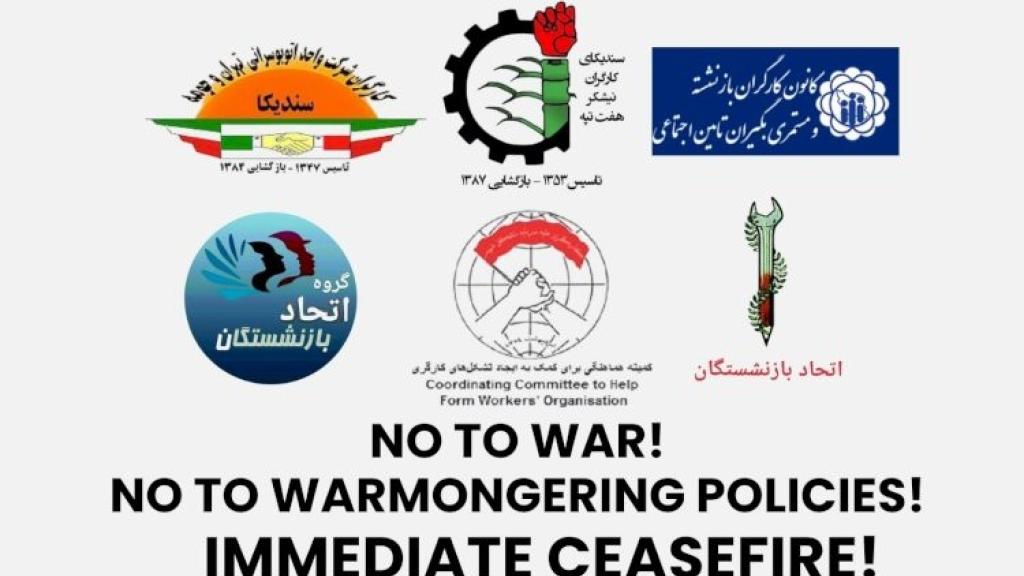
First published on Syndicate of Workers of Tehran and Suburbs Bus Company Telegram channel
Given the current unstable and dangerous situation in Iran and the region, the undersigned organizations believe it is their duty to take a collective stand.
The workers of Iran — including laborers, teachers, nurses, pensioners, and other wage earners — have never benefited, do not benefit, and will not benefit from war, militarization, the bombing of the country, or policies of domination and exploitation.
The military attacks by Israel and the bombing of hundreds of targets across various regions of Iran — including infrastructure, workplaces, refineries, and residential areas — are part of a war-mongering project, the cost of which is borne by ordinary people, especially workers, through their lives, livelihoods, and well-being.
Israel’s claim that it harbors no hostility toward the Iranian people is nothing but a lie and political propaganda. Just yesterday, Israel’s defense minister threatened to “burn Tehran.” Repeated threats by Trump and other U.S. officials, along with full support from Western governments for these actions, have only fueled tension, insecurity, and destruction in the region.
The governments of Israel and the United States are among the main perpetrators of the ongoing genocide in Gaza and many other crimes in the region and the world. The United Nations and international institutions that hypocritically posture as peace-seekers but in practice remain silent in the face of these crimes are part of the same structure of domination. The global capitalist system — its profit-driven logic and imperialist powers — is one of the main causes of war, human catastrophe, and environmental destruction.
The Iranian working class not only gains nothing from war — it is one of its primary victims. The continuation of economic sanctions, the allocation of massive budgets to military purposes, and the restriction of freedoms will only lead to deeper poverty, intensified repression, hunger, death, and the displacement of millions.
We, the independent workers and popular activists in Iran, have no illusions that the U.S. or Israel seeks to bring us freedom, equality, and justice — just as we have no illusions about the repressive, interventionist, adventurist, and anti-worker nature of the Islamic Republic.
We, the workers and toilers of Iran, have paid a heavy price over many years in our struggle for basic rights and minimal living conditions: imprisonment, torture, execution, dismissal, threats, and beatings. We remain deprived of the right to organize, assemble, and express ourselves freely. Workers and the broader working population are justly angry and disgusted with the ruling regime of the Islamic Republic and the capitalists who, for more than four decades, have amassed enormous wealth at the expense of our disenfranchisement and constant insecurity. All officials and institutions involved in the repression and killing of workers, women, youth, and oppressed peoples of Iran must be held accountable and punished by the people.
Our struggle is a social and class struggle. It will continue, relying on our own strength, as a continuation of the recent movements for "Bread, Work, Freedom" and "Woman, Life, Freedom," and in coordination with international solidarity from the global working class and humanist, freedom-loving, and egalitarian forces.
The continuation of the current war will only bring further destruction, irreversible damage to the environment, and new human catastrophes. The working class and the impoverished sectors of Iranian society, like the oppressed in other countries of the region, are the main victims of this situation.
We, the undersigned organizations, call on all trade unions, human rights organizations, anti-war groups, environmental activists, and peace advocates around the world to demand an immediate end to the war, bombings, the killing of innocent people, and the destruction of nature. Support the struggles of the peoples of Iran and the region to end genocide, militarism, and repression.
The peoples of the Middle East need an end to the devastating conflicts between regional and global powers, and the establishment of a lasting peace — a peace in which people can determine their own destinies through self-organization, mass movements, and broad popular participation.
No to war — no to militarist policies.
An immediate ceasefire is our urgent demand.
Signatory Organizations:
- Syndicate of Workers of Tehran and Suburbs Bus Company
- Syndicate of Workers of the Haft Tappeh Sugarcane Company
- Retired Workers of Khuzestan
- Pensioners’ Alliance
- Coordinating Committee to Help Form Workers’ Organizations
- Retirees’ Unity Group

Why Do We Hate Iran?
Because they deserve it? Because we’re told to? Or because, in truth, we play dirty given the slightest excuse.
Britain and America would like everyone to believe that hostilities with Iran began with the 1979 Islamic Revolution. But you have to go back over 70 years to find the root cause in America’s case, while Iranians have endured more than a century of British exploitation and bullying. The US-UK Axis don’t want this important slice of history resurrected to become part of public discourse. Here’s why.
William Knox D’Arcy, having obtained a 60-year oil concession to three-quarters of Persia and with financial support from Glasgow-based Burmah Oil, eventually found oil in commercial quantities in 1908. The Anglo-Persian Oil Company was formed and in 1911 and completed a pipeline from the oilfield to its new refinery at Abadan.
Just before the outbreak of World War 1 Winston Churchill, then First Lord of the Admiralty, wanted to convert the British fleet from coal. To secure a reliable oil source the British Government took a major shareholding in Anglo-Persian.
In the 1920s and 1930s, the company profited hugely from paying the Persians a miserly 16% and refusing to renegotiate terms. An angry Persia eventually cancelled the D’Arcy agreement and took the matter to the Court of International Justice in The Hague. A new agreement in 1933 provided Anglo-Persian with a fresh 60-year concession but on a smaller area. The terms were slightly improved but still didn’t amount to a square deal.
In 1935 Persia became known internationally by its other name, Iran, and the company was re-named Anglo-Iranian Oil. By 1950 Abadan was the biggest oil refinery in the world and the British government, with its 51% holding, had affectively colonized part of southern Iran.
Iran’s tiny share of the profits had long soured relations and so did the company’s treatment of its oil workers. 6,000 went on strike in 1946 and the dispute was brutally put down with 200 dead or injured. In 1951 while Aramco shared profits with the Saudis on a 50/50 basis Anglo-Iranian handed Iran a miserable 17.5%.
Hardly surprising, then, that Iran wanted economic and political independence. Calls to nationalise its oil could no longer be ignored. In March of that year the Majlis and Senate voted to nationalize Anglo-Iranian, which had controlled Iran’s oil industry since 1913 under terms frankly unfavourable to the host country.
Social reformer Dr Mohammad Mossadeq was named prime minister by a 79 to 12 majority and promptly carried out his government’s wishes, cancelling Anglo-Iranian’s oil concession and expropriating its assets. His explanation was perfectly reasonable:
Our long years of negotiations with foreign countries… have yielded no results thus far. With the oil revenues, we could meet our entire budget and combat poverty, disease, and backwardness among our people.
Another important consideration is that by the elimination of the power of the British company, we would also eliminate corruption and intrigue, by means of which the internal affairs of our country have been influenced…. Iran will have achieved its economic and political independence. (M. Fateh, Panjah Sal-e Naft-e Iran, p. 525)
Britain, determined to bring about regime change, orchestrated a worldwide boycott of Iranian oil, froze Iran’s sterling assets and threatened legal action against anyone purchasing oil produced in the formerly British-controlled refineries. The Iranian economy was soon in ruins… All sounds very familiar, doesn’t it?
Churchill (prime minister at the time) let it be known that Mossadeq was turning communist and pushing Iran into the arms of Russia just when Cold War anxiety was high. That was enough to bring America’s new president, Eisenhower, onboard and plotting with Britain to bring Mossadeq down.
So began a nasty game of provocation, mayhem and deception. Shah Mohammad Reza Pahlavi, in exile, signed two decrees, one dismissing Mossadeq and the other nominating the CIA’s choice, General Fazlollah Zahedi, as prime minister. These decrees were written as dictated by the CIA. The coup by MI6 and the CIA was successful and in August 1953, when it was judged safe for him to do so, the Shah returned to take over.
For his impudence Mossadeq was arrested, tried, and convicted of treason by the Shah’s military court. He was imprisoned for 3 years then put under house arrest until his death. He remarked: “My greatest sin is that I nationalized Iran’s oil industry and discarded the system of political and economic exploitation by the world’s greatest empire… I am well aware that my fate must serve as an example in the future throughout the Middle East in breaking the chains of slavery and servitude to colonial interests.”
His supporters were rounded up, imprisoned, tortured or executed. Zahedi’s new government reached an agreement with foreign oil companies to form a consortium to restore the flow of Iranian oil, awarding the US and Great Britain the lion’s share, with 40% going to Anglo-Iranian.
The consortium agreed to split profits on a 50-50 basis with Iran but refused to open its books to Iranian auditors or allow Iranians to sit on the board.
The US massively funded the Shah’s government, including his army and his hated secret police force, SAVAK. Anglo-Iranian changed its name to British Petroleum in 1954. Mossadeq died in 1967.
Smouldering resentment for more than 70 years
The British-American conspiracy that toppled Mossadeq, reinstated the Shah and let the American oil companies in, was the final straw for the Iranians. It all backfired 25 years later with the Islamic Revolution of 1978-9, the humiliating 444-day hostage crisis in the American embassy and a tragically botched rescue mission.
If Britain and America had played fair and allowed the Iranians to determine their own future instead of using economic terrorism to bring the country to its knees Iran might today be “the only democracy in the Middle East”, a title falsely claimed by Israel which is actually a repulsive ethnocracy. So never mention the M-word MOSSADEQ – the Iranian who dared to break the chains of slavery and servitude to Western colonial interests.
Is Britain incapable of playing fair? During the Iran-Iraq war (1980-88) the US, and eventually Britain, leaned strongly towards Saddam and the alliance enabled Saddam to more easily acquire or develop forbidden chemical and biological weapons. At least 100,000 Iranians fell victim to them.
This is how John King, writing in 2003, summed it up. “The United States used methods both legal and illegal to help build Saddam’s army into the most powerful army in the Mideast outside of Israel. The US supplied chemical and biological agents and technology to Iraq when it knew Iraq was using chemical weapons against the Iranians. The US supplied the materials and technology for these weapons of mass destruction to Iraq at a time when it was known that Saddam was using this technology to kill his Kurdish citizens.
“The United States supplied intelligence and battle planning information to Iraq when those battle plans included the use of cyanide, mustard gas and nerve agents. The United States blocked the UN censure of Iraq’s use of chemical weapons. The United States did not act alone in this effort. The Soviet Union was the largest weapons supplier, but England, France, and Germany were also involved in the shipment of arms and technology.”
The company I worked for at that time supplied the Iranian government with electronic components for military equipment and we were mulling an invitation to set up a factory in Tehran when the UK Government announced it was revoking all export licences to Iran. They had decided to back Saddam. Hundreds of British companies were forced to abandon the Iranians at a critical moment.
Betraying Iran and throwing our weight behind Saddam went well, didn’t it?
Saddam was overthrown in April 2003 following the US/UK-led invasion of Iraq, and hanged in messy circumstances after a dodgy trial in 2006. The dirty work was left to the Provisional Iraqi Government. At the end of the day, we couldn’t even ensure that Saddam was dealt with fairly. “The trial and execution of Saddam Hussein were tragically missed opportunities to demonstrate that justice can be done, even in the case of one of the greatest crooks of our time”, said the UN Human Rights Council’s expert on extrajudicial executions.
Philip Alston, a law professor at New York University, pointed to three major flaws leading to Saddam’s execution. “The first was that his trial was marred by serious irregularities denying him a fair hearing and these have been documented very clearly. Second, the Iraqi Government engaged in an unseemly and evidently politically motivated effort to expedite the execution by denying time for a meaningful appeal and by closing off every avenue to review the punishment. Finally, the humiliating manner in which the execution was carried out clearly violated human rights law.”
In 2022 when Nazanin Zaghari-Ratcliffe, a British-Iranian, was freed after five years in a Tehran prison it transpired that the UK had owed around £400m to the Iranian government arising from the non-delivery of Chieftain battle tanks ordered by the Shah of Iran before his overthrow in 1979. Iran had been pursuing the debt for over four decades. In 2009 an international court in the Netherlands ordered Britain to repay the money. Iranian authorities said Nazanin would be released when the UK did so, but she suffered those years of incarceration, missing her children and husband in the UK, while the British government took its own sweet time before finally paying up.
Now we’re playing dirty yet again, supporting an undemocratic state, Israel, which is run by genocidal maniacs and has for 77 years defied international law and waged a war of massacre, terror and dispossession against the native Palestinians. And we’re even protecting it in its lethal quarrel with Iran.
It took President Truman only 11 minutes to accept and extend full diplomatic relations to Israel when the Zionist entity declared statehood in 1948 despite the fact that it was still committing massacres and other terrorist atrocities. Israel’s evil ambitions and horrendous tactics were well known and documented right from the start but eagerly backed and facilitated by the US and UK. In the UK’s case betrayal of the Palestinians began in 1915 thanks to Zionist influence. Even Edwin Montagu, the only Jew in the British Cabinet at that time, described Zionism as “a mischievous political creed, untenable by any patriotic citizen of the United Kingdom”.
Sadly, the Zionist regime’s unspeakable cruelty and inhumanity against unarmed women and children in Gaza and the West Bank — bad enough in the decades before October 2023 but now showing the Israelis as the repulsive criminals they’ve always been — still isn’t enough to end US-UK adoration and support. UK prime minister Starmer much prefers to talk about “the malign influence of Iran”
The excuse this time is that Iran’s nuclear programme might be about to produce weapons-grade material which is bad news for Israel. There’s a blanket ‘hush’ over Israel’s 200 (or is it 400?) nukes. The US and UK and allies think it’s OK for mad-dog Israel to have nuclear weapons but not Iran which has to live under this horrific Israeli threat. Then there’s America’s QME doctrine which guarantees Israel a ‘Qualitative Military Edge’ over its Middle East neighbours.
Then consider that Israel is the only state in the region not to have signed the Nuclear Non-Proliferation Treaty. It hasn’t signed the Biological and Toxin Weapons Convention either. It has signed but not ratified the Comprehensive Nuclear Test-Ban Treaty, similarly the Chemical Weapons Convention. Yes, it’s quite evident that the Zionist entity, not Iran, is the ultimate “malign influence” in the Middle East.

No comments:
Post a Comment