It’s possible that I shall make an ass of myself. But in that case one can always get out of it with a little dialectic. I have, of course, so worded my proposition as to be right either way (K.Marx, Letter to F.Engels on the Indian Mutiny)
Friday, June 06, 2025
Thailand Works to Advert Disaster as Rickety Cargo Ship Sinks on Coral Reef
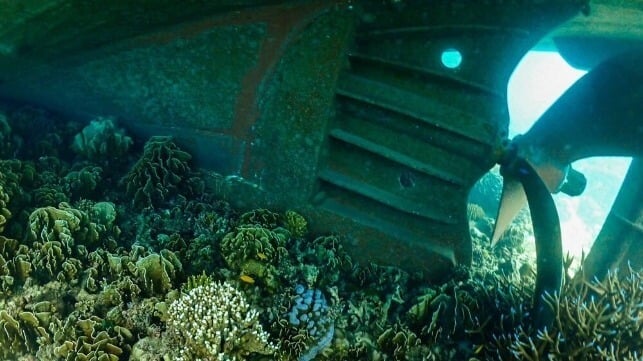
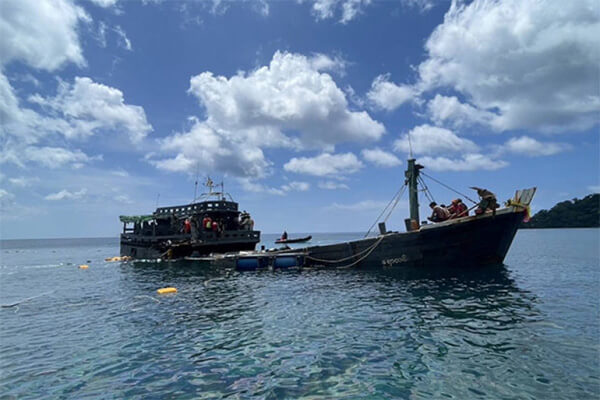
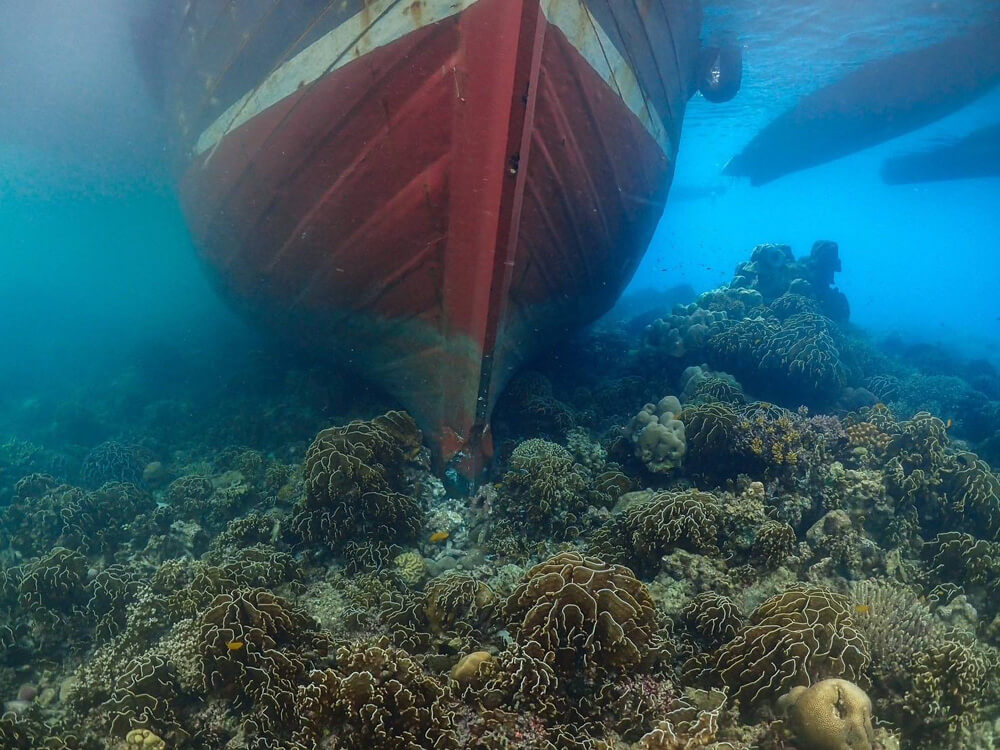
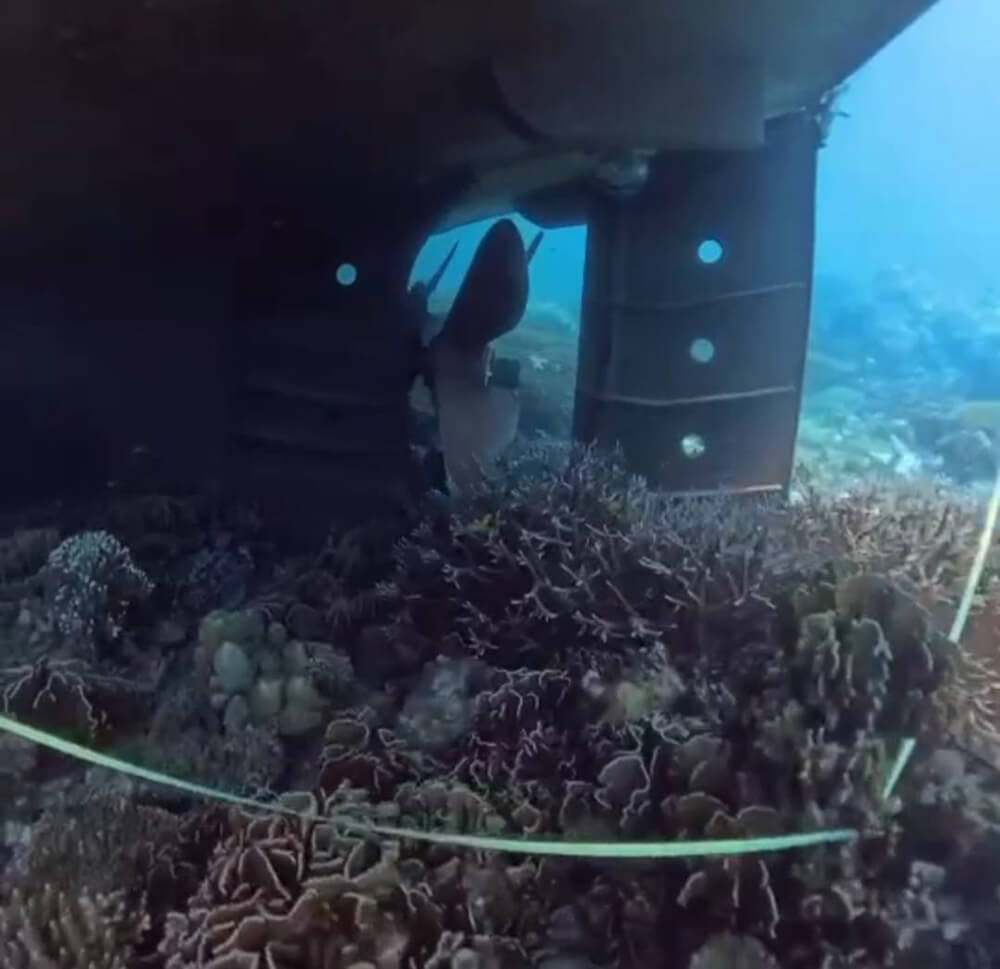
Myanmar cargo ship sitting of Thai coral reef (photos courtesy of Dept. of National Parks)
The authorities in Thailand are working to address the grounding and sinking of a rickety wooden cargo ship from Myanmar that has hit one of the country’s premier coral reefs. The vessel grounded and partially sunk damaging at least 75 meters (approximately 250 feet) of precious Blue and Deer Coral and has the potential to leak oil into the environment.
The wooden 100-tonne cargo ship named Ayar Linn sank on Sunday, June 1, after grounding on the reef in the Mu Ko Surin National Park in the Surin Islands of the Andaman Sea. Thai officials report it is one of the most famous diving and marine life viewing sites in the world. It is within the National Parks in Thailand.
The vessel stranded off Jak Bay in the northern parts of the province and then sank spilling its cargo onto the reef. It has 7,700 liters of diesel onboard.
Divers were sent to inspect the region and report a 75-meter trench of damage in the reef with the worst portions being between meters 45 and 75, where the vessel is now stuck. The coral under the vessel has been crushed and a line of coral, especially the tall species, was broken. In addition, the vessel spilled bags of cement as well as significant amounts of cardboard, rags, truck tires, hoses, and other debris that is littered on the reef.
The divers were initially attempting to seal the values on the fuel tanks. Efforts were also underway to pump the fuel from the partially submerged vessel. The Department of National Parks, Wildlife, and Plant Conservation working with other agencies called for oil booms that could also be strung to contain any fuel leaks.
They said a full salvage mission can not be carried out at this time because it is monsoon season. The danger of strong waves and winds makes any salvage operation risky. They are working with the other authorities to develop an approach for managing the situation.
The Kuraburi Police Station is also collecting relevant evidence as well as checking the ship’s documents, and entry and exit from the country. They are planning to lodge a complaint against the owner of the vessel and seek compensation.
The authorities are also asking citizens and tourists to avoid approaching the area for safety and to allow the recovery operation to proceed.
New research challenges long-held belief of coral reefs as oases in marine deserts
Credit: Jordan M. Casey/University of Texas at Austin
Coral reefs are likely one of the most common subjects of nature documentaries and hold special interest to the world for their diverse beauty and productivity. Often, they are depicted as a thriving oasis surrounded by a clear blue ocean devoid of nutrients and plankton. While these reef systems certainly do exist, a new study released today in Current Biology shatters the long-held notion and belief that coral reefs are oases in marine deserts, a notion that became known as “Darwin’s Paradox.”
In fact, the study shows that, although reefs are indeed among the world’s most productive ecosystems, their existence in nutrient-deprived oceans is the exception rather than the rule and, importantly, not linked to Charles Darwin either. The study was funded in part by the U.S. National Science Foundation.
The narrative of Darwin’s paradox has evolved over the past few decades and has since become a staple in mainstream media and high-profile publications.
“While the narrative is really compelling, it is both factually and historically wrong, which can have important implications for how we manage coral reef ecosystems,” said senior author Simon Brandl, assistant professor at the University of Texas Marine Science Institute.
The oases in the desert hypothesis implies that reefs are closed systems that are largely independent from conditions in the surrounding waters.
“Our findings suggest that the majority of the world’s coral reefs exist in conditions where surrounding waters may very well be able to sustain much of the fabulous productivity on reefs,” Brandl said.
This has large implications, since links between the reefs and surrounding oceans may be modified by a variety of human impacts, including nutrient runoff and global warming effects that may alter nutrient and phytoplankton distributions throughout the tropics.
To better understand coral reef systems and their global distribution, the authors tested both parts of the alleged paradox: high productivity (i.e. oases) and limited resources available in surrounding waters (i.e. deserts). To examine productivity, they analyzed the net primary production of coral reefs against a wide range of other ecosystems, demonstrating that the productivity of coral reefs is only matched by coastal wetlands, while most other habitats on Earth, including forests, rivers and lakes, or even coastal upwelling zones, lag far behind.
To test the surrounding “desert” component, the authors measured both direct food sources of coral reef organisms (i.e., phytoplankton) and their nutrient sources in tropical ocean waters using both satellite data and empirical measurements. Remarkably, they found that most coral reef systems thrive in intermediate or elevated nutrient concentrations and in areas where chlorophyll a—a green pigment used by phytoplankton to absorb sunlight and an indicator of the level of photosynthesis by phytoplankton—is twice the median range for tropical oceans and double for oligotrophic oceans or “deserts.” In fact, 80% of coral reefs occur in conditions that scientists would generally classify as nutrient enriched.
Poignantly, not only the paradox’s meaning, but also its attribution to Darwin is fundamentally wrong. Using a combination of manual review and text mining, the authors show that Darwin’s cited work does not include any mention of coral reef productivity or the role of surrounding oceans, nor would Darwin have had an understanding of ocean conditions deep enough to arrive at the alleged conclusion. Attribution to Darwin was likely made (and persisted) due to his gravity and name recognition; and it likely persisted because a large-scale in-depth global review has not been completed until now. This demonstrates that scientists must not be afraid to rethink and challenge existing knowledge.
“With this study, we hope to cast a more quantitative light on coral reefs and what allows them to be so productive,” said Brandl.
Their persistence across a broad range of oceanic conditions indicates that linkages between reef animals and their prey are more complex and context-dependent than previously thought. As human impact continues to enrich coastal oceans with nutrients and rising temperatures change plankton communities surrounding reefs, additional effort should be put into understanding these linkages and energy flow.
“Our analysis shows that coral reefs are truly unique in their capacity to produce an abundance of life, but how this occurs depends on where these reefs are located and, unfortunately, how human impact will change local conditions,” Brandl said.
Brandl is joined by his colleagues Renato Moris, lead author at Université Paris Sciences et Lettres, Larissa Patricia-Valerio from Central Queensland University, and Pauline Narvaez and Valeriano Parravicini from Université Paris Sciences et Lettres. The work was supported by RAMS’s Branco Weiss Fellowship Society in Science, PSL Junior Fellowship, and a U.S. National Science Foundation Award to Brandl.
Where do you go when you’re a fish and you need a skincare treatment? Coral reefs contain natural “beauty salons,” lively social hubs of activity where fish “clients” swim up and wait to be serviced by smaller fish cleaners. The little cleaners dart under and around their much bigger clients — even entering their mouths — cleaning their scales of bacteria and parasites like a team of car washers servicing a Buick. Sometimes cleaners even rub against their clients, providing a soothing massage.
But aside from skincare benefits, what role might busy cleaner fish stations play in spreading microbes and bacteria — for good or ill — throughout the reef?
A study published in the journal Marine Ecology Progress Series is the first to investigate the influence of cleaner fish stations on reef microbial diversity. It is led by scientists from the University of California, Davis, and Woods Hole Oceanographic Institute (WHOI) in collaboration with the University of Miami Rosenstiel School of Marine, Atmospheric, and Earth Science.
Could busy cleaning stations, like some medical clinics, be hotspots for spreading bacteria and pathogens? Conversely, could they help spread beneficial microbes among reef communities? Such questions carry important implications for protecting and restoring coral reefs.
“How pathogens or microbes are moving around a reef could be critically important to understanding how individuals will be affected,” said lead author Anya Brown, an assistant professor with the UC Davis Bodega Marine Laboratory and a National Geographic Explorer who conducted the study while at WHOI. “We know microbes play a role in coral bleaching, for example. This study really lays a foundation for using cleaner fish stations as a way to study movement of microbes around the reef environment.”
Cleaner fish and reef health
One hardworking fish is the cleaning goby, a pinky-sized fish with a boldly colored stripe running along its length. To understand how the presence of cleaner fish stations influence microbial diversity, the researchers experimentally removed cleaning gobies from cleaner stations on two Caribbean reefs in Puerto Rico and St. Croix in June 2021. They compared water nutrients and microbial communities of the surrounding reef area with and without gobies. This also included resident damselfish, frequent clients of cleaner gobies.
They found that more fish visited sites where cleaner fish were present compared to where they were removed in both Puerto Rico and St. Croix. They also found that cleaner fish do influence damselfish and reef microbial diversity, but the extent of their role depends on substrate type and the specific reef environment, as each reef carries a unique microbial signature. In the study, client fish, nutrient concentrations and water bacterial cell densities varied throughout the sites.
The authors say the results highlight yet another potential impact of cleaner fish and the need to further demystify their role in shaping reef microbial diversity and transmission.
Tiny fish can have big impact
“While larger organisms on coral reefs attract the most attention, the study underscores the huge impact tiny organisms such as these fish can have and how important they are to helping healthy reef ecosystems function,” said coauthor Paul Sikkel, a research professor at the Rosenstiel School’s Department of Marine Biology and Ecology. “While cleaner fish are well-known for their role in consuming parasites and reducing stress in other fish, this is the first field study to quantify their effects on microbes of other fish and the surrounding coral reef environment.”
Additional coauthors include Amy Apprill and Jeanne Bloomberg of Woods Hole Oceanographic Institution (WHOI), Gina Hendrick and Matthew Nicholson of the University of Miami Rosenstiel School, and Marta Soares and Raquel Xavier of the University of Porto in Portugal.
The study was funded by the National Science Foundation, WHOI, and The Foundation for Science and Technology in Portugal.
Cleaner gobies set up "shop" in coral reefs, attracting bigger fish "clients," who come to have their scales cleaned of parasites and bacteria. Scientists are studying the role these little fish play in reef microbial diversity.
No comments:
Post a Comment