"I saw body parts flying everywhere, and bodies cut and burned," said one eyewitness to a strike on the popular al-Baqa Café.
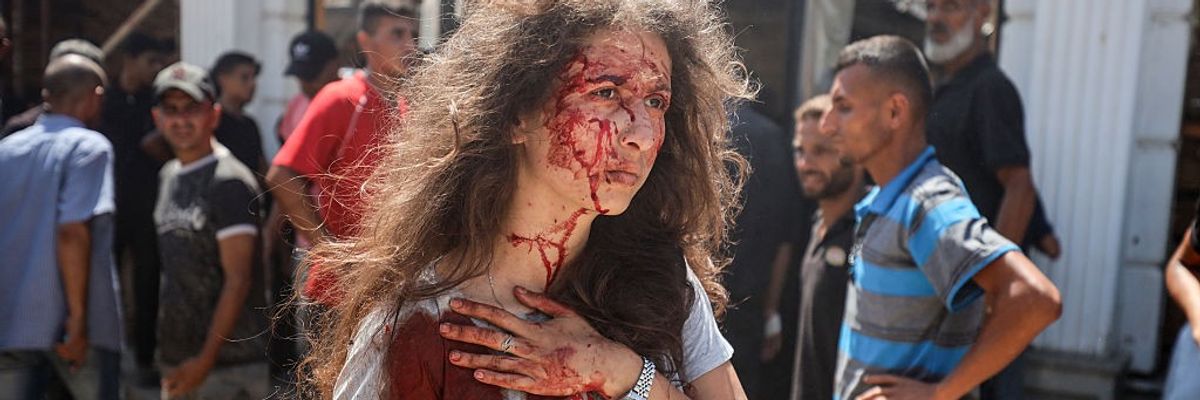
Palestinian journalist Bayan Abu Sultan is seen after being wounded during the al-Baqa Cafe massacre, committed by Israeli forces in Gaza City, Palestine on June 30, 2025.
(Photo: Majdi Fathi/NurPhoto via Getty Images)
Brett Wilkins
Jun 30, 2025
COMMON DREAMS
Israeli forces ramped up their genocidal assault on the Gaza Strip Monday, killing at least 95 Palestinians in attacks including massacres at a seaside café and a humanitarian aid distribution center and bombings of five school shelters housing displaced families and a hospital where refugees were sheltering in tents.
An Israeli strike targeted the al-Baqa Café in western Gaza City, one of the few operating businesses remaining after 633 days of Israel's obliteration of the coastal strip and a popular gathering place for journalists, university students, artists, and others seeking reliable internet service and a respite from nearly 21 months of near-relentless attacks.
Medical sources said at least 33 civilians were killed and nearly 50 others wounded in the massacre, including footballer Mustafa Abu Amira, photojournalist Ismail Abu Hatab—who survived an earlier Israeli airstrike and is reportedly the 227th journalists killed by Israel since October 2023—and prominent artist Frans Al-Salmi, whose final painting depicting a young Palestinian woman killed by Israeli forces resembles photographs of its slain creator posted on social media after her killing.
Warning: Photos shows image of death
Survivor Ali Abu Ateila toldThe Associated Press that the café was crowded with women and children at the time of the attack.
"Without a warning, all of a sudden, a warplane hit the place, shaking it like an earthquake," he said.
Another survivor of the massacre told Britain's Sky News: "All I see is blood... Unbelievable. People come here to take a break from what they see inside Gaza. They come westward to breathe."
Eyewitness Ahmed Al-Nayrab toldAgence France-Presse that a "huge explosion shook the area."
"I saw body parts flying everywhere, and bodies cut and burned," he said. "It was a scene that made your skin crawl."
Witnesses and officials said Israeli Defense Forces (IDF) troops opened fire on Palestinians seeking food and other humanitarian aid from a U.S.-backed Gaza Humanitarian Foundation distribution point in southern Gaza, killing 15 people amid near-daily massacres of aid-seekers.
"We were targeted by artillery," survivor Monzer Hisham Ismail told The Associated Press. Another survivor, Yousef Mahmoud Mokheimar, told the AP that Israeli troops "fired at us indiscriminately." Mokheimar was shot in the leg, another man who tried to rescue him was also shot.
IDF troops have killed nearly 600 Palestinian aid-seekers and wounded more than 4,000 others over the past month, with Israeli military officers and soldiers saying they were ordered to deliberately fire on civilians in search of food and other necessities amid Israel's weaponized starvation of Gaza.
Another 13 people were reportedly killed Monday when IDF warplanes bombed an aid warehouse in the Zeitoun quarter of southern Gaza City, according to al-Ahli Baptist Hospital officials cited by The Palestine Chronicle. IDF warplanes also reportedly bombed five schools housing displaced families, three of them in Zeitoun. Israeli forces also bombed the courtyard of al-Aqsa Hospital in Deir al-Balah in central Gaza, where thousands of forcibly displaced Palestinian families are sheltering in tents. It was reportedly the 12th time the hospital has been bombed since the start of the war.
The World Health Organization has documented more than 700 attacks on Gaza healthcare facilities since October 2023. Most of Gaza's hospitals are out of service due to Israeli attacks, some of which have been called genocidal by United Nations experts.
Israel's overall behavior in the war is the subject of an ongoing International Court of Justice genocide case, while Israeli Prime Minister Benjamin Netanyahu is wanted by the International Criminal Court for alleged war crimes and crimes against humanity in Gaza, including murder and using starvation as a weapon of war.
Since October 2023, Israeli forces have killed or wounded more than 204,000 Palestinians in Gaza, including over 14,000 people who are missing and presumed dead and buried under rubble, according to the Gaza Health Ministry, whose casualty figures have been found to be generally accurate and even a likely undercount by peer-reviewed studies.
The intensified IDF attacks follow Israel's issuance of new forced evacuation orders amid the ongoing Operation Gideon's Chariots, an ongoing offensive which aims to conquer and indefinitely occupy all of Gaza and ethnically cleanse much of its population, possibly to make way for Jewish recolonization as advocated by many right-wing Israelis.
Jun 30, 2025
COMMON DREAMS
Israeli forces ramped up their genocidal assault on the Gaza Strip Monday, killing at least 95 Palestinians in attacks including massacres at a seaside café and a humanitarian aid distribution center and bombings of five school shelters housing displaced families and a hospital where refugees were sheltering in tents.
An Israeli strike targeted the al-Baqa Café in western Gaza City, one of the few operating businesses remaining after 633 days of Israel's obliteration of the coastal strip and a popular gathering place for journalists, university students, artists, and others seeking reliable internet service and a respite from nearly 21 months of near-relentless attacks.
Medical sources said at least 33 civilians were killed and nearly 50 others wounded in the massacre, including footballer Mustafa Abu Amira, photojournalist Ismail Abu Hatab—who survived an earlier Israeli airstrike and is reportedly the 227th journalists killed by Israel since October 2023—and prominent artist Frans Al-Salmi, whose final painting depicting a young Palestinian woman killed by Israeli forces resembles photographs of its slain creator posted on social media after her killing.
Warning: Photos shows image of death
Survivor Ali Abu Ateila toldThe Associated Press that the café was crowded with women and children at the time of the attack.
"Without a warning, all of a sudden, a warplane hit the place, shaking it like an earthquake," he said.
Another survivor of the massacre told Britain's Sky News: "All I see is blood... Unbelievable. People come here to take a break from what they see inside Gaza. They come westward to breathe."
Eyewitness Ahmed Al-Nayrab toldAgence France-Presse that a "huge explosion shook the area."
"I saw body parts flying everywhere, and bodies cut and burned," he said. "It was a scene that made your skin crawl."
Witnesses and officials said Israeli Defense Forces (IDF) troops opened fire on Palestinians seeking food and other humanitarian aid from a U.S.-backed Gaza Humanitarian Foundation distribution point in southern Gaza, killing 15 people amid near-daily massacres of aid-seekers.
"We were targeted by artillery," survivor Monzer Hisham Ismail told The Associated Press. Another survivor, Yousef Mahmoud Mokheimar, told the AP that Israeli troops "fired at us indiscriminately." Mokheimar was shot in the leg, another man who tried to rescue him was also shot.
IDF troops have killed nearly 600 Palestinian aid-seekers and wounded more than 4,000 others over the past month, with Israeli military officers and soldiers saying they were ordered to deliberately fire on civilians in search of food and other necessities amid Israel's weaponized starvation of Gaza.
Another 13 people were reportedly killed Monday when IDF warplanes bombed an aid warehouse in the Zeitoun quarter of southern Gaza City, according to al-Ahli Baptist Hospital officials cited by The Palestine Chronicle. IDF warplanes also reportedly bombed five schools housing displaced families, three of them in Zeitoun. Israeli forces also bombed the courtyard of al-Aqsa Hospital in Deir al-Balah in central Gaza, where thousands of forcibly displaced Palestinian families are sheltering in tents. It was reportedly the 12th time the hospital has been bombed since the start of the war.
The World Health Organization has documented more than 700 attacks on Gaza healthcare facilities since October 2023. Most of Gaza's hospitals are out of service due to Israeli attacks, some of which have been called genocidal by United Nations experts.
Israel's overall behavior in the war is the subject of an ongoing International Court of Justice genocide case, while Israeli Prime Minister Benjamin Netanyahu is wanted by the International Criminal Court for alleged war crimes and crimes against humanity in Gaza, including murder and using starvation as a weapon of war.
Since October 2023, Israeli forces have killed or wounded more than 204,000 Palestinians in Gaza, including over 14,000 people who are missing and presumed dead and buried under rubble, according to the Gaza Health Ministry, whose casualty figures have been found to be generally accurate and even a likely undercount by peer-reviewed studies.
The intensified IDF attacks follow Israel's issuance of new forced evacuation orders amid the ongoing Operation Gideon's Chariots, an ongoing offensive which aims to conquer and indefinitely occupy all of Gaza and ethnically cleanse much of its population, possibly to make way for Jewish recolonization as advocated by many right-wing Israelis.
Gaza mourns those killed in Israeli strike on seafront cafe
Gaza City (Palestinian Territories) (AFP) – Once a bustling seafront spot where young people could hope for a rare respite from war, Gaza City's al-Baqa cafe lay in ruins after an Israeli strike killed 24 people including a journalist and an artist.
Issued on: 01/07/2025

 Tributes have also poured in for Ismail Abu Hatab, who is described by friends as a journalist and videographer © Omar AL-QATTAA / AFP
With food only trickling into Gaza, the kitchens were closed, but customers could still get a cup of tea to drink against a backdrop of destruction.
Maher al-Baqa, who co-owns the establishment, told AFP that it is "one of the most well-known cafes on the Gaza coast, frequented by educated youth, journalists, artists, doctors, engineers and hardworking people".
"Young people are fleeing the tragedies and difficult conditions in Gaza. They come here for work meetings or just to relax a little."
Israel "has betrayed these people and bombed the place without any justification", he added.
Journalist Shrouq Aila, who shared photos of the cafe on Instagram, said: "The sea has become our only refuge".
Another journalist, Wassim Saleh, wrote on Facebook that "the sea continues to wash up pieces of bodies, which we bury."
Still in shock but moved by the messages of support, cafe owner Baqa said he lost four employees and three family members in the strike.
"I felt, through the great solidarity of the people with this place, that they were defending wh
Gaza City (Palestinian Territories) (AFP) – Once a bustling seafront spot where young people could hope for a rare respite from war, Gaza City's al-Baqa cafe lay in ruins after an Israeli strike killed 24 people including a journalist and an artist.
Issued on: 01/07/2025
The cafe was known before the war for welcoming young professionals and even the few foreigners who were able to visit Gaza © Omar AL-QATTAA / AFP
Blood stains dotted the debris-strewn floor in the aftermath of the strike on Monday, AFP footage showed. Upturned plastic chairs lay alongside wooden planks blown apart in the blast, as tattered fabric gently blew in the sea breeze.
The strike triggered a fresh outpouring of grief in the Palestinian territory already devastated by more than 20 months of war, with social media flooded with posts paying tribute to the dead.
"Gaza lost a rare talent. The world lost beauty and hope," wrote two friends of the artist Amina al-Salmi, nicknamed Frans, in an Instagram post after the young woman's death in the cafe.
"The occupation killed her, but it will never erase her voice," they added. One of the friends, journalist Noor Harazeen, drew parallels between one of Salmi's last drawings and a photo of the attack showing her face covered in blood.

Blood stains dotted the debris-strewn floor in the aftermath of the strike on Monday, AFP footage showed. Upturned plastic chairs lay alongside wooden planks blown apart in the blast, as tattered fabric gently blew in the sea breeze.
The strike triggered a fresh outpouring of grief in the Palestinian territory already devastated by more than 20 months of war, with social media flooded with posts paying tribute to the dead.
"Gaza lost a rare talent. The world lost beauty and hope," wrote two friends of the artist Amina al-Salmi, nicknamed Frans, in an Instagram post after the young woman's death in the cafe.
"The occupation killed her, but it will never erase her voice," they added. One of the friends, journalist Noor Harazeen, drew parallels between one of Salmi's last drawings and a photo of the attack showing her face covered in blood.
Images of the devastated cafe flooded social media, showing several lifeless bodies © Omar AL-QATTAA / AFP
Tributes have also poured in for Ismail Abu Hatab, described by friends as a journalist and videographer.
During the final prayer before his body was laid to rest, his press vest was placed on his chest, as Gazans have often done for the numerous Palestinian journalists killed during the war triggered by Hamas's attack on Israel on October 7, 2023.
Salmi and Abu Hatab were among 24 people killed in the strike, according to Gaza's civil defence agency.
Images of the bombed cafe showing several lifeless bodies flooded social media.
Journalist and rights activist Bayan Abusultan was also seen in photos posted online, half covered in blood in the aftermath of the blast.
"We survived to curse the occupation for one more day," she wrote on Facebook.
- 'Sea the only refuge' -
The Israeli military told AFP it had "struck several Hamas terrorists" and that "steps were taken to mitigate the risk of harming civilians", adding that the incident was under review.
The cafe was known before the war for welcoming young professionals and the few foreigners who were able to visit the Gaza Strip under Israeli blockade.
Built in several sections, part of which was on stilts above the water, al-Baqa was damaged and then repaired several times in recent months, particularly during the two-month truce that ended in March.
A few weeks ago, the cafe was once again able to offer an internet connection, attracting its pre-war clientele back.
Tributes have also poured in for Ismail Abu Hatab, described by friends as a journalist and videographer.
During the final prayer before his body was laid to rest, his press vest was placed on his chest, as Gazans have often done for the numerous Palestinian journalists killed during the war triggered by Hamas's attack on Israel on October 7, 2023.
Salmi and Abu Hatab were among 24 people killed in the strike, according to Gaza's civil defence agency.
Images of the bombed cafe showing several lifeless bodies flooded social media.
Journalist and rights activist Bayan Abusultan was also seen in photos posted online, half covered in blood in the aftermath of the blast.
"We survived to curse the occupation for one more day," she wrote on Facebook.
- 'Sea the only refuge' -
The Israeli military told AFP it had "struck several Hamas terrorists" and that "steps were taken to mitigate the risk of harming civilians", adding that the incident was under review.
The cafe was known before the war for welcoming young professionals and the few foreigners who were able to visit the Gaza Strip under Israeli blockade.
Built in several sections, part of which was on stilts above the water, al-Baqa was damaged and then repaired several times in recent months, particularly during the two-month truce that ended in March.
A few weeks ago, the cafe was once again able to offer an internet connection, attracting its pre-war clientele back.
Tributes have also poured in for Ismail Abu Hatab, who is described by friends as a journalist and videographer © Omar AL-QATTAA / AFPWith food only trickling into Gaza, the kitchens were closed, but customers could still get a cup of tea to drink against a backdrop of destruction.
Maher al-Baqa, who co-owns the establishment, told AFP that it is "one of the most well-known cafes on the Gaza coast, frequented by educated youth, journalists, artists, doctors, engineers and hardworking people".
"Young people are fleeing the tragedies and difficult conditions in Gaza. They come here for work meetings or just to relax a little."
Israel "has betrayed these people and bombed the place without any justification", he added.
Journalist Shrouq Aila, who shared photos of the cafe on Instagram, said: "The sea has become our only refuge".
Another journalist, Wassim Saleh, wrote on Facebook that "the sea continues to wash up pieces of bodies, which we bury."
Still in shock but moved by the messages of support, cafe owner Baqa said he lost four employees and three family members in the strike.
"I felt, through the great solidarity of the people with this place, that they were defending wh
Israeli Forces Liken Gaza Aid Site Shootings to Game of “Red Light, Green Light”
The deadly aid site protocol is called “Operation Salted Fish,” the Israeli name for the children’s game.
By Sharon Zhang ,

The deadly aid site protocol is called “Operation Salted Fish,” the Israeli name for the children’s game.
By Sharon Zhang ,
PublishedJune 30, 2025
Palestinians carry away bags of flour as others wait in front of a distribution point set up by the independent Save Youth Future Society, in coordination with the UN World Food Programme, in Gaza City on June 26, 2025.Bashar Taleb / AFP via Getty Images
Israeli soldiers are ordered to treat crowds of Palestinians gathered to receive humanitarian aid in Gaza as a “hostile force” and communicate with the desperate aid seekers by opening fire, according to a new report citing soldiers who were deployed in Gaza.
Haaretz, echoing reporting by Palestinians and humanitarian groups on the ground, reports that Israeli soldiers are told to shoot at crowds to prevent them from approaching an aid site before it’s open. The fact that they are civilians doesn’t matter, soldiers say, and military leaders pay no mind as to whether or not civilians are killed as a result.
The military uses “everything imaginable” to fire on the crowds, including heavy machine guns, tanks, grenades, and mortars, one soldier said, referring to the area around the U.S.- and Israel-backed “aid” sites as a “killing field.”
“At night, we open fire to signal to the population that this is a combat zone and they mustn’t come near,” one officer said, describing the supposed security practices for the site. “Once, the mortars stopped firing, and we saw people starting to approach. So we resumed fire to make it clear they weren’t allowed to. In the end, one of the shells landed on a group of people.”
The protocol, one soldier said, is called “Operation Salted Fish,” a reference to the Israeli name for the children’s game, “red light, green light.”
Indeed, Palestinian officials and journalists have repeatedly reported Israel hitting crowds with tank fire and other heavy weapons, often causing hundreds of casualties at once, on a near-daily basis. Israeli forces have killed at least 583 Palestinians and injured 4,186 more at sites operated by the Gaza Humanitarian Foundation (GHF), the Gaza Ministry of Health has reported.
In some instances, soldiers are supposedly also firing at crowds near “aid” sites in order to protect private contractors who are demolishing homes in Gaza nearby. Sources said private contractors are “making a fortune” by demolishing homes in Gaza, with the government paying out the equivalent of $1,500 per home.
The Israeli military has claimed that they are simply firing “warning shots” at aid seekers. However, even if this were a legitimate practice, it seems to be yet another coverup from the military as soldiers say they’ve been instructed to open fire directly on civilians.
Soldiers say that this and other practices have made Gaza into a combat zone unlike any other, where there are no rules about who constitutes a legitimate target or whether or not there are instances where soldiers should restrain from fire. Because of the lack of any guidelines or restraints, not only is live fire toward civilians allowed, it’s effectively encouraged, soldiers said.
“Technically, it’s supposed to be warning fire — either to push people back or stop them from advancing,” one reserve tank soldier told Haaretz. “But lately, firing shells has just become standard practice. Every time we fire, there are casualties and deaths, and when someone asks why a shell is necessary, there’s never a good answer. Sometimes, merely asking the question annoys the commanders.”
This practice, of seemingly using the “aid” sites as a honeytrap, comes after Israel has spent the last 20 months systematically starving Palestinians in Gaza, pushing the entire territory into or on the cusp of famine, experts have said.
“The moral aspect is practically nonexistent,” said one military figure, who recently attended a higher-level meeting within the military. “No one stops to ask why dozens of civilians looking for food are being killed every day.”
Israeli soldiers are ordered to treat crowds of Palestinians gathered to receive humanitarian aid in Gaza as a “hostile force” and communicate with the desperate aid seekers by opening fire, according to a new report citing soldiers who were deployed in Gaza.
Haaretz, echoing reporting by Palestinians and humanitarian groups on the ground, reports that Israeli soldiers are told to shoot at crowds to prevent them from approaching an aid site before it’s open. The fact that they are civilians doesn’t matter, soldiers say, and military leaders pay no mind as to whether or not civilians are killed as a result.
The military uses “everything imaginable” to fire on the crowds, including heavy machine guns, tanks, grenades, and mortars, one soldier said, referring to the area around the U.S.- and Israel-backed “aid” sites as a “killing field.”
“At night, we open fire to signal to the population that this is a combat zone and they mustn’t come near,” one officer said, describing the supposed security practices for the site. “Once, the mortars stopped firing, and we saw people starting to approach. So we resumed fire to make it clear they weren’t allowed to. In the end, one of the shells landed on a group of people.”
The protocol, one soldier said, is called “Operation Salted Fish,” a reference to the Israeli name for the children’s game, “red light, green light.”
Indeed, Palestinian officials and journalists have repeatedly reported Israel hitting crowds with tank fire and other heavy weapons, often causing hundreds of casualties at once, on a near-daily basis. Israeli forces have killed at least 583 Palestinians and injured 4,186 more at sites operated by the Gaza Humanitarian Foundation (GHF), the Gaza Ministry of Health has reported.
In some instances, soldiers are supposedly also firing at crowds near “aid” sites in order to protect private contractors who are demolishing homes in Gaza nearby. Sources said private contractors are “making a fortune” by demolishing homes in Gaza, with the government paying out the equivalent of $1,500 per home.
The Israeli military has claimed that they are simply firing “warning shots” at aid seekers. However, even if this were a legitimate practice, it seems to be yet another coverup from the military as soldiers say they’ve been instructed to open fire directly on civilians.
Soldiers say that this and other practices have made Gaza into a combat zone unlike any other, where there are no rules about who constitutes a legitimate target or whether or not there are instances where soldiers should restrain from fire. Because of the lack of any guidelines or restraints, not only is live fire toward civilians allowed, it’s effectively encouraged, soldiers said.
“Technically, it’s supposed to be warning fire — either to push people back or stop them from advancing,” one reserve tank soldier told Haaretz. “But lately, firing shells has just become standard practice. Every time we fire, there are casualties and deaths, and when someone asks why a shell is necessary, there’s never a good answer. Sometimes, merely asking the question annoys the commanders.”
This practice, of seemingly using the “aid” sites as a honeytrap, comes after Israel has spent the last 20 months systematically starving Palestinians in Gaza, pushing the entire territory into or on the cusp of famine, experts have said.
“The moral aspect is practically nonexistent,” said one military figure, who recently attended a higher-level meeting within the military. “No one stops to ask why dozens of civilians looking for food are being killed every day.”
No comments:
Post a Comment