Op-Ed: Next Two Months are Critical for Stability in the Mideast
The next two months look set to be critical for world stability, offering the prospect of resolution of two global security issues that have caused conflicts and problems for decades. The two issues are linked, and neither looks likely to be solved in isolation.
A 60-day ceasefire in Gaza leading to negotiations for a permanent settlement is on the table, from which Israel needs an end to threats to its national security and Palestinians seek a broader solution to their quest for statehood. At the same time, the United States hopes to continue the negotiations over nuclear issues and regional expansionism with Iran. Even limited success in either of these two negotiations could have far-reaching impacts on global trade, opening up the prospect of economic cooperation across what were once barriers, the development of new markets, and the establishment of previously impossible trading routes. Success might even provide momentum for a resolution of the war in Ukraine as well.
But while hopes are high that settlements can be achieved, there is significant risk that the conflict with Iran in particular could flare up again.
Notwithstanding the combined attacks on Iran’s nuclear facilities, there can be no certainty that Iran has lost the ability to produce a crude nuclear weapon, since it may still have stocks of already-enriched uranium and hidden manufacturing facilities that survived. Hardliners in Iran are pressing for an acceleration of their nuclear program.
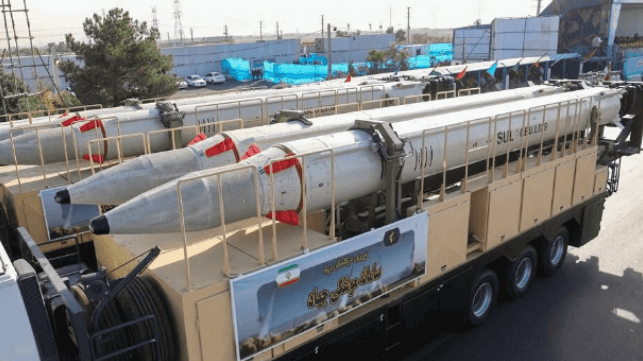
Iran retains a formidable stockpile of ballistic missiles. Israeli Prime Minister Benjamin Netanyahu has claimed that half of Iran’s ballistic missile launchers have been destroyed. Of a stockpile of about 3,000 ballistic missiles, Iran managed to fire 500 missiles and Israel destroyed a further 1,000, leaving an estimated inventory of 1,500.
Iran also improved ballistic missile accuracy as the war progressed, having initially kept more advanced systems like the Haj Qassem in reserve. At peak, 16% of Iranian missiles penetrated Israeli air defenses. Five military and 36 civilian targets in Israel were hit over the 12 days - never at sufficient tempo to suppress Israeli military activity, but a significant result nonetheless.
This limited Iranian success and the remaining missile inventory indicate that if war were resumed, the residual Iranian ballistic missile capability would pose a problem. Israeli attacks on Iran also suggest that the Iranian missile armory was larger than had been generally appreciated outside intelligence circles. About 25 Iranian missile sites had been identified in open source listings before the conflict began. But with Israeli bloggers and Ministry of Defense reveals of attacks on previously unknown sites, the Iranians seem to have been maintaining at least 36 such sites, of which the Israelis are known to have attacked at least 26.
Known IRGC Ballistic Missile Sites unmasked by the 12-Day War (CJRC)
CLUSTER | LOCATION/SITE | LATITUDE | LONGITUDE | HIT | NEWLY LOCATED |
Abhar (independent site?) | 36.086210N | 49.227040E | ü | ü | |
Bandar Abbas Area Independent Sites | Bandar Abbas Khorgu | 27.528789N | 56.451021E |
|
|
Haji Abad | 28.328772N | 55.942649E |
|
| |
Bandar Lengeh | 26.658735N | 54.893197E |
|
| |
Lar | 27.643131N | 54.256253E |
|
| |
Jam/Bandar Kangam | 27.794144N | 52.318042E |
|
| |
Borujerd (independent site?) | 33.945160N | 48.603120E | ü |
| |
Dezful Cluster | Dezful North | 32.614819N | 48.331450E | ü | ü |
Dezful South | 32.607790N | 48.323210E | ü | ||
Garmdareh Cluster | Garmdareh NW | 35.788410N | 51.059026E |
|
|
Garmdareh NE | 35.768729N | 51.085032E |
|
| |
Eshtehard Missile Depot | 35.679399N | 50.434855E | ü | ü | |
Isfahan Cluster | Isfahan West | 32.695027N | 51.430270E | ü |
|
Isfahan South/Baharestan | 32.459346N | 51.714619E |
| ||
Mobarakeh | 32.342160N | 51.664470E | ü | ü | |
Kangavar (independent site?) | 34.439340N | 47.877860E | ü | ü | |
Kashan (independent site?) | 34.093362N | 51.255711E | ü |
| |
Kerman (independent site?) | 30.239153N | 56.851713E |
|
| |
Kermanshah Cluster
| Panj Peleh/Bakhtaran | 34.360500N | 47.228508E | ü |
|
Konesh Canyon | 34.389521N | 47.181043E |
| ||
Kermanshah South | 34.394788N | 47.222654E |
| ||
Kermanshah NE | 34.525045N | 47.361183E |
| ||
Kermanshah NW | 34.439950N | 47.187934E |
| ||
Ghazanchi | 34.479430N | 47.015580E | ü | ü | |
Kamijeh | 34.522583N | 47.362406E | ü | ü | |
Khorramabad Cluster | Khorramabad Imam Ali NW | 33.581276N | 48.181536E | ü |
|
Khorramabad Imam Ali SE | 33.564324N | 48.217238E |
| ||
Khorramabad Imam Ali Main | 33.552360N | 48.214160E | ü | ü | |
Qom (independent site?) | 34.943853N | 50.763649E | ü |
| |
Shiraz Cluster | Shiraz NW | 29.726310N | 52.558080E | ü |
|
Shiraz North | 29.707720N | 52.590671E | ü |
| |
Tabriz Cluster | Tabriz North/Ammnad | 38.251449N | 46.119187E | ü |
|
Tabriz South | 37.977313N | 46.176606E |
| ||
Yazd (independent site?) | 31.802441N | 54.295549E |
|
| |
Zanjan (independent site?) | 36.746500N | 48.435190E | ü | ü | |
One can conclude that Iran appears to have sufficient residual capability to resume a missile war if hardliners within the Iranian political leadership get their way. To this threat must be added the risk of a closure of the Straits of Hormuz, for which the Iranians have made some military preparations by training for the task and forward-deploying stocks.
The Iranians may have the capability to resume warfare. But they now also know that Israel has both proven political will and intent - as well as the capability - to attack again if it perceives its national security to be under threat.
The opinions expressed herein are the author's and not necessarily those of The Maritime Executive.
Attack on Bulker Could Signal Restart of Houthis' Red Sea Campaign
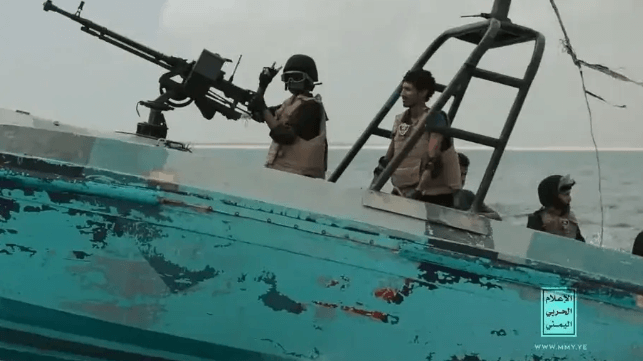
Yemen's Houthi rebels appear to have resumed their campaign of attacks on shipping after a long hiatus. This weekend, a Liberian-flagged bulker was attacked by small craft in the Red Sea, giving new justification for major ocean carriers' decision to continue to avoid the waterway.
On Sunday afternoon, the bulker Magic Seas was approached by about half a dozen small craft at a position about 51 nautical miles southwest of Hodeidah. The personnel aboard these boats were carrying rocket-propelled grenades and small arms, and the armed security team aboard the bulker returned fire. An RPG reportedly hit the bridge, according to security consultancy Vanguard.
EOS Risk Group adds that Houthi forces used four unmanned bomb boats against the Magic Seas. Two of the bomb boats were destroyed and two reached their target, according to EOS' Martin Kelly. The Houthis may also have launched missiles against the vessel, but this is not confirmed, he added.
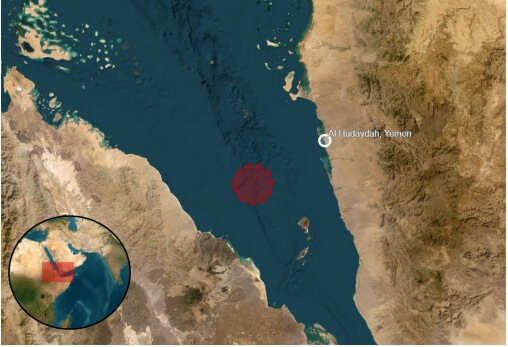
Attack location (UKMTO)
As of 1500 UTC on Sunday, the cargo was reportedly on fire and the ship was taking on water. The crew decided to abandon ship at about 1545 hours and were awaiting rescue; at 1900 hours, UKMTO received confirmation that they were rescued by a passing merchant vessel.
"[The] scale of the attack with multiple weapons types was intended to sink the ship," Kelly said.
The Greek owner of the Magic Seas, Allseas Marine, reportedly has at least three other vessels that have previously called in Israel. The Houthis have warned that they were willing to attack the assets of shipowners who engage in business with Israeli shippers; the militant group's anti-shipping campaign has been quiet since the concerted American airstrike campaign earlier this year, which ended when Houthi leadership agreed to cease fire on American vessels - but the Houthi threat against Israeli shipping interests was never withdrawn.
No comments:
Post a Comment