Rare Earths Rally After the Pentagon Picks a Winner
- The Pentagon’s landmark deal with MP Materials guarantees magnet prices and gives the U.S. government a direct equity stake.
- Rare earth stocks worldwide soar as investors rotate into Western producers and juniors following the MP announcement.
- Apple quickly follows with a $500M commitment to source recycled magnets from MP, boosting the reshoring momentum.
Shares of rare earths companies have exploded higher since MP Materials (NYSE:MP) unveiled a game-changing deal with the U.S. Department of Defense that marks the most aggressive federal intervention in the rare earths space in decades. The DoD-backed investment package will see the Nevada-based producer build out a fully domestic magnet supply chain and lock in long-term pricing support for neodymium-praseodymium, the critical alloy used in everything from fighter jets to iPhones. MP shares have doubled in just days, taking year-to-date gains north of 275% and re-rating the entire Western rare earths complex.
The deal isn’t just about cash; it’s about control. Under the agreement, the Pentagon will take a 15% equity stake in MP through a $400 million preferred share issuance and secure warrants for additional common stock down the road. The government is also extending a $150 million loan, while JPMorgan and Goldman Sachs are syndicating $1 billion in private financing to bring MP’s so-called “10X Facility” online. Construction is already underway, with commissioning slated for 2028.
The real deal sweetener is a $110/kg floor price guarantee for NdPr magnets, nearly double today’s spot price of $63. That pricing mechanism, backed by the full faith and credit of the U.S. government, creates a bulletproof margin environment for domestic producers and resets the cost basis for long-term buyers across defense, autos, and consumer electronics, according to Reuters.
Analysts say it's the rare earths equivalent of a strategic petroleum reserve, but for permanent magnets.
MP’s planned capacity of 10,000 metric tons per year will cover a significant chunk of U.S. magnet demand and more than double current domestic output. For defense planners, the numbers are even more compelling: that volume would be enough to secure magnet supply for the entire F-35 fleet, major missile systems, and naval sonar applications—all without touching Chinese exports.
The move immediately drew follow-on activity. Apple Inc. said it would invest $500 million to source NdFeB magnets from MP made entirely from recycled feedstock. The tech giant, which has faced mounting scrutiny over its reliance on Chinese rare earths, said production would begin in 2027 and ramp up to cover “hundreds of millions” of devices per year. Apple will source from MP’s upgraded facility in Mountain Pass, California, and its soon-to-be-operational Texas plant, using material pulled from discarded devices and scrap.
The Apple deal adds enormous commercial legitimacy to MP’s scale-up and underscores the trend toward localization at the OEM level. Recycled magnet manufacturing has long been viewed as a technical curiosity. Now it’s a $500 million line item on Apple’s strategic sourcing agenda.
Meanwhile, rare earth equities have gone vertical. Lynas Rare Earths (OTCPK:LYSDY) surged to a two-year high after Jefferies hiked its price target from A$6.40 to A$10, calling the company “the next logical beneficiary” of U.S.-led reshoring. Iluka Resources exploded 30% in a single session—its biggest one-day gain on record—as investors rotated into any name with near-term capacity outside China. Australian juniors like Liontown and Sayona also caught a bid.
MP added to the frenzy by announcing a $500 million common stock offering to fund continued expansion and working capital—triggering a minor pullback in the stock but doing little to dent the broader narrative. Capital is pouring into rare earths like it’s 2011.
Defense contractors were quick to endorse the move. Lockheed Martin, prime contractor for the F-35, said it welcomed efforts to “strengthen secure, resilient supply chains.” Analysts say the move will de-risk magnet inputs for THAAD batteries, Virginia-class submarines, and next-gen missile systems. At the industrial level, General Motors and Stellantis are evaluating new sourcing options for permanent magnet EV motors as they accelerate domestic platform rollouts.
What sets this deal apart is its structure. Rather than handing out tax credits or indirect subsidies, the U.S. government is writing equity checks, underwriting price floors, and letting commercial lenders come in behind. The structure resembles the CHIPS Act, but more serious. Analysts say this model could be replicated for battery anodes, graphite, and even gallium.
Still, execution risks loom. MP will need a reliable pipeline of rare earth oxide feedstock, and while it has upstream capability at Mountain Pass, questions remain about whether that will scale fast enough. Labor and permitting hurdles in both California and Texas could delay full ramp-up. And there's the broader question of how quickly defense and OEM contracts can be converted into long-term offtake agreements.
As of mid-July 2025, Beijing has remained quiet. No official response from the Chinese government or state media has been issued in response to the Pentagon-MP announcement. That silence is notable. In 2024, Chinese officials warned against “artificially constructing supply chains” without China. That language has not been repeated publicly this year.
But observers note that China's influence remains concentrated in refining, oxide conversion, and separation, areas where Western capacity still lags. Any serious U.S. effort to localize rare earths will inevitably collide with these structural realities, and Beijing may yet respond through informal levers like export permit delays or price manipulation.
By Alex Kimani for Oilprice.com
Billionaire turns Pentagon into Trump’s defense investment wing
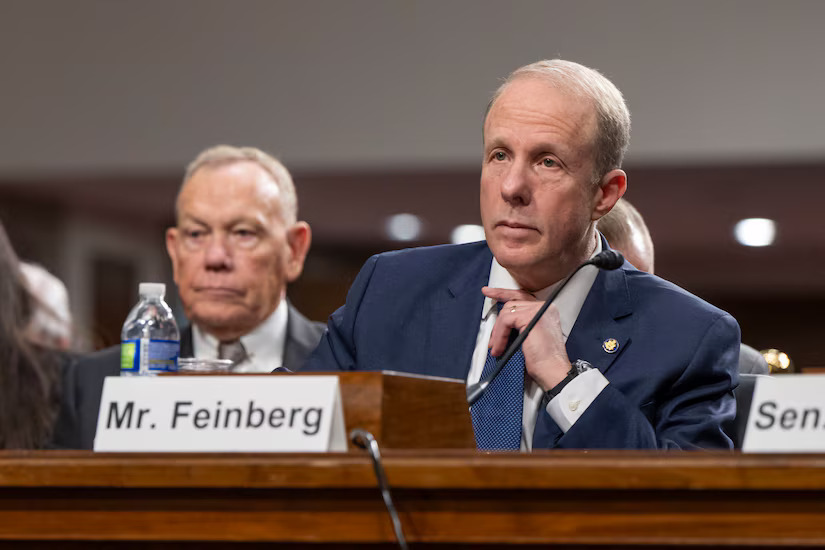
Just four months into his tenure at the Pentagon, private equity billionaire Steve Feinberg has landed his first big deal: a $400 million bet on the US’s only miner of rare earth elements, a key commodity in the rivalry with China.

The equity investment in MP Materials Corp. – the first in modern Pentagon history – was a priority for the Cerberus Capital Management co-founder, who took over as deputy secretary of defense in March, according to people familiar with the efforts. The deal, which comes alongside $1 billion in financing from JP Morgan Chase & Co. and Goldman Sachs Group Inc., is to be the first of several aimed at leveraging Pentagon support and Wall Street cash to jump-start efforts to break China’s lock on global supplies of rare earth minerals, the people said.
Feinberg, who has made few public comments since taking office, declined to respond to written questions for this article. In his confirmation hearing, he vowed to make unleashing US critical-minerals production a priority and highlighted the need to accelerate use of the Defense Production Act – a law dating back to the Korean War that was used for the MP deal.
US dependence on Chinese supplies of rare earth minerals – used for everything from cars to missiles to data centers – emerged as a key vulnerability for the administration when Beijing cut off supplies this spring in retaliation for President Donald Trump’s tariffs, driving the White House to the negotiating table.
Pentagon officials immediately began canvassing the industry for ways to ramp up production of permanent magnets, an especially critical product made from neodymium-praseodymium oxide.
Feinberg pushed the MP deal despite objections within the Pentagon about using DPA authority, which typically involves loans, to take a 15% equity stake that would make the Pentagon MP’s largest shareholder, according to people familiar with the matter. The company highlighted the “unconventional use” of the law, along with the fact the Pentagon will need to secure more funding from Congress for the deal, among the risk factors it disclosed to investors.
US administrations have for years sought to develop domestic supplies of the minerals to counter China’s grip on 85% of global processed supplies. But the domestic industry has struggled for decades with high costs and brutal competition from Beijing.
“DoD selected a unique approach to this agreement to account for the difficulties in establishing and sustaining production of critical rare earth magnets in a market environment in which China controls much of the supply chain,” a Pentagon spokesperson said.
The MP deal includes a 10-year agreement to establish a price floor that’s nearly double current market prices to ensure profitability, as well as a Pentagon commitment to make sure all the so-called permanent magnets the Las Vegas-based company will produce at a new factory find either defense or commercial customers.
The deal, followed days later by a $500 million pact with Apple, catapulted MP’s stock to a record. Hopes of similar agreements boosted share prices across the small US rare earth sector.
Feinberg is eager to build national champions across key sectors to boost US competitiveness, according to people familiar with his thinking. He’s personally making decisions on which companies will get Pentagon funding through the DPA, which allows the government to support strategic projects. He co-signed the MP deal with his boss, Defense Secretary Pete Hegseth.
“Taking a partial stake is something I have not seen,” said William Greenwalt, a former deputy undersecretary of defense for industrial policy. “It is much easier for DoD to own the factory or means of production and bring a contractor in to perform the work.”
Feinberg made his name in private equity and has deep experience dealing with defense contractors. He’s also known on Wall Street for keeping a tight circle of staff, a characteristic that’s carried over to his Defense Department post, according to people familiar with the situation. Secrecy around the MP deal was especially tight.
“Even though there’s significant government equity, they’re also moving a lot of capital,” said Gracelin Baskaran, director of the critical minerals security program at the Center for Strategic and International Studies. “That’s what you want out of federal dollars — you want federal dollars to mobilize a lot of private capital.”
The bet on MP is a potentially risky one. The last company that owned the deposit MP is now developing went bankrupt. Most of the expertise in refining the materials and turning them into magnets is in China.
“There’s a lot of good faith in this, but for the taxpayer I’m concerned,” said David Abraham, a critical minerals specialist at Boise State University. “We’ve chosen a company that’s never made magnets to rely on to make all the magnets.”
(By Joe Deaux)
LA REVUE GAUCHE - Left Comment: Search results for PERMANENT ARMS ECONOMY
No comments:
Post a Comment