Climate Change And The Rising Threat Of Arsenic In Rice – Analysis
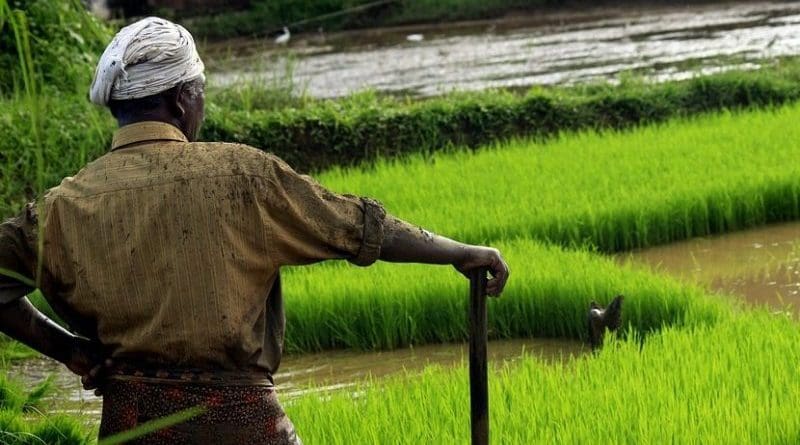
Rice farmer in Kerala, India.
By Observer Research Foundation
By Shoba Suri and Tanya Verma
According to recent reports, arsenic has been detected in all samples of rice in the United States (US), with over a quarter exceeding the Food and Drug Administration (FDA) food safety guidelines. Thus, it becomes imperative to mention that climate change is impacting not only weather patterns and agricultural productivity, but also aggravating the invisible hazards in food systems.
One of these threats that remains inconspicuous is the increasing incidence of inorganic arsenic in rice—especially in the context of India, where rice is a dietary staple. The carbon dioxide levels in the air are increasing, and temperatures are climbing, which, in turn, is affecting how crops interact with soil and water. Moreover, it is also affecting the redistribution of nutrients and toxins of crops. Nonetheless, lately arsenic contamination in rice, which has always been closely linked to geography and groundwater exposure, is translating into a climate-related issue impacting both food safety and people’s health.
The issue is further compounded by prevailing rice cultivation practices. Mostly cultivated during floods within flooded paddies, rice grows well in low-oxygen conditions that unintentionally enhance the bioavailability of arsenic. Such predispositions—along with the widespread use of irrigational water contaminated by arsenic—make it possible to transform toxin into soluble form, which is easily absorbed by the rice roots.
This is further exacerbated by climate change, which induces modifications in the soil chemistry, temperature, and water balance. This results in climatic conditions that have hastened the uptake of arsenic. In India, the problem is exacerbated because flood irrigation is extensively used in areas where arsenic is prevalent. With rising temperatures, the mean consumption of inorganic arsenic in India periodically (now estimated to be 1.54 micrograms in one kilogram of body weight) is expected to increase to 2.21 micrograms. The increase poses a risk to vulnerable groups and communities that routinely consume rice in their meals.
Inorganic arsenic is highly toxic and naturally present in soil and ground water. This can enter the human body through the consumption of crops such as rice, which is absorbed in waterlogged areas. Prolonged exposures to low doses are linked with high risks of skin, lung and bladder cancer, cardiovascular diseases, and developmental problems in children. The Environmental Protection Agency has recently re-evaluatedthe carcinogenicity of arsenic, pegging it even higher and warranting an urgent intervention.
The World Health Organization (WHO) does not set a certain limit of arsenic in rice. Still, the Codex Alimentarius Commission, a United Nations (UN) body, jointly administrated by WHO and Food and Agricultural Organization (FAO), has set a ceiling of 0.2 mg/kg (or 200 0g/kg) of inorganic arsenic in polished rice, yet in a majority of the regions this limit is exceeded. Asia is particularly affected by elevated arsenic in rice in countries such as Bangladesh, China, India, Vietnam, Myanmar, and Indonesia. According to a study published in Lancet Planetary Health (2024), the climatic effect of arsenic contamination in rice is projected to increase lifetime cancer cases (from 13.4 to 19.3 million in China) and non-communicable diseases in Asian countries, including India, by 2050.
This threat is not uniform across Indian states. It persists most severely in southern Indian states of Andhra Pradesh, Telangana, Karnataka, Tamil Nadu, and Kerala, where rice predominates the cereal basket, making them vulnerable due to high consumption of 60-90 percent and flood irrigation practices in areas where arsenic is predominantly found.
The growing crisis calls for a concerted multi-faceted response. At the farm level, it includes selecting low-arsenic rice varieties using alternate wetting and drying irrigation methods instead of continuous flooding, and amending soil with silicon or iron to reduce arsenic bioavailability. Additionally, regulatory reforms must accompany such practices to ensure a more inclusive redressal. Unlike the European Union(EU) and the United States (US), where limits have been set on arsenic levels in infant rice cereals and baby food, India lacks binding regulatory standards for arsenic levels in rice.
Display of quality markers – such as arsenic level should be clearly listed by retail stores through easily understandable and accessible Certificates of Analysis (COAs) from recognised laboratories. Such COAs can be digitally distributed to packaging through QR codes, enabling consumers to make informed choices. Furthermore, governments can promote affordable and user-friendly arsenic test kits to ensure safety.
Additionally, decentralised testing using field test kits to check arsenic levels in soil and irrigation water, and collating data in a central database to facilitate real-time monitoring, can augment the remedial response to arsenic contamination. The introduction of new technologies—such as Internet of Things (IoT) and machine learning—can transform early detection and mitigation of arsenic contamination. The application of IoT-based soil and water sensors along with machine-learning can aid in monitoring the arsenic levels continuously in rice-growing areas, and forecast high-risk zone areas to implement specific treatment measures. This will ensure irrigation cleanliness and reduce health risks from farm to fork.
One of the key challenges in addressing the arsenic crisis is lack of public awareness. The majority of consumers are unaware of the arsenic in rice and the long-term health risk its consumption poses. A common misconception is equating polished white rice with quality, overlooking the nutritive value of rice bought from branded outlets or local mandis (marketplace) to be safe. However, even the rice varieties that are promoted as healthier options, for instance, brown rice, tend to have higher levels of arsenic accumulated in the bran. This gap in awareness can be addressed through an education campaign in areas with high rice consumption. Arsenic level can be significantly reduced through simple cooking practicessuch as copious rinsing of rice and using extra water during boiling. For example, cooking interventions in Japan and Bangladesh, and cultivation in low arsenic soil have led to low arsenic exposure despite high rice consumption.
The way forward needs to be strong, integrative, and policy-based. Beyond setting the safety standards of arsenic in rice, Food Safety and Standards Authority of India (FSSAI) could also consider creating a national roadmap for climate-resilient rice cultivation. This includes encouraging farmers to invest in climate-smart agriculture system that reduces arsenic uptake, along with inclusion in the national food security agenda. As India prepares to tackle the rising effects of climate change, the case of arsenic threat in rice indicates the pressing need for a holistic approach to address environmental, health, and agricultural challenges. There is an urgent need for proactive efforts to offer an antidote to the problem of arsenic contamination to reduce future health hazards and quality of staple grain, which matters for the food security of a nation.
About the authors:
- Shoba Suri is a Senior Fellow with the Health Initiative at the Observer Research Foundation.
- Tanya Verma is an Intern at the Observer Research Foundation.
Source: This article was published by the Observer Research Foundation.

Observer Research Foundation
ORF was established on 5 September 1990 as a private, not for profit, ’think tank’ to influence public policy formulation. The Foundation brought together, for the first time, leading Indian economists and policymakers to present An Agenda for Economic Reforms in India. The idea was to help develop a consensus in favour of economic reforms.
New chlorophyll fluorescence imaging technique enables early detection of rice fungal diseases
Nanjing Agricultural University The Academy of Science
The findings offer a non-invasive and efficient method for early disease detection, crucial for timely intervention and better disease management.
Rice is a vital global food staple, contributing significantly to daily calorie intake. However, up to 30% of annual rice yield is lost due to diseases, with rice blast and brown spot being among the most destructive fungal diseases. Accurate early detection of these diseases is challenging due to the similarity in their visual symptoms at the pre-symptomatic stage. Traditional molecular methods, while precise, are time-consuming and not easily scalable for field applications. In contrast, ChlF imaging, which measures the light emitted by chlorophyll molecules during photosynthesis, has emerged as a promising tool for detecting early plant stress before visible symptoms appear. This study aimed to harness ChlF imaging for distinguishing rice blast and brown spot at the early stages of infection.
A study (DOI: 10.1016/j.plaphe.2025.100012) published in Plant Phenomics on 15 February 2025 by Jae Hoon Lee’s team, Seoul National University, provides a powerful, non-destructive tool for diagnosing rice fungal diseases at the pre-symptomatic stage.
The study employed pulse-amplitude modulation (PAM) ChlF imaging to monitor changes in rice leaves infected with rice blast and brown spot. A total of 120 leaves and 750 spots were analyzed across five time points in detached leaf assays. The experimental setup involved treating rice leaves with conidial suspensions of Magnaporthe oryzae and Cochliobolus miyabeanus at various concentrations. The ideal concentrations of 5 × 10^4 for M. oryzae and 1 × 10^3 for C. miyabeanus were selected, as they induced individual lesions while maintaining comparable disease severity. Disease progression was categorized into asymptomatic, pre-symptomatic, and symptomatic stages based on lesion appearance, with visual inspection confirming the distinct patterns for each disease. ChlF images were taken at different time points, and 98 ChlF parameters were analyzed using principal component analysis (PCA), revealing a divergence in ChlF patterns between healthy and infected leaves, particularly during the pre-symptomatic stage. Significant increases in photochemical quenching parameters were noted in both diseases, with rice blast showing unique decreases in non-photochemical quenching (NPQ) and qN parameters, which were not observed in brown spot. Machine learning techniques were employed to classify ChlF data, achieving high classification accuracies (over 92%) at both leaf and lesion levels. The study identified several key ChlF parameters, including Rfd_L2, QY_Lss, and qP_Lss, as reliable diagnostic indicators for early disease detection. Validation through whole-plant assays confirmed the efficacy of these parameters, with rice blast-specific indicators showing distinct patterns compared to brown spot. These findings suggest that ChlF imaging is a powerful tool for early, non-invasive detection of rice fungal diseases, facilitating timely disease management and intervention.
This study underscores the potential of ChlF imaging as an early diagnostic tool for rice fungal diseases, offering a non-invasive, scalable, and accurate method for disease detection. By identifying distinct ChlF signatures for rice blast and brown spot, the research paves the way for more efficient disease management practices, enhancing rice production and contributing to global food security.
###
References
DOI
Original Source URL
https://doi.org/10.1016/j.plaphe.2025.100012
Funding information
This work was supported by Rural Development Administration of Korea (RS-2022-RD010059) and Creative-Pioneering Researchers Program by Seoul National University.
About Plant Phenomics
Science Partner Journal Plant Phenomics is an online-only Open Access journal published in affiliation with the State Key Laboratory of Crop Genetics & Germplasm Enhancement, Nanjing Agricultural University (NAU) and distributed by the American Association for the Advancement of Science (AAAS). Like all partners participating in the Science Partner Journal program, Plant Phenomics is editorially independent from the Science family of journals. Editorial decisions and scientific activities pursued by the journal's Editorial Board are made independently, based on scientific merit and adhering to the highest standards for accurate and ethical promotion of science. These decisions and activities are in no way influenced by the financial support of NAU, NAU administration, or any other institutions and sponsors. The Editorial Board is solely responsible for all content published in the journal. To learn more about the Science Partner Journal program, visit the SPJ program homepage.
Journal
Plant Phenomics
Method of Research
Experimental study
Subject of Research
Not applicable
Article Title
Pre-symptomatic diagnosis of rice blast and brown spot diseases using chlorophyll fluorescence imaging
No comments:
Post a Comment