Equinor Takes $955 Million Charge Citing US Wind Policy and Tariffs
The Norwegian state-owned energy company Equinor included a nearly $1 billion impairment charge in its second quarter financial report linked to the changing outlook for the U.S. offshore wind industry. While the company reports the Empire Wind I offshore project is back on track after a month-long stop-work order by the U.S., it said the outlook for the offshore wind industry in the U.S. is diminished.
Speaking on the outlook, CFO Torgrim Reitan told investors, “Without investment tax credits and without a government that wants it to happen, we are not going to invest in it.” He said the main driver for this charge is the “changes in regulations for future offshore wind projects in the U.S.”
In April, Equinor called the actions by the Trump administration “unlawful” as it related to a stop work order issued days before offshore work began on Empire Wind I, an 810 MW project being built 15 to 30 miles off New York. The company denied the administration’s allegations that the approval process had been rushed, noting it won the lease in 2017 during the first Trump administration. Final approvals were issued in February 2024.
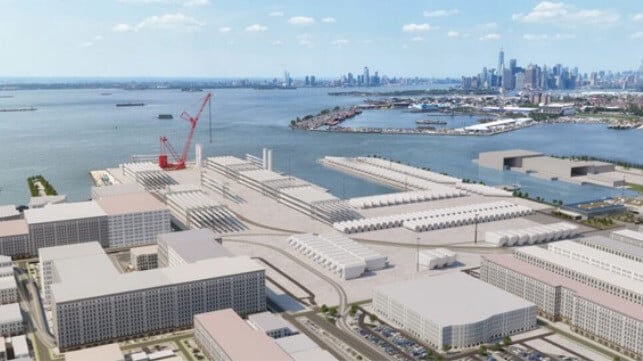
The company said, however, that the charges were due to the future outlook. It is taking a $192 million charge to reduce the value of the lease for Empire Wind II, a planned second phase of the project that it does not expect will proceed in the near term. The bulk of the charge, $763 million, is related to Empire Wind I and the investment in the redevelopment of the South Brooklyn Marine Terminal.
The company said that the investment in the terminal had included the assumption that it would be a base for two more developments in addition to Empire Wind, which would help pay for the project. “That is now unlikely,” Reitan said.
While the tax credits will remain in place for Empire Wind I, the company pointed out that other costs are rising due to the tariffs Trump has imposed. It cited specifically the impact on the cost of steel and other key materials for Empire Wind I. While it had reported significant daily costs during the work stoppage, the company said the charge included “a more limited amount” related to the pause in work.
The charges came in what was overall a positive quarter for the company. It highlighted its investments in U.S. offshore gas, which it said delivered substantial value during the quarter. The company also cited the stabilized production from the Johan Castberg FPSO as contributing to it meeting its forecasts.
First US-Flagged Subsea Rock Installation Vessel Floated at Hanwha Philly
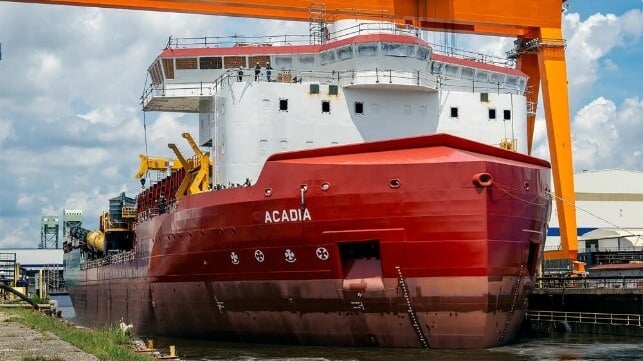
The first U.S.-flagged, Jones Act-compliant, subsea rock installation vessel designed to support the offshore energy sector marked a milestone as the vessel was floated out at the Hanwha Philly Shipyard. The vessel has faced delays in its construction and challenges as the U.S. offshore wind market largely collapsed, but owners Great Lakes Dredge & Dock Corporation continue to express confidence as it expands its strategy for the vessel.
The Arcadia is engineered to transport and install up to 20,000 metric tons of rock on the seabed. This is a vital part of the offshore energy projects, providing scour protection for subsea infrastructure, including cables. Great Lakes initially ordered the vessel at a cost of $197 million in November 2021, focusing on the offshore wind energy sector to protect offshore wind turbine foundations and cables. It points out that the rock installation is a critical element of the project, as it prevents erosion caused by waves and currents and mechanical impacts from equipment and vessels.
“The company proactively expanded its strategic target markets for the Arcadia to include oil and gas pipeline and power and telecommunications cable protection, as well as international offshore wind,” Great Lakes wrote in a recent stock exchange filing. It has contracts to support Equinor’s Empire Wind I and Ørsted’s Sunrise Wind, both of which are fully permitted projects and under construction. Work began on Sunrise Wind in 2024 and Empire Wind I in 2025.
Great Lakes reported that it also has a reservation for the vessel from a third, unnamed offshore wind project in the United States. However, a contract to support Empire Wind II was canceled by Equinor. Great Lakes expects the projects will keep the vessel engaged through 2026, and it reports it has used the past two years for discussions with clients for new offshore energy projects domestically and internationally, where the vessel would be employed in 2027 and beyond.
“We are excited to see the launch of the Acadia, getting us closer to her expected delivery early next year, which will also mark the completion of our major new build program,” said Lasse Petterson, President and Chief Executive Officer of Great Lakes Dredge & Dock Corp. “The Acadia is the centerpiece of our Offshore Energy growth strategy and will begin operations immediately upon leaving the shipyard.”
Work on the vessel began in the summer of 2023 with a ceremonial first steel cut attended by President Joe Biden, and assembly began on May 2, 2024, when the first section, known as the grand block, was placed into the assembly dry dock. When completed, Arcadia will be 461 feet (140.5 meters) with crew accommodations for 45 people.
The owner and Philly Shipyard have been in dispute over delays on the construction timeline. The vessel was due for delivery in November 2024, but it has been postponed several times. Great Lakes filed a complaint in court regarding the construction delays, but says the situation changed after the sale of the yard to Hanwha Ocean was completed in December 2024. In April 2025, it notified the court that it was voluntarily withdrawing the complaint and was pursuing a private dispute resolution, including possibly arbitration, as set out in the construction agreement.
Arcadia is one of several large vessels that were ordered in the U.S. to support the offshore wind energy sector. The offshore wind industry also spurred the construction of a U.S.-flagged turbine installation vessel, several offshore support vessels, and multiple crew transfer vessels.
No comments:
Post a Comment