Greece Dispatches Salvage Tug for Rescues Off Yemen
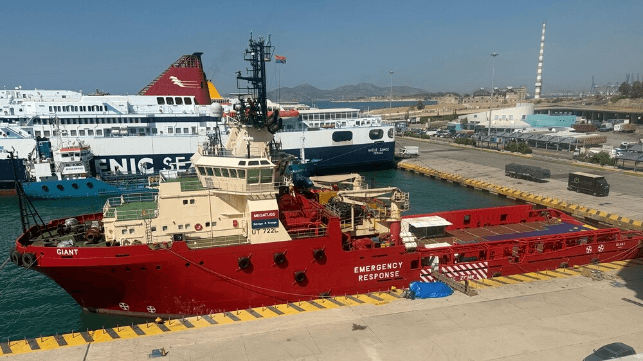
Greek authorities are sending a salvage tug to fill a much-needed capacity gap in the southern Red Sea, where a resurgence of Houthi attacks - enabled by a sudden absence of naval forces - led to the loss of two Greek vessels in a month.
Shipping Minister Vassilis Kikilias said Wednesday that the salvage tug Giant would be dispatched to the region to "protect and assist Greek-owned vessels and Greek seafarers." At present, there are no salvage assets in the region, and any rescue intervention must be provided by European tugs dispatched south through the Suez Canal or by Good Samaritans passing by. A Greek-led European naval intervention mission in the region, EUNAVFOR Operation Aspides, has three warship assets; none were in range to intervene during the recent attacks.
"The Ministry of Shipping and Insular Policy supports this effort and the cooperation of the public with the private sector, always at this level - of safety, protection of human life and measures against marine pollution. All of this is extremely important and the heart of our policy," said Kikilias.
The vessel is being provided by the Hellenic Association of Tugboat Owners. Its president, Pavlos Xiradakis, told local media that the decision to dispatch the Giant was inspired by the incident aboard the tanker Sounion. When Sounion was attacked and set on fire in August 2024, it took weeks to get a tug on scene and get the blaze under control.
"Now, we decided, seeing that the situation continues and worsens, to send this rescue vessel to the area," Xiradakis said. "Other flags are pushing sailors not to pass through the Red Sea with their ships. Our people are willing to go to this area, despite the prevailing situation, to assist and help fellow sailors who are there."
Giant is a 16,000-horsepower oceangoing tug with a bollard pull of 180 tonnes. It has advanced firefighting capabilities, accommodations for 40 responders or survivors, pollution response gear, and provisions for salvage towing.
Kikilias has also announced a major 450 million euro investment in the Hellenic Coast Guard, which has been under pressure due to increased maritime migration. He said that the funds would be committed rapidly to acquire six patrol boats, ten high-speed pursuit boats, drones, and a "war room" for maritime domain awareness and operations, all on an expedited basis.
"The men and women of the Coast Guard defend the security of our homeland every day. We have the obligation and duty to equip them with all the necessary means to protect our maritime borders," he said. "We have a lot of work ahead of us in the coming months and we will implement it in every possible way."
Livestock Carrier Detained and Released After Sailing Near Yemen
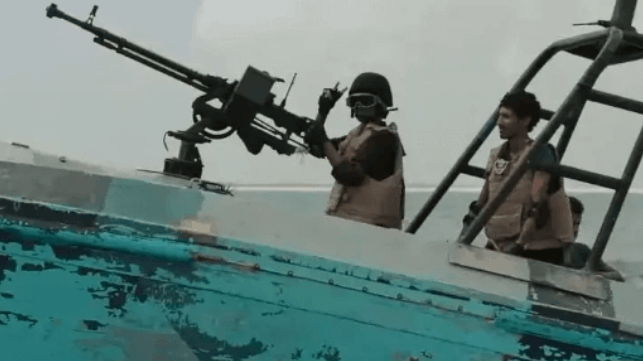
A small livestock carrier was confronted and briefly detained as it was sailing near the Yemeni coast on July 24. The situation remains unclear, but security services are speculating it might have been intercepted by locals because of the position of the vessel instead of an attack by the Houthis.
The vessel named Merinos Livestock (2,200 dwt) departed Bossaso, Somalia, and indicated it was bound for Jeddah, Saudi Arabia, before turning off its AIS transmissions. The lack of an AIS signal may have contributed to the intercept, with some reports saying it took place with the Yemeni Coast Guard. The Houthis have not taken credit for the intercept, although they often take hours or days to acknowledge their activities.
The vessel was reportedly underway east of the Hanish Islands, approximately 30 nautical miles northwest of Mocha, Yemen. A single wooden boat confronted the livestock carrier, and the reports indicate there was small arms fire. The vessel was ordered to turn to the Yemeni port, and tracking signals show it made a U-turn bound for Mocha. The last report to the UK Maritime Trade Operation was that the vessel was being detained by the Yemeni Coast Guard.
Reuters reports the vessel was held on “suspicion.” The report says the vessel was later released.
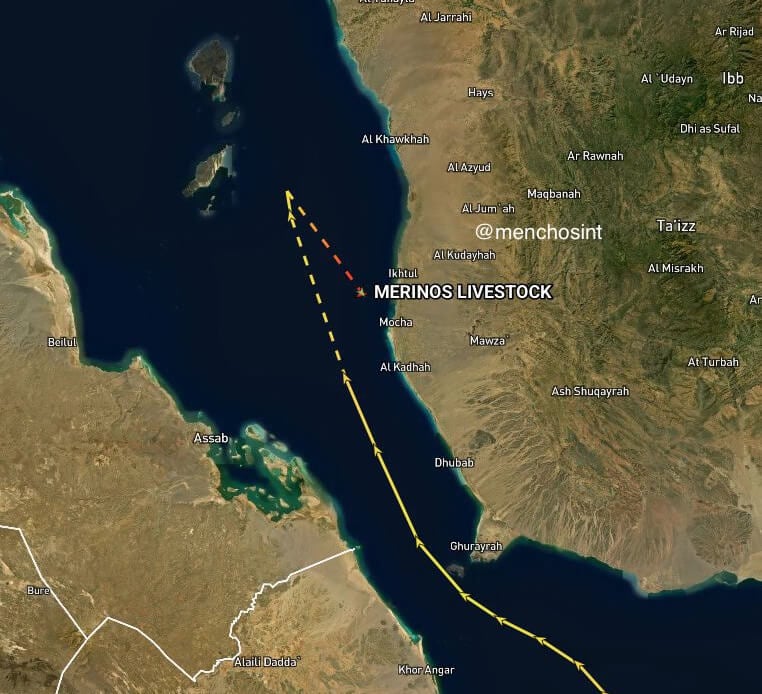
Tracking on the Merinos Livestock (posted on X)
The Merinos Livestock is a converted cargo ship built in 1976 and now operating under the Comoros flag, managed by a Greek company. It would be a relatively easy target, with reports that it has a top speed of just 10 knots. It is 88 meters (289 feet) in length.
Details on the ship are shadowy, with the Equasis database not reflecting a port state inspection since 2023, shortly after it was renamed Merinos Livestock. Between 2016 and 2023, the vessel underwent 14 port state inspections, each of which listed deficiencies and, in several cases, resulted in detentions.
Israel Can Deliver Active Suppression of Houthi Attack Boats
The Israeli attack mounted in the early hours of July 21, targeting port infrastructure in Hodeida, was conducted by drones, in contrast to previous Israeli attacks that employed manned aircraft.
Employing relatively light-payload drones means that the weight of ordnance that can be launched at targets is limited - considerably less than that of the heavy bombs which can be dropped from manned aircraft. But suitable for neutralizing many targets, missiles fired from drones can be delivered with greater accuracy, and the drone can loiter ready to attack until an optimal moment presents itself. Use of drones enables a persistent presence to be maintained, at minimal running cost and without risk to aircrews. The attack mode employed on July 21 therefore presents a viable alternative - and for some scenarios a better alternative - than dispatching an air armada of fighters, air defense suppression, tanker and surveillance platforms 1,250 miles down the Red Sea to the Yemeni coast and back.
Israel has not announced what equipment was used to mount the July 21 attack. It has in its inventory at least two medium range drones that could have carried out the task: the IAI Heron TP Eitan and the Elbit Systems Hermes 900 Kochav drones. Considering the Hermes 900, it could cruise 1,250 miles from base to target area, linger for 24 hours, and then return. It can use onboard standoff surveillance systems to loiter off and monitor potential targets. With a 450-kilogram payload, the Hermes 900 can carry a large number of missiles such as the Rafael Aerospike, able to attack moving targets at 30 km range instantly as attack parameters are met.
Thus it would be feasible for Israel to monitor the Houthi small boat and sea drone attack force in its bases, and to attack whenever hostile intent is detected. An aggressive stance such as this could complement (but be kept separate from) interceptions of incoming smuggled Houthi arms at sea. The latter mission has been conducted with increasing success by General Tareq Abdullah Saleh’s National Resistance Forces, as seen in early May and late June. General Tareq’s latest seizure has demonstrated that the Houthis are still dependent on Iranian-imported components for their more advanced drone and missile systems. As an armchair strategy for closing down the threat in the Red Sea, this has many holes, but rather fewer than reliance on naval defenses - and the hope that naval assets are in the right sea area at the right time to defend merchant traffic.
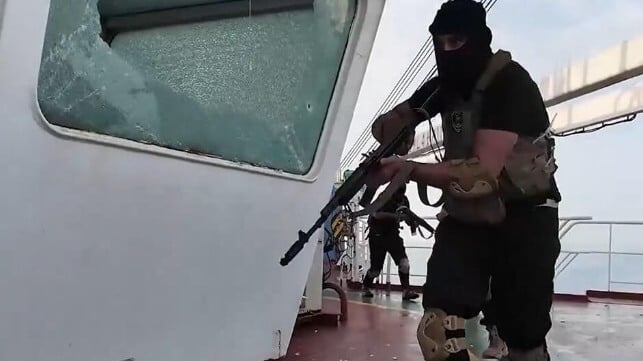
Local Yemeni sources have reported that during Israel’s July 21 drone attack, seven Houthi naval commandos were killed in a speedboat as they attempted to leave the port in Hodeidah for a routine mission. The team and the boat had been used in previous weeks to track, chase and attack commercial ships. After months of no apparent solution being in sight, this may be the first indication that a successful suppression strategy could be implemented.
No comments:
Post a Comment