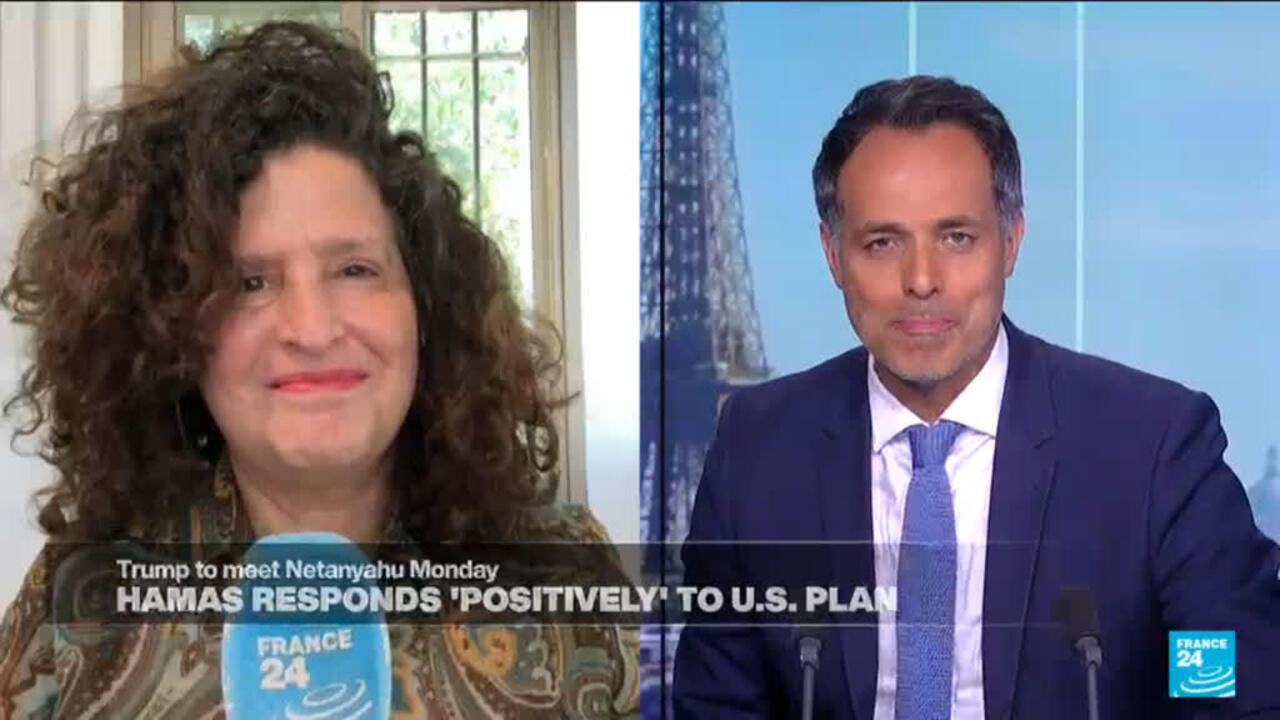
Hamas on Friday said it had given a positive response to a proposal for a ceasefire with Israel mediated by Egypt and Qatar and that it was ready to start talks "immediately". Earlier this week, US President Donald Trump said Israel had agreed to the terms of a 60-day truce proposal and urged Hamas to accept the deal.
Issued on: 04/07/2025 -
By:
FRANCE 24
Video by:
Vedika BAHL/
Yinka OYETADE

Hamas said Friday it was ready to start talks "immediately" on a proposal for a ceasefire
"The movement is ready to engage immediately and seriously in a cycle of negotiations on the mechanism to put in place" the terms of a draft truce proposal received from Egyptian and Qatari mediators, the militant group said in a statement.
Hamas said earlier on Friday it was "conducting consultations with leaders of Palestinian forces and factions regarding the proposal received... from the mediators".
It was not clear if Hamas’s statement meant it had accepted the proposal from US President Donald Trump for a 60-day ceasefire.
Hamas has been seeking guarantees that the initial truce would lead to a total end to the war, now nearly 21 months old.
Hours earlier, Israeli Prime Minister Benjamin Netanyahu vowed to bring home all the hostages held by militants in Gaza, after coming under massive domestic pressure over their fate.
"I feel a deep commitment, first and foremost, to ensure the return of all our abductees, all of them," Netanyahu said.
Trump said Tuesday that Israel had agreed on terms for a 60-day ceasefire in Gaza and urged Hamas to accept the deal before conditions worsen, adding on Thursday that he wanted "safety for the people of Gaza".
"They've gone through hell," he said.
A Palestinian source familiar with the negotiations told AFP earlier this week that the latest proposals included "a 60-day truce, during which Hamas would release half of the living Israeli captives in the Gaza Strip" – thought to number 22 – "in exchange for Israel releasing a number of Palestinian prisoners and detainees".
Two previous ceasefires brokered by Qatar, Egypt and the United States have seen temporary halts in fighting, coupled with the return of Israeli hostages in exchange for Palestinian prisoners.
Out of 251 hostages seized by Palestinian militants during the October 2023 attack, 49 are still held in Gaza, including 27 the Israeli military says are dead.
Nearly 21 months of war have created dire humanitarian conditions for the more than two million people in the Gaza Strip, where Israel has recently expanded its military operations.
The military said in a statement it had been striking suspected Hamas targets across the territory, including around Gaza City in the north and Khan Younis and Rafah in the south.
The health ministry in Gaza said the number of Palestinians killed in the territory has passed 57,000.
(FRANCE 24 with AP and AFP)
The Time Has Arrived for a Comprehensive Middle East Peace
Reprinted from Common Dreams.
The attack by Israel and the U.S. on Iran had two significant effects. First, it once again exposed the root cause of turmoil in the region: Israel’s project to “reshape the Middle East” through regime change, aimed at maintaining its dominance and blocking a Palestinian state. Second, it highlighted the futility and recklessness of this strategy. The only path to peace is a comprehensive agreement that addresses Palestine’s statehood, Israel’s security, Iran’s peaceful nuclear program, and the economic recovery of the region.
Israel wants to topple the Iranian government because Iran has supported proxies and non-state actors aligned with the Palestinians. Israel has also consistently undermined U.S.-Iran diplomacy regarding Iran’s nuclear program.
The far-right Israeli government’s refusal to accept a Palestinian state is the root of the problem.
When the British empire promised a Jewish homeland in Mandatory Palestine in 1917, the Palestinian Arabs constituted 90% of the population and Jews less than 10% of the population. In 1947, with intense U.S. lobbying, the U.N. General Assembly voted to grant 56% of Palestine to a new Zionist state, while the Jews were only 33% of the population. Palestinians rejected this as a violation of their right to self-determination. After the 1948 war, Israel expanded to 78% of Palestine, and in 1967, occupied the remaining 22% – Gaza, the West Bank, East Jerusalem, and the Golan Heights.
Instead of returning occupied lands in exchange for peace, Israeli right-wing politicians insisted on permanent control of 100% of the land, with the Likud founding charter declaring in 1977 that there would be only Israeli sovereignty “between the Sea and Jordan.”
Israeli Prime Minister Benjamin Netanyahu represents this policy of domination—and has served as prime minister for a total of 17 years since 1996. When he came to power, he and his U.S. neocon allies authored the “Clean Break” strategy to block the creation of a Palestinian state. Instead of pursuing land for peace, Israel aimed to reshape the Middle East by overthrowing governments that supported the Palestinian cause. The U.S. would be the implementing partner of this strategy.
This is exactly what happened after 9/11, as the U.S. led or sponsored wars against Iraq (invasion in 2003), Lebanon (U.S. funding and arming Israeli aggressions), Libya (NATO bombing in 2011), Syria (CIA operation during 2010’s), Sudan (supporting rebels to break Sudan apart in 2011), and Somalia (backing Ethiopia’s invasion in 2006).
Contrary to the glib promises by Netanyahu to the U.S. Congress in 2002 – that regime change in Iraq would bring a new day to the Middle East – the 2003 Iraq War augured the events that were to come across the region. Iraq descended into turmoil, and since then, each new war has brought death, destruction, and economic disarray.
This month, Israel attacked Iran even as negotiations between Iran and the U.S. were underway to ensure the peaceful use of Iran’s nuclear program – repeating the same WMD propaganda that Netanyahu used to justify the Iraq War.
Israel has been claiming for more than 30 years that Iran is on the verge of acquiring nuclear weapons. However, on June 18, 2025, the International Atomic Energy Agency (IAEA) director general stated that there is “no proof of a systematic effort” by Iran to develop nuclear weapons. More to the point, Iran and the U.S. were actively engaged in negotiations according to which the IAEA would monitor and verify the peaceful nature of Iran’s nuclear program.
The attack on Iran proves yet again the futility and nihilism of Netanyahu’s approach. The Israeli and U.S. attacks accomplished nothing positive. According to most analysts, Iran’s enriched uranium remains intact, but is now in a secret location rather than under IAEA monitoring. In the meantime, with Israel’s ongoing genocide in Gaza, neither peace nor security have been achieved.
Israel has driven the region to a 4,000-kilometer swash of violence from Libya to Iran through its reckless, lawless, and warmongering actions, all ultimately aimed at preventing a State of Palestine by “remaking” the Middle East.
The solution is clear: It is time for the United States to recognize that its own strategic interests require a decisive break from partnering in Israel’s destructive strategy.
Prioritizing genuine peace in the Middle East is not only a moral imperative, but a fundamental U.S. interest – one that can only be achieved through a comprehensive peace deal. The key pillar of this deal is for the U.S. to lift its veto on a Palestinian State on the borders of June 4, 1967, and to do so at the start, not in some vague distant future that never actually arrives.
For more than 20 years, Arab nations have backed a practical peace plan. So too has the Organization for Islamic Cooperation (OIC), with its 57 member countries, and the League of Arab States (LAS), with its 22 members. So too have almost all the nations in the U.N. General Assembly. So too has the International Court of Justice in its 2024 ruling that Israel’s occupation is illegal. Only Israel, with support from the U.S. veto, has stood in the way.
Here is a seven-point peace plan in which all parties would benefit. Israel would gain peace and security. Palestine would achieve statehood. Iran would win an end to economic sanctions. The U.S. would win an end to costly and illegal wars fought on Israel’s behalf, as well as the risks of nuclear proliferation if the current violence continues. The Middle East would win economic development, security, and justice.
- First, an immediate cease-fire would apply across the entire region—and the cease-fire would include an immediate release of all hostages and prisoners.
- Second, the U.N. Security Council would vote upfront to welcome Palestine as the 194th U.N. Member State on the June 4, 1967 borders, with East Jerusalem as its capital. Israel and Palestine could subsequently agree on mutually desired border adjustments.
- Third, Israel would withdraw from all territories occupied since 1967. U.N.-mandated international forces would ensure a peaceful, orderly transition; a transfer of Palestinian territories to Palestinian authorities; and mutual security for both Israel and Palestine.
- Fourth, the territorial integrity and sovereignty would be guaranteed for Lebanon, Syria, and all states in the region. All non-state armed groups would be demilitarized, and foreign troops would be withdrawn.
- Fifth, the U.N. Security Council would adopt an updated nuclear agreement with Iran, including binding verification, and with all economic sanctions on Iran lifted alongside Iran’s verified compliance with the peaceful uses of its nuclear program.
- Sixth, Israel and all Arab and Islamic states would establish full diplomatic relations following the admission of the State of Palestine as a U.N. member state.
- Seventh, the Middle East nations would establish an international fund for rebuilding the war-torn parts of Lebanon, Syria, and Palestine, with contributions coming from within the region and from external sources.
Jeffrey D. Sachs is a University Professor and Director of the Center for Sustainable Development at Columbia University, where he directed The Earth Institute from 2002 until 2016. He is also President of the UN Sustainable Development Solutions Network and a commissioner of the UN Broadband Commission for Development. He has been advisor to three United Nations Secretaries-General, and currently serves as an SDG Advocate under Secretary-General Antonio Guterres. Sachs is the author, most recently, of A New Foreign Policy: Beyond American Exceptionalism (2020). Other books include: Building the New American Economy: Smart, Fair, and Sustainable (2017), and The Age of Sustainable Development, (2015) with Ban Ki-moon.
Sybil Fares is a specialist and advisor in Middle East policy and sustainable development at SDSN.
Hamas is open to a ceasefire agreement. But Netanyahu says there's no room for group in postwar Gaza
JERUSALEM (AP) — Trump said Tuesday that Israel had agreed on terms for a 60-day ceasefire in Gaza and urged Hamas to accept the deal before conditions worsen.
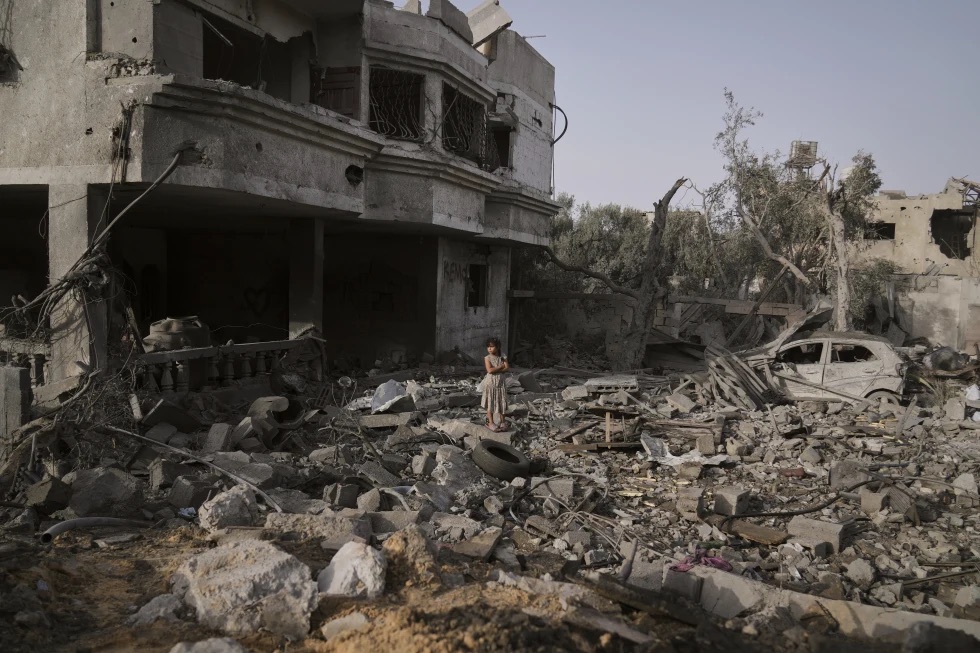
A Palestinian girl stands atop the rubble of the AI-Aimawi family's home that was destroyed by Israeli airstrikes in Al-Zawaideh, Gaza Strip, Tuesday, July 1, 2025.
July 2, 2025
JERUSALEM (AP) — Hamas suggested Wednesday that it was open to a ceasefire agreement with Israel, but stopped short of accepting a Washington-backed proposal announced by U.S. President Donald Trump hours earlier, insisting on its longstanding position that any deal bring an end to the war in Gaza.
Israeli Prime Minister Benjamin Netanyahu, meanwhile, vowed “there will be no Hamas” in postwar Gaza.
Trump said Tuesday that Israel had agreed on terms for a 60-day ceasefire in Gaza and urged Hamas to accept the deal before conditions worsen. The U.S. leader has been increasing pressure on the Israeli government and Hamas to broker a ceasefire, and hostage agreement and bring about an end to the war.
Trump said the 60-day period would be used to work toward ending the war — something Israel says it won’t accept until Hamas is defeated. He said that a deal might come together as soon as next week.
But Hamas’ response, which emphasized its demand that the war end, raised questions about whether the latest offer could materialize into an actual pause in fighting.
Hamas official Taher al-Nunu said that the militant group was “ready and serious regarding reaching an agreement.”
He said Hamas was “ready to accept any initiative that clearly leads to the complete end to the war.”
A Hamas delegation is expected to meet with Egyptian and Qatari mediators in Cairo on Wednesday to discuss the proposal, according to an Egyptian official. The official spoke on condition of anonymity, because he wasn’t authorized to discuss the talks with the media.
Disagreement on how the war should end
Throughout the nearly 21-month-long war, ceasefire talks between Israel and Hamas have repeatedly faltered over whether the war should end as part of any deal.
Hamas said in a brief statement Wednesday that it had received a proposal from the mediators and is holding talks with them to “bridge gaps” to return to the negotiating table to try to reach a ceasefire agreement.
Hamas has said that it’s willing to free the remaining 50 hostages, less than half of whom are said to be alive, in exchange for a complete Israeli withdrawal from Gaza and an end to the war.
Israel says it will only agree to end the war if Hamas surrenders, disarms and exiles itself, something the group refuses to do.
An Israeli official said that the latest proposal calls for a 60-day deal that would include a partial Israeli withdrawal from Gaza and a surge in humanitarian aid to the territory. The mediators and the U.S. would provide assurances about talks to end the war, but Israel isn’t committing to that as part of the latest proposal, the official said.
The official wasn’t authorized to discuss the details of the proposed deal with the media and spoke on condition of anonymity.
It wasn’t clear how many hostages would be freed as part of the agreement, but previous proposals have called for the release of about 10.
Israel has yet to publicly comment on Trump’s announcement. On Monday, Trump is set to host Netanyahu at the White House, days after Ron Dermer, a senior Netanyahu adviser, held discussions with top U.S. officials about Gaza, Iran and other matters.
Trump issues another warning
On Tuesday, Trump wrote on social media that Israel had “agreed to the necessary conditions to finalize the 60 Day CEASEFIRE, during which time we will work with all parties to end the War.”
“I hope, for the good of the Middle East, that Hamas takes this Deal, because it will not get better — IT WILL ONLY GET WORSE,” he said.
Trump’s warning may find a skeptical audience with Hamas. Even before the expiration of the war’s longest ceasefire in March, Trump has repeatedly issued dramatic ultimatums to pressure Hamas to agree to longer pauses in the fighting that would see the release of more hostages and a return of more aid for Gaza’s civilians.
Still, Trump views the current moment as a potential turning point in the brutal conflict that has left more than 57,000 dead in the Palestinian territory.
Gaza’s Health Ministry said the death toll passed the 57,000 mark Tuesday into Wednesday, after hospitals received 142 bodies overnight. The ministry doesn’t differentiate between civilians and combatants in its death count, but says that more than half of the dead are women and children.
Since dawn Wednesday, Israeli strikes killed a total of 40 people across the Gaza Strip, the mMinistry said. Hospital officials said four children and seven women were among the dead.
The Israeli military, which blames Hamas for the civilian casualties because it operates from populated areas, was looking into the reports.
The war began on Oct. 7, 2023, when Hamas-led militants attacked southern Israel, killing 1,200 people and taking roughly 250 hostages.
The war has left the coastal Palestinian territory in ruins, with much of the urban landscape flattened in the fighting. More than 90% of Gaza’s 2.3 million population has been displaced, often multiple times. And the war has sparked a humanitarian crisis in Gaza, pushing hundreds of thousands of people toward hunger.
Hospital director killed
The director of the Indonesian Hospital, Dr. Marwan Sultan, was killed in an apartment in an Israeli strike west of Gaza City, a hospital statement said. The hospital is the Palestinian enclave’s largest medical facility north of Gaza City and has been a critical lifeline since the start of the Israel-Hamas war.
The hospital was surrounded by Israeli troops last month, and evacuated alongside the other two primary hospitals in northern Gaza.
The bodies of Sultan, his wife, daughter and son-in-law, arrived at Shifa Hospital torn into pieces, according to Issam Nabhan, head of the nursing department at the Indonesian Hospital.
“Gaza lost a great man and doctor,” Nabhan said. “He never left the hospital one moment since the war began and urged us to stay and provide humanitarian assistance. We don’t know what he did to deserve getting killed.”
___
Bassem Mroue reported from Beirut. Kareem Chehayeb in Beirut, and Josef Federman in Jerusalem, contributed to this report.
___
Follow the AP’s war coverage at https://apnews.com/hub/israel-hamas-war
No comments:
Post a Comment