'Matter of Life and Death': New Tracker Exposes Trump Regime's Attack on Disaster Preparedness
"It's only a matter of time before Trump and Musk's reckless assault on disaster response and preparedness kills people in the United States," said a researcher with government watchdog The Revolving Door Project.
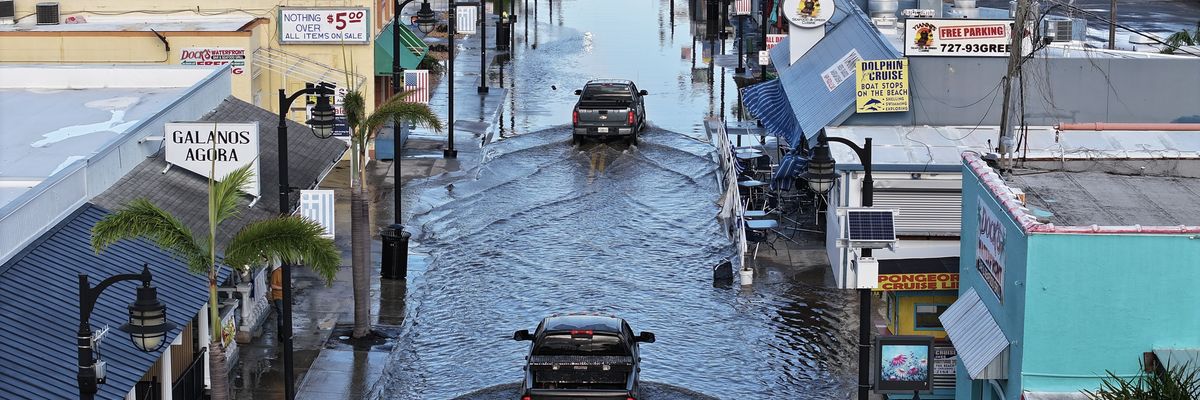
Flood waters inundate the main street after Hurricane Helene passed offshore on September 27, 2024 in Tarpon Springs, Florida. (Photo: Joe Raedle/Getty Images)
Brad Reed
Jul 02, 2025
COMMON DREAMS
President Donald Trump has openly stated his desire to dismantle the Federal Emergency Management Agency—a move that has left some experts fearful about how the United States will handle natural disasters such as hurricanes in the coming months.
The Revolving Door Project, a government watchdog group, has now put together a tracking tool to keep tabs on how much the administration's attacks on both FEMA and the National Oceanic and Atmospheric Administration have worsened the nation's disaster preparedness.
The tool has two components: An interactive map showing all of the state disaster aid requests that the Trump administration has outright denied or only partially approved and an interactive timeline documenting all of the times that the administration has undermined the functionality of America's disaster preparedness agencies through actions such as placing agency employees on administrative leave and disbanding key bodies such as FEMA's National Advisory Council and its National Dam Safety Review Board.
All of these disruptions and cuts, argued Revolving Door Project senior researcher Kenny Stancil, are likely to come back to bite America in a big way when another natural disaster strikes.
"It's only a matter of time before Trump and Musk's reckless assault on disaster response and preparedness kills people in the United States," he said in explaining the need for the initiative. "It nearly happened in mid-May in Kentucky, where a DOGE-damaged NWS forecast office had to scramble for staff before a tornado. Amid last week's heatwave, low-income households across the country were missing the federal support they need to keep the air conditioning on. And when a major hurricane arrives, Trump, Musk, OMB Director Russell Vought, Commerce Secretary Howard Lutnick, and DHS Secretary Kristi Noem will almost certainly have blood on their hands."
Revolving Door Project executive director Jeff Hauser issued a similarly dire warning about the administration's actions on U.S. disaster preparedness and he described the actions being taken by the administration as "a matter of life-and-death." He also accused the administration of "preventing forecasters and emergency managers at all levels from doing what is necessary to prepare for and respond to disasters."
Trump in the past has tried to use federal disaster relief money as a cudgel against his political opponents, such as when he threatened to withhold funding from California during catastrophic wildfires unless the state did a better job of "raking" its forests.
"It's only a matter of time before Trump and Musk's reckless assault on disaster response and preparedness kills people in the United States," said a researcher with government watchdog The Revolving Door Project.
Flood waters inundate the main street after Hurricane Helene passed offshore on September 27, 2024 in Tarpon Springs, Florida. (Photo: Joe Raedle/Getty Images)
Brad Reed
Jul 02, 2025
COMMON DREAMS
President Donald Trump has openly stated his desire to dismantle the Federal Emergency Management Agency—a move that has left some experts fearful about how the United States will handle natural disasters such as hurricanes in the coming months.
The Revolving Door Project, a government watchdog group, has now put together a tracking tool to keep tabs on how much the administration's attacks on both FEMA and the National Oceanic and Atmospheric Administration have worsened the nation's disaster preparedness.
The tool has two components: An interactive map showing all of the state disaster aid requests that the Trump administration has outright denied or only partially approved and an interactive timeline documenting all of the times that the administration has undermined the functionality of America's disaster preparedness agencies through actions such as placing agency employees on administrative leave and disbanding key bodies such as FEMA's National Advisory Council and its National Dam Safety Review Board.
All of these disruptions and cuts, argued Revolving Door Project senior researcher Kenny Stancil, are likely to come back to bite America in a big way when another natural disaster strikes.
"It's only a matter of time before Trump and Musk's reckless assault on disaster response and preparedness kills people in the United States," he said in explaining the need for the initiative. "It nearly happened in mid-May in Kentucky, where a DOGE-damaged NWS forecast office had to scramble for staff before a tornado. Amid last week's heatwave, low-income households across the country were missing the federal support they need to keep the air conditioning on. And when a major hurricane arrives, Trump, Musk, OMB Director Russell Vought, Commerce Secretary Howard Lutnick, and DHS Secretary Kristi Noem will almost certainly have blood on their hands."
Revolving Door Project executive director Jeff Hauser issued a similarly dire warning about the administration's actions on U.S. disaster preparedness and he described the actions being taken by the administration as "a matter of life-and-death." He also accused the administration of "preventing forecasters and emergency managers at all levels from doing what is necessary to prepare for and respond to disasters."
Trump in the past has tried to use federal disaster relief money as a cudgel against his political opponents, such as when he threatened to withhold funding from California during catastrophic wildfires unless the state did a better job of "raking" its forests.
Sarah K. Burris
June 26, 2025
RAW STORY
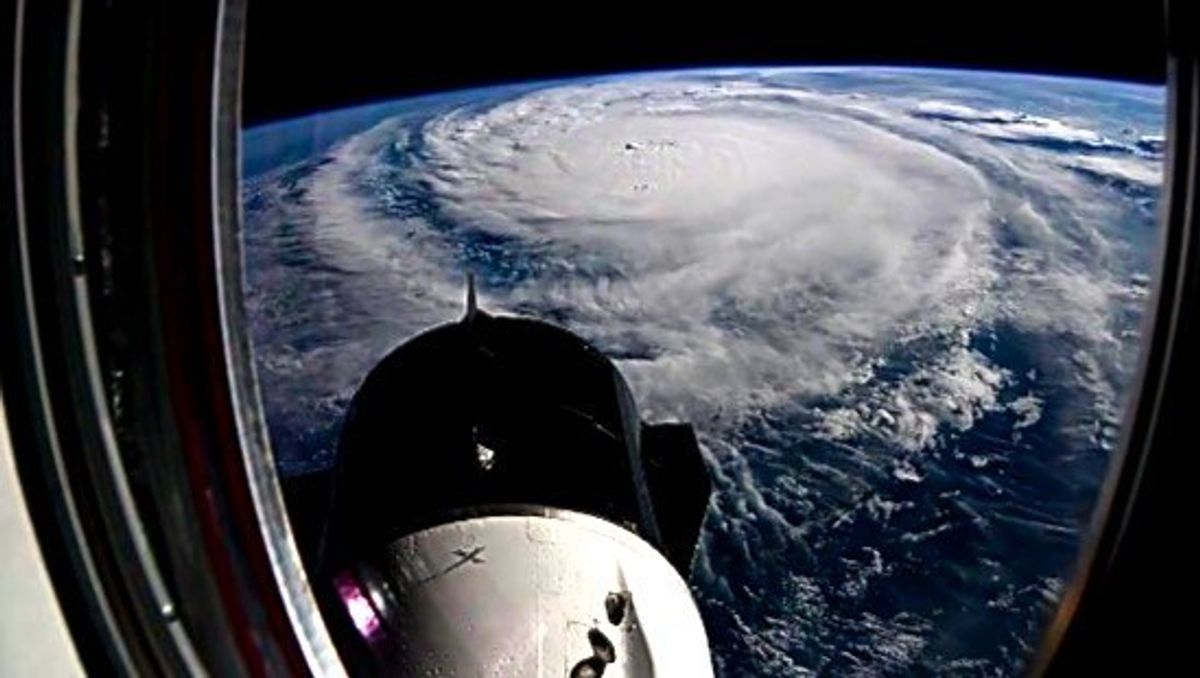
Hurricane Milton as seen from the International Space Station (Screen cap via NASA)
Hurricane and storm surge expert Michael Lowry penned a column on Thursday, warning of a recent decision by President Donald Trump's administration to kill three weather satellites just as hurricane season is ramping up.
He wrote that on Monday, the U.S. Department of Defense announced it would "stop ingesting, processing, and transmitting data essential to most hurricane forecasts."
By Tuesday, the National Oceanic and Atmospheric Administration (NOAA) confirmed the news in a "a service change notice to all users," which included those monitoring the Atlantic's skies at the Hurricane Center.
"By next Monday, June 30th, they would no longer receive real-time microwave data collected aboard three weather satellites jointly run by NOAA and the U.S. Department of Defense," wrote Lowry.
The Atlantic's hurricane season begins June 1, but this week was the first time a named storm popped up in the ocean. Lowry noted on X that the accumulated cyclone energy (ACE) was extremely low and it dissipated by Wednesday. Being able to chart that information in the future might be more difficult without access to the data gathered by the three satellites. Those three provide about half of all forecasters with scans needed to track and predict hurricanes.
The specific information gathered comes from the Special Sensor Microwave Imager Sounder (SSMIS), wrote Lowry. The loss of information runs the risk of forecasters missing an increase in hurricane severity when the sun comes up.
"Since hurricanes form and strengthen over the open water where direct observations are scarce or nonexistent, forecasters rely largely on data remotely gathered from satellites," explained Lowry. "While hurricane hunting airplanes help to close that gap, they’re only available for about 1 in every 3 hurricane forecasts in the Atlantic and virtually none – except for a handful of stronger storm exceptions – in the Pacific.
Traditional satellites lack the capability for forecasters to look beneath the clouds and access the key data necessary to make accurate predictions. Lowry described it as similar to an MRI scan for the storm. Sometimes an X-ray or physical exam is fine, while other injuries or diseases require more information.
Retired National Hurricane Center branch chief James Franklin, told Lowry, “Their loss is a big deal."
Until his retirement in 2017, Franklin oversaw all of the hurricane forecasters in the NHC/
“Without this imagery, there will be increased risk of a ‘sunrise surprise,’ the realization from first-light images that a system had become much better organized overnight, but it wasn’t recognized because structural details are so hard to discern from [infrared satellite]," he said.
At the start of hurricane season earlier this month, Miami meteorologist John Morales showed a clip of a 2019 storm where he assured those on the east coast of Florida that the hurricane would turn. Given the budget cuts at NOAA and the NHC, Morales warned his audience that he would not have enough information to be certain.
"I'm here to tell you I'm not sure I can do that this year. Because of the cuts — the gutting, the sledgehammer attack on science, in general, and I could talk about that for a long, long time and how that's affecting the leadership and science over the years and how we're losing that leadership, and that is a multi-generation impact on science in this country," he said.
This year, more meteorologists will be forced to tell their audiences that, due to budget cuts, they have a lack of certainty. Information like that helps people decide whether or not they should flee the area.
Those at the National Hurricane Center are now preparing to suddenly handle the next few months without the critical forecast data they need for predictions. Now, Lowry wrote, the weather and climate community is "scrambling to understand the rationale behind the abrupt termination." No one seems clear on why the real-time data would be cut.
All of the states along the Gulf Coast and the Southeast Coast are states that supported Donald Trump in the 2024 presidential election. They will now be the states most impacted by the budget cuts, according to experts.
Read Lowry's full column on his Substack here.
Hurricane Milton as seen from the International Space Station (Screen cap via NASA)
Hurricane and storm surge expert Michael Lowry penned a column on Thursday, warning of a recent decision by President Donald Trump's administration to kill three weather satellites just as hurricane season is ramping up.
He wrote that on Monday, the U.S. Department of Defense announced it would "stop ingesting, processing, and transmitting data essential to most hurricane forecasts."
By Tuesday, the National Oceanic and Atmospheric Administration (NOAA) confirmed the news in a "a service change notice to all users," which included those monitoring the Atlantic's skies at the Hurricane Center.
"By next Monday, June 30th, they would no longer receive real-time microwave data collected aboard three weather satellites jointly run by NOAA and the U.S. Department of Defense," wrote Lowry.
The Atlantic's hurricane season begins June 1, but this week was the first time a named storm popped up in the ocean. Lowry noted on X that the accumulated cyclone energy (ACE) was extremely low and it dissipated by Wednesday. Being able to chart that information in the future might be more difficult without access to the data gathered by the three satellites. Those three provide about half of all forecasters with scans needed to track and predict hurricanes.
The specific information gathered comes from the Special Sensor Microwave Imager Sounder (SSMIS), wrote Lowry. The loss of information runs the risk of forecasters missing an increase in hurricane severity when the sun comes up.
"Since hurricanes form and strengthen over the open water where direct observations are scarce or nonexistent, forecasters rely largely on data remotely gathered from satellites," explained Lowry. "While hurricane hunting airplanes help to close that gap, they’re only available for about 1 in every 3 hurricane forecasts in the Atlantic and virtually none – except for a handful of stronger storm exceptions – in the Pacific.
Traditional satellites lack the capability for forecasters to look beneath the clouds and access the key data necessary to make accurate predictions. Lowry described it as similar to an MRI scan for the storm. Sometimes an X-ray or physical exam is fine, while other injuries or diseases require more information.
Retired National Hurricane Center branch chief James Franklin, told Lowry, “Their loss is a big deal."
Until his retirement in 2017, Franklin oversaw all of the hurricane forecasters in the NHC/
“Without this imagery, there will be increased risk of a ‘sunrise surprise,’ the realization from first-light images that a system had become much better organized overnight, but it wasn’t recognized because structural details are so hard to discern from [infrared satellite]," he said.
At the start of hurricane season earlier this month, Miami meteorologist John Morales showed a clip of a 2019 storm where he assured those on the east coast of Florida that the hurricane would turn. Given the budget cuts at NOAA and the NHC, Morales warned his audience that he would not have enough information to be certain.
"I'm here to tell you I'm not sure I can do that this year. Because of the cuts — the gutting, the sledgehammer attack on science, in general, and I could talk about that for a long, long time and how that's affecting the leadership and science over the years and how we're losing that leadership, and that is a multi-generation impact on science in this country," he said.
This year, more meteorologists will be forced to tell their audiences that, due to budget cuts, they have a lack of certainty. Information like that helps people decide whether or not they should flee the area.
Those at the National Hurricane Center are now preparing to suddenly handle the next few months without the critical forecast data they need for predictions. Now, Lowry wrote, the weather and climate community is "scrambling to understand the rationale behind the abrupt termination." No one seems clear on why the real-time data would be cut.
All of the states along the Gulf Coast and the Southeast Coast are states that supported Donald Trump in the 2024 presidential election. They will now be the states most impacted by the budget cuts, according to experts.
Read Lowry's full column on his Substack here.
No comments:
Post a Comment