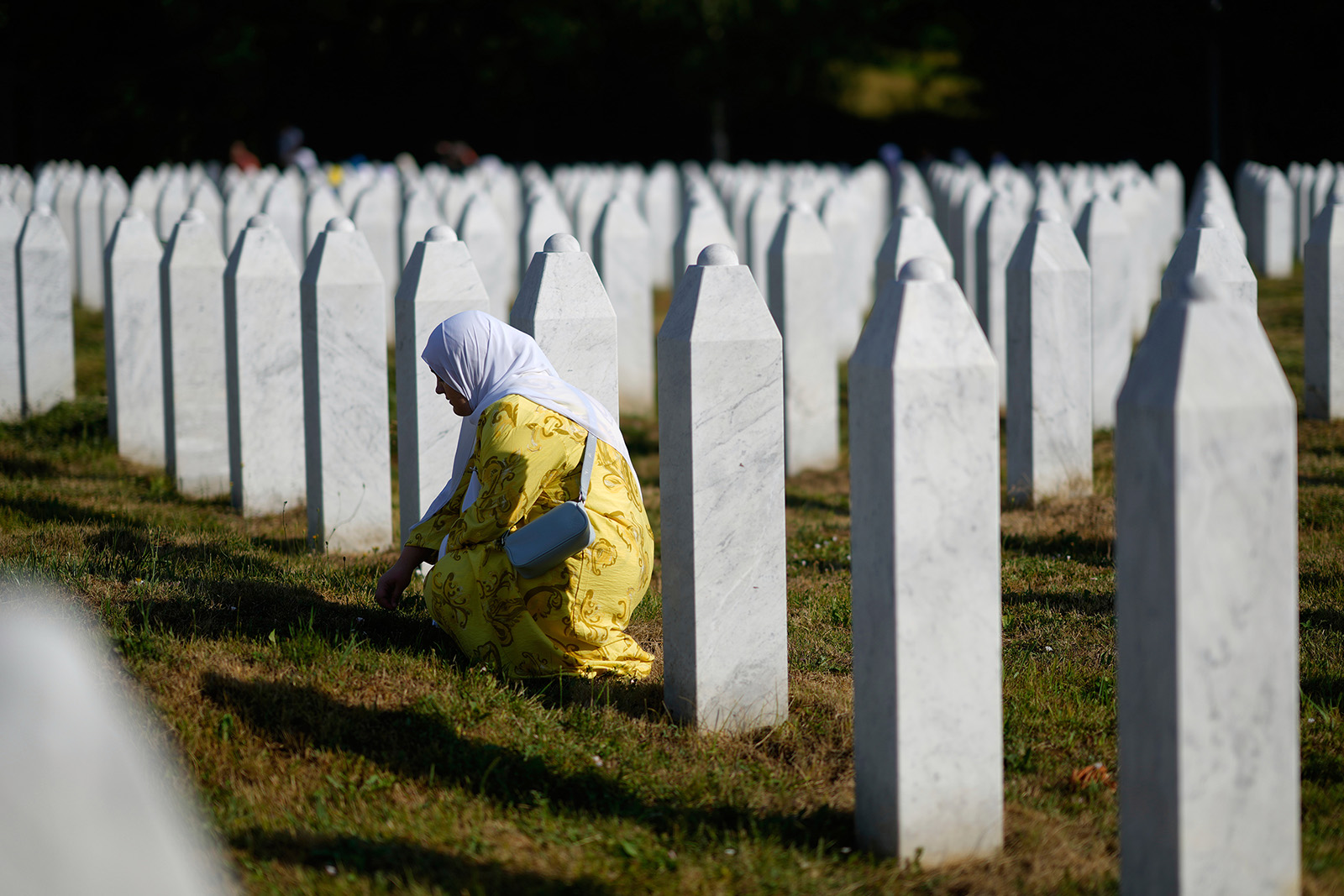
(RNS) — Standing in Srebrenica, 30 years after the genocide, you can feel the haunting presence of unburied grief. It comes not just from the memory of those 8,000 Muslim men and boys who died at the hands of the Bosnian Serb army, or the seven newly recovered bodies, whose bones I had come to help finally put to rest after decades hidden beneath Bosnian soil. As a devastating mass killing continues to unfold in Gaza, the memory of those slaughtered men and children in Srebrenica becomes profoundly more painful.
At the memorial for the seven, I listened to mothers and widows retell their stories with fresh agony. At the remembrance museum in Srebrenica, the cries of the victims coming from the video screens echoed, timeless and harrowing, as men begged for their lives, only to be mercilessly silenced.
RELATED: Thousands gather in Srebrenica on 30th anniversary of Europe’s only acknowledged genocide since WWII
It is an eerie and gut-wrenching experience, demanding we face the essential question: What does “Never again” truly mean?
Today, as ever, we confront that chilling paradox. The screens that bring us cries from Gaza echo those from Srebrenica. Videos flood social media platforms, capturing Israeli soldiers engaged in activities frighteningly reminiscent of what the Serbs termed “sniper safaris.” Soldiers mock their victims, filming death and humiliation, boastfully sharing brutality as entertainment, mass-produced horrors made all the more disturbing as they go viral.
At the memorial in Bosnia, European dignitaries, one after another, proclaimed the solemn promise: “Never again.” They rightfully bemoaned the holocaust of the past and expressed solidarity with Ukraine. Yet a glaring omission lingered heavily in the air — until Munira Subasic, of the Mothers of Srebrenica, shattered hypocritical silence that so many Bosnians present were feeling sickened by. With the righteous indignation only a grieving mother can summon, she asked pointedly: How can you speak of “Never again” while funding, directly or indirectly, the ongoing genocide in Gaza?
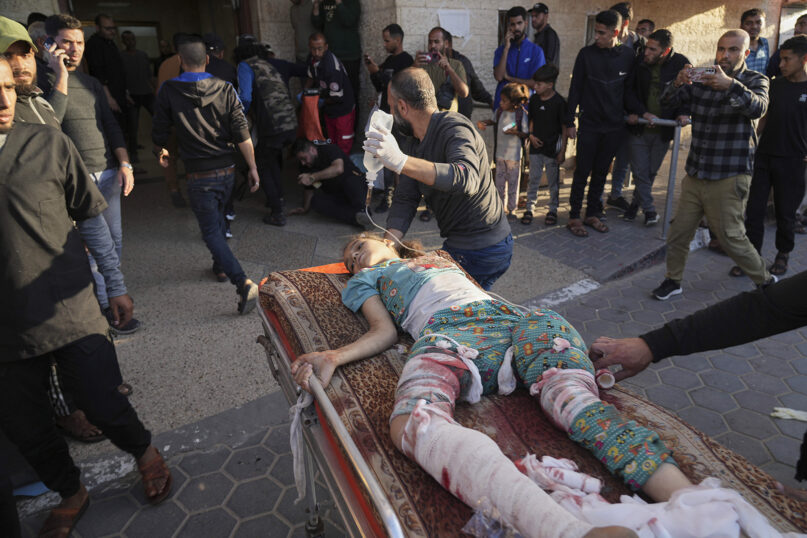
A Palestinian girl wounded in an Israeli airstrike on a school in Bureij refugee camp is brought to Al-Aqsa Martyrs Hospital in Deir al Balah, central Gaza Strip, on May 6, 2025. (AP Photo/Abdel Kareem Hana)
Munira reminded us profoundly that the pain of mothers transcends politics. Politicians may maneuver, posture, strategically omit uncomfortable truths; human beings must uphold humanity itself.
“Never again” is meaningless unless we confront and condemn genocide universally and unequivocally in Bosnia, Gaza and everywhere else that human life is threatened by mass violence. After she spoke, many Bosnians wearing garments bearing the Palestinian flag or the kaffiyeh came to me with tears in their eyes and apologized that it took so long for the pain to be named. That these ordinary people were different from the politicians. I already knew. I responded by saying that I was there for them, not the politicians.
My conversations in Bosnia highlighted the tragic abandonment felt by the survivors before the genocide started. Many lamented the delayed international recognition of their suffering, wishing the world had paid attention sooner. Their reflections mirror the sentiments I’ve repeatedly heard from Palestinians who have pleaded for recognition of the apartheid they faced before the full-scale genocide erupted in Gaza in 2023. Their genocide, too, has followed decades of occupation, widely documented but ignored by the international powers meant to intervene.
RELATED: A loud death: Remembering Gaza photojournalist Fatma Hassona
The survivors of Bosnia, like Palestinians today, understand intimately the cost of global indifference. They carry scars, both visible and invisible, and the testimonies of international failures that they must live with for the rest of their lives.
Bosnia and Gaza, separated geographically but linked indelibly by shared suffering, teach us this critical lesson. The rhetoric of “Never again” is meaningless if it’s just reserved for late memorial ceremonies and performative speeches, caring too late and too little. “Never again” demands that humanity actively resist oppression wherever it appears and act courageously in defense of human dignity. Anything less makes us complicit in cycles of horror that history tragically repeats.
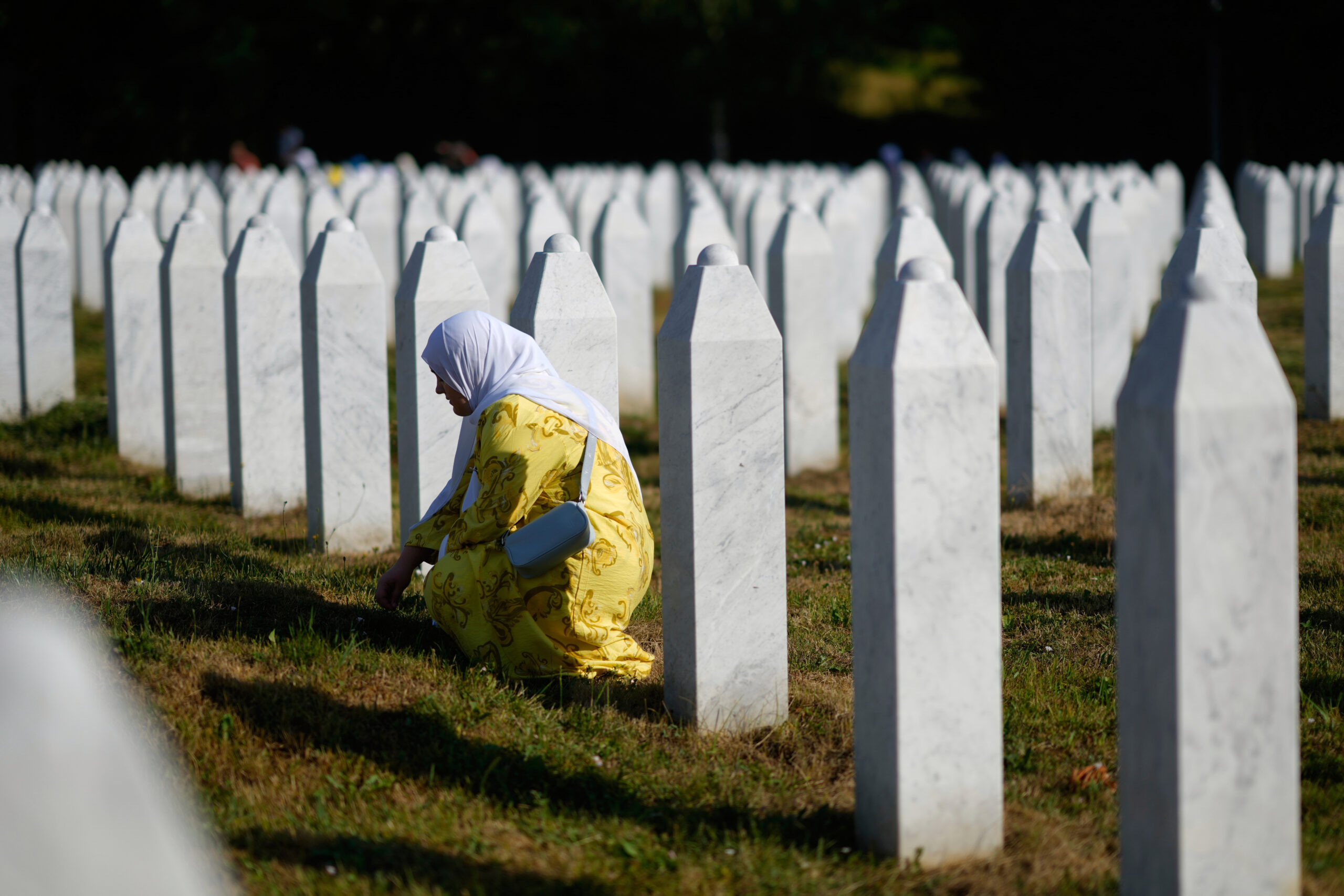
SREBRENICA, Bosnia-Herzegovina (AP) — Thousands of people from Bosnia and around the world gathered in Srebrenica to mark the 30th anniversary of a massacre there of more than 8,000 Bosniak Muslim boys and men — an atrocity that has been acknowledged as Europe’s only genocide after the Holocaust.
Seven newly identified victims of the 1995 massacre, including two 19-year-old men, were laid to rest in a collective funeral at a vast cemetery near Srebrenica Friday, next to more than 6,000 victims already buried there. Such funerals are held annually for the victims who are still being unearthed from dozens of mass graves around the town.
Relatives of the victims, however, often can bury only partial remains of their loved ones as they are typically found in several different mass graves, sometimes kilometers (miles) apart. Such was the case of Mirzeta Karic, who was waiting to bury her father.
“Thirty years of search and we are burying a bone,” she said, crying by her father’s coffin which was wrapped in green cloth in accordance with Islamic tradition.
“I think it would be easier if I could bury all of him. What can I tell you, my father is one of the 50 (killed) from my entire family,” she added.
July 11, 1995, is the day when the killings started after Bosnian Serb fighters overran the eastern Bosnian enclave in the final months of the interethnic war in the Balkan country.
After taking control of the town that was a protected U.N. safe zone during the war, Bosnian Serb fighters separated Bosniak Muslim men and boys from their families and brutally executed them in just several days. The bodies were then dumped in mass graves around Srebrenica which they later dug up with bulldozers, scattering the remains among other burial sites to hide the evidence of their war crimes.
The U.N. General Assembly last year adopted a resolution to commemorate the Srebrenica genocide on the July 11 anniversary.
Scores of international officials and dignitaries attended the commemoration ceremonies and the funeral. Among them were European Council President Antonio Costa and Britain’s Duchess of Edinburgh, Sophie, who said that “our duty must be to remember all those lost so tragically and to never let these things happen again.”
Dutch Foreign Minister Caspar Veldkamp said he felt “humbled” because U.N. troops from the Netherlands were based in Srebrenica when Bosnian Serbs stormed the town.
“I see to what extent commemorating Srebrenica genocide is important,” he said.
In an emotional speech, Munira Subasic, who heads the Mothers of Srebrenica association, urged Europe and the world to “help us fight against hatred, against injustice and against killings.”
Subasic, who lost her husband and youngest son in Srebrenica along with more than 20 relatives, told Europe to “wake up.”
“As I stand here many mothers in Ukraine and Palestine are going through what we went through in 1995,” Subasic said, referring to ongoing conflicts. “It’s the 21st century but instead of justice, fascism has woken up.”
On the eve of the anniversary, an exhibition was inaugurated displaying personal items belonging to the victims that were found in the mass graves over the years.
The conflict in Bosnia erupted in 1992, when Bosnian Serbs took up arms in a rebellion against the country’s independence from the former Yugoslavia and with an aim to create their own state and eventually unite with neighboring Serbia. More than 100,000 people were killed and millions displaced before a U.S.-brokered peace agreement was reached in 1995.
Bosnia remains ethnically split while both Bosnian Serbs and neighboring Serbia refuse to acknowledge that the massacre in Srebrenica was a genocide despite rulings by two U.N. courts. Bosnian Serb political and military leaders Radovan Karadzic and Ratko Mladic, along with many others, were convicted and sentenced for genocide.
Serbia’s populist President Aleksandar Vucic expressed condolences on X while calling the Srebrenica massacre a “terrible crime.”
“There is no room in Europe — or anywhere else — for genocide denial, revisionism, or the glorification of those responsible,” European Council President Costa said in his speech. “Denying such horrors only poisons our future.”
No comments:
Post a Comment