
A Palestinian boy inspects the site of an Israeli strike that killed Palestinians, gathered to collect water from a distribution point, according to medics, in Nuseirat in the central Gaza Strip July 13, 2025.
PHOTO: Reuters
July 13, 2025
JERUSALEM — At least eight Palestinians, most of them children, were killed and more than a dozen were wounded in central Gaza when they went to collect water on Sunday (July 13), local officials said, in an Israeli strike which the military said missed its target.
The Israeli military said the missile had intended to hit an Islamic Jihad militant in the area but that a malfunction had caused it to fall "dozens of metres from the target".
"The IDF regrets any harm to uninvolved civilians," it said in a statement, adding that the incident was under review.
The strike hit a water distribution point in Nuseirat refugee camp, killing six children and injuring 17 others, said Ahmed Abu Saifan, an emergency physician at Al-Awda Hospital.
Water shortages in Gaza have worsened sharply in recent weeks, with fuel shortages causing desalination and sanitation facilities to close, making people dependant on collection centres where they can fill up their plastic containers.

A Palestinian inspects the site of an overnight Israeli strike on a house, in Gaza City July 13, 2025.
PHOTO: Reuters
Hours later, 12 people were killed by an Israeli strike on a market in Gaza City, including a prominent hospital consultant, Ahmad Qandil, Palestinian media reported. The Israeli military did not immediately comment on the attack.
Gaza's health ministry said on Sunday that more than 58,000 people had been killed since the start of the war between Israel and Hamas in October 2023, with 139 people added to the death toll over the past 24 hours.
The ministry does not distinguish between civilians and fighters in its tally, but says over half of those killed are women and children.
Ceasefire?
US President Donald Trump's Middle East envoy Steve Witkoff said on Sunday that he was "hopeful" on Gaza ceasefire negotiations underway in Qatar.
He told reporters in Teterboro, New Jersey, that he planned to meet senior Qatari officials on the sidelines of the FIFA Club World Cup final.
However, negotiations aimed at securing a ceasefire have been stalling, with the two sides divided over the extent of an eventual Israeli withdrawal from the Palestinian enclave, Palestinian and Israeli sources said at the weekend.
Israeli Prime Minister Benjamin Netanyahu was set to convene ministers late on Sunday to discuss the latest developments in the talks, an Israeli official said.
The indirect talks over a US proposal for a 60-day ceasefire are being held in Doha, but optimism that surfaced last week of a looming deal has largely faded, with both sides accusing each other of intransigence.
Netanyahu in a video he posted on Telegram on Sunday said Israel would not back down from its core demands — releasing all the hostages still in Gaza, destroying Hamas and ensuring Gaza will never again be a threat to Israel.
The war began on Oct 7, 2023, when Hamas-led militants stormed into Israel, killing about 1,200 people and taking 251 hostages into Gaza. At least 20 of the remaining 50 hostages there are believed to still be alive.
Families of hostages gathered outside Netanyahu's office in Jerusalem to call for a deal.
PHOTO: Reuters
Hours later, 12 people were killed by an Israeli strike on a market in Gaza City, including a prominent hospital consultant, Ahmad Qandil, Palestinian media reported. The Israeli military did not immediately comment on the attack.
Gaza's health ministry said on Sunday that more than 58,000 people had been killed since the start of the war between Israel and Hamas in October 2023, with 139 people added to the death toll over the past 24 hours.
The ministry does not distinguish between civilians and fighters in its tally, but says over half of those killed are women and children.
Ceasefire?
US President Donald Trump's Middle East envoy Steve Witkoff said on Sunday that he was "hopeful" on Gaza ceasefire negotiations underway in Qatar.
He told reporters in Teterboro, New Jersey, that he planned to meet senior Qatari officials on the sidelines of the FIFA Club World Cup final.
However, negotiations aimed at securing a ceasefire have been stalling, with the two sides divided over the extent of an eventual Israeli withdrawal from the Palestinian enclave, Palestinian and Israeli sources said at the weekend.
Israeli Prime Minister Benjamin Netanyahu was set to convene ministers late on Sunday to discuss the latest developments in the talks, an Israeli official said.
The indirect talks over a US proposal for a 60-day ceasefire are being held in Doha, but optimism that surfaced last week of a looming deal has largely faded, with both sides accusing each other of intransigence.
Netanyahu in a video he posted on Telegram on Sunday said Israel would not back down from its core demands — releasing all the hostages still in Gaza, destroying Hamas and ensuring Gaza will never again be a threat to Israel.
The war began on Oct 7, 2023, when Hamas-led militants stormed into Israel, killing about 1,200 people and taking 251 hostages into Gaza. At least 20 of the remaining 50 hostages there are believed to still be alive.
Families of hostages gathered outside Netanyahu's office in Jerusalem to call for a deal.

An Israeli APC manoeuvres in Gaza, near the Israel-Gaza border, July 13, 2025.
PHOTO: Reuters
"The overwhelming majority of the people of Israel have spoken loudly and clearly. We want to do a deal, even at the cost of ending this war, and we want to do it now," said Jon Polin, whose son Hersh Goldberg-Polin was held hostage by Hamas in a Gaza tunnel and slain by his captors in August 2024.
Netanyahu and his ministers were also set to discuss a plan on Sunday to move hundreds of thousands of Gazans to the southern area of Rafah, in what Israeli Defence Minister Israel Katz has described as a new "humanitarian city" but which would be likely to draw international criticism for forced displacement.
An Israeli source briefed on discussions in Israel said that the plan was to establish the complex in Rafah during the ceasefire, if it is reached.
On Saturday, a Palestinian source familiar with the truce talks said that Hamas rejected withdrawal maps which Israel proposed, because they would leave around 40 per cent of the territory under Israeli control, including all of Rafah.
Israel's campaign against Hamas has displaced almost the entire population of more than two million people, but Gazans say nowhere is safe in the coastal enclave.
Early on Sunday morning, a missile hit a house in Gaza City where a family had moved after receiving an evacuation order from their home in the southern outskirts.
"My aunt, her husband and the children, are gone. What is the fault of the children who died in an ugly bloody massacre at dawn?" said Anas Matar, standing in the rubble of the building.
"The overwhelming majority of the people of Israel have spoken loudly and clearly. We want to do a deal, even at the cost of ending this war, and we want to do it now," said Jon Polin, whose son Hersh Goldberg-Polin was held hostage by Hamas in a Gaza tunnel and slain by his captors in August 2024.
Netanyahu and his ministers were also set to discuss a plan on Sunday to move hundreds of thousands of Gazans to the southern area of Rafah, in what Israeli Defence Minister Israel Katz has described as a new "humanitarian city" but which would be likely to draw international criticism for forced displacement.
An Israeli source briefed on discussions in Israel said that the plan was to establish the complex in Rafah during the ceasefire, if it is reached.
On Saturday, a Palestinian source familiar with the truce talks said that Hamas rejected withdrawal maps which Israel proposed, because they would leave around 40 per cent of the territory under Israeli control, including all of Rafah.
Israel's campaign against Hamas has displaced almost the entire population of more than two million people, but Gazans say nowhere is safe in the coastal enclave.
Early on Sunday morning, a missile hit a house in Gaza City where a family had moved after receiving an evacuation order from their home in the southern outskirts.
"My aunt, her husband and the children, are gone. What is the fault of the children who died in an ugly bloody massacre at dawn?" said Anas Matar, standing in the rubble of the building.
Occupation commits systematic massacres against civilians by targeting water filling points
Published: 14 Jul 2025 - THE PENINSULA - QNA

Boys stand near a destroyed mobile water cistern that was hit by Israeli bombardment in the Nuseirat camp for Palestinian refugees in the central Gaza Strip on July 14, 2025. (Photo by Eyad BABA / AFP)
Gaza: The Government Media Office in Gaza emphasized that the Israeli occupation forces are waging a systematic war of deprivation, committing 112 massacres against water-filling queues, resulting in the deaths of hundreds of Palestinians, the majority of whom were children, since Oct. 7, 2023.
In a statement on Monday, the office indicated that the most recent of these massacres occurred in the new camp, northwest of the Nuseirat camp in the central Gaza Strip, and resulted in the death of 12 civilians, including 8 children.
It noted that the Israeli occupation continued to wage a systematic and deliberate war of starvation against the Palestinian people in the Gaza Strip, in flagrant violation of all international and humanitarian conventions.
The office added that the occupation deliberately destroyed 720 water wells and put them out of service, depriving more than a million and a quarter people of access to clean water.
It pointed out that the occupation prevented the entry of 12 million liters of fuel per month, which is the amount necessary to operate the minimum number of water wells, sewage stations, waste collection mechanisms, and other vital sectors.
The office urged the international community, and all UN, international, and global human rights and legal institutions, to take urgent action to halt the war on water immediately, ensure unhindered access to water for civilians, and pressure the occupation to allow the entry of fuel and equipment necessary to operate water wells and sewage treatment plants.
It also stressed the need for an urgent international investigation into the crime of depriving civilians of water, as it is part of the ongoing genocide against civilians in the Gaza Strip.
It also stressed the need to hold the occupation accountable before international courts for its crimes against defenseless civilians, and to bring its criminal leaders to justice.
Published: 14 Jul 2025 - THE PENINSULA - QNA
Boys stand near a destroyed mobile water cistern that was hit by Israeli bombardment in the Nuseirat camp for Palestinian refugees in the central Gaza Strip on July 14, 2025. (Photo by Eyad BABA / AFP)
Gaza: The Government Media Office in Gaza emphasized that the Israeli occupation forces are waging a systematic war of deprivation, committing 112 massacres against water-filling queues, resulting in the deaths of hundreds of Palestinians, the majority of whom were children, since Oct. 7, 2023.
In a statement on Monday, the office indicated that the most recent of these massacres occurred in the new camp, northwest of the Nuseirat camp in the central Gaza Strip, and resulted in the death of 12 civilians, including 8 children.
It noted that the Israeli occupation continued to wage a systematic and deliberate war of starvation against the Palestinian people in the Gaza Strip, in flagrant violation of all international and humanitarian conventions.
The office added that the occupation deliberately destroyed 720 water wells and put them out of service, depriving more than a million and a quarter people of access to clean water.
It pointed out that the occupation prevented the entry of 12 million liters of fuel per month, which is the amount necessary to operate the minimum number of water wells, sewage stations, waste collection mechanisms, and other vital sectors.
The office urged the international community, and all UN, international, and global human rights and legal institutions, to take urgent action to halt the war on water immediately, ensure unhindered access to water for civilians, and pressure the occupation to allow the entry of fuel and equipment necessary to operate water wells and sewage treatment plants.
It also stressed the need for an urgent international investigation into the crime of depriving civilians of water, as it is part of the ongoing genocide against civilians in the Gaza Strip.
It also stressed the need to hold the occupation accountable before international courts for its crimes against defenseless civilians, and to bring its criminal leaders to justice.
Children among 700 Palestinians killed waiting to get water in Gaza
Last updated: July 14, 2025 |
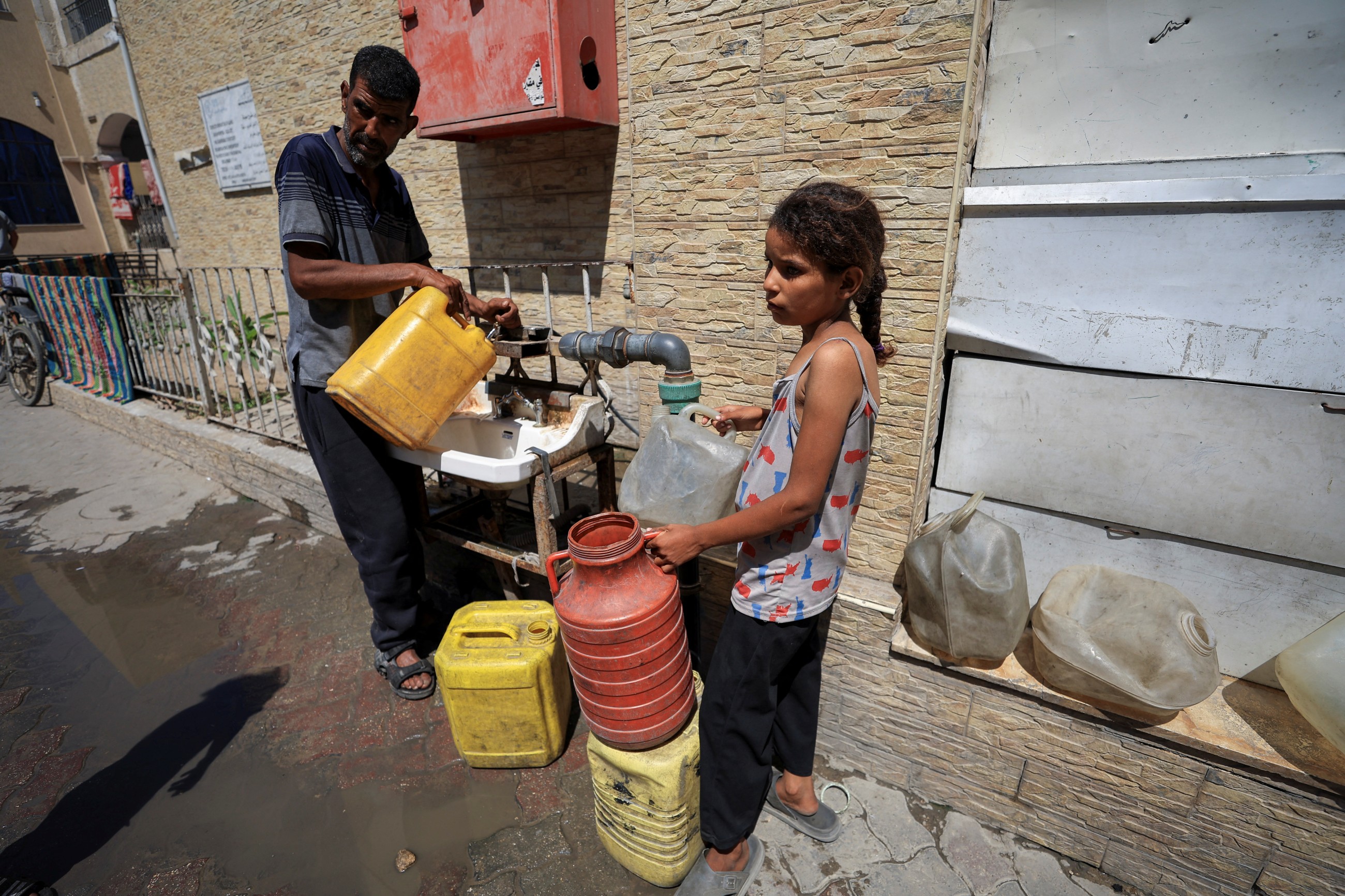
Displaced Palestinian man Akram Al Manasra collects water with his daughter amid shortages in Gaza City on Monday. Reuters
The government media office in Gaza says attacks on people waiting in line for water have killed more than 700 Palestinians as part of a “systematic thirst war,” a media outlet reported on Monday.
The Israeli army has targeted 112 freshwater filling points and destroyed 720 water wells, putting them out of service. This has deprived more than 1.25 million people of access to clean water, the office said in a statement.
“We affirm that this racist policy constitutes a full-fledged war crime under the Geneva Conventions, and a grave violation of international humanitarian law and human rights law.”
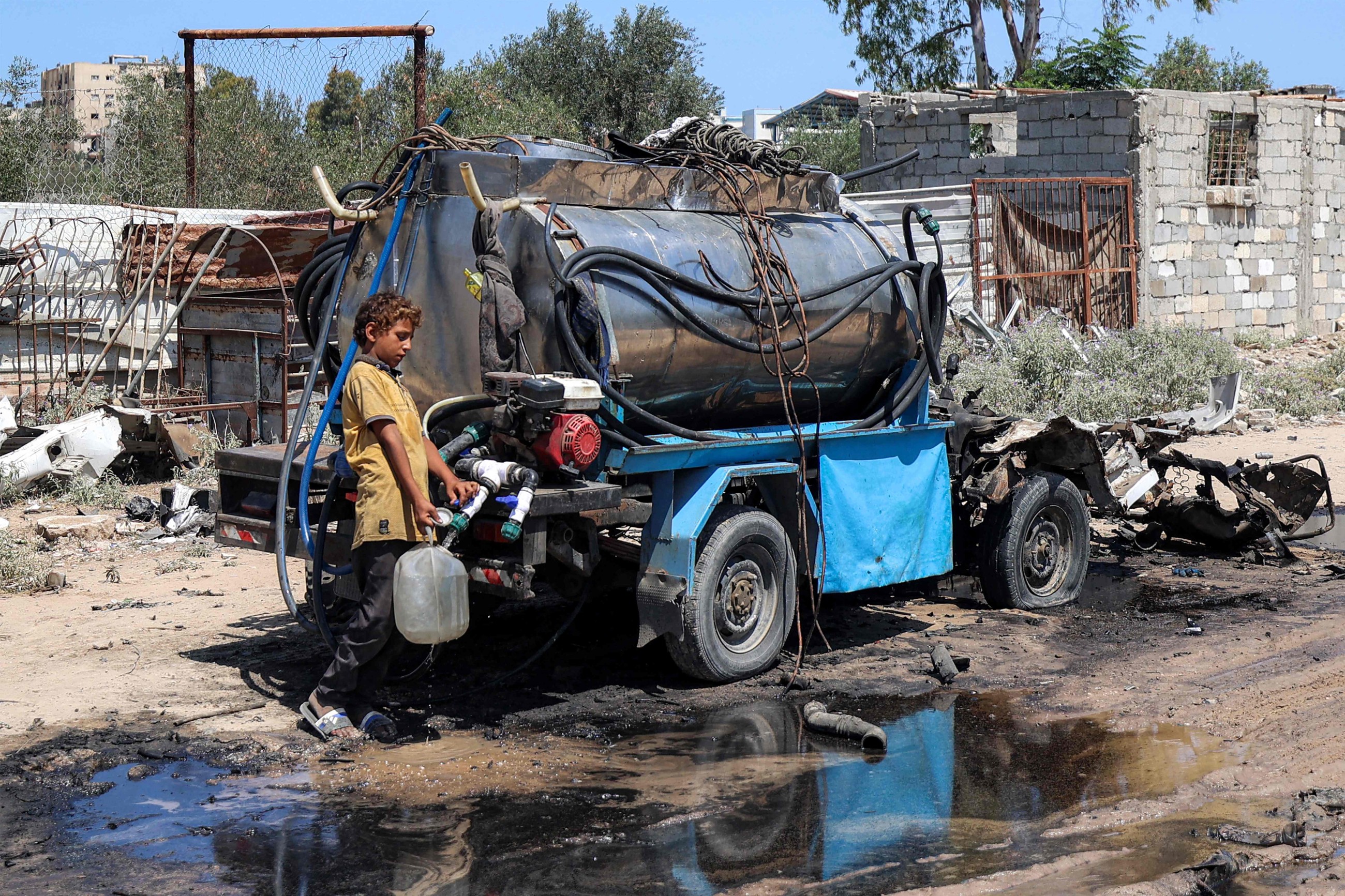
A boy draws water into a jerrycan from the tank of a destroyed mobile water cistern that was hit by Israeli bombardment in the Nuseirat camp. AFP
The office said Israel has prevented the entry of 12 million litres of fuel monthly, the amount necessary to operate the minimum number of water wells, sewage treatment plants, garbage collection vehicles and other vital services. This ban has “caused near-total paralysis of water and sewage networks and worsened the spread of diseases, especially among children,” the office said.
Gazans' daily struggle for water after deadly strike
The Al Manasra family rarely get enough water for both drinking and washing after their daily trudge to a Gaza distribution point like the one where eight people were killed on Sunday in a strike that Israel's military said had missed its target.
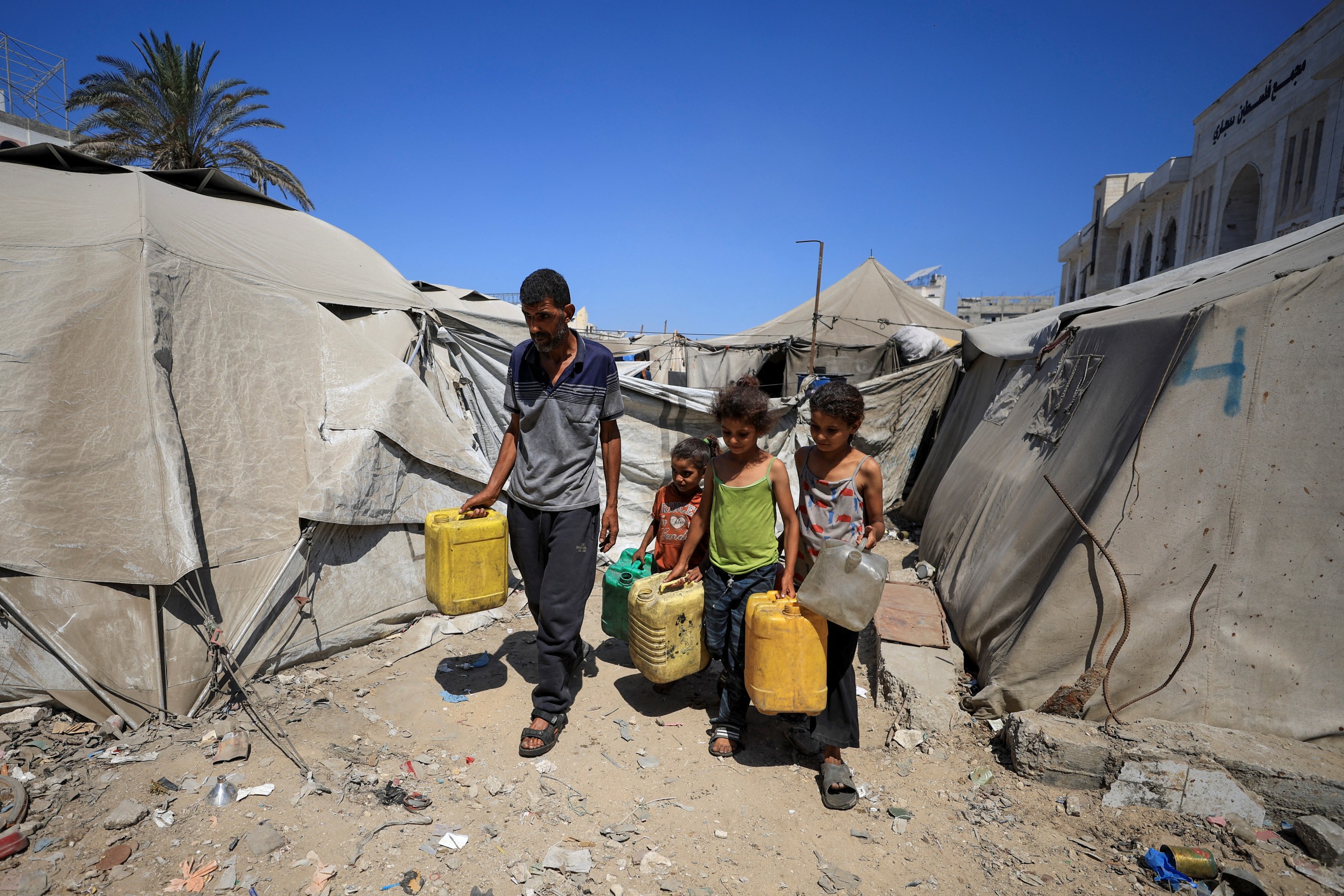
Displaced Palestinian man Akram Al Manasra and his children make their way to collect water from a distribution point amid shortages in Gaza City on Monday. Reuters
Living in a tent camp by the ruins of a smashed concrete building in Gaza City, the family say their children are already suffering from diarrhoea and skin maladies and from the lack of clean water, and they fear worse to come.
"There's no water, our children have been infected with scabies, there are no hospitals to go to and no medications," said Akram Manasra, 51.
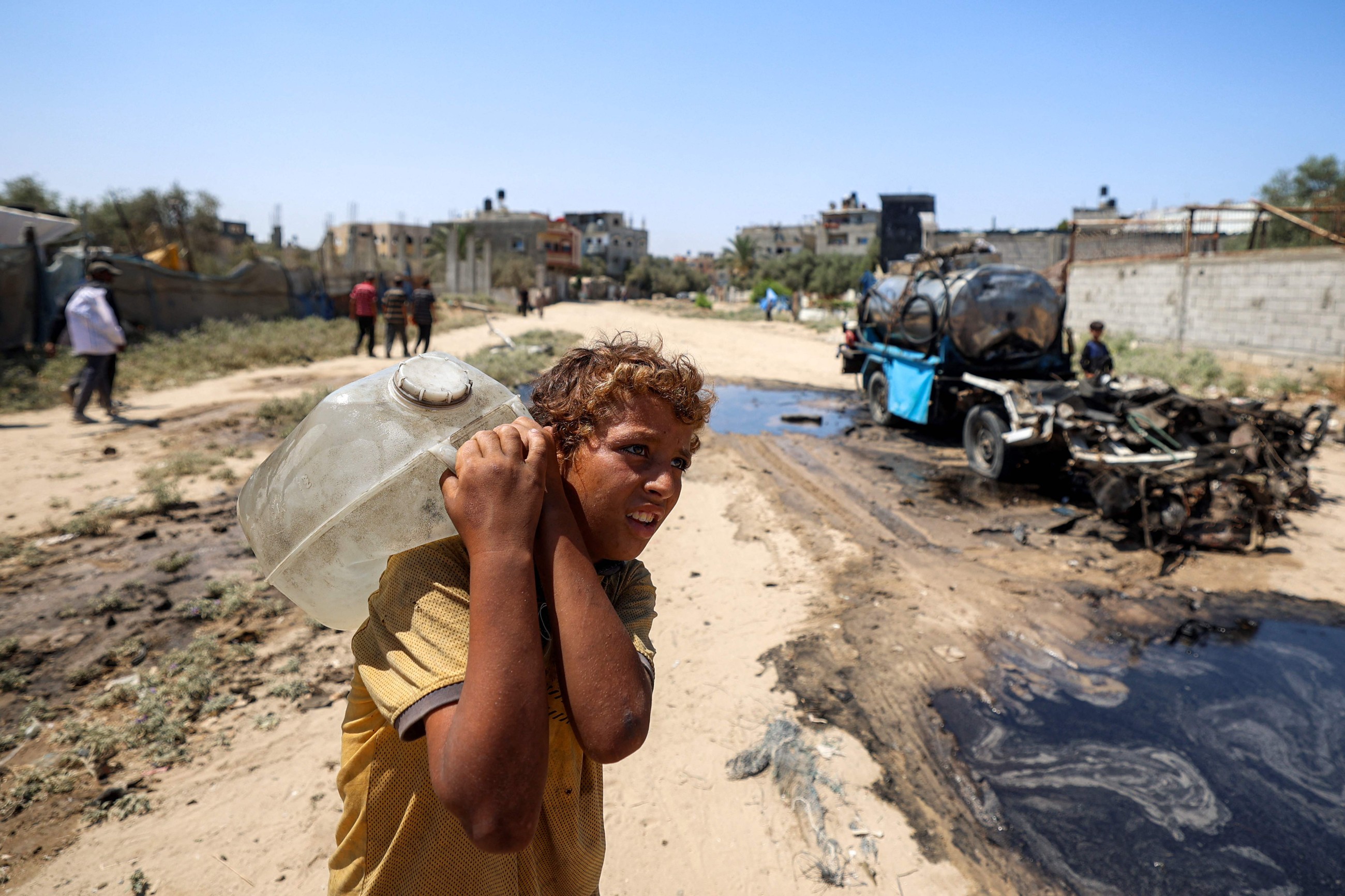
A boy carries on his back a jerrycan filled with water drawn from the tank of a destroyed mobile water cistern. AFP
He had set off on Monday for a local water tap with three of his daughters, each of them carrying two heavy plastic containers in Gaza's blazing summer heat, but they only managed to fill two - barely enough for the family of 10. Gaza's lack of clean water after 21 months of war and four months of Israeli blockade is already having "devastating impacts on public health" the United Nations humanitarian agency OCHA said in a report this month.
For people queuing at a water distribution point on Sunday it was fatal. A missile that Israel said had targeted militants but malfunctioned hit a queue of people waiting to collect water at the Nuseirat refugee camp.
Israel's blockade of fuel along with the difficulty in accessing wells and desalination plants in zones controlled by the Israeli military is severely constraining water, sanitation and hygiene services according to OCHA.
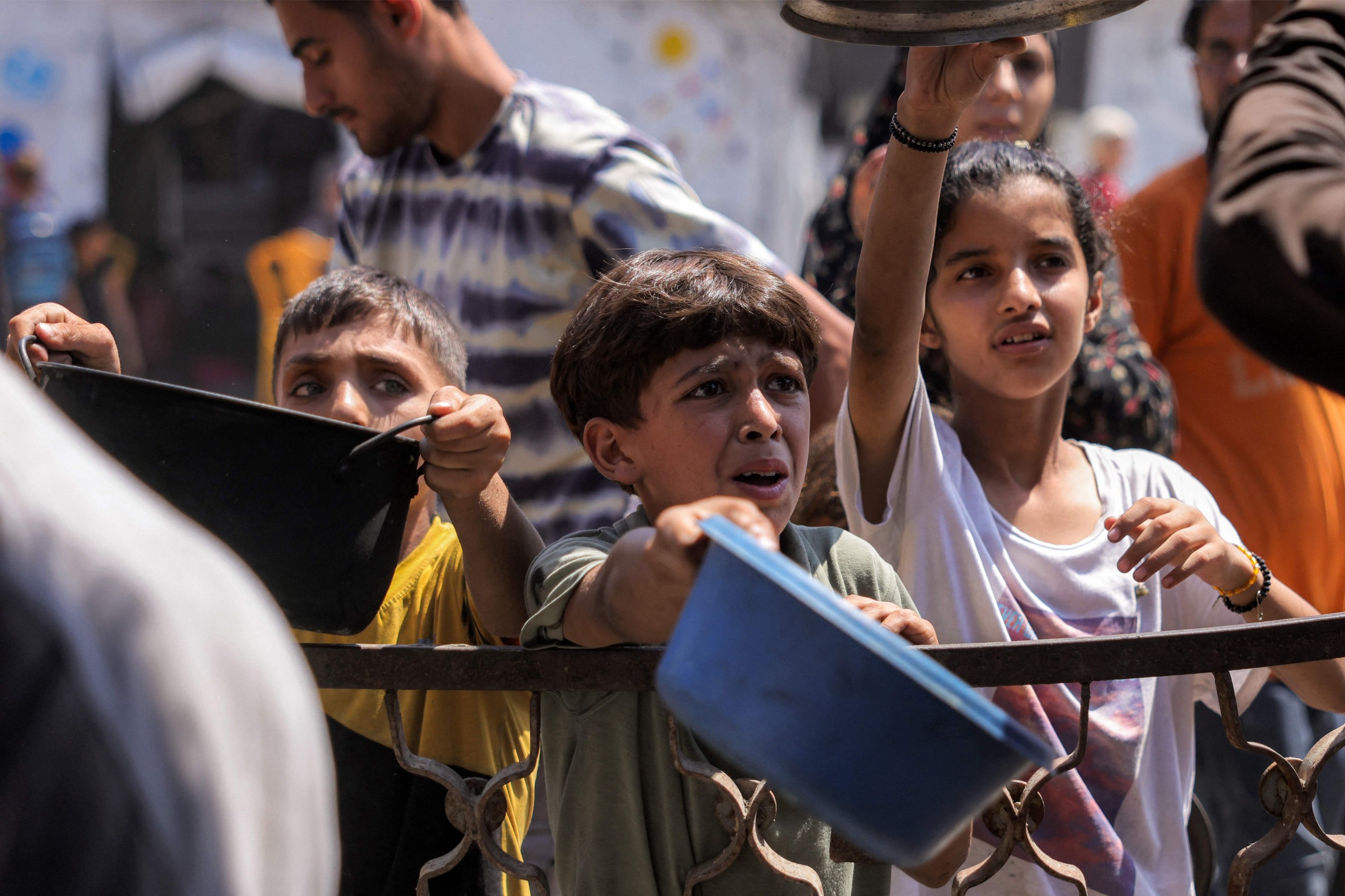
Children queue with pots to receive meals from a charity kitchen in Gaza City. AFP
Fuel shortages have also hit waste and sewage services, risking more contamination of the tiny, crowded territory's dwindling water supply, and diseases causing diarrhoea and jaundice are spreading among people crammed into shelters and weakened by hunger.
"If electricity was allowed to desalination plants the problem of a lethal lack of water, which is what's becoming the situation now in Gaza, would be changed within 24 hours," said James Elder, the spokesperson for the U.N.'s children's agency UNICEF.
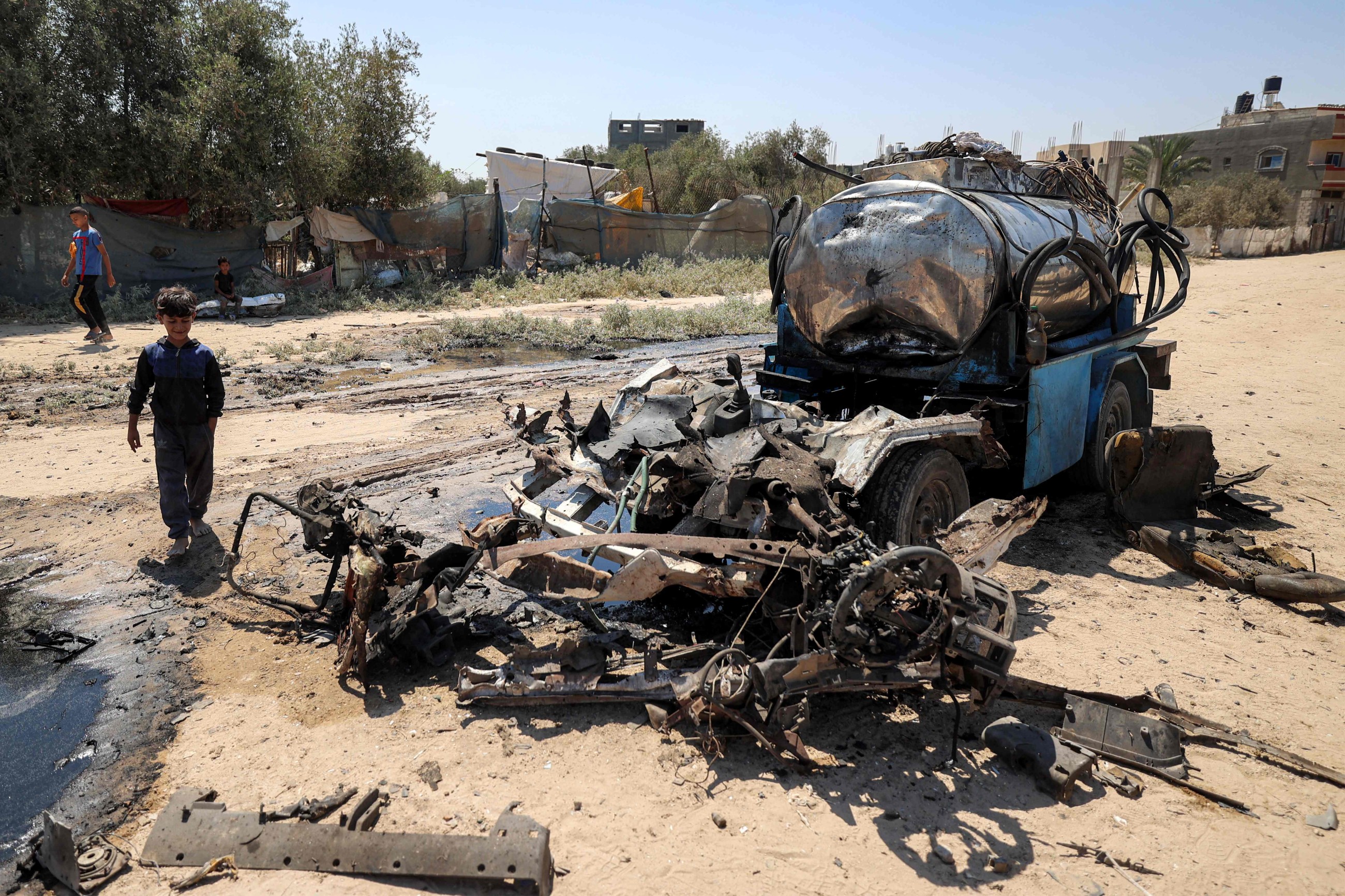
A boy stands near a destroyed mobile water cistern that was hit by Israeli bombardment. AFP
"What possible reason can there be for denying of a legitimate amount of water that a family needs?" he added.
COGAT, the Israeli military aid coordination agency, did not immediately respond to a request for comment.
Last week, an Israeli military official said that Israel was allowing sufficient fuel into Gaza but that its distribution around the enclave was not under Israel's purview.
THIRSTY AND DIRTY
For the Manasra family, like others in Gaza, the daily toil of finding water is exhausting and often fruitless.
Inside their tent the family tries to maintain hygiene by sweeping. But there is no water for proper cleaning and sometimes they are unable to wash dishes from their meagre meals for several days at a time.
Manasra sat in the tent and showed how one of his young daughters had angry red marks across her back from what he said a doctor had told them was a skin infection caused by the lack of clean water.
They maintain a strict regimen of water use by priority.
After pouring their two containers of water from the distribution point into a broken plastic water butt by their tent, they use it to clean themselves from the tap, using their hands to spoon it over their heads and bodies.
Water that runs off into the basin underneath is then used for dishes and after that - now grey and dirty - for clothes.
"How is this going to be enough for 10 people? For the showering, washing, dish washing, and the washing of the covers. It's been three months we haven't washed the covers, and the weather is hot," Manasra said.
His wife, Umm Khaled, sat washing clothes in a tiny puddle of water at the bottom of a bucket - all that was left after the more urgent requirements of drinking and cooking.
"My daughter was very sick from the heat rash and the scabies. I went to several doctors for her and they prescribed many medications. Two of my children yesterday, one had diarrhoea and vomiting and the other had fever and infections from the dirty water," she said.
Reuters / Agencies
Displaced Palestinian man Akram Al Manasra collects water with his daughter amid shortages in Gaza City on Monday. Reuters
The government media office in Gaza says attacks on people waiting in line for water have killed more than 700 Palestinians as part of a “systematic thirst war,” a media outlet reported on Monday.
The Israeli army has targeted 112 freshwater filling points and destroyed 720 water wells, putting them out of service. This has deprived more than 1.25 million people of access to clean water, the office said in a statement.
“We affirm that this racist policy constitutes a full-fledged war crime under the Geneva Conventions, and a grave violation of international humanitarian law and human rights law.”
A boy draws water into a jerrycan from the tank of a destroyed mobile water cistern that was hit by Israeli bombardment in the Nuseirat camp. AFP
The office said Israel has prevented the entry of 12 million litres of fuel monthly, the amount necessary to operate the minimum number of water wells, sewage treatment plants, garbage collection vehicles and other vital services. This ban has “caused near-total paralysis of water and sewage networks and worsened the spread of diseases, especially among children,” the office said.
Gazans' daily struggle for water after deadly strike
The Al Manasra family rarely get enough water for both drinking and washing after their daily trudge to a Gaza distribution point like the one where eight people were killed on Sunday in a strike that Israel's military said had missed its target.
Displaced Palestinian man Akram Al Manasra and his children make their way to collect water from a distribution point amid shortages in Gaza City on Monday. Reuters
Living in a tent camp by the ruins of a smashed concrete building in Gaza City, the family say their children are already suffering from diarrhoea and skin maladies and from the lack of clean water, and they fear worse to come.
"There's no water, our children have been infected with scabies, there are no hospitals to go to and no medications," said Akram Manasra, 51.
A boy carries on his back a jerrycan filled with water drawn from the tank of a destroyed mobile water cistern. AFP
He had set off on Monday for a local water tap with three of his daughters, each of them carrying two heavy plastic containers in Gaza's blazing summer heat, but they only managed to fill two - barely enough for the family of 10. Gaza's lack of clean water after 21 months of war and four months of Israeli blockade is already having "devastating impacts on public health" the United Nations humanitarian agency OCHA said in a report this month.
For people queuing at a water distribution point on Sunday it was fatal. A missile that Israel said had targeted militants but malfunctioned hit a queue of people waiting to collect water at the Nuseirat refugee camp.
Israel's blockade of fuel along with the difficulty in accessing wells and desalination plants in zones controlled by the Israeli military is severely constraining water, sanitation and hygiene services according to OCHA.
Children queue with pots to receive meals from a charity kitchen in Gaza City. AFP
Fuel shortages have also hit waste and sewage services, risking more contamination of the tiny, crowded territory's dwindling water supply, and diseases causing diarrhoea and jaundice are spreading among people crammed into shelters and weakened by hunger.
"If electricity was allowed to desalination plants the problem of a lethal lack of water, which is what's becoming the situation now in Gaza, would be changed within 24 hours," said James Elder, the spokesperson for the U.N.'s children's agency UNICEF.
A boy stands near a destroyed mobile water cistern that was hit by Israeli bombardment. AFP
"What possible reason can there be for denying of a legitimate amount of water that a family needs?" he added.
COGAT, the Israeli military aid coordination agency, did not immediately respond to a request for comment.
Last week, an Israeli military official said that Israel was allowing sufficient fuel into Gaza but that its distribution around the enclave was not under Israel's purview.
THIRSTY AND DIRTY
For the Manasra family, like others in Gaza, the daily toil of finding water is exhausting and often fruitless.
Inside their tent the family tries to maintain hygiene by sweeping. But there is no water for proper cleaning and sometimes they are unable to wash dishes from their meagre meals for several days at a time.
Manasra sat in the tent and showed how one of his young daughters had angry red marks across her back from what he said a doctor had told them was a skin infection caused by the lack of clean water.
They maintain a strict regimen of water use by priority.
After pouring their two containers of water from the distribution point into a broken plastic water butt by their tent, they use it to clean themselves from the tap, using their hands to spoon it over their heads and bodies.
Water that runs off into the basin underneath is then used for dishes and after that - now grey and dirty - for clothes.
"How is this going to be enough for 10 people? For the showering, washing, dish washing, and the washing of the covers. It's been three months we haven't washed the covers, and the weather is hot," Manasra said.
His wife, Umm Khaled, sat washing clothes in a tiny puddle of water at the bottom of a bucket - all that was left after the more urgent requirements of drinking and cooking.
"My daughter was very sick from the heat rash and the scabies. I went to several doctors for her and they prescribed many medications. Two of my children yesterday, one had diarrhoea and vomiting and the other had fever and infections from the dirty water," she said.
Reuters / Agencies
No comments:
Post a Comment