USTR Port Fee Proposal Puts a Dent in China's Shipbuilding Dominance
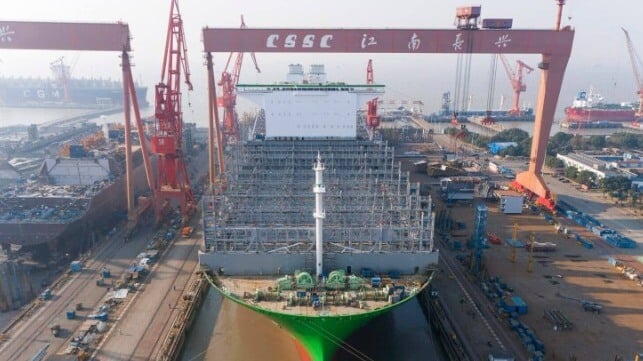
Chinese shipbuilders are already feeling the pinch from the Trump administration's unprecedented port fee proposal, even though the details have not yet been released in final form. The Office of the U.S. Trade Representative's fee schedule would increase the cost of doing business at U.S. seaports for all Chinese-built ships, in hopes of jumpstarting demand for American shipbuilding and undercutting the dominance of Chinese state industrialists.
Whether or not it prompts a resurgence at U.S. shipyards, the USTR plan is already driving international shipowners to reconsider the idea of ordering at market-leading Chinese shipyards. If a Chinese-made ship costs more to operate to and from the United States, then a Korean or Japanese ship may be a better overall value proposition on a lifecycle basis, even if it is more expensive up-front. Owners appear to be taking that bet, based on the latest numbers from Bimco and Clarksons.
By Bimco's tally, China led the world market in sales in the first six months of the year - but by a much smaller margin, just 52 percent of all tonnage, down from 72 percent in the same period last year. The overall market was also smaller: total global sales numbers plummeted by half compared to the first six months of 2024, led by a sharp drop in bulker orders. This sounds drastic, but Clarksons notes that the drop brings the sales volume back down to earth after a period of hyperactive ordering; when considered against the 10-year average, the first half of 2025 was reasonably typical. Boxship ordering still remains remarkably elevated at nearly double the10-year average pace.
None of these changes will threaten China's market-leading position in the immediate term. CSSC and its compatriot yards still hold a commanding share of the world's existing orderbook - nearly 60 percent by CGT - but the drop in new-order share represents a hefty chunk out of China's future shipbuilding revenue. South Korea is the leading beneficiary, gaining 25 percent global marketshare in the first half, up from 15 percent year-on-year. Korean yards even picked up the majority of the world's new orders in the month of March (quickly reversed again in April).
Report: China Demands Role for Cosco in Deal to Sell Hutchison’s Port Ops
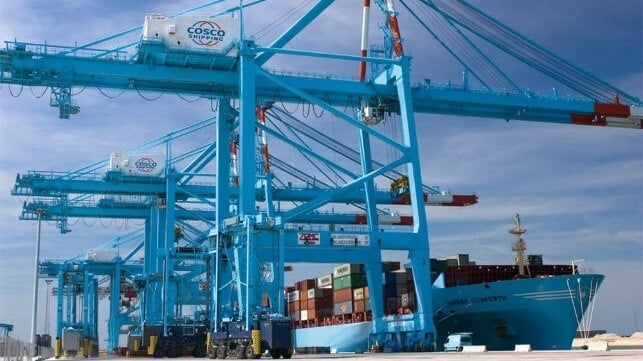
Chinese officials have reportedly set an ultimatum for the approval of the sale agreement between CK Hutchison, BlackRock, and MSC’s Terminal Investments (TiL) for the Hong Kong company’s global port operations. According to a story in The Wall Street Journal, China has privately told the companies that Cosco must have a role in the deal, or it will move to block the transaction.
Rumors that China was seeking a role for Cosco in the deal have been circulating for months, and it is seen as a face-saving step, especially for the terminal operations at Panama’s two ports. WSJ reports that, “China is pushing for state-owned Cosco to be an equity partner and shareholder of the ports with BlackRock and Mediterranean Shipping Company.”
“Chinese officials have told BlackRock, MSC, and Hutchison that if Cosco is left out of the deal, Beijing would take steps to block Hutchison’s proposed sale, according to people familiar with the deal talks,” writes The Wall Street Journal.
It is unclear how China could block the deal, but days after the agreement was announced, Hong Kong’s Chief Executive John Lee spoke out against the proposed sale. He said at the time there were “concerns” that deserved “serious attention.” Hutchison is Hong Kong-based, and in addition, China in the past has used its Commerce Ministry, asserting its right to review deals and demand alterations in the terms.
This comes just 10 days before the end of the exclusive lock-up period Hutchison granted to BlackRock and MSC. The company had announced the “in principle” agreements on March 4, saying they expected to complete definitive documentation for the part of the deal for the two terminal operations in Panama by April 2, while due diligence and exclusive negotiation were proceeding.
WSJ speculates that the parties cannot strike a deal on revised terms that include Cosco until the exclusivity period ends on July 27. It is unclear what portion of the deal, valued at nearly $23 billion, Cosco would participate in or at what level.
The wildcard is the Trump administration, which used Hutchison’s terminal operations at each end of the Panama Canal to assert “China runs the Panama Canal,” and to threaten that the U.S. would take back the canal. Panama has repeatedly asserted its sovereignty over the canal and denied Chinese domination.
Hutchison has remained mostly silent in the face of China’s attacks, which ranged from the loyalty of its founder tycoon Li Ka-shing to the legality of the deal, and assertions that it was all driven by the U.S. In early April, Hutchison’s Panama company issued a long list of responses refuting many of the claims that it was in violation of the concession to operate the terminals. Panama, however, has threatened under pressure from the U.S. to review and possibly terminate the concession for the terminals.
Under the terms of the “in principle” agreement, Hutchison would sell its 90 percent interest in the Panama operation (Panama holds 10 percent of the company) to the consortium between BlackRock and TiL. They would also acquire 80 percent of the global operations, which include 43 ports comprising 199 berths in 23 countries. Hutchison would retain its interests in China. Later reports revealed that the investment group would largely be owned by MSC.
China Accuses Philippine Coast Guard of Dangerous "Crossing Astern"
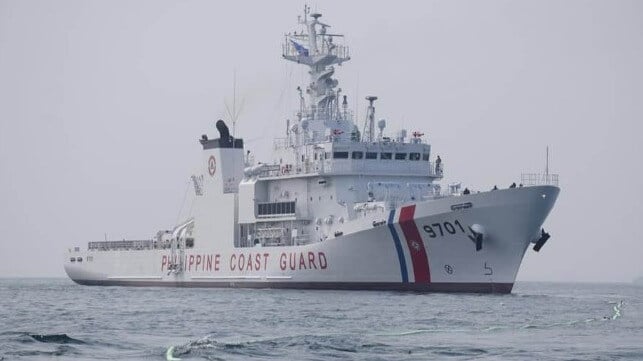
The China Coast Guard (CCG) has long harassed the Philippine Coast Guard (PCG) with close-quarters maneuvering, water-cannons and blockades, sometimes resulting in serious injuries. But China has now accused the Philippines of a similar tactic: "making high-speed crossings astern" behind two China Coast Guard ships. While this is not a defined COLREGS violation, China claims that it "seriously threatened the navigation safety" of two vessels.
The alleged incident occurred on July 15 when two Chinese cutters, CCG 21550 and 5009, were intercepted by BRP Teresa Magbanua at a position near Chinese-controlled Scarborough Shoal. The location is within the Philippines' exclusive economic zone, as affirmed by the Permanent Court of Arbitration in 2016; however, China claims this region as its own sovereign territory, and it maintains a large military and paramilitary presence within the Philippine EEZ for the purpose of "rights enforcement."
In a video released on social media, Chinese state-owned media outlet Global Times showed CCG 21550 crossing the bow of Magbanua from the latter's starboard side. For the duration of the video, both vessels appear to hold course and speed, then pass without harm.
In a social media statement, Global Times claimed that the crew of Magbanua were "repeatedly making high-speed crossings astern with the closest distance only about 100 meters."
PCG spokesman Jay Tarriela said in a statement that the Philippine Coast Guard "categorically rejects" China's claims, and that BRP Teresa Magbanua was conducting a maritime patrol within the Philippine exclusive economic zone. He reiterated Manila's claim that the China Coast Guard operates illegally within the Philippine EEZ, and said that the two Chinese cutters were obstructing Magbanua's navigation by speeding up and then crossing her bow. He described the maneuvers as dangerous "bullying tactics" designed to harass the PCG cutter's crew.
"The PCG remains dedicated to defending our nation’s sovereignty and sovereign rights in the West Philippine Sea without resorting to aggression," he said.
Just last weekend, BRP Teresa Magbanua intercepted a Chinese spy ship - the Tianwangxing - at a position about 70 nm west of Mindoro. The surveillance ship did not reportedly respond to radio hails; its presence coincided with a series of aerial combat exercises with the U.S. Air Force over the Philippines.
BRP Teresa Magbanua has had multiple encounters with Chinese forces before, including a protracted standoff at Sabina Shoal. The crew held position at the reef to fend off a Chinese incursion for five months, leaving only when supplies ran out and hunger and dehydration set in. During that mission, Magbanua was rammed by a Chinese cutter on her starboard quarter.
No comments:
Post a Comment