The hideous truth about Trump’s ‘One Big Beautiful Bill’

First published at International Socialism Project.
Donald Trump ruined everyone’s Fourth of July holiday by signing what he so fatuously called the “One Big Beautiful Bill.” It may be the single most damaging piece of legislation signed into law since . . . Who knows?
Ronald Reagan’s first budget in 1981, which marked a major conservative turn in US social and economic policy, seems moderate by comparison. Comparisons to other historically racist, repressive, and anti-immigrant laws of the past — the McCarran Internal Security Act of 1950 or the 1924 Immigration Act or even the Fugitive Slave Act of 1850 — are not out of the question.
For such a radical change in social and economic policy, it barely squeaked by. Vice President JD Vance had to break a 50-50 tie in the US Senate to pass it. And it received 218 votes in the US House, the one vote majority in the 435-member chamber.
There are many horrible things shoe-horned into its nearly 1000 pages, as Republican congressmembers who voted for it without reading it will discover. And while the GOP members might be pleasantly surprised by what they find, the rest of us will be horrified. To focus our analysis, we will sum up three major impacts of this big, ugly mess.
The rich are made richer
The bill makes permanent the 2017 tax cuts that were tilted to the rich. According to one estimate of full impact — with both cuts to taxes and to income support programs considered — the poorest 20 percent of households stand to lose income while the richest .01 percent will gain $301,550.
Still, the tax part of this bill preserves the status quo. At the same time, it exempts larger fortunes from estate taxes, and it increases the deductibility from federal taxation of the amount of money taxpayers pay in state and local taxes. The “pro-working class” tax reforms that Trump and the GOP will tout — no taxes on tips, added tax deductions for seniors 65 and over, and no taxes on overtime earnings — are heavily circumscribed and temporary. All of them disappear by 2028.
Even if one accepted the standard “trickle-down” argument that cutting taxes on the rich will lead to a boom in investment and growth, it’s hard to see how largely preserving the status quo will provide “rocket fuel” for the economy, as Rep. Darren LaHood (R-Ill.) put it. Even more fanciful is the notion that economic growth unleashed will lower the government’s budget deficit and allow the tax cut to “pay for itself.” This has become an article of Republican faith approaching almost religious status, despite 50 years of empirical evidence to the contrary. But Republicans have sustained their strategic goal of starving the government for funds, and putting the onus on a future Democratic administration to raise taxes to cover more government spending.
Most people will hardly notice a difference in their situation from the tax part of this bill. That can’t be said about other parts of the bill, specifically the cuts to the social safety net.
The poor are made poorer
To get the funds to make the 2017 tax rates permanent, to increase the military budget to more than $1 trillion for the first time, and to establish a vast deportation machine, Trump and the Republicans stole from the poor. Over the next decade, the bill cuts almost $1 trillion from Medicaid (medical insurance for low-income people) and about $500 billion each from food assistance and Medicare (medical insurance to the elderly). This is the single largest cut ever in the already thin social safety net.
As Sasha Abramsky, writing in The Nation, put it:
If you thought the safety net systems fought for, and secured, during the Progressive Era, the New Deal, and the Great Society, were a mainstay of modern society, think again. If you thought that after a decade-plus of sparring, the increased healthcare coverage generated by the Affordable Care Act was now a generally accepted part of the social fabric, you were, it appears, sorely mistaken.
Cuts to Medicaid will cost 12-17 million people health insurance coverage, depending on which estimate is more accurate. About 3 million will lose access to food assistance. But the impacts go far beyond those cuts. Safety net hospitals, especially those in rural areas, will cut services and jobs, if not close altogether. Cuts to subsidies for Affordable Care Act insurance will drive up out-of-pocket costs. Soon, everyone’s health insurance will feel increased costs and declining coverage.
This had nothing to do with rooting out “waste and fraud” or securing these programs for the future, as Republicans claimed. Many of them just lied through their teeth, saying that the program didn’t cut Medicaid, even though the black-and-white of the bill said so. The key point is that this represented in crystalized view, the right’s full agenda: tax cuts for the rich, safety net cuts for the poor, and showering of money on the military and other repressive apparatuses of the state.
“They pushed right up to the limit of what their budget could do and still hold enough votes to win a majority,” the liberal writer Paul Waldman explained.
And with every immigrant parent torn from their children’s arms, every family that loses their health coverage, every young person who decides to forego college, every rural health clinic that shuts down, every research grant that gets revoked, every solar energy project that gets dismantled, they can sit back, smile, and say, ‘This is why we came to Washington. No matter what happens tomorrow, it was worth it.’
Anti-immigrant repression will be turbocharged
One of the biggest “winners” in this bill is the immigration enforcement apparatus that stands to receive more than $170 billion over the next four years. To put that perspective, the current budget for the Immigration and Customs Enforcement (ICE) agency — whose masked agents are kidnapping people off street corners and from workplaces — is just under $10 billion.
The amount of money devoted to this arrest/detention/deportation operation will be more than is allocated to other federal agencies like the FBI, the Bureau of Prisons — even the US Marine Corps. This means that the sort of operation that ICE conducted in Los Angeles earlier this year will be expanded, not only in LA, but in every major city in the country simultaneously. And with an unaccountable militarized police force operating nationwide, no one — including US citizens — will be safe.
The bill authorizes spending of more than $45 billion to build a network of detention facilities like Florida’s “Alligator Alcatraz” that will mostly house people who are not charged with a crime, but who are slated for expulsion from the US. The assault on the social fabric and civil liberties that is coming will be unprecedented since the internment of Japanese Americans during the Second World War.
Because most of these facilities will be privately-operated and crash-built, the opportunities for corruption will be limitless. Talk about “waste, fraud and abuse!” They could even be a source of forced labor for industries like farming and construction that depend on immigrant workers.
With states and localities losing Medicaid, one of the largest federal sources of local and state budgets, they will be hard-pressed to resist the one source of federal money where the spigot is fully open — that is, the billions that will be available to sign up local law enforcement as a “force multiplier” for ICE. And if rural hospitals close down, the GOP is hoping that ICE prisons will provide substitute jobs that will entrench them in local political economies for the foreseeable future.
Unpopular
For now, the “big, beautiful bill” is, by most reliable measures of public opinion, extremely unpopular. In fact, it is the second-most unpopular bill considered in Congress since 1990s (second to Trump’s 2017 attempt to repeal the Affordable Care Act), according to data journalist G. Elliott Morris. The party-line vote, where no Democrats in either the US House of Representatives or the Senate voted for it, means that the GOP owns it, and its consequences.
The Democrats expect that its unpopularity, and its negative impacts, will help them to win one or both houses of Congress in the 2026 midterm elections. But November 2026 is a long way off.
Moreover, Democrats don’t have clean hands. Their messaging on the bill focused on how it would slash Medicaid to pay for tax cuts for the rich. Fair enough. But in 2023 and 2024, in an effort to restore “normalcy” after the COVID pandemic, the Biden administration ended the expansion of Medicaid, tossing 16 million people from the program. This was one of the contributing factors to Kamala Harris’s loss to Trump in the 2024 election.
Democrats were also reticent about condemning the expansion of ICE and its gulag. Again, that’s to be expected from a party that has spent the last few years running away from any pro-immigration stance. Recall that 48 House Democrats and 12 Democratic senators voted with the GOP for the Laken Riley Act, which is helping ICE round people up, and 75 of them joined a resolution expressing “gratitude” to ICE.
All of this means that the Democrats, the courts, and other institutions are not coming to save us. In fact, many of them are being coerced or corrupted into accepting Trump’s austerian authoritarianism as the new normal. The labor and social movements can only depend on ourselves to prevent the US’s further slide into the abyss.
Lance Selfa is the author of The Democrats: A Critical History (Haymarket, 2012) and editor of U.S. Politics in an Age of Uncertainty: Essays on a New Reality (Haymarket, 2017).
Trump’s “Big Beautiful Bill” Passes with Ugly Results for the Country
Monday 7 July 2025, by Dan La Botz
By just a few votes in both houses, the Republicans passed President Donald Trump’s 940-page “Big Beautiful Bill,” a $3.4 trillion package, cutting taxes for the rich and slashing social programs for the working class and the poor, while at the same time increasing the national debts by $3 trillion or more.
When he signed it, Trump called it “the most popular bill ever signed,” but according to one reliable poll, half of the country oppose it and only one-third supported it. Several progressive organizations—50501, Indivisible, and the Women’s March—organized over 300 “Free America” rallies with thousands of participants raising the call to: “Free America from the grip of greedy billionaires who rig the system for themselves.”
The bill reorders American priorities, cutting social welfare programs in order to give enormous tax cuts to the rich. Trump strong armed Republicans, threatening to oppose their reelection if they opposed him. Some of them wanted even deeper cuts to social welfare in order to reduce the country’s $36.2 trillion national debt, while others opposed Medicaid cuts that would harm their constituents and their own chances of reelection. In the end, only a few Republicans had the courage to oppose him, and the bill passed by four votes in the House and by one vote in the Senate, the tie-breaking vote of Vice-President J.D. Vance.
What’s in the Bill
The most important measures in the bill are these. Cut Medicaid health coverage for low-income and elderly Americans over the next ten years, amounting to $1 trillion, which means 11.8 million adults and children will no longer be covered. The Supplemental Nutrition Assistance Program (SNAP), will be reduced by $287 billion in federal spending over 10 years, affecting millions. The bill also eliminates programs and funds to stop climate change and for environmental justice. The cost of cuts like these immediately became clear. Trump and the Republicans cut the staff of the National Weather Service and slashed the climate budget just as extreme rains and floods drowned 15 children and swept away and presumably drowned another 25 girls in summer camp in Texas.
These cuts made it possible to extend Trump’s 2017 tax cuts and add new ones, reducing taxes principally on the rich by $4.5 trillion.
At the same time, it appropriates $150 billion for the military, for ship building, for the “Golden Dome” missile defense system, and for arms. The military budget will for the first time reach almost $1 trillion. And the budget allocates $45 billion for the construction by private companies of immigrant detention centers, in effect prisons, with 100,000 beds. There is also $46.5 billion to build the U.S.-Mexico border wall and $6 billion for technology and surveillance.
Trump took advantage of the Fourth of July, America’s Independence Day, as B-2 bombers flew overhead, to celebrate the U.S. bombing of Iran and to praise Republican leaders for passing his “Big Beautiful Bill,” claiming falsely that people wouldn’t even notice the cuts because they only eliminated “fraud and abuse.” Trump concluded, “We will have the strongest economy and the strongest borders on earth.”
Democrats believe that the bill will anger voters and make it possible for them to take back the House of Representatives in the November 2026 elections. But the Democratic Party may not be able to take advantage of this opening because it remains divided, between the party’s leaders, who have failed to successfully address the American public, and Democratic Socialists like Senator Bernie Sanders, Congresswoman Alexandria Cortez, who attracted tens of thousands to their anti-oligarchy rallies, and Zohran Mamdani who just won the New York City Democratic Party’s mayoral primary election. The resistance is growing, but must become stronger to have an impact on the elections.
6 July 2025
Attached documentstrump-s-big-beautiful-bill-passes-with-ugly-results-for-the_a9077.pdf (PDF - 905.5 KiB)
Extraction PDF [->article9077]
Dan La Botz was a founding member of Teamsters for a Democratic Union (TDU). He is the author of Rank-and-File Rebellion: Teamsters for a Democratic Union (1991). He is also a co-editor of New Politics and editor of Mexican Labor News and Analysis.
International Viewpoint is published under the responsibility of the Bureau of the Fourth International. Signed articles do not necessarily reflect editorial policy. Articles can be reprinted with acknowledgement, and a live link if possible.
One Big Ugly Death Sentence for Disabled People
On July 4, President Trump signed into law a sweeping GOP budget reconciliation package, which he and the GOP proudly dubbed their “one big beautiful bill.” The law is anything but pretty, however, for the millions of Americans with disabilities who stand to lose medical insurance coverage. The legislation imposes deep cuts to Medicaid and new work requirements — changes that threaten to strip essential medical care from the very people who need it most.
Medicaid plays an outsized role in serving the disabled population. Over 41 percent of working-age (those ages 18 to 64) US adults with disabilities rely on Medicaid for their health coverage, compared to just 13.2 percent of those without disabilities. The share of disabled working-age adults enrolled in Medicaid is even higher in some parts of the country (Figure 1); 58.2 percent of working-age disabled adults in Puerto Rico rely on Medicaid, as do 46.3 percent in New Mexico and 43.8 percent in Massachusetts.
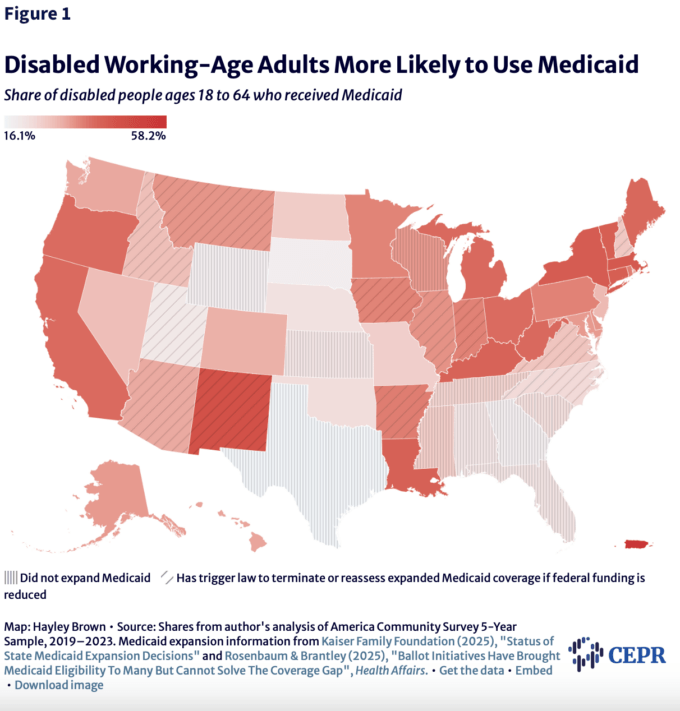
Disabled people are disproportionately represented among those who use Medicaid. Among working-age adults, 28 percent of Medicaid enrollees report at least one type of disability, compared to just 7.7 percent of those who do not use Medicaid. The trend is also not confined to states that declined to expand Medicaid under the Affordable Care Act (Figure 2). Disabled people who benefited from such Medicaid expansions face additional uncertainty in the wake of the cuts to federal funding. Several states that expanded coverage have so-called “trigger laws,” which require them to revisit or terminate their expansions if federal support falls below certain thresholds. If that happens, thousands of disabled adults in those states could lose coverage almost overnight, with no clear alternatives.

These figures reflect persistent barriers to participation for disabled people. Full-time employment, and therefore employer-sponsored insurance, is often out of reach for disabled adults. Navigating alternative programs like Supplemental Security Income (SSI) or Social Security Disability Insurance (SSDI) can take years of appeals and paperwork, requiring both money and expertise. Even among disabled Medicaid enrollees, only about 35 percent also receive SSI, and many don’t have another formal recognition of their disability. Medicaid remains one of the only dependable ways that disabled people can access the medical care and equipment they need to survive.
The new law reflects no such consideration, however, instead imposing punitive work requirements on Medicaid recipients with only limited (and complicated) exceptions for disabled people. These exceptions are structured so that many people who desperately need help will find it impossible to qualify. They risk cutting off coverage for many who don’t qualify for SSI or SSDI but still face significant limitations on their ability to work. Stringent work requirements also ignore the systemic challenges disabled Americans face, from inaccessible workplaces to employers failing to provide sufficient accommodations. Denying people health care does nothing to address these barriers — it only makes participation in work and community life even harder. Denying people health care does save money, however — money that the folks behind this bill are eager to redistribute to their wealthy patrons in the form of lucrative tax cuts.
Rather than erecting new barriers to care, the US should be moving closer to a system that treats health care as a right, rather than privilege. This bill proceeds in exactly the opposite direction. And its devastating effects will be borne disproportionately by disabled people, whom it treats as disposable.
This first appeared on CEPR.
No comments:
Post a Comment