GAO Finds Opportunities for Improvement in MARAD's Shipyard Programs
The Government Accountability Office has completed a review of MARAD's promotional programs for shipbuilding, and has found room for improvement - primarily in goal-setting and tracking. Ever under-resourced, MARAD carries out its statutorily-mandated programs but does not always have internal goals for what these programs should accomplish - nor has it likely been asked by anyone before GAO arrived. GAO also found that there may be room for improvement in the Small Shipyard Grant program, with potential to enlarge it and to increase its transparency.
The Small Shipyard Grant program awards minor federal support funding to yards, typically totaling about $10-20 million per year. The number of applications outstrips the supply of funding, and so MARAD staff use a scoring system to weigh the merits of each application. After rating about 100 factors per project, they pick the best candidates and present them to the Maritime Administrator (or acting administrator) for final approval.
The administrator decides which applicants get grants, which are typically small sums in the range of $300,000-$1 million - not enough for a full modernization, but enough to buy a crane or train a new cohort of apprentices. But the reasons for picking projects are not written down or presented to the successful shipyards, GAO said, nor do unsuccessful applicants find out why their project was turned down (at least not in a formal, documented way).
"While grantees have benefitted . . . the Maritime Administration cannot determine to what extent the Small Shipyard Grant program is achieving its intended outcomes because it does not have measurable goals and does not assess the performance of the program," GAO found. "A better understanding of the impact of the Small Shipyard Grant program could help inform the Maritime Administration’s broader efforts to support the U.S. maritime industry."
GAO also recommended writing down the reasons why each grant is approved or disapproved in order to make the process more transparent and consistent. It has previously made the same recommendation for all of the Department of Transportation, MARAD's parent agency.
A bigger Small Shipyard Grant program could help struggling yards to modernize, GAO found. In a survey of shipbuilders conducted for the study, 92 out of 105 reported that their outdated infrastructure impeded efficiency, and 89 out of 105 said that it was hard to finance infrastructure improvements with private capital. "Expanding the Small Shipyard Grant program could allow shipyards to invest more in new equipment, according to nine out of 10 industry groups and shipbuilding or repair companies that discussed the program with us," GAO reported.
In its review of MARAD's twin newbuild financing programs, the Capital Construction Fund Program and the Construction Reserve Fund Program, GAO found that recent statutory changes have made them both about the same. They are both run by the same staffers at MARAD, a total of two people, and at least one owner uses the programs interchangeably. GAO recommended merging the programs to reduce duplication.
Workforce woes
Beyond MARAD, GAO also took input from shipbuilders in a general survey about market conditions, and relayed familiar news about the availability of willing and capable workers. "Boom-and-bust" shipbuilding has made it difficult to retain good welders and shipfitters, and now the industry is competing with service-sector employers too. "One shipyard representative said that at one point, the shipyard had 1,000 employees, but now that number is down to 200, in part because younger generations are not getting into the shipbuilding and repair industry," GAO reported.
The agency also took the time to talk to foreign officials in the UK, Singapore and South Korea, and all reported a hard time recruiting young people. Unlike the United States, Singapore and South Korea use foreign guest workers to round out their payrolls, subject to percentage limits.
A consistent government procurement program would help smooth out the boom-and-bust cycles for American shipbuilders, participants told GAO. These could include American-made newbuilds for the aging Ready Reserve Fleet, as proposed and funded in the FY2024 budget for MARAD. To further stimulate fleet growth, GAO held up the example of the multi-billion-dollar procurement programs in South Korea and Canada, and called for setting specific goals for vessel construction numbers and types.
Huntington Ingalls Tries Out AI to Fight Schedule Delays
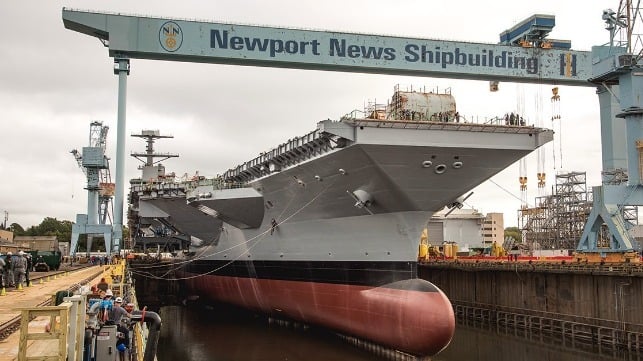
Huntington Ingalls Industries' shipbuilding programs for the U.S. Navy face significant delays, particularly for the Ford-class aircraft carrier program, which is running years behind. To speed up work, HII is working with publicly-listed enterprise AI company C3 AI to put advanced algorithms behind the wheel for its yards' work scheduling and planning.
HII and C3 tried out a six-month trial production deployment program at Ingalls Shipbuilding, the yard that builds all U.S. Navy amphibs and most Arleigh Burke-class destroyers. During the trial, C3's agentic enterprise AI systems adjusted and optimized work schedules for Ingalls. The platform showed significant improvements in schedule performance, HII said - significant enough that the shipbuilder now wants to scale it up across all of its yards.
HII also runs Newport News Shipbuilding, the only builder of nuclear-powered carriers in the world and one of two builders of the U.S. Navy's Columbia-class and Virginia-class submarines. Both Ingalls and NNS will now begin using C3 AI for planning and scheduling for their programs.
"This collaboration underscores our growing role as a strategic provider to the U.S. government and defense sector,” said Thomas M. Siebel, Chairman and CEO, C3 AI. “By deploying Enterprise AI across planning, operations, and the supply chain, we are powering a modern, intelligent infrastructure to ensure America’s edge in naval readiness.”
The handful of shipyards that build surface combatants and subs for the U.S. Navy are under scrutiny, and Acting CNO Adm. James Kilby reports that all of the service's newbuild programs are now behind schedule. "We are behind in every ship class [by] different rates, but at least years," Kilby said.
All shipbuilding contracts are under review, Navy Secretary John Phelan said earlier this year. Two big contracts - the next follow-on order for the Constellation-class frigate and the much-discussed block buy for two future Ford-class carriers - are not funded in the Navy's proposed FY2026 budget.
U.S. Navy Budget Request Leaves Out Next Constellation-Class Frigate
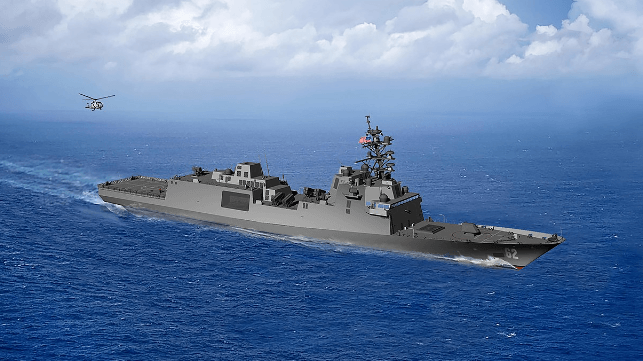
Each year's proposed Navy budget gets a lot of attention for what's in and what's out, but this year has some big surprises. The next order for a Constellation-class frigate is zeroed out - no frigates are in the budget request. But the Pentagon has asked Congress to set aside $1.7 billion for on-water autonomous systems, along with $730 million for underwater autonomous capabilities.
A senior Navy official told DefenseScoop that the unmanned line items include "new efforts in unmanned undersea and in unmanned surface, to include procuring our medium unmanned surface vessel [MUSV]."
GAO reports that the Navy is consolidating its two ship-like unmanned surface vessel programs, the MUSV and the larger LUSV. The plan, GAO reported earlier this month, is to start development of a single hull design under a major capability acquisition pathway by FY2027.
The news for the manned fleet is mixed. Fleet size would remain the same under the budget, but the much-delayed Constellation-class frigate program appears to be facing an executive-level decision, according to USNI: Pentagon officials told the outlet that "the Trump administration has not yet decided whether it will move forward" with the frigate.
The Constellation-class faces a long list of challenges. Originally intended as a quick and low-risk adaptation of an existing French-Italian design, the program office opted to alter about 85 percent of the vessel, lengthening it and changing its internal arrangements so that it has little in common with the original. It is running three years behind schedule, the design is not yet complete, and it is on track to deliver about 13 percent overweight, according to GAO; if not corrected, this would reduce margin for future system installations, and could affect performance. The shipbuilder's costs also appear to have gone up, though the Navy has not released the amount of the yard's requests for payment adjustment.
This budget is a one-year request without a 30-year plan, and does not forecast future-year carrier acquisitions - like a much-discussed block buy for the fifth and sixth Ford-class hulls. But it does include $600 million for advanced procurement for the fifth hull, a signal that the Pentagon is committed to the program. Also on the plus side for the carrier (and submarine) industrial base, the proposed budget includes no less than $2.5 billion for "nuclear shipyard productivity enhancements."
U.S. Navy is Using AI to Plan Out Drone Swarm Operations
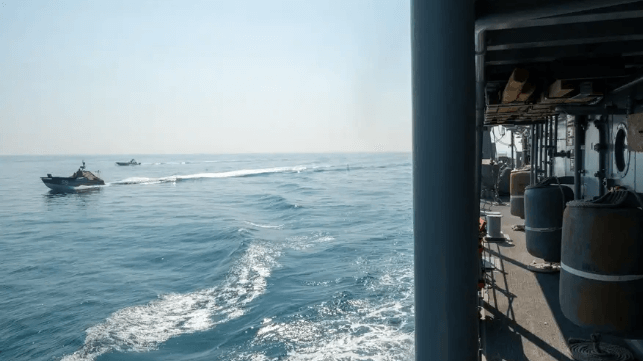
Drones are already playing a key role in combat at sea, as seen in the Black Sea and in the recent Red Sea crisis. Leading navies are investing in drone technology in all domains, and are learning how to orchestrate drone capabilities to work together to maximum effect. In the U.S., Naval Air Warfare Center Aircraft Division (NAWCAD) is using AI to plan out the actions of unmanned air, surface and subsurface assets all at once.
NAWCAD's newly-developed Optimized Cross Domain Swarm Sensing (OCDSS) software system helps Navy operational planners set up unmanned swarms for success. The new program simulates different combinations of aerial, surface and subsurface drones and sensors to achieve various mission objectives. The software was trialed at the NSWC Port Hueneme Coastal Trident exercise last year.
“OCDSS quickly runs thousands of simulations to predict how different unmanned systems might perform together,” said NAWCAD Mechanical Engineer Raymond Koehler, OCDSS’ lead software developer. "OCDSS levels-up how unmanned systems are used in a wide range of missions, and we’re ready to scale this autonomy to operational teams or test programs across the Navy and Marine Corps."
For his contributions to swarm autonomy, Koehler won an "emergent engineer" award from the Assistant Secretary of the Navy in 2025, and his team won a command-level award for the same project.
The technology could find application in the Navy's new push towards unmanned systems at sea. It would dovetail with procurement efforts aimed at large numbers of hulls, like the Defense Innovation Unit's Production-Ready, Inexpensive, Maritime Expeditionary (PRIME) Small Unmanned Surface Vehicle program, which aims to deliver attritable small craft that could chase down a target vessel.
The PRIME project goes beyond current state-of-the-art in drone boat operations. Ukraine's drone boats can attack targets at long range and high speed, but only with a human operator in control by satellite uplink. DIU wants to develop an unmanned surface vessel system that can "operate in cohesive groups and execute complex autonomous behaviors that adapt to the dynamic, evasive movements of the pursued vessel" on its own, even if the remote connection to a manned control center is lost. A software-driven "collaborative intercept capability" is a stated goal.
No comments:
Post a Comment