It’s possible that I shall make an ass of myself. But in that case one can always get out of it with a little dialectic. I have, of course, so worded my proposition as to be right either way (K.Marx, Letter to F.Engels on the Indian Mutiny)
Friday, July 11, 2025
Iranian Naval Forces Still Dispersed at Sea
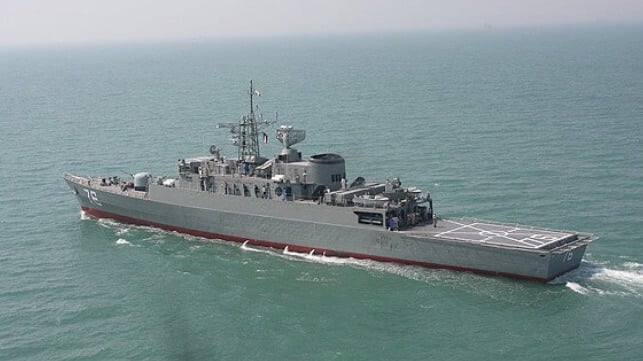
Iran has kept key naval assets outside its ports (Mehr file photo CC By 4.0 license)
As has been seen previously, the current dispositions of Iranian naval forces give an indication of how the current Iranian leadership is considering its current political situation with regard to its adversaries, Israel and the United States.
On June 14, two days after the first Israeli attack of the 12-Day War against Iran, most of the principal ships of the regular Iranian Navy (Nedaja) left the Bandar Abbas Naval Harbor, having clearly decided there was now a risk of attack. The Nedaja’s original calculation that they would not be attacked appears, however, to have been a correct assessment, because by the time of the ceasefire, the only casualties the Nedaja suffered were inflicted when an ammunition storage facility was attacked in Bandar Abbas. Although many Nedaja ships were moored in the Bandar Abbas anchorage throughout the war, and were easily identifiable, none were targeted.
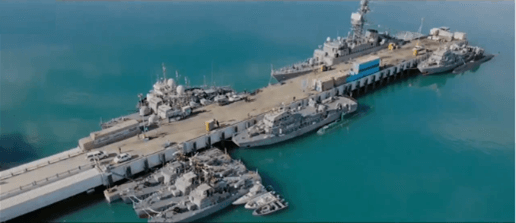
Jask Naval Port when busier last September; the port is now empty (Fars News/Iran MoD)
Since then, Nedaja ships have slipped into harbor for quick replenishment stops, but have then left quickly. On June 11, only a single Moudge Class frigate was alongside, plus others known to be under refurbishment and some smaller patrol craft. Outside in the Bandar Abbas anchorage, a second Moudge Class frigate could be identified. But the location of most of the remaining ships of the Nedaja’s Southern Fleet cannot be determined; they have not relocated to either the new naval port at Jask, nor further to the east at the naval port in Chah Bahar, both of which, on July 11, were empty of naval vessels. In summary, most of the fleet appears to be dispersed at sea or sheltering in foreign friendly harbors, still in a defensive posture, seeking to avoid detection.
The IRGC Navy (Nesda) appears to be following a similar course of action. The drone carrier with distinctive angled flight deck Shahid Madhavi (C110-3) is in the Bandar Abbas anchorage, with the catamaran vessel Shahid Nazeri close by; the Shahid Nazeri, whose role has never become apparent, almost never leaves the Bandar Abbas Naval Harbor, possibly because of seaworthiness issues.
Shahid Madhavi (C110-3) anchored off Bandar Abbas on July 11, with the the Shahid Nazeri aft (Sentinel-2/CJRC)
The lack of operational activity is also reflected in the press output of Nedaja spokesmen, who normally provide a steady stream of press releases giving an indication of exercise activity and deployments. This posture suggests that the Nedaja commanders are preserving combat power and are still uncertain of the political situation, waiting for a determination of the way ahead between the competing hard-liner and reformist factions within the political leadership.
U.S. Cracks Down on Iran's Oil Marketing Network in Hong Kong
After cracking down on the "shadow fleet" of gray-market tankers that serve Iran's oil exporters, the U.S. Treasury is now taking aim at the financiers that help Iranian oil traders move money. It has designated 22 different entities for violating U.S. sanctions on the Iranian energy trade, including companies in Hong Kong, the UAE and Turkey.
These firms stand accused of arranging oil sales for the Islamic Revolutionary Guard Corps-Qods Force (IRGC-QF), the paramilitary and covert-operations arm of Iran's most powerful military division. The IRGC has vast reach within Iran's economy, and it finances much of its activity through the direct sale of Iranian oil to foreign buyers. The Qods Force, designated by the U.S. as a foreign terrorist organization, is heavily involved in marketing the IRGC's share of government oil.
To arrange sales and move money, the IRGC uses front companies. Refiners (primarily in China) make payments for Iranian oil to the front companies, which shuffle money between each other or spend it on IRGC activities, to include buying weapons and supporting terrorist proxy forces - like Yemen's Houthi rebels, who have long benefited from IRGC oil sales.
In a statement, Treasury laid out the details of a web of interconnected front companies that regularly did business with each other and with sanctioned groups, including representatives of Tehran-backed Hezbollah. The first group transacted with Turkish trader Pulcular Enerji, which bought multiple shipments of IRGC-supplied petroleum worth hundreds of millions of dollars. To make the buy, Pulcular worked with Hezbollah's oil trader Concepto Screen SAL Off-Shore. The money was handled by Hong Kong front companies Amito Trading Ltd. and Peakway Global Ltd., Treasury said. The department also named Hong Kong-based JTU Energy, Shelf Trading and Cetto International for allegedly handling bank transfers for Pulcular Enerji and the IRGC-QF.
Treasury also identified multiple Hong Kong trading houses as Qods Force fronts, including Ventus Trade, Marmerth, Future Resource Trading, Moon Imp & Exp. Co, Radix Trade, Macera Int'l, Queens Ring, Star OilGlobal, GAH Petrochemical Trading, Metallex, Mist Trading, Enka Trading, and Finesse Global Trading Ltd.
In the UAE, Treasury identified two suspect firms with IRGC ties, Bright Spot Goods Wholesalers LLC and Lavida Corporation Ltd.
The biggest player of all, according to the Treasury's release, is Turkish trading house Golden Globe Demir Celik Petrol Sanayi ve Ticaret Anonim Sirketi - a cover company for the oil headquarters of the IRGC. Golden Globe handles hundreds of millions of dollars in oil sales for the IRGC, Treasury alleges.
“The Iranian regime relies heavily on its shadow banking system to fund its destabilizing nuclear and ballistic missile weapons programs, rather than for the benedsfit of the Iranian people,” said Secretary of the Treasury Scott Bessent. “Treasury remains focused on disrupting this shadowy infrastructure that allows Iran to threaten the United States and our allies in the region.”

No comments:
Post a Comment