86 million people still live on less than $3.65 a day
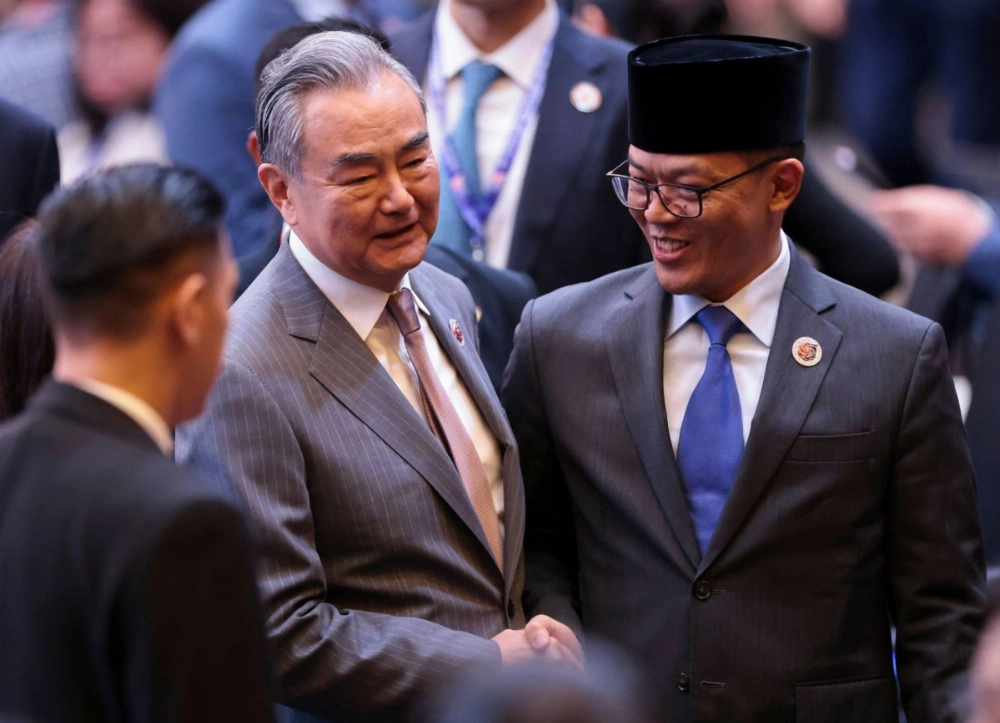
Chinese Foreign Minister Wang Yi (left) shakes hands with Indonesian Minister for Foreign Affairs Sugiono during the 58th ASEAN Foreign Ministers' meeting and related meetings in Kuala Lumpur on July 10. | AFP-JIJI
AFP-JIJI
Jul 22, 2025
Sydney –
China is set to expand its influence over Southeast Asia's development as the administration of U.S. President Donald Trump and other Western donors slash aid, a study by an Australian think tank said Sunday.
The region is in an "uncertain moment," facing cuts in official development finance from the West as well as "especially punitive" U.S. trade tariffs, the Sydney-based Lowy Institute said.
"Declining Western aid risks ceding a greater role to China, though other Asian donors will also gain in importance," it said.
Total official development finance to Southeast Asia — including grants, low-rate loans and other loans — grew "modestly" to $29 billion in 2023, the annual report said.
But Trump has since halted about $60 billion in development assistance — most of the United States' overseas aid program.
Seven European countries — including France and Germany — and the European Union have announced $17.2 billion in aid cuts to be implemented between 2025 and 2029, it said.
And the United Kingdom has said it is reducing annual aid by $7.6 billion, redirecting government money toward defense.
Based on recent announcements, overall official development finance to Southeast Asia will fall by more than $2 billion by 2026, the study projected.
"These cuts will hit Southeast Asia hard," it said.
"Poorer countries and social sector priorities such as health, education, and civil society support that rely on bilateral aid funding are likely to lose out the most."
Higher-income countries already capture most of the region's official development finance, said the institute's Southeast Asia Aid Map report.
Poorer countries such as East Timor, Cambodia, Laos and Myanmar are being left behind, creating a deepening divide that could undermine long-term stability, equity and resilience, it warned.
Despite substantial economic development across most of Southeast Asia, around 86 million people still live on less than $3.65 a day, it said.
"The center of gravity in Southeast Asia's development finance landscape looks set to drift East, notably to Beijing but also Tokyo and Seoul," the study said.
As trade ties with the United States have weakened, Southeast Asian countries' development options could shrink, it said, leaving them with less leverage to negotiate favorable terms with Beijing.
"China's relative importance as a development actor in the region will rise as Western development support recedes," it said.
Beijing's development finance to the region rose by $1.6 billion to $4.9 billion in 2023 — mostly through big infrastructure projects such as rail links in Indonesia and Malaysia, the report said.
At the same time, China's infrastructure commitments to Southeast Asia surged fourfold to almost $10 billion, largely due to the revival of the Kyaukphyu Deep Sea Port project in Myanmar.
By contrast, Western alternative infrastructure projects had failed to materialize in recent years, the study said.
"Similarly, Western promises to support the region's clean energy transition have yet to translate into more projects on the ground — of global concern given coal-dependent Southeast Asia is a major source of rapidly growing carbon emissions."
Climate disasters drain Southeast Asia’s shrinking aid budgets
The 2025 Lowy Institute Southeast Asia Aid Map reveals relief spending has soared while prevention investment stagnates, forcing hard choices for development partners.

Flood waters inside a convenience store in Chiang Mai after Thailand’s northern provinces were hit by torrential rain following Typhoon Yagi in the preceding weeks (AFP/Getty Images)
Published 22 Jul 2025
Grace Stanhope, Alexandre Dayant
Lowy Institute
Last September, Typhoon Yagi killed hundreds, injured thousands, and displaced even more across Vietnam, Myanmar, Laos, Thailand and the Philippines. The cost of damage ran into the billions – more than US$3 billion for Vietnam alone. Humanitarian assistance and disaster relief were sent from all over the world, from Australia, China, the United Kingdom, Europe, the United States, Russia, and other Southeast Asian nations.
It was an example of the type of help the region is expected to need ever more of in coming decades. The Lowy Institute’s 2025 Southeast Asia Aid Map, released this week, shows that assistance to Southeast Asia for extreme weather events and disasters hit a record high US$1.4 billion in 2023 (the latest full year of available data). It’s still a small proportion of overall humanitarian and development spending: just 5% of the total $29 billion provided in official development finance in 2023. But it’s growing rapidly, and that means that the region’s partners have tough choices ahead.
The number of people affected by extreme weather events in Southeast Asia grew again in 2024 and shows no sign of slowing down.
Southeast Asia’s energy demand is on track to double, surpassing Europe by 2050. The region’s clean energy shortfall will become the world’s problem.
The World Bank and Japan are the main providers of humanitarian assistance and disaster relief, known as HADR, together responsible for two-thirds of all disaster relief. France, the United States, the Asian Development Bank and Australia are also major contributors. France, Canada and Japan devote the highest proportion of their overall aid and development budgets to HADR. But we already know that France and the United States will restrict their foreign aid spending after announcing dramatic cuts in early 2025. Despite its relative weight as Southeast Asia’s third-largest development partner in 2023, China ranks 24th for disaster relief.
These providers also give differently. For grants, the United States is by far the most generous provider, while Japan dominates in concessional loans.
The primary mode of delivery, and the reason the World Bank ranks so highly in this sector, are what are called “CAT-DDO loans”, standing for Catastrophe Deferred Drawdown Option. These are liquidity tools for middle-income economies. The line of financing is pre-approved, once the recipient country has met certain requirements for disaster preparedness, and then can be accessed instantly after a disaster. For example, the World Bank has committed more than $1.5 billion to the Philippines across three different non-concessional CAT-DDO loans since 2015.
The trajectory is certain. HADR will consume greater proportions of shrinking foreign aid budgets – around the world, and especially in Southeast Asia. The Climate Risk Index ranks Myanmar and the Philippines among the top ten affected countries globally, and UNESCAP estimates that only 7.4% of financial needs for disaster adaptation are met in Southeast Asia.
All this is treating symptoms of a changing climate, not the cause. The Lowy Institute’s Southeast Asia Aid Map also finds that international support for Southeast Asia’s clean energy transition is sorely lacking, at just US$708 million in 2023 – only just more than half of what was spent on disaster relief. Southeast Asia is by no means responsible for the bulk of historical emissions, and the effects of climate change are of course global, meaning there is no link between the site of an extreme weather event and the location of the generated emissions. But Southeast Asia’s energy demand is on track to double, surpassing Europe by 2050. The region’s clean energy shortfall will become the world’s problem.
Broader climate development finance is also in trouble, with analysis revealing the $4 billion provided for climate-resilient and low-carbon infrastructure in 2023 is less than 3% of what the ADB estimates the region needs annually. 2023 also saw the lowest level on record of funding directed to projects that list climate action as their principal objective.
The choice is between short-term relief and long-term prevention. There is clearly a role and a need for both. As HADR absorbs greater amounts of foreign aid, Southeast Asian governments and their development partners must confront that choice with clarity. An option may be to ring-fence funding for adaptation, particularly in the most disaster-prone regions.
The 2025 Lowy Institute Southeast Asia Aid Map reveals relief spending has soared while prevention investment stagnates, forcing hard choices for development partners.
Flood waters inside a convenience store in Chiang Mai after Thailand’s northern provinces were hit by torrential rain following Typhoon Yagi in the preceding weeks (AFP/Getty Images)
Published 22 Jul 2025
Grace Stanhope, Alexandre Dayant
Lowy Institute
Last September, Typhoon Yagi killed hundreds, injured thousands, and displaced even more across Vietnam, Myanmar, Laos, Thailand and the Philippines. The cost of damage ran into the billions – more than US$3 billion for Vietnam alone. Humanitarian assistance and disaster relief were sent from all over the world, from Australia, China, the United Kingdom, Europe, the United States, Russia, and other Southeast Asian nations.
It was an example of the type of help the region is expected to need ever more of in coming decades. The Lowy Institute’s 2025 Southeast Asia Aid Map, released this week, shows that assistance to Southeast Asia for extreme weather events and disasters hit a record high US$1.4 billion in 2023 (the latest full year of available data). It’s still a small proportion of overall humanitarian and development spending: just 5% of the total $29 billion provided in official development finance in 2023. But it’s growing rapidly, and that means that the region’s partners have tough choices ahead.
The number of people affected by extreme weather events in Southeast Asia grew again in 2024 and shows no sign of slowing down.
Southeast Asia’s energy demand is on track to double, surpassing Europe by 2050. The region’s clean energy shortfall will become the world’s problem.
The World Bank and Japan are the main providers of humanitarian assistance and disaster relief, known as HADR, together responsible for two-thirds of all disaster relief. France, the United States, the Asian Development Bank and Australia are also major contributors. France, Canada and Japan devote the highest proportion of their overall aid and development budgets to HADR. But we already know that France and the United States will restrict their foreign aid spending after announcing dramatic cuts in early 2025. Despite its relative weight as Southeast Asia’s third-largest development partner in 2023, China ranks 24th for disaster relief.
These providers also give differently. For grants, the United States is by far the most generous provider, while Japan dominates in concessional loans.
The primary mode of delivery, and the reason the World Bank ranks so highly in this sector, are what are called “CAT-DDO loans”, standing for Catastrophe Deferred Drawdown Option. These are liquidity tools for middle-income economies. The line of financing is pre-approved, once the recipient country has met certain requirements for disaster preparedness, and then can be accessed instantly after a disaster. For example, the World Bank has committed more than $1.5 billion to the Philippines across three different non-concessional CAT-DDO loans since 2015.
The trajectory is certain. HADR will consume greater proportions of shrinking foreign aid budgets – around the world, and especially in Southeast Asia. The Climate Risk Index ranks Myanmar and the Philippines among the top ten affected countries globally, and UNESCAP estimates that only 7.4% of financial needs for disaster adaptation are met in Southeast Asia.
All this is treating symptoms of a changing climate, not the cause. The Lowy Institute’s Southeast Asia Aid Map also finds that international support for Southeast Asia’s clean energy transition is sorely lacking, at just US$708 million in 2023 – only just more than half of what was spent on disaster relief. Southeast Asia is by no means responsible for the bulk of historical emissions, and the effects of climate change are of course global, meaning there is no link between the site of an extreme weather event and the location of the generated emissions. But Southeast Asia’s energy demand is on track to double, surpassing Europe by 2050. The region’s clean energy shortfall will become the world’s problem.
Broader climate development finance is also in trouble, with analysis revealing the $4 billion provided for climate-resilient and low-carbon infrastructure in 2023 is less than 3% of what the ADB estimates the region needs annually. 2023 also saw the lowest level on record of funding directed to projects that list climate action as their principal objective.
The choice is between short-term relief and long-term prevention. There is clearly a role and a need for both. As HADR absorbs greater amounts of foreign aid, Southeast Asian governments and their development partners must confront that choice with clarity. An option may be to ring-fence funding for adaptation, particularly in the most disaster-prone regions.
No comments:
Post a Comment