Russian President Vladimir Putin and his Brazilian counterpart Lula da Silva called up PM Narendra Modi. The Indian PM is set to visit China soon for the SCO summit. Brics activity has gained momentum amid Trump's tariffs, attacks on the bloc and his cryptocurrency bet against the reported Brics currency.
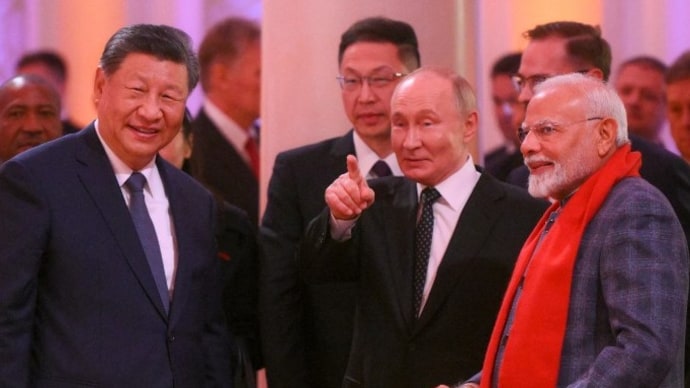
At the 2024 BRICS Summit in Russia's Kazan, Russian President Vladimir Putin, Chinese President Xi Jinping, and Indian Prime Minister Narendra Modi came together for high-level discussions. (Image: AFP/BricsRussia2024(dot)ru)
India Today World Desk
New Delhi,
Written By: Sushim Mukul
In Short
PM Modi and Brazil's Lula talk of deepening ties amid mounting US tariffs
Trump embraces crypto amid reports of Brics push for alternative currency
In the past week, the Global South has witnessed a flurry of diplomatic activity. India, China, Brazil, and even Russia, the 'expelled' Global North member, have all been actively engaged in discussions. Much of this momentum can be attributed to US President Donald Trump's aggressive tariff policies and vocal attacks on the bloc. This huddle of the OG Brics members, now expanded by five new member nations, appears to be forging a stronger alliance, one that experts say is preparing to challenge the US dollar's dominance and push back against Trump's daily tariff offensives. A heavy Brics blowback is most likely brewing against the Trump-led US.
The surge in Brics' diplomatic engagement coincides with Trump's imposition of steep tariffs on India, Russia, China, and Brazil, alongside his repeated criticism of the bloc as "anti-American".
Adding to the economic tensions is Trump's evolving stance on cryptocurrency. Once dismissive, calling Bitcoin a "scam", Trump is now aggressively pushing to make the US the world's crypto capital. This is widely viewed as a response to perceived threats from a potential Brics currency aimed at challenging the petrodollar's dominance, as well as an attempt to capitalise on the lucrative digital asset market.
The signs that the Brics is gearing up to take on Trump are undeniable. In just the past week, around half a dozen key developments have indicated concrete moves underway.
Prime Minister Narendra Modi on Friday said he had a "very good and detailed conversation" with Russian President Vladimir Putin and reaffirmed India's commitment to deepen the strategic partnership between both countries. Just a day earlier, India's National Security Adviser Ajit Doval met Putin in Moscow.
Reports suggest that Putin will visit New Delhi later this year.
The Indo-Russia bear hug came even as Brazilian President Lula da Silva spoke to PM Modi on Thursday.
Meanwhile, Modi is set to attend the Shanghai Cooperation Organisation (SCO) summit in China later this month, his first visit there in seven years. Beijing's tone has become cordial, with its mouthpiece, The Global Times, visibly softening its tone toward India.
WHAT BRICS MEMBERS HAVE SAID ON TRUMP'S TARIFFS
Trump has escalated trade tensions by doubling tariffs on Indian goods to 50%, citing India's continued imports of Russian oil, which accounts for 36% of its oil imports. Brazil faced a similar 50% tariff increase, linked to Trump's allegations of political persecution of former Brazilian President Jair Bolsonaro.
Trump's rhetoric has been blunt and nasty. He called India and Russia "dead economies" and accused New Delhi of profiting from reselling Russian oil. He further warned that Brics nations aligning against US interests would face an additional 10% tariff.
India has called the tariffs "unjustified".
Foreign Ministry spokesperson Randhir Jaiswal said India's "steady and time-tested" ties with Russia, urging the US not to view these relations through a third-country lens.
Meanwhile, Brazil's Lula rejected Trump's offer for direct trade talks, telling news agency Reuters, "I will not call Trump to negotiate anything I'm not going to humiliate myself". Instead, Lula vowed to use Brazil's Brics presidency to galvanise collective support and responses. He said he was planning discussions with PM Modi and Xi Jinping on the tariffs' impact.
LINK BETWEEN BRICS CURRENCY, TRUMP CRYPTOCURRENCY?
Trump's flip, from dismissing Bitcoin as a "scam" to positioning the US as the global cryptocurrency capital, shows the move might also be aimed at mitigating adverse affects of the potential Brics currency.
On Thursday, Tump signed an executive order allowing cryptocurrencies and alternative assets like private equity and real estate to be included in 401(k) retirement accounts, reported The Guardian.
Since his return to the White House, Trump has taken concrete steps in the crypto domain.
In January, he signed an Executive Order to promote US leadership in digital assets and establish a Strategic Bitcoin Reserve. He appointed crypto advocates like Paul Atkins as the Securities and Exchange Commission chair and David Sacks as "crypto czar". He has even backed his family's crypto venture, World Liberty Financial, which has engaged with Pakistan on cryptocurrency.
This shift is seen as a strategic move to counter the potential threat from Brics nations, who are exploring alternatives to the dollar's dominance through initiatives like Brics Pay and discussions of a commodity-backed currency. India, however, has denied pursuing a common Brics currency
By promoting a US-controlled crypto ecosystem, including the Strategic Bitcoin Reserve, Trump aims to maintain America's financial edge in a rapidly evolving global economy.
As American businesswoman Sandy Carter noted in Forbes, this approach could significantly impact the dollar's role as the world's main reserve currency. With more countries exploring digital currencies and decentralised finance, the dollar's dominance is at risk, but by embracing digital assets, the US could retain leadership and adapt to this shifting landscape.
MODI AND LULA STRATEGISE AGAINST US TRADE PRESSURE
Representing approximately 46% of the world's population and contributing around 35.6% to global GDP, the Brics bloc is coalescing against Trump's trade and economic policies.
Lula's hour-long call with PM Modi focused on deepening India-Brazil ties in trade, defence, energy, and technology, aiming to boost bilateral trade from $12 billion in 2024 to $20 billion by 2030. Lula also confirmed a state visit to India in early 2026. PM Modi, in a post on X, called for a "people-centric partnership" among Global South nations. He batted for a broader alignment, which is seen as a direct response to Trump's tariffs and policies.
"So basically, the world's largest democracy and South America's biggest player are swapping notes on how to play hardball with the US," said investor and influencer Mario Nawfal, summarising the situation.
"Next stop? Beijing. Modi's first trip to China in seven years, landing this August, as US–India vibes hit their frostiest point in a decade," added Nawfal.
During his recent Moscow visit, NSA Doval described previous India-Russia summits as "watershed moments". Then came the reports on Putin's planned visit to New Delhi later this year. Modi's attendance at the SCO summit in Tianjin signals India's and China's intent to better ties despite persisting border tensions.
As Brics nations tighten their economic and diplomatic bonds following Trump's tariff wars, they are clearly signalling a united front against the American President's aggressive trade tactics and efforts to maintain dollar supremacy. The evolving alliance not only challenges the status quo but also accelerates the shift toward a more multipolar global world, with the Global South seeking its rightful share. With Trump's tariffs hitting hard, the Brics coalition is gathering strength, and is fuelling a storm of resistance. A Brics blowback is likely coming for Trump.
- Ends
Published By:
Sushim Mukul
Published On:
Aug 9, 2025
Alexander Willis
August 9, 2025
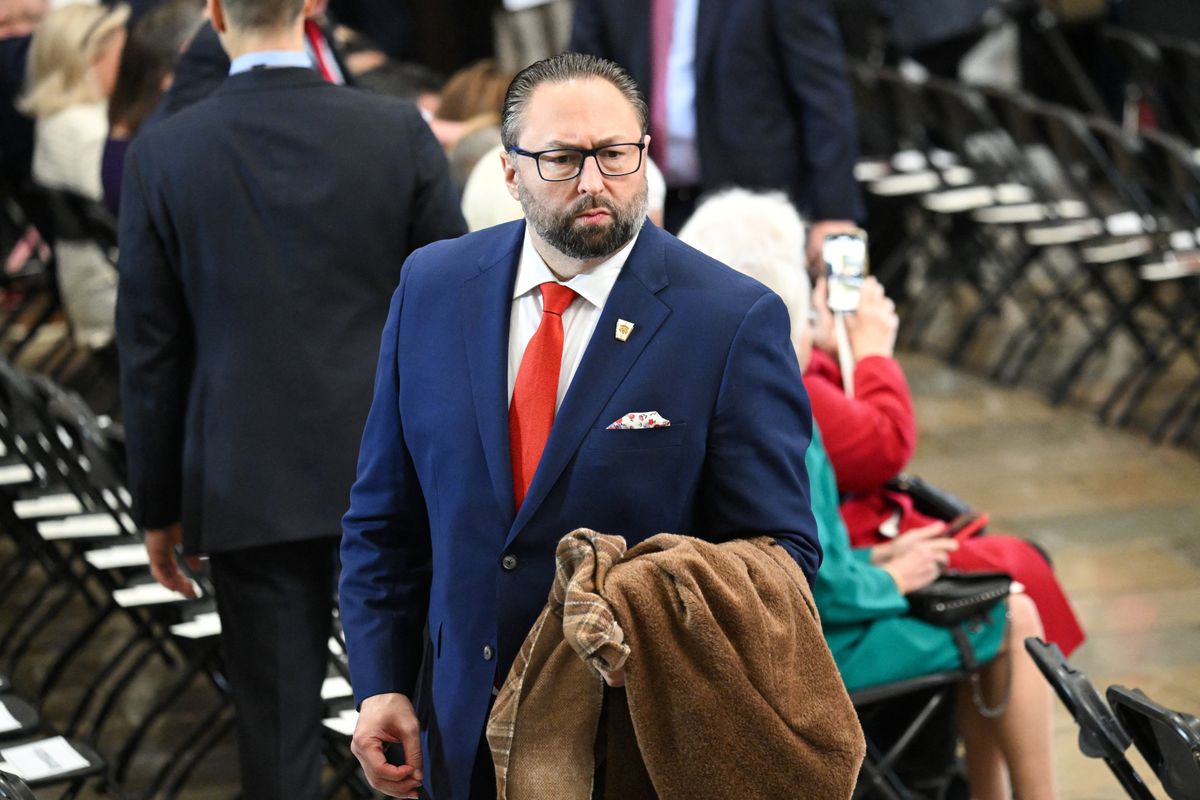
Jason Miller, advisor to US President-elect Donald Trump, arrives for the inauguration ceremony before Trump is sworn in as the 47th US President in the US Capitol Rotunda in Washington, DC, on January 20, 2025. SAUL LOEB/Pool via REUTERS
As governments worldwide scrambled to sway President Donald Trump and secure favorable trade terms before his so-called reciprocal tariffs took effect this week, India wagered heavily on a single Trump insider – and lost.
According to a report Saturday from Politico, India had paid $1.8 million to Jason Miller, a longtime Trump ally who was the president’s chief spokesman during his 2016 campaign, and senior advisor for his 2020 and 2024 campaigns, and Miller was paid, according to Justice Department documents obtained by Politico, for “strategic counsel, tactical planning and government relations assistance.”
Yet despite having the president’s ear, India’s $1.8 million bet failed to pay off, with India ending up being slapped with among the highest tariff rates of any nation at 50%, in large a response to the country continuing to buy Russian oil, undermining Trump’s leverage to end the Russian-Ukraine war.
“I think the current leadership in Washington seems to be disrupting the traditional way of doing things,” said Mukesh Aghi, CEO of the U.S. India Strategic Partnership Forum, speaking with Politico.
“It’s not just about the business part, it’s about diplomacy, it’s about dealing with other nations. I think the whole old model of trying to influence does not seem to work.”
Trump was reportedly “completely upset” with Indian leadership over its refusal to budge on key demands of the White House, a frustration that even a well-paid Miller apparently couldn’t overcome. In response, India has slapped back at the United States, pausing a previously planned purchase of billions of dollars’ worth of American-made weapons.
As to Miller’s failure to sway Trump, one lobbyist told Politico that traditional lobbying efforts don’t work on the current president.
“From my perspective, the best way to lobby President Trump is for the leader to face-to-face lobby him,” said Tami Overby, a partner at the South Korean lobbying group DGA Group Government, speaking with Politico.
“It seems President Trump, he always talks about his relationships with other leaders. You know, whether we’re in a good spot with that country or not [depending] if he feels like he’s got a good relationship. And he sees himself as a deal maker.”
The Other Side of Trump’s Tariff-War & India’s Response!
August 8, 2025
Photograph Source: The White House – Public Domain
What can be said about President Donald Trump’s attempt to exercise a “tariff-war” against countries which do not comply with his terms? This economic policy of his has been described by some as his bargaining-tactic, which perhaps is equivalent to compelling others to bow to his terms. But, what if all don’t give it much importance? What if they choose not to pay the attention to higher tariffs on certain goods, Trump has threatened to impose, which are imported from them? From his angle, Trump is perhaps over-confident that targeted countries, including Russia and China, have no other option but to go by what he says. US has threatened sanctions against Russia if it does not agree to a ceasefire with Ukraine. In other words, Trump appears adamant about an end to Ukraine-war. US has imposed additional 25% on India for not agreeing to stop import of Russian oil. This increases total duties of Indian goods imported to US to 50%.
Simply speaking, increase in tariff of whatever is imported to US also increases prices of the same for American investors, market, consumers and for whoever the goods bear importance within US. Slowly but definitely, it’s inflationary impact is likely to become more prominent in United States. Irrespective of whatever be logic deciding Trump’s tariff, he is apparently being over-confident by assuming that only his voice will echo, heard and then accepted by targeted countries. Regarding Ukraine-crisis, if President Trump is so concerned about continuity of a conflict, why has he chosen not to taken a similar stand on Gaza-genocide, prospects of which being heeded are stronger? The explanation is simple. In this case, Israel is too dependent on United States. If and when, Washington does not take a tough stand, Tel Aviv will have no option but to actually yield to ceasefire and stop “eliminating” Palestinians. The same cannot be said about Russia.
It is possible, at a point, US gave greater importance to continuity of Ukraine-crisis, considering it as a means to weaken Russia. In other words, Ukraine is apparently being used as a pawn between US and Russia. Diplomatically, Russia is wise enough to consider offer of dialogue and so forth on the issue. But that it will yield to US on Trump’s terms may be viewed as hardly possible. Russia still remains a strong and key power. It has considerable support and entertains good economic ties with a number of nations, which are least likely to be affected by sanctions imposed upon it by US.
India certainly has had good ties with US but New Delhi is not solely, exclusively and/or totally dependent on primarily US. It has maintained strong ties with Russia which it cannot afford to risk at “command” of US. Why should it? United States’ hard stand against Russia on any issue cannot compel all other countries to pursue the same path, diplomatically and economically. India has the sovereignty and independence and one may say can afford to chalk its own foreign policies. This is not the age of colonialism, neo-colonialism or neo-imperialism, when US or any power can dictate terms, in name of tariff-war, sanctions or any other strategy, to other countries.
But yes, it cannot be ignored, quite a few countries seem to have no option but to comply with what Trump is directing them to. Certainly, they also appear to caught in a fix given they are not too sure of what the next stand of US President could be. Their dependence, rather over-dependence on US, seems to have left them with extremely limited options. They appear to be caught in a dependency-trap.
Yes, despite a few discounts for some countries, tariff-war is likely to spell economic problems for all, with India and Brazil being among those severely affected. As indicated earlier, it is least likely to spare Americans also. But this is just a part of the game, Trump is playing to gain the upper edge against Russia. His logic is that purchase of oil from Russia is equivalent to giving funds to aggressive Russia and aiding it against Ukraine. If Trump was seriously concerned about ending conflicts, as he said at time of assuming office, the situation would have been different in Israel-occupied Palestine at present.
Trump is probably hopeful that his tariff-ploy will prompt Russian allies, including BRICS-members to his side and isolate Russia. His aim is to apparently spell economic as well as diplomatic blows for Russia. Chances of his having his way in this game at present seem quite limited. On the contrary, the impact seems to be contrary to what was probably speculated upon by Trump. Signs of Russia being isolated are hardly visible. His tariff-war appears to have prompted countries, who are closer to Russia than to USA- including BRICS member to consider closer ties among themselves. The message is simple. They are wise enough not to get entangled in Trump’s dependency-trap, the manner in which United States’ western allies have got caught in it. What the world is witnessing at present is not Trump’s “attempt” to convince Russia to a ceasefire or his tariff-war against those not yielding to his demands, particularly that of not buying oil from Russia, but another ploy. His predecessor Joe Biden was hopeful of weakening Russia by continuity of Ukraine-war. Trump is apparently not. He is thus trying his hand at tariff-war with the same objective. He hasn’t probably given much importance to considering options of his strategy not being acceptable to quite a few countries. More than probably he bargained for. Now, it’s to be watched, who has the last laugh. Perhaps, nobody, certainly not Trump!
No comments:
Post a Comment