Good Samaritans Save Nova Scotian Fishermen on the Grand Banks

The crew of the fishing vessel Atlantic Treasure can thank fellow Nova Scotian fishermen for their survival. When Atlantic Treasure started taking on water overnight Sunday, the crew of the nearby fishing vessel Maid Of Amsterdam answered their mayday call and brought them to safety within hours.
The Atlantic Treasure was under way on a fishing trip to the Grand Banks over the weekend. Late Sunday, the vessel suddenly began taking on water at a fast rate - possibly from a burst pipe, skipper Noah Deveau told CBC. Deveau had three crewmembers deploy the liferafts and gather all needed survival gear, then turned everyone else to the task of attempting to save the ship.
The flooding overwhelmed the bilge pumps, and within a short period of time the Atlantic Treasure was taking water on deck. When the power to the pumps went out, Deveau had the crew abandon ship into the life raft while the deck lights were still lit. All hands made it safely aboard the raft and away from the sinking vessel.
Deveau got a mayday out before abandoning ship, and Maid Of Amsterdam's skipper responded. The Amsterdam was about three hours away, headed back to port ahead of the arrival of Hurricane Erin. It diverted to meet up with the drifting raft, and in calm surface conditions, all Atlantic Treasure crewmembers transferred over safely and headed back for Nova Scotia.
The timing of the rescue was fortunate: Hurricane Erin is expected to pass off the coast of Nova Scotia and Newfoundland on Saturday with winds of about 80-100 knots.
Bulk of Oil Removed During Salvage of MSC Baltic III in Canada
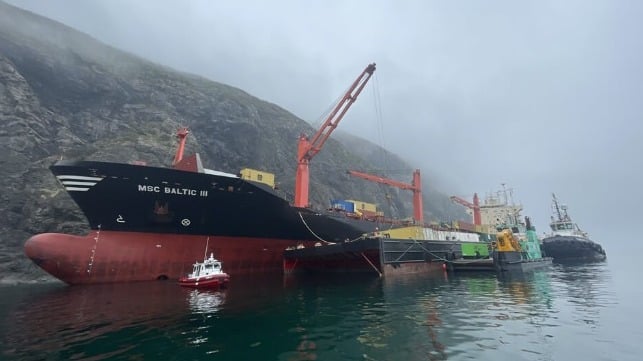
The Canadian Coast Guard signaled a milestone in the ongoing salvage operation for the MSC Baltic III, which grounded five months ago during a fierce winter storm off Newfoundland, Canada. After a slow start delayed by weather and the remote location of the vessel, the latest update said the bulk of the oil has been removed from the internal tanks, and nearly three-quarters of the containers have been offloaded.
Fuel has been and remains the largest concern for the vessel, which is firmly aground in a cove on the western shore of Newfoundland. The weather and grounding caused cracks in the hull, and the vessel has been weeping small amounts of oil, with a few tar balls found along the shorelines.
The ship blacked out on February 15 and was driven ashore, with the Canadians conducting a daring helicopter rescue of the 20 crewmembers aboard. When they were able to begin a survey of the vessel, at first, they said there was as much as 1,710 metric tons (1.7 million liters) of heavy fuel oil and Marine Gas Oil aboard as fuel. Later soundings of the tanks lowered the quantity to 1,600 metric tons, but the concern remained that the tanks would leak, causing an environmental disaster.
The process of removing the fuel has been laborious as it needs to be heated with steam. The Coast Guard has said that it takes up to a week, and then the fuel is pumped from the ship’s tanks to temporary storage tanks that were placed on the deck. However, those tanks once filled are too heavy to lift, so the fuel has to be again heated and pumped to tanks on a barge placed alongside. MSC’s salvage company has been organizing this, and the fuel is ultimately loaded aboard other passing MSC containerships.
The salvage effort was quickly able to secure and then remove a small number of containers with hazardous materials. The ship, in total, had approximately 475 containers aboard, although reports said more than half were empties. The vessel’s onboard cranes have continued to work, and they have aided with the offloading of the boxes.
Last week, the Coast Guard said a further 26 containers had been removed. A total of 333 containers have been offloaded, with a further 142 remaining on the vessel.
With the fuel tanks largely empty, the focus is now on the approximately 10 percent of residual oil aboard. The Coast Guard considers the remaining fuel oil equally important because if it were to leak, it could still cause significant environmental damage.
No plans have been announced for the hulk. Early assessments said it would not be possible to remove the vessel in its current state while it was still loaded. It is unclear if there will attempt to pull the vessel free after the offloading is completed or if they plan to cut the vessel up in its current position.
No comments:
Post a Comment