CRIMINAL CAPITALI$M;GRIFTER IN CHIEF
Most of Trump's Net Worth Comes From 'Crypto Empire': Report
According to an investigation by Accountable.US, 73% of Trump's net worth may now come from crypto, which his administration is working to dramatically deregulate.
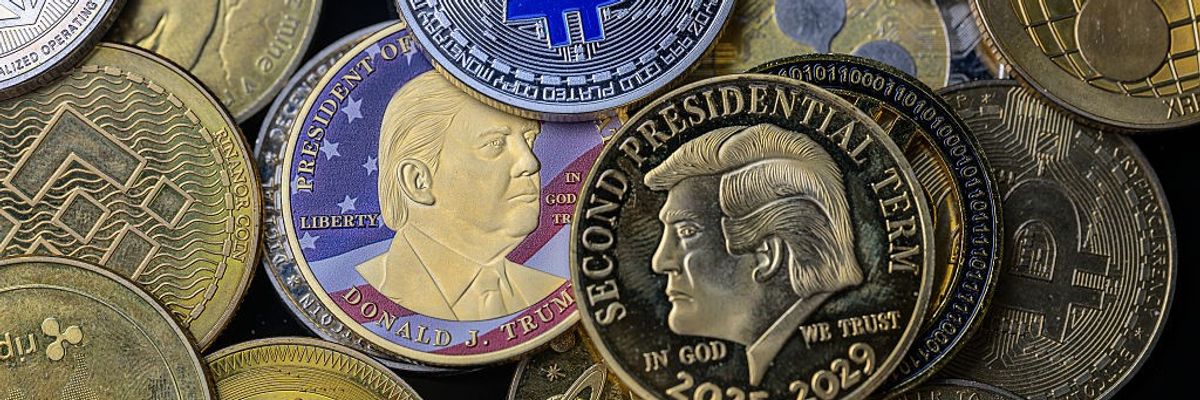
A Donald Trump coin is pictured alongside Bitcoin and various other cryptocurrencies in this photo illustration in Brussels, Belgium, on August 5, 2025.
(Photo: Jonathan Raa/NurPhoto via Getty Images)
Stephen Prager
Aug 11, 2025
COMMON DREAMS
Over his nearly seven months as president, the administration of U.S. President Donald Trump has been taking a sledgehammer to regulations on cryptocurrency. A new report sheds further light on the reasons why.
The president may be profiting far more from his "rapidly-growing crypto empire" than was previously known and has used it to dramatically increase his net worth, according to an investigation released Thursday by the anti-corruption group Accountable.US
While a report from Bloomberg on July 2 estimated the billionaire president's crypto holdings to total about $620 million of his nearly $7 billion net worth, Accountable examined other investments that had not previously been reported.
"President Trump's net worth," the group estimated, "could roughly be $15.9 billion, with about $11.6 billion in uncounted crypto assets." This would mean crypto accounts for 73% of his net worth.
Accountable reached this number by including investments that either had not yet occurred or were not public at the time of previous reporting.
These included roughly 22.5 billion tokens issued by Trump-owned WorldLiberty Financial Inc., which are estimated to be worth about $2 billion in value, but had not yet become tradable.
Other analyses, it said, also excluded the $7 billion in value of the new $TRUMP memecoins released in late July 2025.
"Two Trump-affiliated companies owned 80% of the $TRUMP venture as of May 2025 and were estimated to have collected over $324 million just in fees since January 2025," the report said.
Accountable also factored the holdings of Trump Media—the company that owns the president's social media app Truth Social. In July, the company bought $2 billion in Bitcoin and reserved another $300 million for Bitcoin options, and also announced the launch of its own set of NFTs.
As part of what they called "Crypto Week," Republicans passed multiple industry-friendly pieces of crypto legislation in July, the GENIUS Act and the CLARITY Act, which Accountable says allow Trump to directly profit.
The GENIUS Act purported to create a regulatory framework for so-called "stablecoins," which are pegged to existing financial assets like the U.S. dollar and are poised to become part of the portfolios of increasing numbers of companies. However, as Nikki McCann Ramirez wrote for Rolling Stone in June:
One of Trump's priorities has been the normalization of these so-called stablecoins — a type of asset that his family is now hawking.
Despite the moniker, stablecoins can be extremely unstable. A 2023 study published by the Bank for International Settlements found that of 60 stablecoins analyzed in their review, all of them had become de-pegged from their underlying asset at least once.
The 2022 crypto crash was triggered by the failure of Terraform Lab's Terra/Luna "algorithmic" stablecoin—the collapse of which saw $45 billion erased in the span of a week.
The bill places only very light regulations on stablecoins, and Sen. Elizabeth Warren (D-Mass.) has warned that since he controls such a large percentage of the stablecoin market, their uptake into the broader economy could "create a superhighway for Donald Trump's corruption."
"As soon as the players understand that Trump's intervention is a real possibility, then the stablecoin market is no longer about a careful review of whether there are adequate dollars to back up a particular stablecoin, or whether the stablecoin issuer has an AAA rating," Warren said.
"Instead, the whole game becomes one of trying to engage the president to weigh the end and make one set of coins more valuable, and therefore another set of coins less valuable," she added. "It's corruption, but it's also a market manipulation that ultimately drains away any development...It undermines all the markets at that point."
But the CLARITY Act, which has been passed by the House and now awaits consideration in the Senate, is "the real prize" for the industry. It would dramatically narrow the Securities and Exchange Commission's (SEC) ability to regulate cryptocurrencies—most notably by recategorizing many assets as commodities instead of securities, which places them under the much smaller and less-resourced Commodity Futures Trading Commission (CFTC).
Trump would be one of the foremost beneficiaries of this bill, which would exclude digital assets like his $TRUMP and $MELANIA "meme coins" from SEC regulation.
It would also likely affect the classification of Bitcoin, which Trump Media has explicitly acknowledged would benefit the president. "If Bitcoin is determined to constitute a security," the company said in a June SEC filing, it could "adversely affect" the price of Bitcoin and the price of Trump Media's holdings.
Not only does this benefit Trump, said Accountable.US executive director Tony Carrk, but the legitimization and entrenchment of these unstable assets has the potential to make the whole economy less stable.
"Eerily reminiscent of the risky behavior that gave us the 2008 financial collapse, Donald Trump is ushering in a new era of casino-like speculation on Wall Street with highly volatile crypto trading in retirement accounts," Carrk said.
"While the Trump family stands to win either way with crypto investment product fees," Carrk added, "throwing such a wild card into the financial system with little to no guardrails could lead to history repeating itself—with everyday Americans footing the bill when things inevitably go south."
GENIUS Act gives global crypto industry ‘clarity, simplicity,’ says expert
By Jordan Fleguel
By Jordan Fleguel
Published: July 24, 2025
Landmark cryptocurrency legislation signed into law by U.S. President Donald Trump last week gives the fast-growing global crypto industry new legitimacy while making it easier for investors to gain exposure to the sector in a safe way, an expert says.
“It gives clarity, simplicity and lets everybody understand what the rules of the playing field are,” Andrew Forson, president of Toronto-based DeFi Technologies, told BNN Bloomberg in an interview on Wednesday.
“That encourages innovation without fear of inadvertently triggering a securities law or breaking some sort of rule that would make it really, really difficult for the business to recover from.”
The legislation, known as the GENIUS Act, is a major step toward legitimatizing the crypto industry in the eyes of the U.S. government through overarching rules and regulations. But the law’s impact will reach far beyond American crypto markets, said Forson.
“The U.S. is without a doubt the largest capital market in the world, and whenever they provide a degree of regulatory clarity, it makes it easier for everybody worldwide,” he explained.
The rise of cryptocurrency trading has led to increased demand from investors looking to gain exposure to the industry without taking on the risk and volatility it’s historically been associated with.
Crypto-linked exchange-traded funds (ETFs) have began popping up on exchanges around the world in recent months, offered by financial services companies like DeFi.
“DeFi Technologies and our wholly owned subsidiary Valour is probably one of Europe’s most significant or prominent digital asset exchange-traded product (ETP) issuers,” Forson said.
“In particular, we have 78 digital asset-underlying ETPs listed on over eight exchanges throughout the world, and one of the big benefits of this is it makes it a lot easier for institutions and retail investors to gain exposure to digital assets in their investment portfolios.”
Forson said he acknowledges that there will likely continue to be a certain amount of hesitancy towards cryptocurrency from some investors given the numerous instances of fraud in the industry over the years.
The most notable example being the high-profile collapse of popular crypto exchange FTX in 2022, which led to fraud charges being brought against founder Sam Bankman-Fried. He eventually was found guilty and is currently serving a 25-year prison sentence.
“That actually is one of the reasons why DeFi… (is) so well positioned to help institutions and individuals gain real exposure to the digital asset space, with broad exposure across many, many digital assets beyond just bitcoin, in a safe and regulated manner,” said Forson.
Shares in DeFi itself, which were changing hands at around US$3 per share in midday trading on Thursday, are cheaper than they should be, Forson argued, noting that the company is profitable and has many avenues for future growth.
“I can unequivocally say that we are undervalued. We should be trading at a higher multiple than we are… we are a profitable company, we actually make real money and (will) continue to do so into the foreseeable future,” he said.
“Just a few days ago, we hit the US$1 billion assets under management metric, which is always a nice threshold to reach, with the assets that are held by Valour, and DeFi Technologies itself is also involved in a number of other areas including a corporate venture capital portfolio.”
Jordan Fleguel
Journalist, BNNBloomberg.ca
Landmark cryptocurrency legislation signed into law by U.S. President Donald Trump last week gives the fast-growing global crypto industry new legitimacy while making it easier for investors to gain exposure to the sector in a safe way, an expert says.
“It gives clarity, simplicity and lets everybody understand what the rules of the playing field are,” Andrew Forson, president of Toronto-based DeFi Technologies, told BNN Bloomberg in an interview on Wednesday.
“That encourages innovation without fear of inadvertently triggering a securities law or breaking some sort of rule that would make it really, really difficult for the business to recover from.”
The legislation, known as the GENIUS Act, is a major step toward legitimatizing the crypto industry in the eyes of the U.S. government through overarching rules and regulations. But the law’s impact will reach far beyond American crypto markets, said Forson.
“The U.S. is without a doubt the largest capital market in the world, and whenever they provide a degree of regulatory clarity, it makes it easier for everybody worldwide,” he explained.
The rise of cryptocurrency trading has led to increased demand from investors looking to gain exposure to the industry without taking on the risk and volatility it’s historically been associated with.
Crypto-linked exchange-traded funds (ETFs) have began popping up on exchanges around the world in recent months, offered by financial services companies like DeFi.
“DeFi Technologies and our wholly owned subsidiary Valour is probably one of Europe’s most significant or prominent digital asset exchange-traded product (ETP) issuers,” Forson said.
“In particular, we have 78 digital asset-underlying ETPs listed on over eight exchanges throughout the world, and one of the big benefits of this is it makes it a lot easier for institutions and retail investors to gain exposure to digital assets in their investment portfolios.”
Forson said he acknowledges that there will likely continue to be a certain amount of hesitancy towards cryptocurrency from some investors given the numerous instances of fraud in the industry over the years.
The most notable example being the high-profile collapse of popular crypto exchange FTX in 2022, which led to fraud charges being brought against founder Sam Bankman-Fried. He eventually was found guilty and is currently serving a 25-year prison sentence.
“That actually is one of the reasons why DeFi… (is) so well positioned to help institutions and individuals gain real exposure to the digital asset space, with broad exposure across many, many digital assets beyond just bitcoin, in a safe and regulated manner,” said Forson.
Shares in DeFi itself, which were changing hands at around US$3 per share in midday trading on Thursday, are cheaper than they should be, Forson argued, noting that the company is profitable and has many avenues for future growth.
“I can unequivocally say that we are undervalued. We should be trading at a higher multiple than we are… we are a profitable company, we actually make real money and (will) continue to do so into the foreseeable future,” he said.
“Just a few days ago, we hit the US$1 billion assets under management metric, which is always a nice threshold to reach, with the assets that are held by Valour, and DeFi Technologies itself is also involved in a number of other areas including a corporate venture capital portfolio.”
Jordan Fleguel
Journalist, BNNBloomberg.ca
No comments:
Post a Comment