DOT and MARAD Pull Nearly $700M in Port and Wind Terminal Grants
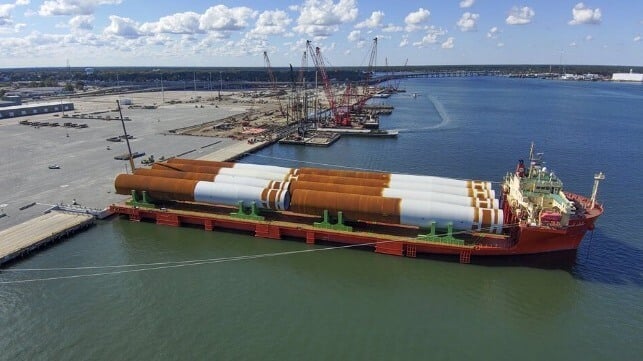
The efforts to detail the U.S. offshore wind power industry are continuing with the US Department of Transportation and the Maritime Administration (MARAD) terminating and withdrawing nearly $700 million in grants made by the Biden administration for wind ports and terminals. In total, they identified 12 offshore wind grants and project selections in discretionary grant programs to be canceled.
The press statement references “doomed offshore wind projects,” saying the funding will be prioritized toward restoring America’s maritime dominance. They report that DOT and MARAD are refocusing on “rebuilding America’s shipbuilding capacity, unleashing more reliable, traditional forms of energy, and utilizing the nation’s bountiful natural resources.”
DOT has withdrawn one project from the Nationally Significant Freight and Highways Projects program, saving they report roughly $427 million. MARAD has withdrawn six projects, retracting $177 million, and terminated six projects in the Port Infrastructure Development Program, saving roughly $75 million. It totals $679 million in grants.
“The Trump administration is weakening our country’s national security and destroying good-paying jobs by pulling critical funding designed to update our aging maritime infrastructure," said Liz Burdock, CEO of Oceantic Network, a nonprofit supporting offshore wind and ocean energy. "Offshore wind port development upgrades facilities and capabilities that serve multiple industries; however, by selectively limiting infrastructure investments and removing mandated agreements in energy and shipyards, the administration is stalling essential development that delivers on shared priorities of national security and energy dominance, and signals to the investment community the U.S. is not safe place for investment."
The largest project included in the list is California’s Humboldt Bay Offshore Wind, which loses roughly $427 million in grants. The list also includes major wind projects including the Salem Wind Port in Massachusetts which was terminated at a saving of roughly $33.8 million, the Norfolk (Virginia) Offshore Wind Logistics Port ($39 million), Sparrows Point (Maryland) Steel Marshalling Port ($47 million), New Jersey’s Wind Port at Paulsboro ($20 million), Arthur Kill (New York) Terminal ($48 million) and the Redwood (California) Marine Terminal ($8.7 million). It also includes $10.5 million for the Bridgeport Port Authority (Connecticut) for the Operations and Maintenance Wind Port Project.
The Port of Davisville (Rhode Island) loses $11.25 million. The Lake Erie Renewable energy project ($11 million), Radio Island Rail Improvements (North Carolina) loses $1.7 million, and Portsmouth Marine Terminal (Virginia) loses $20 million.
The statement says that, where possible, funding from these projects will be "recompeted" to address critical port upgrades and other core infrastructure needs of the United States.
“Wasteful wind projects are using resources that could otherwise go towards revitalizing America’s maritime industry,” said U.S. Transportation Secretary Sean Duffy. “Joe Biden and Pete Buttigieg bent over backwards to use transportation dollars for their Green New Scam agenda while ignoring the dire needs of our shipbuilding industry.”
The accusations from Duffy and the Trump administration ignore the extensive investments made by the offshore wind industry into shipbuilding and the revitalization of ports such as Salem, Bridgeport, Norfolk, and Portsmouth. In 2023, President Joe Biden highlighted that companies had announced 18 offshore wind shipbuilding projects as well as investments of nearly $3.5 billion across 12 manufacturing facilities and 13 ports to strengthen the American offshore wind supply chain. The vessels ranged from the first Jones Act-compliant installation vessels to SOVs and crew transfer vessels. They were being built at shipyards ranging from Florida to Louisiana, New York, Massachusetts, Michigan, Rhode Island, Wisconsin, and Pennsylvania.
Many of the projects went to smaller shipyards to build crew transfer vessels. Among the large projects were SOVs built by Edison Chouest Offhore in Louisiana and Fincantieri Bay in Wisconsin. Seatrium AmFELS shipyard in Brownsville, Texas, is completing the massive turbine installation vessel Charybdis, the first of its kind in the United States, for Dominion, and Hanwha Philly Shipyard recently floated a rock installation vessel being built for Great Lakes Dredge & Dock Company.
Australia Awards More Preliminary Feasibility Licenses for Offshore Wind
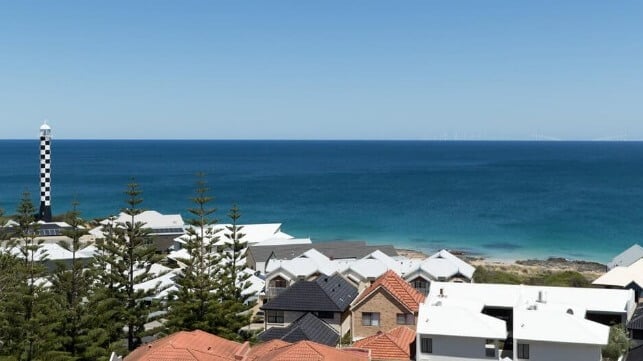
The Australian government reports it is continuing to push forward with efforts to spur development for offshore wind energy. In its latest step, it awarded two additional preliminary feasibility licenses, both going to groups backed by European majors, for what could become the first offshore wind farms in the Indian Ocean.
The move comes as some of the major European corporations have stalled their efforts in Australia or withdrawn. Last week, it was revealed that Equinor will not be accepting its feasibility license for a proposed project that would have involved floating wind turbines off the Hunter coast of New South Wales. The company reportedly could not reach an agreement with its local partner Oceanex, while last month it also withdrew from a project planned for the Bass Strait.
Minister for Climate Change and Energy, Chris Bowen, called the new licenses being awarded another important step for the industry in Western Australia. He highlighted that “Western Australia needs some 50 GW of additional generation by 2042.”
The zone located south of Perth was declared in September 2024, with the government saying it could provide as much as 11.4 GW of renewable energy. The first of the licenses was awarded to Oceanex Energy, which is planning a project in the northern part of the zone, but awards for the southern portion of the zone were delayed while two developers could resolve an overlap between their plans.
One of the new licenses went to a group backed by France’s EFP Group. It is planning the Bunbury Offshore Wind South project. Ocean Winds, a partnership between Spain’s EDP Renewables and France’s ENGIE is also receiving a preliminary license for its Westward Wind project.
The preliminary licenses permit the companies to continue planning efforts. They are also required to meet with the indigenous people, which Australia calls “traditional owners.” The companies will later apply for the full feasibility permits.
A third project, called Wind With Purpose, is still pursuing discussions with a potential Tier 1 partner, it told ABC News Australia. The government deferred granting it a preliminary feasibility license.
Minister Bowen said in a statement, “Australia’s offshore wind industry is progressing, with feasibility licenses granted for projects targeting a total of 24.21 GW of renewable energy and preliminary offers for another 4 GW.” He told ABC News that there is more to come, referencing the ongoing efforts to push forward the offshore wind industry.
North Carolina Utility Cites Costs Deferring Offshore Wind Power for Solar
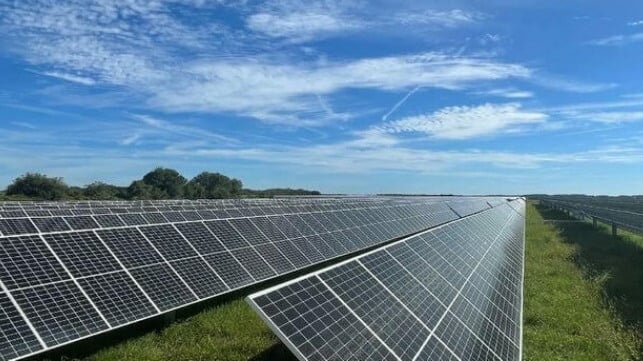
Duke Energy, which is one of the United States’ largest energy companies, has determined that offshore wind energy does not offer a cost advantage over solar power for North Carolina. The determination came as the utility was planning its long-term power sources and is based on proposals from the current leaseholders for offshore wind in North Carolina.
Headquartered in North Carolina, the company operates utilities in the Southeast as well as the Midwest. Its North Carolina utility was directed by the state's Utilities Commission last fall to explore offshore wind energy. As part of this review, it was instructed to request estimates from the three leaseholders for the development of up to 2.4 GW of offshore wind energy.
Duke, through its non-regulated subsidiary Cinergy, holds one of the leases that it was awarded in 2022. The project known as Carolina Long Bay is 22 miles south of Bald Head Island and could support up to approximately 1.6 GW. Neighboring Carolina Long Bay is TotalEnergies, which has the potential for 1.6 GW, and the two companies have explored collaborations.
A third offshore site available to Duke is Avangrid’s Kitty Hawk South, which was awarded in 2017. The company originally said it could produce up to 2.4 GW, but in 2022 sold the northern portion of its lease to Dominion Energy.
The three developers submitted a total of eight proposals, Duke reports in a filing to the Utilities Commission. It was looking for the projects to be developed by 2035.
In the filing submitted on August 11, Duke informed the commission that, based on its review, it determined solar and battery storage was cheaper in every instance. The company reports it was comparing the cost of building 3,576 MW of solar panels and 3,440 MW of battery storage capacity.
A spokesperson for the company told North Carolina Public Radio that they determined “offshore wind is not cost-competitive at this time.” The commission had instructed Duke that if the proposals were cost-competitive, to proceed with a binding request for proposals.
Supporters of wind energy were quick to criticize the review, noting that solar only provides power 30 to 40 percent of the time, whereas wind energy can generate between 80 and 90 percent of the time. They said they were “disappointed” that Duke was not proceeding, highlighting that it would require at least a decade before construction and commercial operations could be realized.
“The cost of wind being compared to solar and storage is one thing, but the efficiency of offshore wind being compared to solar and storage is a completely different thing because there are just fundamentally so many key differences between the technologies," Karly Brownfield, a senior program manager with the Southeastern Wind Coalition, told the public radio station WUNC.
Duke Energy is aggressively pursuing solar energy in Florida. The company reported last month that it currently owns, operates, and maintains a portfolio of more than 25 solar sites across Florida that generate approximately 1.5 GW, and between 2025 and 2027, the company plans to build 12 new solar sites, adding 900 megawatts. By the end of 2033, Duke Energy Florida projects it will have over 6.1 GW of utility-scale solar generating capacity online.
The company is reviewing its North Carolina plans. In a 2024 plan, it showed up to 1.6 GW of offshore wind energy by 2035. Another model included as much as 2.4 GW of offshore wind energy.
The planning study was undertaken before the Trump administration’s latest moves against the offshore wind energy sector. In addition to its ending leasing, the administration is now starting a national security review. It has also curtailed tax credits and other incentives for offshore wind energy development.
No comments:
Post a Comment