It’s possible that I shall make an ass of myself. But in that case one can always get out of it with a little dialectic. I have, of course, so worded my proposition as to be right either way (K.Marx, Letter to F.Engels on the Indian Mutiny)
Friday, August 01, 2025
Sri Lanka Seeks Compensation as Debris From MSC Elsa 3 Washes Ashore
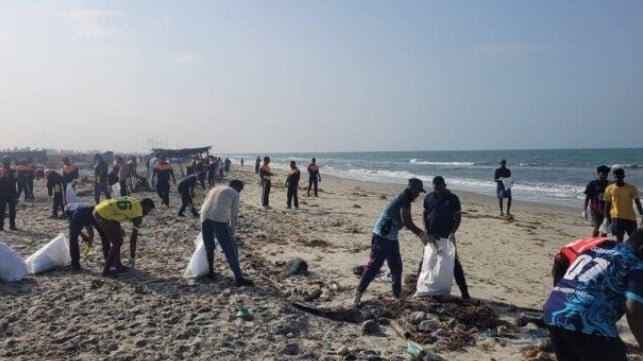
Volunteers clearing the beaches as part of the Clean Sri Lanka campaign are finding debris believed to be coming from the MSC Elsa 3 casualty more than 500 miles away (MEPA Sri Lanka)
Sri Lanka’s Marine Environment Protection Authority (MEPA) confirmed that it has begun negotiations with MSC Mediterranean Shipping Company seeking compensation for environmental damage related to the MSC Elsa 3 casualty. The government is considering legal action, although a representative said MSC has accepted responsibility in the ongoing discussions.
The containership sank in late May, southwest of the Indian state of Kerala on the west coast. The direct distance is over 300 miles from Sri Lanka, but approximately 500 miles following the ocean currents around the southern tip of the Indian continent. Despite the distance, Sri Lankan authorities report they are clearing plastic beads (nurdles) from the beaches daily. Officials declined to identify the quantity of material retrieved, but did confirm that so far, no oil from the wreck has reached the shores of Sri Lanka.
Officials told the media that plastic pellets have been found washed ashore in areas such as Jaffna, Kalpitiya, and Delft. They said the debris is being collected and will be used as evidence in the demand for compensation and a possible insurance claim.
They are discussing the best course of action while the Lankasara news outlet reports initial discussions are underway with MSC. It reports that the damage assessment is ongoing. The report says in addition to the nurdles, packing materials, plastic fragments, damaged consumer goods, and other debris believed to be from the MSC Elsa 3 have been washing up along the shore as far south as the Hambantota District at the southern tip of the island. On July 29, Sri Lanka alerted residents as part of its "Clean Sri Lanka" coastal clean-up campaign.
Reports from India have said that so far, MSC’s lawyers have denied claims of widespread environmental damage from the casualty. India’s Directorate General reported that approximately 60 containers washed ashore and were recovered. As of July 17, it says 557 metric tons of nurdles have been collected from the affected shoreline areas. Its priority, however, is now on the second phase of the recovery operation, which was due to start in the coming days. Equipment has been moved to the site for a campaign of saturation diving as part of the effort to pump the fuel and oils from the wreck. In June, divers were successful in capping the tanks to stop a slow seepage of oil.
Sri Lanka looks to the recent court decision from the 2021 casualty of the X-Press Pearl as a model for its compensation claims. The country’s highest court ordered the shipping company and its agents to pay nearly $1 billion in compensation for what was termed the worst environmental incident in the Indian Ocean.
India has also launched legal actions for compensation from MSC for the impact of the casualty. The Indian courts impounded the containership MSC Akiteta II, which is being held until the company posts a bond in the case. The initial court filing made at the beginning of July lists a total claim for $1.1 billion, with the bulk, $1 billion, for damages as a result of pollution. It is also seeking $44 million to restore the environment and a further $61.3 million in economic loss for the fishing community.
Greenpeace Calls for MSC to Pay for Sunken Boxship's Cleanup
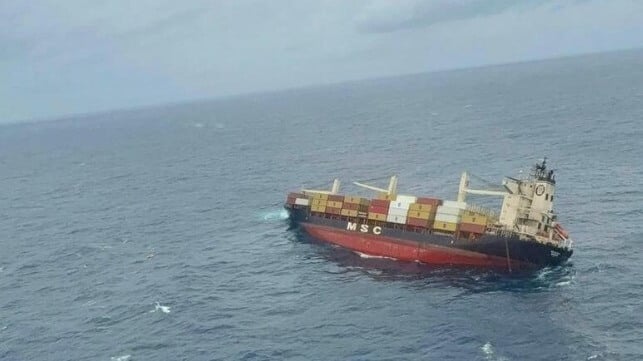
MSC Elsa 3, seen shortly before capsizing (Indian Ministry of Defense)
Greenpeace India is demanding more action from Mediterranean Shipping Company (MSC) in the wake of the sinking of the MSC Elsa 3, the small boxship that went down off Kochi in late May. The operator is engaged in litigation with the state of Kerala, and has so far declined to pay compensation for pollution or interruption in economic activity along the coastline.
On May 25, the feeder MSC Elsa 3 was under way from Vizhinjam to Kochi with a cargo of 640 containers on board. The ship developed a list, and the crew sent out a distress signal and abandoned ship. The vessel capsized and went down with about 450 tonnes of fuel aboard, along with various chemicals and a substantial cargo of nurdles (plastic pellets). The salvor's plans for fuel removal are expected to begin in August, and cleanup of nurdle contamination is ongoing. In court, MSC's counsel has denied that the sinking has resulted in pollution.
As a precautionary measure, the Indian government banned fishing within 20 nautical miles of the wreck site, and Greenpeace reports that fears about seawater pollution have reduced public demand for fish in the region. This has led to a loss of income for local fishing communities, Greenpeace says, only partially offset by hardship payments from the Indian government.
In addition to concerns about fuel oil, the NGO reports that large volumes of nurdles (plastic pellets) have washed ashore on the coast of Kerala, the Gulf of Mannar and even the coast of Sri Lanka, far to the southeast. Nurdles have a negative effect on fish, birds, turtles and other wildlife, as the pellets are often mistaken for food and consumed. Kerala's Directorate General of Shipping reported that as of the beginning of July, an estimated 450 to 500 tonnes of nurdles have been collected from the shoreline.
Greenpeace called for the pursuit of a legal action against MSC to secure damages; three cases are currently under way. A public-interest suit filed at the High Court of Kerala has already resulted in the arrest of two other MSC vessels at Indian ports, held as collateral under admiralty jurisdiction while litigation moves ahead. Separately, the Fort Kochi Police have also registered a first information report - an initial allegation of criminal wrongdoing - against MSC, the vessel's master and the crew. Kerala's state government later filed its own admiralty suit to recover costs of the cleanup and damages, and its claims total more than $1 billion.
MSC Elsa 3 was a small feeder ship built in 1997. The 28-year-old vessel had a history of port state control deficiencies, including issues with her auxiliary engines, electrical systems, lifeboats and firefighting provisions, among others. The cause of the casualty has not yet been definitively identified, but Indian officials have alleged that the ship's ballast system suffered a malfunction.
MSC Aims to Deepen Relationship with China Despite Looming U.S. Fees
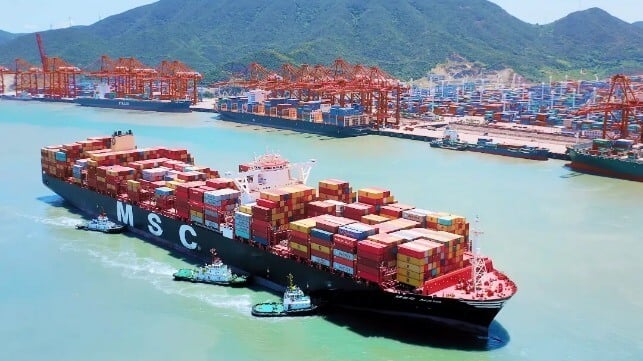
MSC, which is already a major presence in Ningbo, is adding an office for ship management services and crewing (Ningbo-Zhoushan Port)
MSC Mediterranean Shipping Company is expanding its relationship with China on multiple fronts as the company continues its unrelenting drive to expand and pull away from the pack in container shipping. The company celebrated last week the launch of a new ship management operation to be based in Ningbo, China, and is reported to have more than 70 vessels on order from Chinese shipyards, all despite the looming move by the U.S. Trade Representative to impose fees on Chinese-built ships calling in U.S. ports.
In an exclusive interview with the Ningbo Daily, Prabhat Jha, CEO of the newly launched MSC Ship Management (Ningbo) and MSC Crewing Services (China), highlighted the company’s deep relationship with Ningbo, which he also highlights as a center of the Chinese shipping industry. He calls the company “a big user” of the Ningbo port, noting MSC has a 16 percent market share in containers.
He reiterates that the company is looking to build new locations and needs new sources of crew and locations for crew training to support its growth plans. He says MSC currently employs about 700 Chinese seafarers and by 2026 it looks to grow this to 2,000 seafarers.
Historically, MSC has maintained its ship management operations in Cyprus and its headquarters in Switzerland. It manages chartered ships and a portion of its fleet of nearly 1,000 ships from Cyprus. The unrelenting drive of the past few years has seen the company surpass Maersk and now has a nearly 50 percent larger capacity, or over 6.7 million TEU.
The new Chinese companies will provide full services to support the fleet beyond just its operations in China. In addition to a location for crew recruitment and training, they will provide ship management services. Jha also notes China’s efforts to meet the shipping industry’s needs to achieve decarbonization.
As a private company, MSC rarely announces its shipbuilding plans, but multiple reports from brokers have tied the carrier to yet another round of large ship orders. In recent weeks, MSC has been linked to orders for six 22,000 TEU containerships to be built at two Chinese yards and another order, 3 + 3, for 21,000 TEU vessels. Chinese shipyards are believed to represent approximately half of the company’s total newbuild containership orders.
Alphaliner calculates that MSC has a total of 131 new vessels on order. They report that this represents 2.2 million in TEU capacity.
Jha told the Ningbo Daily that the company’s decision to set up the management and crewing operation in Ningbo was “closely tied to the scale, efficiency, and strategic location of the Ningbo-Zhoushan Port.”
All of this comes as the USTR is moving to finalize its plans for fees on Chinese-built ships. MSC seems unfazed by the U.S. efforts to break China’s dominance in shipbuilding and role in global shipping as it continues its own growth.
MSC Group’s Cruise Division today published its 2024 Sustainability Report reaffirming its commitment to achieving net-zero greenhouse gas (GHG) emissions by 2050, accompanied by an independently verified Energy Transition Plan (ETP) to clearly show how it is working to achieve this ambition.
The report, now in its sixth edition, highlights milestones in environmental innovation, responsible tourism, and social impact. It reflects MSC Group’s Cruise Division’s integrated approach to sustainability for its MSC Cruises’ and Explora Journeys’ brands.
Pierfrancesco Vago, Executive Chairman, MSC Group’s Cruise Division, said, “As a family business, we do not operate ships just for tomorrow. We sail them for future generations, designed for fuel flexibility, guided by innovation, and powered by people who share our long-term vision.
“The Cruise Division in 2024 reaffirmed its commitment to advancing a bold and transparent sustainability strategy that balances environmental stewardship, social responsibility, and economic resilience.”
Report highlights include:
Launching of the Energy Transition Plan for the fleets of MSC Cruises and Explora Journeys, outlining interim absolute emissions reduction targets. This is a published roadmap to achieving net-zero GHG emissions from marine operations by 2050.
Avoiding 50,000 tonnes of CO? emissions through fleet-wide optimisation tools (OptiCruise and Oceanly Performance) which support real-time operational efficiency and itinerary planning.
An increase in shore power connections from 44 in 2023 to 142 in 2024, across 13 ports. All new ships since 2017 are shore-power ready with retrofitting continuing across the fleet, and the Cruise Division remains committed to using shore power wherever it's available.
An increase in crew retention rate to 89 per cent, up from 83 per cent in 2023, demonstrating the commitment of the Cruise Division to employee engagement and development.
The formation of a Diversity & Inclusion Advisory Committee, underlining a strong commitment to workforce equity across more than 140 nationalities.
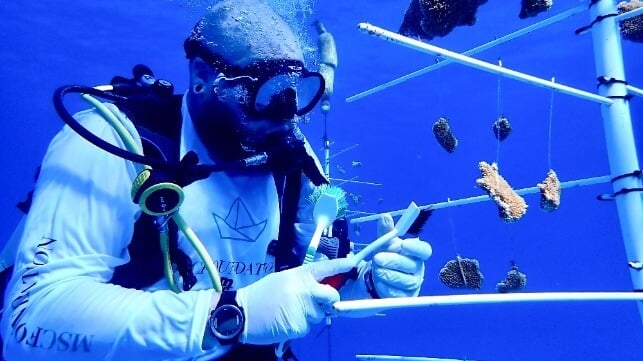
Continued investment in destinations like Ocean Cay, where environmental stewardship has enabled marine wildlife to thrive and coral restoration is underway.
Whale strike prevention training for 469 key crew members in conjunction with marine protection charity ORCA to understand more about the species of whale at risk, how to identify them, and take steps to reduce the risk.
More than 4,500 shore excursions offered in 84 countries, including 284 “Protectours”, low-impact experiences.
The report also shows that in 2024 the fleets of MSC Cruises and Explora Journeys together carried 4.6 million guests and sailed to 341 itineraries in 90 countries.
Looking Ahead As MSC Group’s Cruise Division looks to the future, it remains focused on scaling clean energy solutions, retrofitting existing ships, advocating for port infrastructure investments, and collaborating across the maritime sector to accelerate the global energy transition.
Mr. Vago added, “There is no single solution to decarbonisation. It is a puzzle we solve piece by piece - with new technology, operational excellence, strong partnerships, and a shared commitment to move forward,”
No comments:
Post a Comment