HD Hyundai Wins First Repair Project from U.S. Military Sealift Command
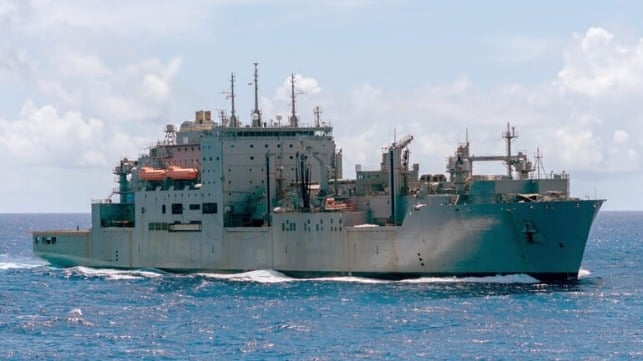
Competition continues to build for work under the U.S.’s MRO (Maintenance, Repair, and Overhaul) contracts, with HD Hyundai Heavy Industries reporting it has won its first assignment. The company reportedly said it would be targeting two to three contracts a year from the United States, and it is linking this to Korea’s promised investment made during the trade talks.
HD Hyundai was certified and signed a Ship Maintenance Relations Agreement (MSRA) with the U.S. military authorities in July 2024. Media reports from Korea suggest it had bid on two previous contracts, losing one to its Korean rival Hanwha Ocean and another to a Singapore-based yard. Hyundai was also reported to have space constraints as its yards are busy with commercial work.
The yard has won the MRO contract for USNS Alan Shepard, a 41,000-ton displacement Lewis and Clark class dry cargo and ammunition vessel used to support vertical replenishment for the U.S. Navy while on a deployment. The vessel, which is 210 meters (689 feet), was commissioned in 2007 and is currently assigned to the U.S. 7th Fleet.
Maintenance work is scheduled to begin in September at HD Hyundai Mipo in Ulsan, South Korea. The scope of work includes propeller cleaning, tank inspections and repairs, and equipment checks. The ship is slated for delivery back to the U.S. Navy in November.
It is the second vessel of the class to undergo its overhaul in Korea. Last year, the first MRO contract awarded to a Korean yard went to Hanwha Ocean to overhaul the USNS Wally Schirra, which arrived at Hanwha Ocean’s Geoje Plant in September. Hanwha also started a second job in late 2024 to repair USNS Yukon, a fleet replenishment vessel, and it was recently reported that it had won the repair assignment for USNS Charles Drew, another Lewis and Clark class vessel.
The MRO business is seen as a lucrative opportunity by the Korean industry. The U.S. military is estimated to spend more than $14 billion annually on MRO contracts. The Korean yards are competing against Japan and Singapore, which are also in the MRO market.
“This MRO contract is especially meaningful as it is the first awarded following the government’s proposal of the MASGA project for Korea–U.S. shipbuilding collaboration,” said Joo Won-ho, head of the Special Ship Business Unit at HD HHI. “As a representative of South Korea’s shipbuilding industry, we will make every effort to successfully complete the U.S. Navy’s logistics support ship MRO project.”
The Koreans are linking this project to the government’s planned $150 billion MASGA (Make American Shipbuilding Great Again) initiative proposed to the Trump administration during the trade talks. South Korea committed to a broader $350 billion investment in the United States to win a reduction in its tariff from 25 to 15 percent.
Both Hyundai and Hanwha completed the certification for U.S. repair work in 2024, while recently Korea’s mid-sized builder HJ Heavy Industries was also reported to be developing a consortium of suppliers for entry into the MRO business. The South Koreans hope to use this to expand their shipbuilding to include vessels for the U.S. government. HD Hyundai announced a strategic partnership with Edison Chouest Offshore for commercial shipbuilding, while Hanwha Ocean acquired Philly Shipyard.
Med Marine Launches a State-of-the-Art Tugboat for Remolcanosa
[By: Med Marine]
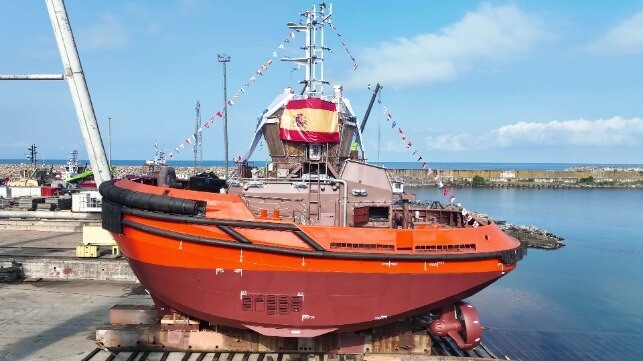
MED MARINE launched a new RAmparts 2300-W series tugboat for REMOLCANOSA at its EREGLI SHIPYARD on July 18th. MED MARINE is proud to contribute to REMOLCANOSA’s fleet with a high-performance, 23-meter harbour tug, equipped to deliver 50 tonnes of bollard pull and meet the demands of modern port operations.
The newly launched 23-meter harbour tug is expertly engineered to deliver a powerful bollard pull of 50 tonnes, fully meeting Class FIFI-1 standards. Built as a true multi-purpose vessel, it seamlessly blends strength and versatility, ready to tackle ship handling, towing, pushing, mooring, and firefighting with confidence. Equipped with both forward and aft winches and an aft towing hook, this tugboat stands prepared for whatever challenges the sea may bring.
Its propulsion system centers on an azimuth stern drive powered by two robust diesel engines linked to drive shafts and Z-drive units. The combination of fixed pitch propellers and high-efficiency nozzles not only guarantees outstanding bollard pull but also precise manoeuvrability, essential for demanding harbour operations. The welded steel hull is reinforced with watertight bulkheads, thoughtfully dividing the vessel into key compartments such as the fore peak, accommodation, engine room, diesel oil tanks, Z-drive area, and aft peak tanks, ensuring safety, durability, and structural integrity in every wave.
This launch reflects MED MARINE’s ongoing commitment to understanding its clients’ unique operational needs and delivering tailored, high-performance solutions that meet them, built not just with technical precision, but with genuine collaboration at every stage.
Technical specifications of the tugboat:
Length: 23.40 m
Beam: 11.90 m
Depth: 4.60 m
Draft: 5.10 m
Bollard Pull, ahead: 50 tons
Speed: 11.4 knots
Crew: 7 persons
The products and services herein described in this press release are not endorsed by The Maritime Executive.
Electric Propulsion Technology for Industry Earns ABS Certification
[By: ABS]
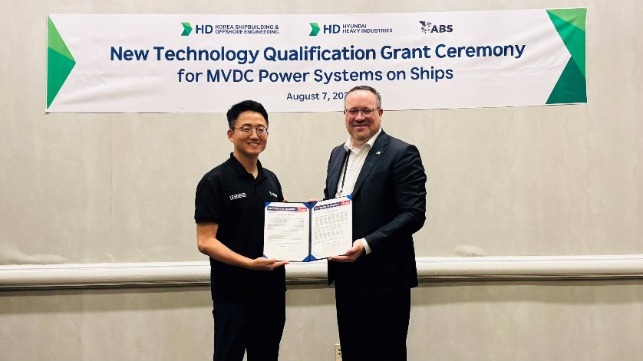
ABS issued a New Technology Qualification (NTQ) certificate to HD Korea Shipbuilding & Offshore Engineering (HD KSOE) and HD Hyundai Heavy Industries (HD HHI) for their next-generation electric propulsion solution: the Medium Voltage Direct Current (MVDC) power system for ships.
The Breakerless-MVDC Power System builds on HD Hyundai’s modular propulsion drive system and is the first in the world to receive an ABS NTQ certificate, indicating the technology’s feasibility and maturity through a systematic evaluation program.
“Collaboration is key to safely accelerating the technological progress that the maritime industry demands. We’re excited to deepen our relationship with HD KSOE and HD HHI, jointly exploring forward-thinking solutions that will shape and refine the next generation of vessels,” said Patrick Ryan, ABS Senior Vice President and Chief Technology Officer.
Sanghyun Kim, HD KSOE Senior Vice President, said: “The MVDC power system, now certified as new technology by ABS for both commercial and naval vessels, represents our advanced capability in marine electrification and our success in overcoming existing technological barriers. We aim to lead the commercialization of zero-carbon electric propulsion vessels.”
The NTQ is the latest in a long running program of collaboration between ABS, HD HHI and HD KSOE and is part of an agreement announced in 2024 to explore medium-voltage direct current (MVDC) power systems on ships. The next milestones for the project team include the development of new ABS requirements for high voltage systems along with a new ABS notation.
Low voltage systems are addressed in the ABS Requirements for DC Power Distribution Systems for Marine and Offshore Applications. Download a copy here. ABS New Technology Qualification services provide vendors and end-users with a clearly defined approach to confirm new technologies perform intended functions in accordance with defined performance requirements. Learn more here.
The products and services herein described in this press release are not endorsed by The Maritime Executive.
Fincantieri Marine Repair Achieves ISO 9001 Certification
[By: Fincantieri]
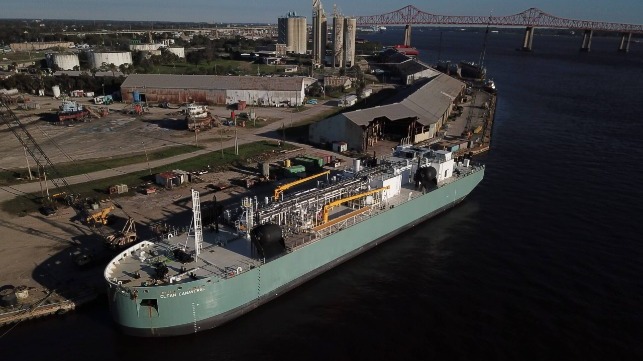
Local commercial and military ship maintenance experts, Fincantieri Marine Repair, recently received certification for its quality management systems (QMS), commonly referred to as ISO 9001.
“Professional maritime companies, like ours, must continually demonstrate our value to customers, and this world recognized certification is a reminder of the quality work our team undertakes each day and our commitment to continuous improvement,” said Ryan W. Smith, CEO of Fincantieri Marine Systems North America, Inc (FMSNA).
Fincantieri Marine Repair (FMR) is a subsidiary of FMSNA, who has been operating in the American maritime market for more than 40 years. FMR was established in 2022, in Northeastern Florida where they maintain tugs, barges, bulk tankers, workboats, commercial, government and military vessels.
FMR is part of a vast global network of repair facilities—shipyards located on four continents providing comprehensive services. FMR provides a full complement of services at their downtown Jacksonville yard and offers remote vessel support at customer facilities and underway repair services. With years of experience in repairs to workboats and military vessels, the FMR team is well positioned to handle future projects.
The ISO 9001 certification means that an independent third-party has verified the organization’s procedures, policies, and records for effectiveness and compliance. All four of Fincantieri shipyards in the United States are ISO 9001 certified.
This certification further reinforces Fincantieri’s long-standing commitment to the U.S. maritime sector. With more than $800 million invested in American facilities since 2008, a network of over 900 suppliers across 43 states, and a skilled workforce of over 3,000 employees in its yards in Florida and Wisconsin, Fincantieri offers a robust industrial model and deep expertise. The Group stands ready to support the U.S. in strengthening its shipbuilding base through innovation, operational excellence, and strategic collaboration.
The products and services herein described in this press release are not endorsed by The Maritime Executive.
Pacific-Gulf Marine Awarded Ship Manager Contracts
[By: Pacific-Gulf Marine]
Pacific-Gulf Marine (PGM) has been awarded three 10-year firm contracts with a total value of approximately $621 million, including fixed fees and reimbursables. Of the six ships PGM will manage on behalf of the U.S. Maritime Administration (MARAD), two are out ported in the San Francisco Bay Area, two in Newport News, Va., and two in New Orleans, La. These ships are part of MARAD’s 51-vessel Ready Reserve Force (RRF) fleet.
The RRF consists of military-useful ships maintained by commercial operators in a high state of readiness, able to activate upon notice from the Department of Defense in support of military missions and humanitarian or disaster relief operations. MARAD is the U.S. government agency responsible for overseeing the RRF fleet.
Established in 1976, PGM is a privately held, full-service marine operating and ship management company serving both commercial and government accounts domestically and internationally. With a core business focus on vessel management, PGM is certified to the International Safety Management (ISM) Code and the International Organization for Standardization (ISO) 9002 and 14002 standards.
“We are extremely pleased with the announcement out of Washington and look forward to continuing our working relationship with the Maritime Administration — a partnership that has spanned more than four decades. Our commitment to the U.S. maritime industry has been the foundation of our operation and represents a level of service that has consistently been delivered to the many customers we’ve served over the last 48 years,” said Todd Johnson, president and chief executive officer of PGM.
The products and services herein described in this press release are not endorsed by The Maritime Executive.
Legacy and Innovation
Industry leaders are merging old school tradition and principles with modern innovation, developing designs that meet sometimes diverging industry demands

(Article originally published in May/June 2025 edition.)
The roots of naval architecture are steeped in tradition with knowledge passed down through generations. Scientific ship design in the 18th century introduced mathematical models used to inform hull design while the Industrial Revolution brought iron and steam, revolutionizing design, materials science and propulsion.
The 21st century ushered in the digital transformation alongside essential new tools in the naval architect's arsenal. Advanced CAD technology, Artificial Intelligence (AI) and data-driven modeling are now used to optimize designs. From concept through a ship's lifecycle, digital twins enable predictive maintenance and monitoring to model fuel consumption across voyage profiles.
These new tools bridge the gap between design and day-to-day operations in a way never before possible. Naval architecture has evolved from a craft to a robust engineering discipline but remains rooted in the principles of the earliest shipwrights. Successful naval architects today are those who can balance cutting-edge innovation with time-tested fundamentals and work alongside data scientists and software engineers, blending classical engineering judgment with innovative insight.
The ability to intuitively understand how a vessel will behave underway and under duress is as critical as proficiency with modern tools and software.
That ethos defines the modern age of naval architecture. AI and Big Data are no longer optional, they're integral. Lifecycle sustainability is not just something to consider, it's a core design driver. "We continue to work with clients, old and new, to apply traditional best practices to a modern fleet," says John Gilbert, President of Gilbert Associates Inc., a stalwart of naval architecture for over 60 years.
FUTURE-PROOFING VESSEL DESIGNS
As design itself may be more efficient by virtue of the available tools, a wide variety of challenges persist even as new ones develop. Naval architects are no longer viewed simply as technical designers but as long-term partners involved from the concept stage and continuing throughout a vessel's functional life.
Often, long-term strategies require designers to develop a "crystal ball" approach, assisting vessel owners in anticipating issues before they even arise. Predicting future regulations, fuel transitions or new technology that have not yet materialized (or whose viability is unknown) is now par for the course.
"Future-proofing ship designs is easy to say, but far more difficult to execute," says Morgan Fanberg, CEO of Glosten.
Most domestic vessels have operational life expectancies of 30 years or more, and Glosten's designers have to weigh the consequences of each vessel detail while allowing for the inevitable changes in everything from materials to regulation. A balanced approach requires considering the most advanced equipment available from OEMs while building in allowances for future upgrades.
While both may help delay obsolescence, they also carry risks. Emerging technologies lack a proven track record while integration challenges and costs can increase rapidly. And, of course, predictions may simply be wrong. "Ultimately, future-proofing requires a careful balance between foresight, flexibility and cost – designing vessels that meet today's requirements while giving them room to evolve," Fanberg says.
REGULATORY CHALLENGES
Perhaps the greatest challenge in vessel design has always been regulation. Regulators are notoriously slow to react to changes and often uninformed, particularly with today's rapid pace of innovation. As a result, predicting and planning for changes in regulations is often a guessing game at best, requiring even greater collaboration.
This isn't exclusive to future regulations but also relevant to existing rules sometimes forcibly applied to modern technology.
Gilbert Associates has spent considerable time refining its approach to hybrid passenger vessels, culminating most recently in the Capt. Almer Dinsmore, New England's first hybrid diesel-electric ferry. The project required intensive coordination with regulators and equipment vendors to integrate lithium-ion batteries, advanced fire suppression and new electrical systems – all under restrictive Subchapter K tonnage rules.
Across the naval architecture sector, the concept of future-proofing carries with it a natural element of revolution, pushing the boundaries of the regulatory process. As designers implement the latest technology, they challenge both the vendor/system integrator and established rules set by maritime authorities.
The naval architects at Norway's Breeze Ship Design frequently challenge established rules. When the world's first LNG-powered offshore support vessels were designed, there were minimal class or flag state rules that could be applied. Instead, Breeze followed IMO's alternative design process to develop a level of safety that challenged even existing vessels.
In close collaboration with stakeholders (including other designers), the company designed solutions and, in the process, new standards. But rather than hide or protect their innovations from competitors, Breeze shared them across partnerships, believing that, according to CEO Ove Wilhelmsen, "sharing our innovations with other stakeholders drives the whole market to a higher level of safety and efficiency, which will benefit us all."
Designers are caught in a difficult position, trying to make bold advances while remaining practical. Elliott Bay Design Group sees the primary challenge as delivering solutions that draw from the technologies their clients truly need.
"We don't just follow trends," notes Robert Ekse, President. "Instead, we translate them into practical solutions that work in the real world – balancing innovation with practicality to ensure long-term success. Ultimately, it's about partnership, purpose and building what's next together."
LIFE EXTENSIONS
Naval architects don't concern themselves solely with new designs, of course. "A large portion of our activity relates to ships in operation," notes Breeze's Wilhelmsen.
Indeed, with more than 4,000 vessels designed over the decades, the company has a team dedicated to vessel conversions and upgrades, including the Viking Energy. Built in 2003 as the world's first LNG-powered offshore support vessel, Equinor, Eidesvik and Breeze teamed up for the Apollo project to convert the vessel from LNG to ammonia.
Designers work closely with clients, regulators and shipyards to develop and execute practical modernization plans. These refits blend already existing strengths with updated systems while lowering operating costs and extending useful life, demonstrating that progress doesn't always require new steel.
Life extensions are critical for reducing environmental impact and increasing the value of aging assets. Projects that modernize older vessels by integrating centralized management systems enable crews to focus on preventive (versus reactionary) maintenance.
According to Glosten's Fanberg, "These kinds of upgrades are essential in a world where skilled mariners are in short supply. The goal isn't automation for its own sake, but for improving the day-to-day experience of operators and crews."
INTEGRATING LEGACY & INNOVATION
Naval architects are no longer just designers. They're systems integrators, digital strategists and environmental stewards.
The coming decades will see tighter integration between designer and operator, leveraging innovation to vet thousands of design variants before a single steel plate is cut. Regulations will evolve in parallel, pushing innovation in zero-emissions vessels and autonomy.
Forward-thinking companies will continue to demonstrate how deep-rooted tradition, when combined with thoughtful innovation and an appetite for disruption, can shape a future that's as environmentally conscious as it is commercially viable. From their perspective, the future is not as challenging as it is rife with opportunities.
Per Elliott Bay's Ekse, "We are pushed to be more proactive in engaging with stakeholders and more precise in integrating technology that is not only innovative but also practical and aligned with operational realities."
Regular contributor CHAD FUHRMANN is a Senior Consultant at Core Group Resources.
The opinions expressed herein are the author's and not necessarily those of The Maritime Executive.
No comments:
Post a Comment