Paris (AFP) – The world's number two steelmaker, ArcelorMittal, said on Thursday its half-year net profit jumped on exceptional items but US tariffs began to eat into its margin.
Issued on: 31/07/2025 - FRANCE24

Steel coils sitting in the yard at ArcelorMittal Dofasco's steel mill in Hamilton, Canada, which now face 50 percent tariffs to enter the United States
© Cole Burston / GETTY IMAGES NORTH AMERICA/AFP/File
Net profit for the period from January through June rose 39 percent from the same period in 2024 to hit $2.6 billion, thanks to a $1.7 billion exceptional gain from acquiring a stake in a US unit ceded by Nippon Steel.
But operating earnings that strip out interest costs, depreciation and taxes, slid by 10 percent to $3.4 billion, notably due to US tariffs on steel imports.
US President Donald Trump doubled tariffs on steel and aluminium to 50 percent at the beginning of June, including on its neighbour Canada which is the largest foreign supplier to the United States, as well as Mexico.
ArcelorMittal says its global footprint, it produces steel in 15 countries and serves customers in 129, enables it to benefit from high-growth markets such as India and Brazil.
However the introduction of US steel tariffs complicates ArcelorMittal's operations in North America, where it has factories in Canada, Mexico and the United States.
First half sales slid 5.5 percent to $30.7 billion, but that 7.5 percent drop in average steel prices.
"The underlying strength of the business is good, but like every company we must navigate the backdrop of ongoing geopolitical and tariff disruptions," chief executive Aditya Mittal said in a statement.
"Despite the many challenges facing global business today, I am confident that ArcelorMittal has a profile that will enable us to continue to grow and thrive," he added.
Mittal said gaining full ownership in Calvert by acquiring the stake from Nippon Steel strengthens its capabilities to produce high-quality steel products for a range of customers including the automotive industry.
He urged the European Union to detail the measures it plans to take to protect its market from a flood of cheap Chinese steel imports.
"It remains a crucial year for European steelmaking, and I sincerely hope that Europe will hold good onto its commitment to defend and prioritize its domestic steel industry," said Mittal.
He added that the trend in Europe to boost government spending on defence and infrastructure was positive for the steel industry.
ArcelorMittal's shares slumped 3.9 percent in Paris where the CAC 40 index was up 0.4 percent.
© 2025 AFP
Net profit for the period from January through June rose 39 percent from the same period in 2024 to hit $2.6 billion, thanks to a $1.7 billion exceptional gain from acquiring a stake in a US unit ceded by Nippon Steel.
But operating earnings that strip out interest costs, depreciation and taxes, slid by 10 percent to $3.4 billion, notably due to US tariffs on steel imports.
US President Donald Trump doubled tariffs on steel and aluminium to 50 percent at the beginning of June, including on its neighbour Canada which is the largest foreign supplier to the United States, as well as Mexico.
ArcelorMittal says its global footprint, it produces steel in 15 countries and serves customers in 129, enables it to benefit from high-growth markets such as India and Brazil.
However the introduction of US steel tariffs complicates ArcelorMittal's operations in North America, where it has factories in Canada, Mexico and the United States.
First half sales slid 5.5 percent to $30.7 billion, but that 7.5 percent drop in average steel prices.
"The underlying strength of the business is good, but like every company we must navigate the backdrop of ongoing geopolitical and tariff disruptions," chief executive Aditya Mittal said in a statement.
"Despite the many challenges facing global business today, I am confident that ArcelorMittal has a profile that will enable us to continue to grow and thrive," he added.
Mittal said gaining full ownership in Calvert by acquiring the stake from Nippon Steel strengthens its capabilities to produce high-quality steel products for a range of customers including the automotive industry.
He urged the European Union to detail the measures it plans to take to protect its market from a flood of cheap Chinese steel imports.
"It remains a crucial year for European steelmaking, and I sincerely hope that Europe will hold good onto its commitment to defend and prioritize its domestic steel industry," said Mittal.
He added that the trend in Europe to boost government spending on defence and infrastructure was positive for the steel industry.
ArcelorMittal's shares slumped 3.9 percent in Paris where the CAC 40 index was up 0.4 percent.
© 2025 AFP
Trump gets his way on tariffs, but global trade system intact for now
Paris (AFP) – President Donald Trump has succeeded in strong-arming nations to accept higher tariffs on US exports, yet for now experts see little threat to the postwar trend of lower duties in the pursuit of greater wealth all around.
Issued on: 31/07/2025 - FRANCE24

'Pyrrhic victory'
Despite the headline figures, many economists expect the fallout for the global trade system overall to be limited.
US importers may well decide to procure more from American producers as the tariffs are applied, or pass along the higher costs to consumers.
"That won't have a systemic impact" outside the United States, Pascal Lamy, a former WTO chief, told AFP, calling the tariffs a "Pyrrhic victory" for Trump.
He noted that Trump is targeting only the US deficits for goods and not services, "the part of global trade that is increasing the fastest".
"You need to change your outlook when it comes to international trade," Lamy said, adding that "Donald Trump has a medieval view" of the issue.
And instead of making a country more prosperous, the accepted economic wisdom is that by making goods more expensive, tariffs weigh on economic growth for everyone involved.
"Putting up your own tariffs is not a way to make yourself richer -- that's something that people have given up on many years ago," Baldwin said.
"Trump has not screwed up the entire world trading system yet because the rest of the world hasn't changed their opinion as to whether trade is good or bad," he said.
"And generally speaking, it's good."
Bucking the trend
Global trade has risen sharply in recent decades, totalling nearly $24 trillion in 2023, according to WTO figures.
US imports represent just 13 percent of overall imports -- meaning the vast majority of international commerce will not be directly affected by Trump's levies.
"It's significant, but it's only a small part of imports worldwide, and the rest of the world still wants the system of engagement and interdependence to work," said Elvire Fabry, a specialist in geopolitical economics at the Jacques Delors Institute.
Several countries have moved in recent years to forge new trade deals, a trend Trump's tariffs blitz could accelerate.
In March, Japan, South Korea and China pledged to speed up negotiations on an accord, while Brazil's President Luiz Inacio Lula da Silva has called for a deal between the Mercosur Latin America bloc and Japan.
The European Union has also signed a free-trade deal with Mercosur, though its ratification has been held up, in particular by France over concerns about unfair agriculture competition.
The EU has also relaunched efforts to secure a deal with Malaysia and countries in Central Asia.
In April, the WTO said world merchandise trade would fall 0.2 percent this year before a "modest" recovery to growth of 2.5 percent in 2026.
But those forecasts took into account only the tariffs Trump had announced up to then -- not the more severe levels he has threatened to put in place starting August 1 for countries that have not signed deals with Washington.
© 2025 AFP

Paris (AFP) – President Donald Trump has succeeded in strong-arming nations to accept higher tariffs on US exports, yet for now experts see little threat to the postwar trend of lower duties in the pursuit of greater wealth all around.
Issued on: 31/07/2025 - FRANCE24

President Donald Trump has long accused other nations of 'ripping off' the United States © Brendan SMIALOWSKI / AFP
Since World War II, most politicians and economists view free trade as a pillar of globalisation, enshrined in the 1947 signing of the GATT accord.
It was the precursor to the World Trade Organization, which now has 166 members and covers 98 percent of global commerce.
"What we've learned in the postwar is that lower tariffs are better for prosperity of your own country," said Richard Baldwin, a professor at the IMD Business School in Switzerland.
"And it's also good if other countries lower their tariffs, so we have a vibrant international economy," Baldwin, who was a member of US president George Bush's Council of Economic Advisors, told AFP
Trump however has embarked on a punishing trade war, claiming that deficits with other nations show they are "ripping off" the United States.
He has recently landed accords with Japan, the Philippines, Indonesia and, most importantly, the European Union.
For dozens of other nations, US "reciprocal" tariffs are to jump from 10 percent to various steeper levels come August 1, including powerhouse economies such as South Korea, India and Taiwan.
"To me, the most beautiful word in the dictionary is 'tariff'," Trump repeatedly said during the 2024 election campaign that returned him to office.
Since World War II, most politicians and economists view free trade as a pillar of globalisation, enshrined in the 1947 signing of the GATT accord.
It was the precursor to the World Trade Organization, which now has 166 members and covers 98 percent of global commerce.
"What we've learned in the postwar is that lower tariffs are better for prosperity of your own country," said Richard Baldwin, a professor at the IMD Business School in Switzerland.
"And it's also good if other countries lower their tariffs, so we have a vibrant international economy," Baldwin, who was a member of US president George Bush's Council of Economic Advisors, told AFP
Trump however has embarked on a punishing trade war, claiming that deficits with other nations show they are "ripping off" the United States.
He has recently landed accords with Japan, the Philippines, Indonesia and, most importantly, the European Union.
For dozens of other nations, US "reciprocal" tariffs are to jump from 10 percent to various steeper levels come August 1, including powerhouse economies such as South Korea, India and Taiwan.
"To me, the most beautiful word in the dictionary is 'tariff'," Trump repeatedly said during the 2024 election campaign that returned him to office.
'Pyrrhic victory'
Despite the headline figures, many economists expect the fallout for the global trade system overall to be limited.
US importers may well decide to procure more from American producers as the tariffs are applied, or pass along the higher costs to consumers.
"That won't have a systemic impact" outside the United States, Pascal Lamy, a former WTO chief, told AFP, calling the tariffs a "Pyrrhic victory" for Trump.
He noted that Trump is targeting only the US deficits for goods and not services, "the part of global trade that is increasing the fastest".
"You need to change your outlook when it comes to international trade," Lamy said, adding that "Donald Trump has a medieval view" of the issue.
And instead of making a country more prosperous, the accepted economic wisdom is that by making goods more expensive, tariffs weigh on economic growth for everyone involved.
"Putting up your own tariffs is not a way to make yourself richer -- that's something that people have given up on many years ago," Baldwin said.
"Trump has not screwed up the entire world trading system yet because the rest of the world hasn't changed their opinion as to whether trade is good or bad," he said.
"And generally speaking, it's good."
Bucking the trend
Global trade has risen sharply in recent decades, totalling nearly $24 trillion in 2023, according to WTO figures.
US imports represent just 13 percent of overall imports -- meaning the vast majority of international commerce will not be directly affected by Trump's levies.
"It's significant, but it's only a small part of imports worldwide, and the rest of the world still wants the system of engagement and interdependence to work," said Elvire Fabry, a specialist in geopolitical economics at the Jacques Delors Institute.
Several countries have moved in recent years to forge new trade deals, a trend Trump's tariffs blitz could accelerate.
In March, Japan, South Korea and China pledged to speed up negotiations on an accord, while Brazil's President Luiz Inacio Lula da Silva has called for a deal between the Mercosur Latin America bloc and Japan.
The European Union has also signed a free-trade deal with Mercosur, though its ratification has been held up, in particular by France over concerns about unfair agriculture competition.
The EU has also relaunched efforts to secure a deal with Malaysia and countries in Central Asia.
In April, the WTO said world merchandise trade would fall 0.2 percent this year before a "modest" recovery to growth of 2.5 percent in 2026.
But those forecasts took into account only the tariffs Trump had announced up to then -- not the more severe levels he has threatened to put in place starting August 1 for countries that have not signed deals with Washington.
© 2025 AFP

Laos braced for blow of Trump tariff threat
Vientiane (AFP) – Hawking clothes outside the garment factory where her daughter toils inside, a Laos vendor weighs US President Donald Trump's threat of trade tariffs that may soon snarl both their livelihoods.
Issued on: 31/07/2025 - FRANCE24

'Cause for suspicion'
"We estimate about 20,000 workers or more could be impacted," said Xaybandith Rasphone, head of the Association of the Lao Garment Industry.
"We're not certain about the exact number yet, but it could easily be higher if companies shut down," said Xaybandith, who is also vice-president of the Lao National Chamber of Commerce and Industry (LNCCI).
He warned between 35 and 40 factories could be affected if buyers are spooked by the tariffs.
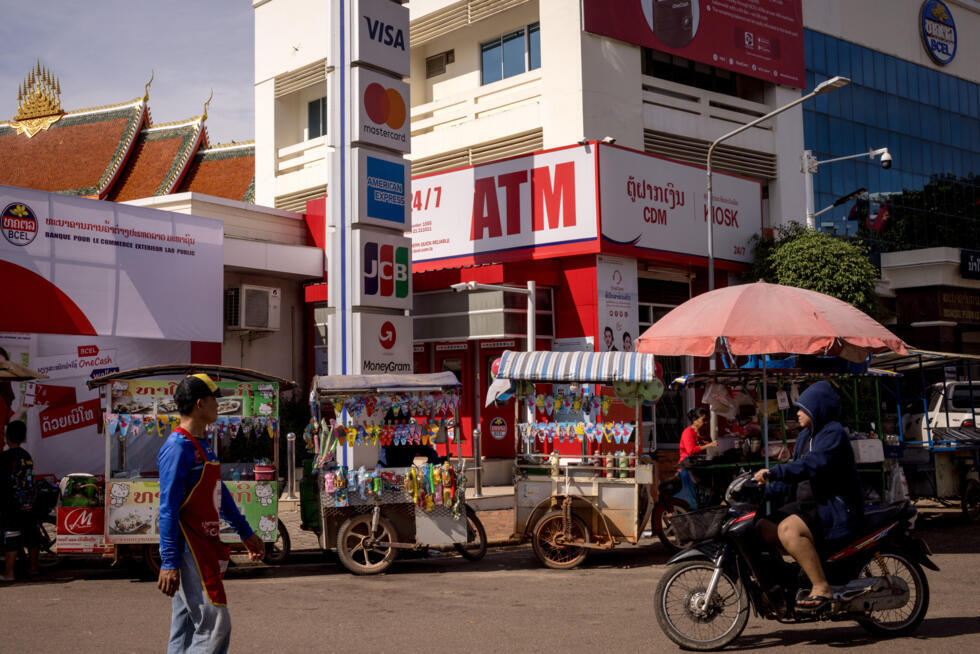
Vientiane (AFP) – Hawking clothes outside the garment factory where her daughter toils inside, a Laos vendor weighs US President Donald Trump's threat of trade tariffs that may soon snarl both their livelihoods.
Issued on: 31/07/2025 - FRANCE24
Laos is already struggling with elevated inflation and a severe labour shortage, fuelling fears that Donald Trump's tariffs could have a devastating effect
© Nhac NGUYEN / AFP/File
"I just live day by day. For now, I still have my business, and the factory is operating as usual," she told AFP, speaking on condition of anonymity in the capital Vientiane.
"I'm not too worried about my daughter's job yet," she added. Then again, she says: "I don't know anything about what the US will decide."
Landlocked Laos -- a country of only eight million -- has a gloomy outlook as it counts down to a Friday deadline when Trump says a 40 per cent levy will kick in unless a trade deal is sealed.
The rate is among the highest Trump has touted in his global tariff blitz, which has yielded a handful of deals with countries including Britain, Japan and Vietnam but left dozens others scrambling for a pact.
Laos has limited exports, little leverage and supply chains deeply entwined with US trade rival China.
The United States had a trade deficit of more than $760 million with Laos last year -- singling it out for steep tolls alongside other nations Trump sees as imbalanced business partners.
"A 40 percent tariff is just a nail in the coffin for any industry trying to ship to the United States," said John F. Somers, head of garment manufacturing firm Diep Vu Co.
Only a handful of factories, mostly in the capital, supply the US market and sales make up only between three and six percent of the country's gross domestic product.
But with the Southeast Asian country already suffering from high inflation and a severe labour shortage, Trump's default tariff could still have a devastating effect, industry insiders say.
"I just live day by day. For now, I still have my business, and the factory is operating as usual," she told AFP, speaking on condition of anonymity in the capital Vientiane.
"I'm not too worried about my daughter's job yet," she added. Then again, she says: "I don't know anything about what the US will decide."
Landlocked Laos -- a country of only eight million -- has a gloomy outlook as it counts down to a Friday deadline when Trump says a 40 per cent levy will kick in unless a trade deal is sealed.
The rate is among the highest Trump has touted in his global tariff blitz, which has yielded a handful of deals with countries including Britain, Japan and Vietnam but left dozens others scrambling for a pact.
Laos has limited exports, little leverage and supply chains deeply entwined with US trade rival China.
The United States had a trade deficit of more than $760 million with Laos last year -- singling it out for steep tolls alongside other nations Trump sees as imbalanced business partners.
"A 40 percent tariff is just a nail in the coffin for any industry trying to ship to the United States," said John F. Somers, head of garment manufacturing firm Diep Vu Co.
Only a handful of factories, mostly in the capital, supply the US market and sales make up only between three and six percent of the country's gross domestic product.
But with the Southeast Asian country already suffering from high inflation and a severe labour shortage, Trump's default tariff could still have a devastating effect, industry insiders say.
'Cause for suspicion'
"We estimate about 20,000 workers or more could be impacted," said Xaybandith Rasphone, head of the Association of the Lao Garment Industry.
"We're not certain about the exact number yet, but it could easily be higher if companies shut down," said Xaybandith, who is also vice-president of the Lao National Chamber of Commerce and Industry (LNCCI).
He warned between 35 and 40 factories could be affected if buyers are spooked by the tariffs.
Laos is set to graduate from 'Least Developed Country' status next year, meaning will lose duty-free access to the European Union, dealing another blow
© Jack TAYLOR / AFP/File
"If the tariff stays in place, some factories will definitely close," he said. "Finding alternative markets takes time, negotiations and a lot of effort. It could take years."
Like neighbouring Cambodia and Vietnam, Laos is a hub of the garment industry -- producing brands for western markets including Dr. Martens.
But the production of mattresses, silicone products and solar panels also stands to be impacted.
Solar panel manufacturing has exploded in Laos since 2023 and driven up its export figures after Trump hit China with a 50 percent tariff on the renewable power sources.
However the US trade offensive has focussed on "transshipment" -- a practice it alleges some countries use to help China dodge American tariffs by repackaging its goods for American markets.
Casey Tolzman, head of the Lao-American Business Association (LABA), said the explosion of Laos' solar industry had likely been "a cause for suspicion" in Washington.
'A big question'
Rules governing the source of materials and the level of Laotian labour required to define products as domestically produced may prove the country's biggest bargaining chip.
"A big question for countries like Cambodia and Laos is what they can offer the US that's attractive enough to reach a deal," Tolzman said.
"Any deal would probably need to see Laos enforce stricter rules on transshipment and country of origin, to ensure products aren't just coming from China and getting a Laos label slapped on."
The US may also ask Vientiane to crack down on internet scam centres targeting wealthy Americans from compounds in Laos, or seek concessions for American goods to enter the market, he added.
The LABA and LNCCI say they are helping the government draft an appeal asking for tariffs to drop back to previous levels, or at least be capped at 20 percent.
But Diep Vu Co boss Somers warns even if Laos manages to reach a deal with Washington, a bigger test soon lies ahead.
Laos is on track to graduate from "Least Developed Country" status next year, meaning it is set to lose duty-free access to the European Union -- dealing another blow.
"We'll be at a competitive disadvantage, our industry will probably collapse within a few years," Somers warned.
"The real discussion is the EU relationship with Laos, not just what the US is doing."
© 2025 AFP
"If the tariff stays in place, some factories will definitely close," he said. "Finding alternative markets takes time, negotiations and a lot of effort. It could take years."
Like neighbouring Cambodia and Vietnam, Laos is a hub of the garment industry -- producing brands for western markets including Dr. Martens.
But the production of mattresses, silicone products and solar panels also stands to be impacted.
Solar panel manufacturing has exploded in Laos since 2023 and driven up its export figures after Trump hit China with a 50 percent tariff on the renewable power sources.
However the US trade offensive has focussed on "transshipment" -- a practice it alleges some countries use to help China dodge American tariffs by repackaging its goods for American markets.
Casey Tolzman, head of the Lao-American Business Association (LABA), said the explosion of Laos' solar industry had likely been "a cause for suspicion" in Washington.
'A big question'
Rules governing the source of materials and the level of Laotian labour required to define products as domestically produced may prove the country's biggest bargaining chip.
"A big question for countries like Cambodia and Laos is what they can offer the US that's attractive enough to reach a deal," Tolzman said.
"Any deal would probably need to see Laos enforce stricter rules on transshipment and country of origin, to ensure products aren't just coming from China and getting a Laos label slapped on."
The US may also ask Vientiane to crack down on internet scam centres targeting wealthy Americans from compounds in Laos, or seek concessions for American goods to enter the market, he added.
The LABA and LNCCI say they are helping the government draft an appeal asking for tariffs to drop back to previous levels, or at least be capped at 20 percent.
But Diep Vu Co boss Somers warns even if Laos manages to reach a deal with Washington, a bigger test soon lies ahead.
Laos is on track to graduate from "Least Developed Country" status next year, meaning it is set to lose duty-free access to the European Union -- dealing another blow.
"We'll be at a competitive disadvantage, our industry will probably collapse within a few years," Somers warned.
"The real discussion is the EU relationship with Laos, not just what the US is doing."
© 2025 AFP
No comments:
Post a Comment