On the Caspian Sea, Tensions Between Russia and Azerbaijan are Rising
Tensions are rising between Azerbaijan and Russia over a maritime dispute which is largely unheard-of but which could have significant impact should it erupt.
Azerbaijan is proud of its sovereign achievements since it achieved independence from the collapsing Soviet Union in 1991, but Russia feels that Azerbaijan should accept a subordinate status within a Russian zone of influence. Nonetheless, for most of the post-independence era, relations between the two countries have been business-like but stilted. Throughout, Russia has maintained its dominant position in the Caspian Sea, maintaining its Caspian Flotilla at a strength of ten modern frigates and corvettes, some equipped with Kalibr cruise missiles with a range of 1,500 miles.
Keeping things cordial, Azerbaijan does feel some kinship with co-religionists in the bordering Russian republics of Chechnya and Dagestan. However, relations with Russians further to the north are somewhat strained.
But relations between the two countries fell off a cliff on Christmas Day 2024, when Azerbaijan Airline Flight 8243 was struck by an anti-aircraft missile while coming in to land at Grozny airport in Chechnya. The Russian authorities refused to allow the damaged plane to land, which instead had to crash-land on the other side of the Caspian Sea at Aktau in Kazakhstan. Of 67 passengers and crew on board, 38 died in the accident. It was later established that the aircraft had been hit with a Russian Pantsir-S1 missile. President Putin refused to acknowledge responsibility for the incident, or to facilitate compensation or investigatory efforts. The dispute remains unresolved.
Since then, relations between Iran and Russia, with sanctions and conflicts affecting both counties, have grown in importance. Sea traffic between the two countries passes through Azeri territorial waters in the Caspian Sea. In particular, Iran has shipped drones, missiles and ammunition from Amirabadport on the southern Caspian shore to the Volga river port Olaya in Russia. Iranian Fatah-360 ballistic missiles shipped in September 2024, and thousands of Shahed-136 drones, have played a crucial role in Russian offensive action in Ukraine. This is likely to have prompted a Ukrainian drone attack on Caspian Flotilla vessels docked at Kaspiysk on November 6 last year, which damaged Project 11661 Gepard-class frigates RFS Tatarstan (691) and RFS Dagestan (693), plus a Buyan-class corvette.
As Azeri-Russian relations deteriorated, Russia has also fallen out with Kazakhstan on the other side of the Caspian, even though much of Kazakh oil exports are piped through Russia to the Black Sea oil export terminal at Novorossiysk. President Tokayev of Kazakhstan has refused to recognize Russian annexations in Ukraine and in Georgia, and is minded to respect Western sanctions on Russia. He has also turned down a request to provide Kazakh troops to fight in Ukraine.
Since then, temporary “technical” closures of Kazakhstan’s CPC pipeline to Novorossiysk have been attributed to Russian displeasure with the independent Kazakh position. While Azerbaijan and Kazakhstan have not hitherto been close allies, their shared disputes with Russia have brought them closer together. Kazakh and Azeri territorial waters in the Caspian theoretically form a barrier between Russian waters to the north and Iranian waters to the south, albeit there has never as yet been a threat to innocent passage.
In a sign of deteriorating relations, the Azeri press has begun referring to Russian place names by their pre-Soviet names. Kaliningrad has reverted to Königsberg and the Volga has become the River Itil. On the Russian side, TASS still employs Armenian rather than Azeri place names in the now defunct Nagorno-Karabakh Republic. While inconsequential to outsiders, such matters generate extreme nationalistic responses in the region. Azerbaijan has also been upset by what it describes as an unjustified wave of arrests of Azeris working in Russia, and has retaliated by arresting Russian gangsters in Baku.
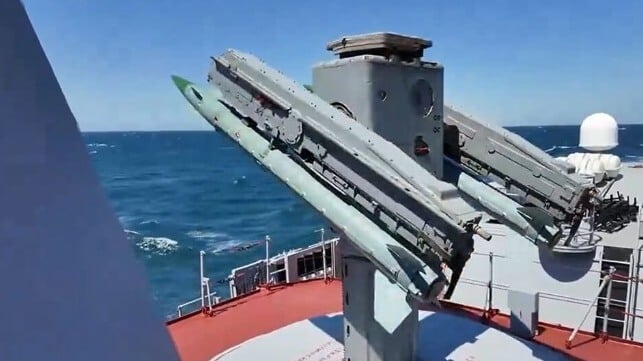
Russia’s Caspian Flotilla has recently been exercising its anti-aircraft capabilities. On July 26, Project 22800 Karakurt-class corvette RFS Typhoon (805) fired Pantsir-S1 air defense missiles to intercept an incoming anti-ship missile, and sister ships RFS Tucha (804) and RFS Amur (803), plus Project 21631 Buyan-M-class corvette RFS Uglich (653) used their anti-aircraft gun systems as part of a networked air defense system. Gepard-class frigate RFS Dagestan (693) tested its new Palash close air defense system. These air defense exercises were repeated the next day, and in the current climate could be interpreted by Azerbaijan and Kazakhstan as threatening.
With tensions high in the Caspian, minor incidents - perhaps provoked by further Ukrainian attacks - could trigger major maritime consequences. North-South sea traffic could be disrupted, one of the only trade routes which Iran and Russia can mutually use without fear of sanctions interference. Shipments of Kazakh crude across the Caspian from Aktau to Baku could be at risk, upsetting shipping interests. The flow of Kazakh oil through the CPC pipeline to Novorossiysk on the Black Sea might again be impacted. Offshore Azeri and Kazakh oil production could be curtailed. For decades commerce across the Caspian Sea has not been threatened by belligerency, so few have taken an interest - but this may be about to change.
U.S. Trade Deal Secures Peace and Influence in the Caucasus
The United States appears to have sealed the solution of a complex geopolitical problem in the Caucasus which has proved impossible to solve since the break-up of the Soviet Union, generating several wars and hindering trade and development in the affected countries over the last 35 years. Armenia’s Prime Minister Nikol Pashinyan and Azerbaijani President Ilham Aliyev signed an agreement at the White House on August 8, which has a good chance of resolving issues between the two countries - and which increases US and Turkish influence in the region at the expense of Iran and Russia.
Newly created independent states were left in 1991 with borders delineated under the old Soviet regime. Ethnic and religious minorities were left on the wrong side of borders, which did not matter when all were part of the Soviet super-state, but mattered when the countries concerned became independent.
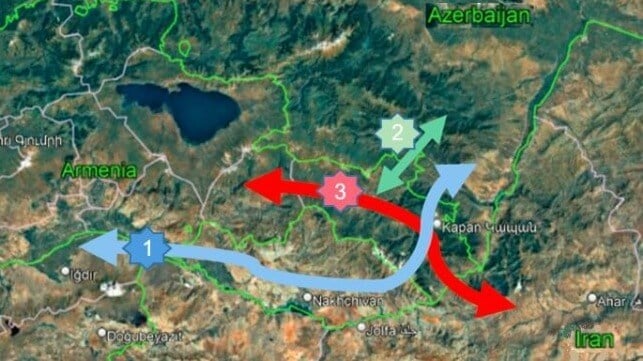
The exclave of Nakhchivan was separated from the rest of Azerbaijan by 20 miles of hostile Armenia (1, top). The ethnic Armenian population of Nagorno-Karabakh, surrounded by Azeris, now had to travel through a hostile Azerbaijan to keep contact with Armenia (2). Iran maintained that it had a right of passage through the 20-mile-wide corridor (3) from its border across Armenian territory, using it as a trade/truck route through to Georgia and Russia. It established consulates staffed with armed security guards along the route, and staged aggressive military maneuvers on the border whenever it felt its access was threatened.
The agreement negotiated bilaterally in Abu Dhabi but finalized in Washington appears to provide American reassurances that Armenia and Azerbaijan will be able to transit “hostile” territory to support their isolated nationals without hindrance, with the United States now fulfilling the guarantor role previously (and ineffectively) played by Russia. Indeed, Russia attempted to sabotage the bilateral negotiations in order to preserve its influence over the two countries as a mediator.
For Turkey, this represents huge progress towards achieving President Erdogan’s dream of building a Turkic bloc, linked by the so-called Zangezur corridor through Turkey to Azerbaijan, then across the Caspian to Turkmenistan. The existing but moribund railway route from Turkey directly into the Nakhchivan enclave, then across Armenia into Azerbaijan and Baku can be restored, and an East-West corridor established. Under the label of the Trump Route for International Peace and Prosperity, the agreement appears to cover the award of an infrastructure management contract to a US company.
For Iran, there will now be an American presence directly cutting across its trade/truck route through Armenia into Georgia and Russia. Notwithstanding professions of friendship, plans to upgrade the rail route from Iran through Baku to Russia never seemed to make progress, nor a similar trucking route, probably because behind professions of friendship there is profound mistrust. This will make Iran and Russia more dependent on sanctions-free sea traffic across the Caspian - and even this route is threatened because Russia and Iran are divided by the territorial waters in the central Caspian belonging to Azerbaijan and Turkmenistan. This is another blow for Iran’s dreams of regional dominance, on top of its loss of influence in Lebanon, Syria and Iraq. To make matters even worse, there is the worry that Azerbaijan on its northern border might even accede to the Abraham Accords and join NATO.
If the agreement holds, and confidence can be established under American overwatch, then there are likely to be significant consequences for the development of trade routes and energy exports.
No comments:
Post a Comment