
"Just spiteful evil for the sake of it," fumed one observer.

Kilmar Ábrego García celebrates his son's third birthday.
(Photo by David Seidenberg/Creative Commons)
Brett Wilkins
Aug 23, 2025
COMMON DREAMS
On the same day he was released from federal custody, the Trump administration on Friday informed Kilmar Ábrego García—a Maryland man wrongfully deported to a notorious Salvadoran prison rife with abuse—that it may deport him to the East African nation of Uganda.
Ábrego García, a Salvadoran national who entered the US without authorization when he was a teenager, was released Friday from a jail near Nashville, Tennessee, where he had been held since June following his errant deportation to El Salvador and imprisonment in the Terrorism Confinement Center (CECOT) super-maximum security prison.
According to a notice sent by a US Department of Homeland Security (DHS) official to Ábrego García's attorneys on Friday, "DHS may remove your client... to Uganda no earlier than 72 hours from now."
US District Judge Paula Xinis last month issued a ruling barring the Trump administration from immediately arresting Ábrego García upon his release and requiring the government to provide three business days' notice if US Immigration and Customs Enforcement (ICE) intended to initiate deportation proceedings against him.
ICE directed Ábrego García to report to the agency's Baltimore field office on Monday morning.
The Associated Press reported Saturday that the Trump administration decide to pursue deportation of Ábrego García to Uganda after he declined an offer to be sent to Costa Rica if he pleaded guilty to human smuggling charges related to his alleged transportation of undocumented immigrants in Tennessee in 2022.
Uganda is one of four African nations—the others are Eswatini, Rwanda, and South Sudan—that have agreed to take third-country nationals deported from the US.
Noting that Ábrego García "has no connections to Uganda," Washington Monthly contributor David Atkins accused the Trump administration of "just spiteful evil for the sake of it."
Ábrego García was deported to CECOT in March after the Trump administration claimed without credible evidence that he was a gang member. He was one of more than 200 people deported to CECOT without due process. The father of three said he was subjected to beatings and "psychological torture" at the prison.
Although acknowledging wrongfully deporting Ábrego García, the Trump administration argued in court that it lacked jurisdiction to order his return to the United States. However, Xinis—who called Ábrego García's deportation "wholly lawless"—on April 4 ordered the administration to facilitate his stateside return.
As the administration balked, the US Supreme Court intervened, affirming Xinis' order in an April 10 ruling. Ábrego García was finally returned to the US in June, only to be arrested for alleged human smuggling. He pleaded not guilty and asked the court to dismiss the charges against him, contending they are retaliation for challenging his deportation to El Salvador.
In a court filing, Ábrego García's lawyers said their client is being subjected to "vindictive and selective prosecution" by the Trump administration.
"There can be only one interpretation of these events: the [Department of Justice], DHS, and ICE are using their collective powers to force Mr. Ábrego to choose between a guilty plea followed by relative safety, or rendition to Uganda, where his safety and liberty would be under threat," the attorneys wrote.
"It is difficult to imagine a path the government could have taken that would have better emphasized its vindictiveness," they added. "This case should be dismissed."

Uganda strikes deal with Washington over migrants deported from the US
Uganda – which has Africa's largest refugee population – has become the latest African country to agree to take in failed asylum seekers deported from the United States, under President Donald Trump's controversial deportation drive.
Issued on: 22/08/2025 - RFI
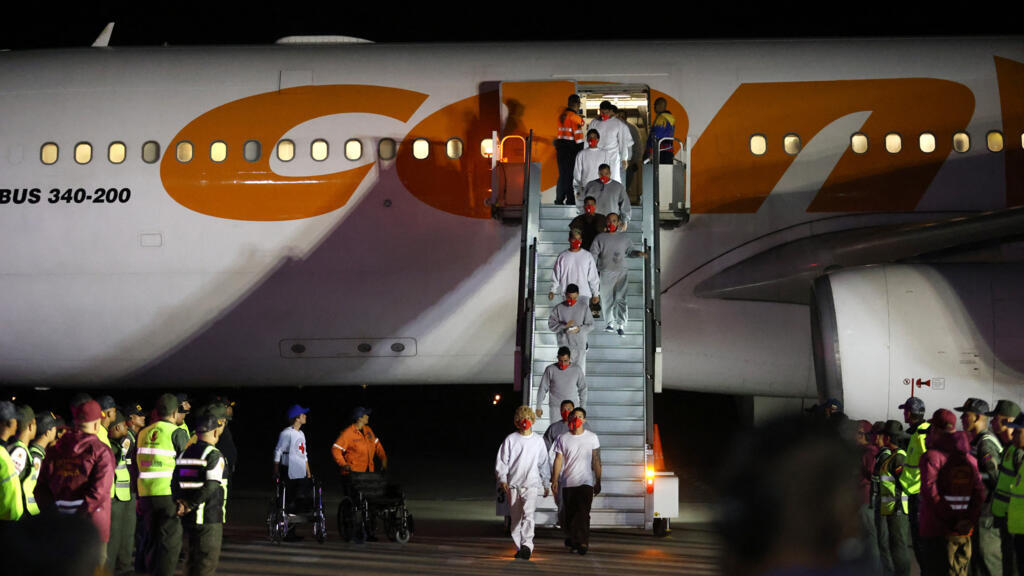
Venezuelan migrants deported from the US arrive at Simon Bolivar International Airport in Venezuela, 20 February, 2025. AFP - PEDRO MATTEY
The announcement, made on Thursday by a senior Ugandan Foreign Ministry official, puts the country among a handful of African and Latin American countries cooperating with the Trump administration on resettlement arrangements.
The deal comes as the US seeks third-country destinations for migrants whose own governments are unwilling to take them back.
Similar arrangements with countries including El Salvador and Eswatini have sparked protests in the US and drawn criticism from rights groups, who argue that such transfers could expose vulnerable people to new risks.
Outcry mounts in Eswatini over ‘illegal aliens’ deported from US
The announcement, made on Thursday by a senior Ugandan Foreign Ministry official, puts the country among a handful of African and Latin American countries cooperating with the Trump administration on resettlement arrangements.
The deal comes as the US seeks third-country destinations for migrants whose own governments are unwilling to take them back.
Similar arrangements with countries including El Salvador and Eswatini have sparked protests in the US and drawn criticism from rights groups, who argue that such transfers could expose vulnerable people to new risks.
Outcry mounts in Eswatini over ‘illegal aliens’ deported from US
'Progressive refugee policy'
According to the United Nations, Uganda already hosts approximately 1.8 million refugees – the largest number on the African continent.
Most come from neighbouring South Sudan and the Democratic Republic of Congo, although Sudan’s civil war has in the past year triggered a sharp spike in arrivals.
Uganda grants these new arrivals the right to work, freedom of movement and access to services. President Yoweri Museveni’s government has long been recognised for its open-door approach – which UN High Commissioner for Refugees, Filippo Grandi called "the most progressive refugee policies in Africa, if not the world".
Regarding the deal agreed with Washington, Vincent Bagiire, permanent secretary at Uganda’s foreign ministry, said in a statement on social media: "The agreement is in respect of Third Country Nationals who may not be granted asylum in the United States, but are reluctant to or may have concerns about returning to their countries of origin."
He stressed that the deal was only a temporary arrangement, and added that: "Individuals with criminal records and unaccompanied minors will not be accepted."
Uganda also indicated it would prefer to receive migrants originally from Africa.
"The two parties are working out the detailed modalities on how the agreement shall be implemented," Bagiire added.
South Sudan turns US deportations to its diplomatic advantage
Humanitarian concerns
Uganda's agreement with the US follows Rwanda’s announcement of a similar deal earlier this month, under which it said it would accept up to 250 migrants deported from the US.
Kigali has yet to release details of this, and Washington has not confirmed the arrangement.
South Sudan too has entered into a deportation agreement with the US, taking in eight migrants earlier this year – only one of whom was South Sudanese. Their case was contested in US courts, but Juba confirmed in July that it had assumed responsibility for the men.
Trump’s administration has pushed to speed up the removal of undocumented migrants, sometimes deporting them to countries where they have no ties. In one controversial example, hundreds of Venezuelans alleged to have gang affiliations were first sent to El Salvador, where they were held in austere prison conditions, before being returned to Venezuela.
Rights organisations – including Amnesty International – are sceptical of the latest deals, warning that such transfers may contravene international law.
Deporting people to countries where they risk torture, abduction or persecution could violate the principle of "non-refoulement", a cornerstone of refugee protection.
Nigeria rejects US push to accept Venezuelan deportees
Critics argue that outsourcing deportations to fragile or unstable states – particularly in Africa – may compound rather than resolve humanitarian crises.
The UN's refugee agency UNHCR notes that: "Uganda’s refugee settlements are located in areas highly vulnerable to the effects of climate change, including extreme heat and seasonal flooding. These conditions have affected agricultural livelihoods and placed growing pressure on natural resources, occasionally fuelling tensions between refugee and host communities."
No comments:
Post a Comment