The Trump administration is weaponizing psychological terminology to create a world where one pathetic old man can stifle all entertainment that forces him to confront his own obvious inadequacies and irrelevance.
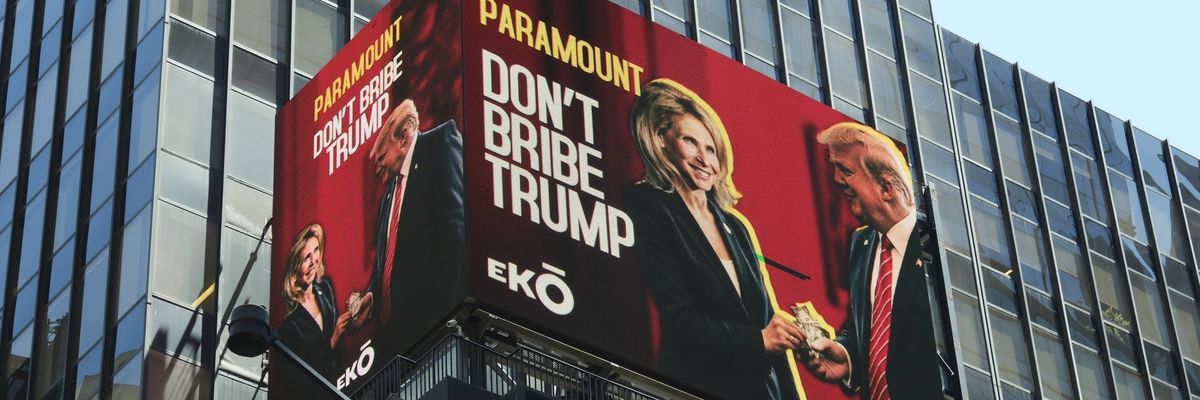
A billboard displayed in New York City on June 25, 2025 urges Paramount Global not to settle a lawsuit brought by President Donald Trump.
(Photo: Ekō/CC BY 4.0)
Emese Ilyés
Aug 02, 2025
It's remarkable how much happens that barely makes the news. While we scroll through memes and sensationalized soundbites, our attention monetized by oligarchs who profit from our stupor, democracy dies in broad daylight.
Many of us fastidiously tracking political events may have missed a chilling detail buried in the Paramount/CBS merger: a "bias monitor." The Trump administration installed this Orwellian position alongside the dismantling of diversity, equity, and inclusion at CBS and Paramount. According to Federal Communications Commission Commissioner Anna Gomez, the sole dissenting vote against the merger, this represents "just another part of this administration's campaign of censorship and control."
Commissioner Gomez explained the gravity of this so-called monitor: "What they're saying is that they are going to self-censor basically for ideological purity according to what this administration likes and to report only in the way this administration likes. Apparently, bias is anything this administration doesn't like. And that is what they're promising not to show anymore to their consumers."
This is not a threat. It is a promise being delivered.
Stephen Colbert's cancellation marks that promise in action. The highest-rated late-night host, Emmy-nominated, and like other effective comedians, someone who has pointed out the absurdities of our political system for decades. As Inae Oh of Mother Jones reported, "one could argue that [until now] Trump's attacks had yet to take down our actual culture. I'm talking about the literal content we consume—the television, art, movies, literature, music—no matter how much Trump complained. That it remained protected and free-willed, a rare area of control for a public that otherwise feels powerless to take action." The cancellation of Colbert changes this. We are witnessing the first successful assault on the cultural sphere itself.
They're not just coming for our votes or our institutions, they're coming for our imagination, our ability to envision a different world.
What does it mean to have a president who uses his enormous platform to pathetically attack performers and entertainers? Just in the last week of July, U.S. President Donald Trump personally attacked Bruce Springsteen, Beyoncé, Oprah, Bono, Taylor Swift, Trey Parker, Matt Stone, and Joy Behar. These attacks aren't just the desperate posturing of a has-been reality TV star president, they threaten to become official government-led investigations.
Of course, there's no credible evidence for any of his claims. But that hasn't prevented the capitulation of systems that could fight back. Recently, Brown, Columbia, University of Pennsylvania, University of California Los Angeles, Paramount, Disney, and Meta all paid multimillion dollar settlements ($221 million in the case of Columbia) to the Trump administration to avoid litigation. This litigation could have helped establish some balance of power in this country. Because of these capitulations, they are now all complicit in the dismantling of our democracy.
This Is Not About Bias
Let me be clear as a psychologist: This is not about bias. Bias is a tendency, often unconscious, that leads to preferences or disfavor of people, ideas, or beliefs, often in ways that are unfair. Real biases manifest as stereotypes, prejudices, and systematic preferences that shape how we perceive and interact with the world.
If we genuinely wanted a bias monitor at any corporation, it would require enormous funding for diversity, equity, and inclusion purposes. Actual bias monitoring would examine unconscious prejudices, systemic discrimination, and unfair treatment of marginalized groups. This is the opposite of what the Trump administration has been doing as all the policies being enacted reinforce white supremacy.
What we have instead is the Trump administration weaponizing psychological terminology to create a world where one pathetic old man can stifle all entertainment that forces him to confront his own obvious inadequacies and irrelevance.
This isn't about bias, it's about following the predictable playbook of authoritarians. This suppression of critical voices mirrors what happens in North Korea, where the government exerts near-total control over media and entertainment, allowing only content that glorifies the ruling family while strictly banning dissent or satire. There are no North Korean Stephen Colberts. Critical art is suppressed, and those attempting to create or access it face harsh punishment, including forced labor or execution.
The Revolutionary Power of Art
While this moment is dire, I believe in the revolutionary power of art. History shows us that authoritarian regimes fear artists above all else because art reveals truth in ways that propaganda cannot counter.
To all who continue to create—comedians, performers, writers, artists—don't stop. Keep faith in the transformative power of art because, in Toni Morrison's words, "Art takes us and makes us take a journey beyond price, beyond cost, into bearing witness to the world as it is and as it should be."
As we navigate this slide away from democracy, we need artists to continue creating more than ever. Every joke that punctures pomposity, every song that speaks truth to power, every story that humanizes the dehumanized is an act of resistance.
The Trump administration understands something we must remember: Culture shapes consciousness. They're not just coming for our votes or our institutions, they're coming for our imagination, our ability to envision a different world.
As usual, Trump doesn't get humanity and doesn't understand that art has always thrived under oppression. The most powerful voices often emerge from the margins, from the underground, from those who refuse to be silenced.
This "bias monitor" isn't monitoring bias, it's monitoring our humanity. And that's exactly why we must not let them win.
Mirror or Mirage? The Future of Truth and
Freedom of the Press Today
Truth or Perception?
True to the words of the legendary 19th-century French novelist Gustave Flaubert, “there is no truth. There is only perception”. The truth may sound or taste bitter. But in reality, there is no singular truth and perception about anything and everything in this divine universe, even about the most abstract ones. Inherent truth is subjective, which lies in the hands of an individual’s interpretation. Together, they have a profound influence on shaping people’s views.
Its real-life exponent is none other than the dictator Hitler⸺thanks to his exceptional oratory skills, once dangerous and fascinating. On the other side of the coin lies the legacy of the great American social and civil rights activist Martin Luther King Jr. His non-violent liberal views on racial equality echoed deeply. Both historical figures left an indelible mark on the world courtesy of their respective mindsets strategically manifested, intertwined with truth and perception.
To shape public perception, key news sources include print and electronic media. These include newspapers, television, books, magazines, and radio. Newspapers and television are naturally the most widely ubiquitous, commanding massive audience coverage and deep penetration.
India has one of the largest newspaper circulations in the world. It endures and reveres the media, but here is the catch. According to media literacy index data, our homeland, India, ranked at a very low level globally. The magnitude of freedom is handy to the journalists at large, and it is alarming! Sadly, in India’s context, it is directionless. Ultimately, it is a wake-up call. The freedom of the press is inextricably linked to the democracy of a country. Apart from this, news channels on television are not behind in the rat race with their contemporaries. Selling content to the audience instead of ensuring quality content that informs them the most. Running for TRP, the real news gets diluted. The essence of informing and information gets killed long before through various media.
India’s complex emotional landscape
In a country as emotionally vulnerable and socially heterogeneous — as India. The longstanding challenges, such as Hindu-Muslim tensions, population explosion, poverty, illiteracy, and more. Labyrinths of other enigmas are often engulfed, which causes reactive, colloquial responses. They manifest vividly during nightmarish, complex — Kafkaesque episodes. Numerous instances of public unrest like riots, rapes, suicides, and more are evidence to it. Such emotionally charged reactions complicate the government’s ability to implement and administer policies in a consistent, transformative manner. This is where the truth and the press hold a critical role. In these complexities, the leakages of the internal machinery get highlighted.
A Press Under Siege
Having such a media state has major concerns and equally questionable consequences. They often tend to leave a painful scar later in the long term. On the contrary, the case is very different in countries as Russia, China, the US, and the U.K. They usually have concrete, strong, hassle-free, definite political motives and policies. They refrain from the ways India often tends to follow. The typical Indian answer to our emotional country goes back to our heated history textbooks. There have been countless deliberate attempts the whole world has made to conquer the roots of our ‘bhāratavarṣa’. It was not only for centuries but for millennia indeed. Starting from the advent of Alexander the Great in 326 BCE to the British Empire in 1947. The continual cycle of ‘sought and fought’ had fragmented and fractured the internal cohesion. This legacy left the nation in a difficult yet diverse situation. Still, it often backfires, creating an ironic, complicated situation of unity in diversity. Unlike other countries, the US and Russia. Unfortunately, India hasn’t enjoyed an uninterrupted political lineage with a uniform singularity of purpose. In our case, the press doesn’t report the truth. It often has to wrestle for it amid the noise of unresolved historical background, painstakingly.
Indispensable, twin forces — the truth is an expression, the press is the medium. Shaping and reshaping our views, then our beliefs. Eventually, it solidifies respective ideologies. The media are the purveyors of truth and freedom. Conveying information concisely under the instructions of the government. With such a vital authority and verdict resting on the press, it is a transparent, crystal-clear mirror of the country. It is a double-edged sword, bridging the supreme authority with the assurance of the people. Just exactly like Snow White’s enchanted mirror, today’s press undergoes examination, “Mirror, mirror on the wall: Who tells the truth among us all”? Publicly, things get amplified and complicated with social media. It affects the scenario, which itself is in an uneasy, lopsided state.
Social Media Perils and Content Pollution
True to the words of the legendary English poet Alexander Pope, the warmth of his lines is produced in his thought-provoking work, ‘An Essay on Criticism’. The lines “A little learning is a dangerous thing.” These are so apt to the complex content we consume today. The essence of the magnum opus is deeply felt even today in the 21st-century modern world.
In the essence of the digital age today, Social Media is the online medium that makes shallow learning among the masses a dangerous thing! It has a profound impact and internal pressure on one’s daily life. The ignorance of countless posts on X (formerly Twitter), Facebook, Instagram, and so on, will undoubtedly be bliss. In shades of innumerable benefits, it often results in ruining one’s privacy. Social media validation and accumulating more and more followers are blinding. It is infused with overloaded fake news, intense addiction, and the urge to form opinions and criticism (trolling). Everyone wants to express something without having the real knowledge about it. With this huge confusion and anxiety, it has emerged everywhere like wildfire. All of this has created misconceptions, prejudice, manipulation, censorship, ambiguity, rumours, and misuse. This mess is one of the major grey shades of social media.
Content is not just consumed; it is exaggerated, engineered, and fabricated. All this is exercised under legitimate knowledge claims. Ultimately, this flooding mechanism has blurred the line between what is reel and what the actual reality is. It has adulterated information to an unprecedented level. India itself produces a large number of content creators globally. In turn, Indians also tend to consume a huge volume of content. Thanks to insanely addictive reels and posts on apps like TikTok, YouTube, and Instagram, and more. As a result, India also leads in average mobile screen time. The estimated screen time is more than 5 hours daily. Even sometimes creating obscene content for the sake of likes and comments is considered normal! At least for disseminating genuine content, social media proves to be an easy yet complex option. Consequently, it has driven the Indian media into peril.
The Collapse of Free Speech
Unearthing the truth in the crossword and its clues embedded in a web of lies is hard. It has paradoxically suffocated the very freedom of speech within the compound chaos altogether. Truth is born out of freedom and courage. The press, which once investigated the unknown, unbelievable, and the unthinkable, now tirelessly circles. Just hunting for the truth for the sake of real, meaningful truth. But alas, today, there is both speech and courage immersed deep. The axis of profoundly malicious, politically motivated actions and intentions is strongly holding it. Both truth and press now operate in a system they once sought to expose. Here, language often bought through bribes speaks loudly and boldly to rule over everyone. Often, institutions buy and sell the freedom of speech, putting their agenda forward to the masses. This dirty, unethical transaction not only trades monetary value but also corrupts the system. It hollows the society morally, emotionally, and socially, both intentionally and unintentionally, like a parasite.
The voice of the innocent (media professionals), who dare to speak the truth, often embraces unjust retribution and tyrannical faith. Their remarkable efforts peel back those thick layers of deception, corruption, and bribery, but go in vain. Pressure groups and others often bury uneasy truths and astonishing facts under the guise of national interest and public welfare. The beautiful irony is just showcased as normal in thin air! The menace is that it is paraded to the audience as a sideshow spectacle. Such skillful, shrewd wordplay and rhetorical acrobatics contribute significantly to it. As a result, even the sharpest person in the room can’t pose a question. This puppetry media manipulation in a performative democracy becomes art, not for informing, but for controlling.
The Legal Lens: Indian Constitution and the Press
Laws and the press share a valiant, intertwined relationship where both have the power and potential in society. The law acts as a watchdog over the duty of both the people and the press. The freedom of the media is not only linked to journalism but to the vocal freedom of a country. Leaving it in a deadly dilemma of oblivion if left unchecked.
Resorting to legal methods for a hand-to-hand confrontation and cleansing it eventually may be the tedious yet best remedy. Highlighting the pitfalls and sorting them to the roots, as there is no smoke without fire. Although this is an even bigger headache since the magnitude of the Indian media industry is a whopping amount of more than a billion dollars.
By turning through the pages of the most voluminous rulebook of the world, the Indian Constitution. It offers us both a better, comprehensive, and far-sighted view. Indian law is just and faithful enough to meet both ends and refine its application by drawing the light of wisdom over the respective case.
Article 19(1)(a) relates to the independent freedom of voice and their respective opinions against the actions of the government. The media is legally backed up to highlight the plight of truth ‘lying’ beneath the surface and above it. Likewise, some notable eye-opening cases include the Romesh Thappar vs State of Madras and the Indian Express Newspapers (Bombay) (P) Ltd. vs Union of India. These astounding cases had thrust the freedom of the press and media into the limelight, concreting their status even more. These cases and many more are at the confluence of the political and social environment. The emancipation to advance facts and reports without any intervention, but with reasonable restrictions behind the fences.
Freedom and truth in the press should be carried sensibly within the thin line of legal demarcation relative to the audience. Sensitive news often triggers harmful ideas, and it can lead to both psychological and mental pain directly. Avoiding the spread of any fake news, defamation, contempt of court, blasphemy, voyeurism, and any threat to the sovereignty and integrity of India is of utmost national significance. There has been some progress over time to overcome the stagnant debacle; there is a long road to travel.
Press, Sacrifice, and Political Ironies
Dubbed as the 4th pillar of democracy, the press and media enjoy an ironic status owing to their gullible volatility. There remain shining examples of fearless Indian journalism that delivered the truth at the right place and at the right time, undeterred by mental pressure. But ironically, the most staggering report gathered is that our motherland, India, stands amongst the top countries to have the most journalist deaths.
Renowned cases of such ill-fated scapegoats include Gauri Lankesh, J.Dey, and Daniel Pearl; the list goes on. Their “sacrifice” bears a thought-provoking lesson. These media professionals fearlessly tried to unmask the bitter truth of the wrongdoers and guilty minds. To combat such authoritarian regimes, often influential political ideals march forward carrying the baton, calling for a major upheaval or revolution. In the process, this leads to doublespeak from the other side in a counterreaction. Often, when things take a U-turn, these political ideals later turn into political prisoners! Eventually, their descendants find their lives embroiled, burdened with defining and redefining their ideologies and legacy.
Such a misuse or mistake can lead to an Orwellian dystopia in a totalitarian manner, as pointed out by the great 20th-century English author George Orwell. In his magnum opus novel, 1984, he showcases the political nightmare the caged media and press cast upon it.
In the dynamics of India, the silver lining is certainly visible. The architectural Gandhian values of truth and freedom will be followed and resonate. Both the sanguine prospects and outputs of journalism will emerge rooted in integrity and moral duty, without fleeting urgency. But rather with an imperative role, a pillar of democracy, not with transience but with transparency.
These grovelers are greedily betraying us all
Tim Karr,
August 1, 2025
Paramount Global and Skydance logos are seen in this illustration.
The rules of authoritarianism are pretty simple: Do as the leader says... or else.
This lopsided power equation runs counter to the checks and balances that are baked into the DNA of any healthy democracy. The early framers of American democracy understood this, which is why they codified the basic rights to free expression and an independent press as checks against power.
Free Press this week released the inaugural Media Capitulation Index to examine how this information ecosystem is fairing nearly 250 years later. This sweeping investigation analyzes and rates the independence of America’s 35 largest media companies, including the many conglomerates that have recently caved to pressure from an authoritarian and corrupt Trump administration.
I led the investigation, produced the performance-based ratings of these companies, and authored the report, A More Perfect Media: Saving America’s Fourth Estate from Billionaires, Broligarchy, and Trump, which accompanies the index.
The findings are sobering. After digging into the many failures of America’s hyper-commercialized media system, we present a series of recommendations to help dig the United States out of the authoritarian quicksand into which we're sinking, and build toward a more independent, democratic, diverse, and free press.
This work is crucial at a time when some of the most dominant news media companies empires including Disney (which owns ABC), Paramount (CBS) and Warner Bros. Discovery (CNN) are capitulating and compromising in the face of this administration’s political extortion and thuggery.
In addition, The New York Times is becoming increasingly “vulnerable” to pressure from the White House. In many ways it's a vulnerability of its own making. As we report, the newspaper's “ill-advised attempt at both-sides objectivity [has the Times] routinely normalizing the most extreme elements of Trumpism.”
The index also investigates the questionable and often lucrative government entanglements of billionaire media owners like Jeff Bezos, Mark Zuckerberg, and Elon Musk.
In evaluating the 35 companies, Free Press found that media owners capitulated to the current White House in four principal ways:
Through payments to U.S. President Donald Trump in the form of legal settlements, production contracts, campaign contributions, and other donations;
By rolling back prior commitments to diversity, equity, and inclusion practices in hiring and community outreach;
Through editorial manipulation and censorship: pressuring their newsrooms to soften criticism of the administration, firing staff, and even pulling content that might anger the president; andBy attempting to curry favor with the president during inaugural ceremonies, private dinners at Mar-a-Lago, and meetings in the White House.
The social compact
This small cartel of billionaire- and equity-fund-controlled conglomerates determines much of what Americans read, see, and hear. Their coverage and amplification too often sets the agenda around nation-defining political issues. Through a history of mergers and acquisitions, these companies have consolidated their control over public discourse.
Our founders sought to protect the U.S. press from government meddling so that reporters and publishers could act as reliable checks against tyranny and other political corruption. But it’s up to the media to exercise these freedoms. Many modern-day media owners, instead, have put their pursuit of power and profits over First Amendment principles.
I can’t imagine that the drafters of the Constitution foresaw a time when so much control over information would fall into the hands of so few. We need to examine the systemic failures that have led us to this point and understand how such accumulation of power and wealth makes it next to impossible for these media giants to fulfill the social compact embodied in the notion of the Fourth Estate.
I spoke with former New York Times public editor Margaret Sullivan, who later wrote the Free Press project was a “thorough new examination of how well — or poorly — the American press is doing that core mission. And why it’s mostly failing.”
Each conglomerate in the Media Capitulation Index is ranked on a scale from “independent” to “propaganda.” The report analyzes the root causes driving commercial media’s inability to defend democracy at a time of spreading domestic and international authoritarianism.
Who owns the owners?
As I was writing, researching, and creating these materials, many people asked me: “Who owns the media?”
The Media Capitulation Index helps answer that question, but it also raises an even more essential (and disturbing) one: “Who owns the media owners?”
The report that accompanies the index reveals the systemic problems behind the media’s failure to meet this moment. But it concludes on a more hopeful note, outlining steps people can take to make “a more perfect media” for everyone.
These include fully funding public media and independent, local-accountability journalism; restoring and strengthening media-ownership limits; and emboldening the Federal Communication Commission’s and Federal Trade Commission’s role in stopping media mergers that harm the public interest.
We will continue to update the index, capturing both instances of media capitulation and examples where media stand up to this extortionate regime. It’s hoped that this structural critique of our current media system will help instill in more media outlets the courage needed to challenge a bullying and power-hungry president.
"While these schemes may also violate federal criminal statutes, the DOJ has been co-opted by Trump and cannot be depended upon to fulfill its obligation to impartially investigate," said a Free Speech for People counsel.
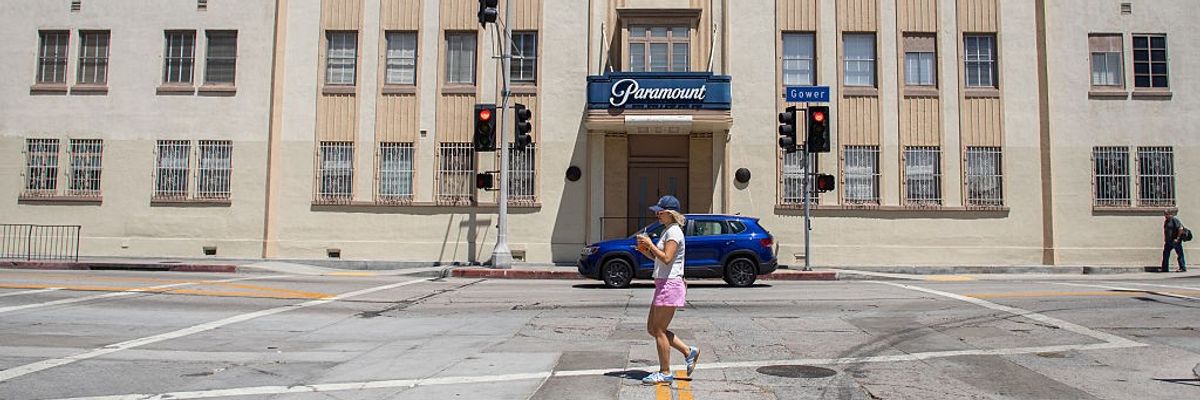
A woman walks on the street by the exterior of Paramount Pictures on July 25, 2025 in Los Angeles, California.
(Photo: by Apu Gomes/Getty Images)
Jessica Corbett
Jul 31, 2025
COMMON DREAMS
Constitutional lawyers on Thursday wrote to leading prosecutors in California and New York, urging them to open criminal investigations into the recent payments made or promised to U.S. President Donald Trump, his personal associates, or his special interests by Paramount Global and Skydance Media, whose $8 billion merger was approved by federal regulators last week.
"Relevant state and local officials of New York and California must fulfill their investigatory obligations to protect their residents, and to launch criminal investigations into those responsible for the extortion of Paramount and Skydance," said Courtney Hostetler, legal director at the nonprofit Free Speech for People (FSFP).
Hostetler and three of her FSFP colleagues—president John Bonifaz, chairman and senior legal adviser Ben Clements, and senior counsel Suparna Reddy—sent letters to California Attorney General Rob Bonta, Los Angeles County District Attorney Nathan Hochman, New York state Attorney General Letitia James, and Manhattan District Attorney Alvin Bragg.
They pointed to the Republican president's "baseless" $20 billion lawsuit against Paramount—whose subsidiaries include CBS—over a "60 Minutes" interview with former Democratic Vice President Kamala Harris, who faced Trump in last year's election.
"While some of these payments ostensibly were made to settle a frivolous lawsuit brought by Trump against Paramount subsidiary CBS Broadcasting Inc., the evidence strongly suggests that the lawsuit and its settlement merely veiled Trump's true purposes—namely, to chill the freedom of the press and unlawfully extort payments and other things of value," the letters state.
Paramount settled at the beginning of the month, agreeing to pay "$16 million toward Trump's attorney fees and to fund his presidential library or purported charitable causes chosen by Trump," the letters detail. Then, Skydance met with the Federal Communications Commission about its acquisition of Paramount, and the FCC swiftly approved the megamerger.
According to the FSFP lawyers:
Now it appears that Paramount and Skydance may have taken other, unreported-to-the-court actions in order to secure FCC approval of the merger. Trump claimed that once the merger is approved, Skydance would contribute $20 million in advertising, public service announcements, or similar programming to Trump as part of a side deal to the $16 million settlement. And CBS canceled the popular program "The Late Show" after its host Stephen Colbert, a longtime critic of Trump (and indeed of many politicians), derided the settlement on air as "a big fat bribe." Trump posted on Truth Social that he "absolutely loves" "The Late Show's" cancellation. Paramount also agreed to hire an ombudsman at CBS News to investigate complaints of "political bias," which has the potential to limit journalistic freedom at CBS.
In addition to providing this background, the letters lay out the basis for "an immediate and thorough" probe, citing various laws in each state, and stress that "the immunity available to federal officials under the supremacy clause of the U.S. Constitution is not available in all circumstances and does not preclude criminal investigation and prosecution here."
Although the letters do not name U.S. Attorney General Pam Bondi, the Trump loyalist has faced mounting allegations of "serious professional misconduct." Reddy suggested that she likely will not investigate the merger and related payments.
"States should not wait for the Department of Justice (DOJ) to act first," said Reddy. "While these schemes may also violate federal criminal statutes, the DOJ has been co-opted by Trump and cannot be depended upon to fulfill its obligation to impartially investigate."
"This capitulation is... a pervasive trend that applies to nearly all commercial media, including cable and telecommunications firms and online platforms," said Free Press.
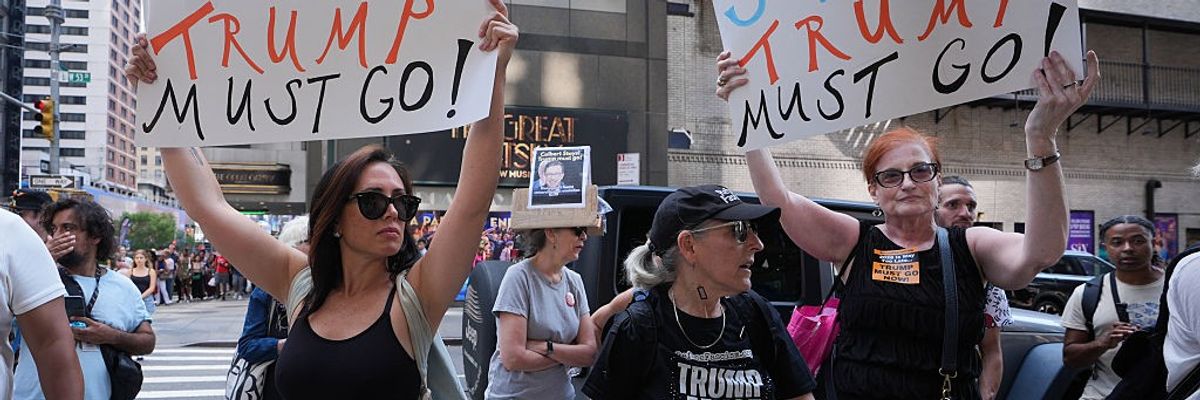
Dozens of anti-Trump demonstrators gathered outside the Ed Sullivan Theater in New York City to protest the cancelation of CBS late-night host Stephen Colbert on July 21, 2025.
(Photo by Lokman Vural Elibol/Anadolu via Getty Images)
Jul 30, 2025
COMMON DREAMS
Media advocacy organization Free Press on Tuesday unveiled an index that documents and rates major media organizations' reactions to the coercive demands being made by U.S. President Donald Trump.
As Free Press explained in a press release, its Media Capitulation Index tracks actions being taken by 35 major media conglomerates who are facing pressure from Trump and his allies to curb critical reporting and commentary on his administration.
"In this investigation, Free Press found that to varying degrees the owners of America's largest media firms are caving to pressure from an authoritarian-minded president and his captured federal agencies," the organization wrote. "This capitulation is not unique to owners of news outlets—like Paramount (which owns CBS), Disney (ABC) and Warner Bros. Discovery (CNN). Rather, it's a pervasive trend that applies to nearly all commercial media, including cable and telecommunications firms and online platforms."
Free Press argued that media companies have been bending to Trump's will through four major methods: Paying out lavish settlements in lawsuits brought by the president; rolling back their programs for enhancing diversity, equity, and inclusion; pressuring journalists and commentators to soften or even censor their criticisms of the president; and "attempting to curry favor with the president during inaugural ceremonies, private dinners at Mar-a-Lago, and meetings in the White House."
The index uses a scale to rate media organizations that range from "independent" on one end to "propaganda" on the other. Of all the media companies surveyed by Free Press, only two are rated as independent: Bloomberg Media Group and Netflix. The New York Times Company for now is the least compromised of any print media conglomerate outside of Bloomberg and is merely listed as "vulnerable," while Nant Capital, the owner of the Los Angeles Times, is the most compromised and is rated as "obeying" the Trump administration.
When it comes to broadcast media, no companies earned an "independent" ranking, and CBS owner Paramount was ranked as "obeying" the Trump administration in the wake of its decisions to give Trump a $16 million payout and then cancel the show of longtime Trump critic Stephen Colbert.
Former New York Times public editor Margaret Sullivan, a longtime critic of the American media's response to Trump, praised Free Press on her Substack page for highlighting the major problems facing the American media in the second Trump term.
"Huge, diverse corporations own news companies, and independent journalism all too often takes a back seat to corporate profits, mergers, and other forms of consolidation," she said. "Meanwhile, public media has been defunded, local journalism lacks local ownership, and partisan propaganda has found an influential home on radio and cable news."
She also interviewed Tim Karr, who works as Free Press' senior director of strategy and communications, about why her former employer did not earn an "independent" rating on the index.
"There is a tendency to 'both-sides' reporting about the Trump administration,” Karr said of The New York Times' coverage, which he added seems to give "equal weight to the forces of democracy and the forces of authoritarianism."
No comments:
Post a Comment